
Seated leg exercises for seniors are one of the safest and most effective ways to strengthen the lower body without standing. These exercises help improve daily mobility, balance, and independence while reducing the strain placed on joints.
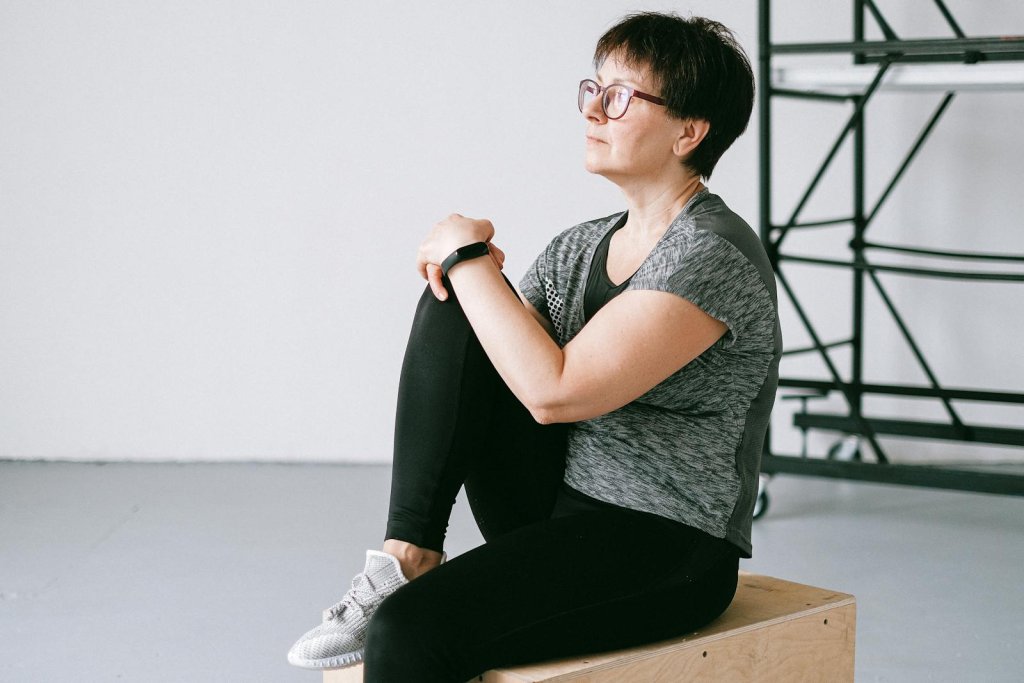
Understanding how to safely strengthen the legs is especially important for adults over 60. Age-related muscle loss affects walking, standing up, climbing stairs, and fall prevention. Chair-based training offers a low-impact, accessible way to maintain strength.
In this guide, you’ll learn the best seated leg exercises for seniors, how often to do them, essential safety tips, and expert-backed recommendations.
Why Seated Leg Exercises for Seniors Matter
Seated leg exercises matter because they allow older adults to build strength safely, even with mobility limitations or balance issues. Lower-body strength plays a major role in preserving independence and making daily tasks easier.
Benefits include:
- Reduces fall risk by strengthening the muscles that support balance and stability.
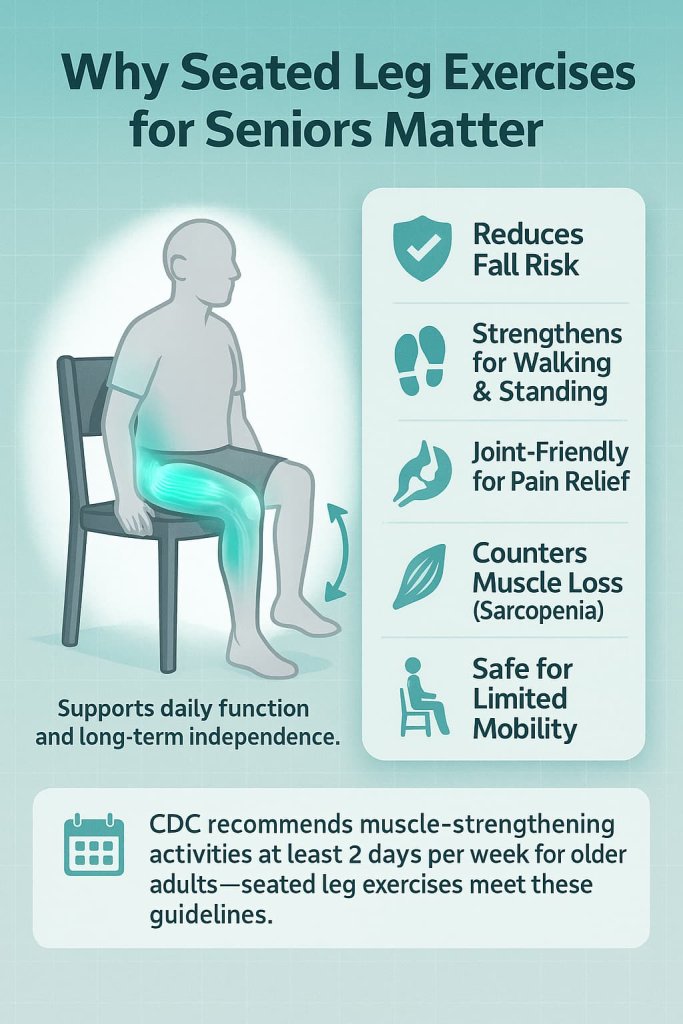
- Builds functional strength for standing, walking, and stair climbing.
- Joint-friendly for adults with arthritis, knee pain, or limited standing tolerance.
- Supports healthy aging by helping counter sarcopenia (age-related muscle loss).
- Safe and accessible for beginners, seniors recovering from illness, or those using mobility aids.
According to the CDC, older adults should perform muscle-strengthening activities at least two days per week and include balance-supportive movements. These seated exercises fit those guidelines and help adults train safely at home.
How to Warm Up Before Seated Leg Workouts
A proper warm-up helps increase blood flow, loosen stiff joints, and prepare your muscles for safe movement—especially important for seniors. Warming up reduces the risk of discomfort, strain, and injury during seated leg exercises.
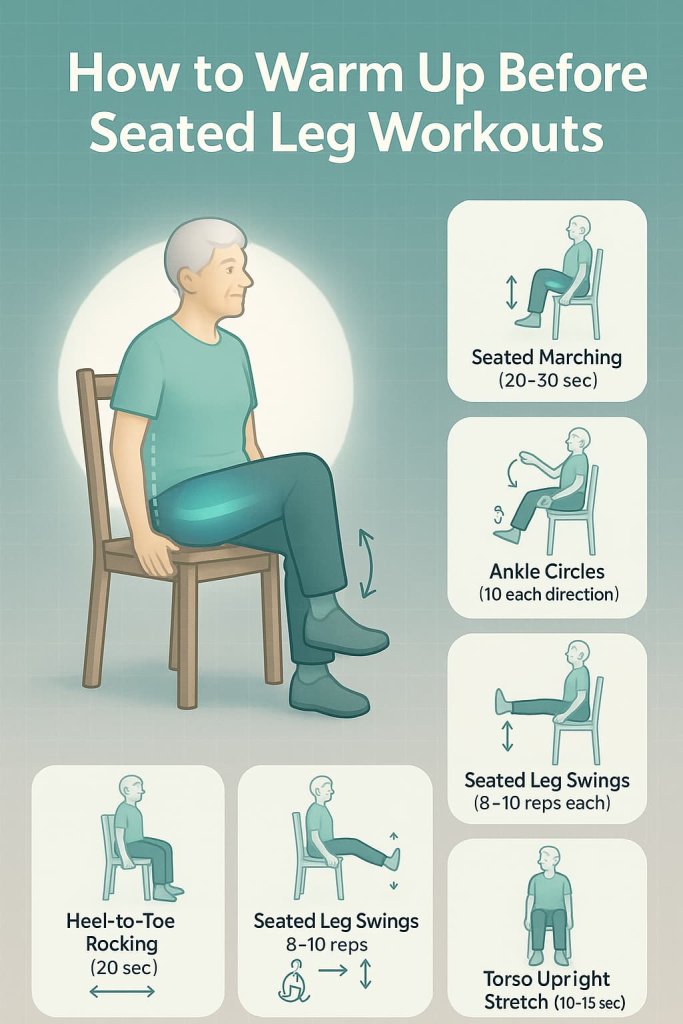
Try this simple 2–4 minute warm-up before starting your workout:
- Seated Marching (20–30 seconds):
Lift your knees gently one at a time to warm up the hips and thighs. - Ankle Circles (10 each direction):
Move each ankle slowly in circles to prepare the joints for toe taps and heel raises. - Heel-to-Toe Rocking (20 seconds):
Lift your heels, then your toes, to activate the ankles and calves. - Seated Leg Swings (8–10 reps per side):
Extend one leg forward and move it gently up and down to loosen the hip and knee. - Gentle Torso Upright Stretch (10–15 seconds):
Sit tall, lengthen your spine, and engage your core to improve posture before exercising.
Perform all movements slowly and comfortably. The goal is to warm the joints, not to get tired. If you feel pain or dizziness at any point, stop and rest.
9 Seated Leg Exercises for Seniors
Below are the 9 best seated leg exercises for seniors. Each exercise includes clear instructions and is safe for most older adults.
1. Seated Marching
Why it works:
This movement strengthens the hip flexors and thighs while improving coordination—key for walking and reducing fall risk. It also gently activates the core, helping support posture.
Muscles worked:
Hip flexors, quadriceps, lower abdominals, hip stabilizers.
How to do it:
- Sit tall with both feet flat on the floor.
- Lift one knee toward your chest in a marching motion.
- Lower it with control.
- Switch sides and continue alternating legs.
Trainer Tip:
Keep your torso upright—avoid leaning backward. Lift the knee only as high as comfortable.
2. Seated Leg Extensions
Why it works:
Targets the quadriceps, which are essential for standing up, walking, and climbing stairs. Helps maintain knee strength and function.
Muscles worked:
Quadriceps (front of thighs).
How to do it:
- Sit upright and hold the sides of the chair for support.
- Extend one leg forward until it’s straight.
- Pause briefly, then lower slowly.
- Switch legs and repeat.
Trainer Tip:
Pull your toes toward your shin as you extend the leg to increase thigh engagement.
3. Seated Heel Raises
Why it works:
Strengthens the calves and improves ankle stability—crucial for better balance and safer walking.
Muscles worked:
Calves (gastrocnemius, soleus), ankle stabilizers.
How to do it:
- Sit with feet flat, knees hip-width apart.
- Lift your heels while keeping toes down.
- Lower slowly and repeat.
Trainer Tip:
Press evenly through the ball of each foot to avoid rolling the ankles inward or outward.
4. Seated Toe Taps
Why it works:
Improves ankle mobility and strengthens the muscles that lift the foot, reducing tripping risk.
Muscles worked:
Tibialis anterior, ankle dorsiflexors.
How to do it:
- Sit with feet hip-width apart.
- Lift your toes while keeping heels down.
- Lower and repeat for both feet.
Trainer Tip:
Keep knees still—let only the ankles move for proper activation.
5. Seated Hip Abductions
Why it works:
Strengthens the outer hips and gluteus medius, which support side-to-side stability and reduce fall risk.
Muscles worked:
Outer hips, gluteus medius, hip stabilizers.
How to do it:
- Sit tall with feet flat.
- Gently open your knees outward.
- Return to the starting position.
- Add a resistance band later to increase difficulty.
Trainer Tip:
Keep your feet planted—avoid lifting toes or heels as you open your knees.
6. Seated Hip Adductions (Inner Thigh Squeeze)
Why it works:
Strengthens the inner thighs, improving pelvic stability and helping with balance and walking control.
Muscles worked:
Adductors (inner thigh muscles).
How to do it:
- Place a pillow or rolled towel between your knees.
- Gently squeeze inward.
- Release and repeat.
Trainer Tip:
Use slow, controlled squeezes—avoid pressing too hard to prevent hip joint strain.
7. Seated Hamstring Curl (with Band)
Why it works:
Targets the backs of the thighs, helping with walking, standing, and stabilizing the knees.
Muscles worked:
Hamstrings, glute stabilizers.
How to do it:
- Loop a resistance band around your ankles.
- Pull one foot backward beneath the chair.
- Return slowly to the starting position.
- Switch sides and repeat.
Trainer Tip:
Keep your knee pointed forward—avoid turning the leg inward or outward.
8. Seated Knee-to-Chest Lift
Why it works:
Improves hip mobility and strengthens the hip flexors and core, supporting better posture and lifting movements.
Muscles worked:
Hip flexors, quadriceps, lower abdominals.
How to do it:
- Sit tall with feet flat.
- Lift one knee toward your chest.
- Lower with control and switch sides.
Trainer Tip:
Exhale as you lift your knee—this helps engage your core and improves control.
9. Seated Side Leg Raise
Why it works:
Strengthens outer thighs and glutes, improving side-to-side stability and pelvic alignment.
Muscles worked:
Gluteus medius, outer thighs, hip stabilizers.
How to do it:
- Sit near the front edge of a chair.
- Slide one leg out to the side.
- Lift it slightly off the floor.
- Lower and repeat.
Trainer Tip:
Lift only a few inches—this is about controlled activation, not height.
How Often Should Seniors Do Seated Leg Exercises?
Research-based guidelines recommend:
- 2–3 days per week of lower-body strengthening
- 8–15 reps per exercise
- 1–3 sets depending on comfort
- Rest 30–60 seconds between sets
- Progress gradually by increasing reps or adding a light resistance band
These recommendations align with CDC and ACSM muscle-strengthening guidelines for older adults.
Common Mistakes to Avoid
- Leaning backward during leg lifts
- Moving too fast or swinging the leg
- Holding the breath
- Sitting on a soft or unstable chair
- Pushing into sharp pain or joint discomfort
- Slouching and rounding the spine
Correcting these improves safety and results.
Safety Tips for Seated Leg Workouts
Follow these guidelines before performing any chair-based exercises:
- Use a sturdy, non-rolling chair with a firm seat and backrest.
- Sit tall with feet flat on the ground and avoid slouching.
- Move slowly and avoid jerking motions.
- Keep breathing steadily—never hold your breath.
- Stop immediately if you feel dizziness, chest pain, sharp joint pain, or shortness of breath.
- If you have balance disorders, osteoporosis, or recent surgeries, talk with a healthcare provider before starting.
Who Should Avoid or Modify These Exercises?
Avoid or modify these movements if you have:
- Severe osteoarthritis
- Recent hip or knee surgery
- Uncontrolled blood pressure
- Sharp joint pain during movement
- Difficulty sitting unsupported
- Active dizziness or vertigo
Always follow your doctor’s guidance, especially if you have chronic conditions.
FAQs
1. Are seated leg exercises effective for seniors?
Yes. They strengthen the lower body safely and follow CDC and WHO recommendations for muscle-strengthening in older adults.
2. How many times per week should seniors do seated leg exercises?
Most seniors benefit from 2–3 sessions per week, with rest between training days.
3. Can beginners start with these exercises?
Absolutely. They’re safe, low-impact, and perfect for older adults with limited mobility.
4. Do seniors need equipment for seated leg workouts?
No. All exercises can be done with bodyweight. A resistance band or pillow is optional.
5. Can these exercises help prevent falls?
Yes. Strong legs improve balance, stability, and confidence—key factors in fall prevention.
6. Are these exercises safe for seniors with arthritis?
Yes, if performed slowly and pain-free. Always consult a healthcare provider first.
7. How long does a seated leg workout take?
A full routine takes 10–15 minutes, making it easy to do daily or several times a week.
Conclusion
Seated leg exercises for seniors are a simple, gentle, and effective way to maintain strength, mobility, and independence at home. With just a sturdy chair and a few minutes per day, older adults can improve leg function, increase confidence, and support healthier aging.
Start with 10–12 minutes of these chair-based movements and progress at your own pace.
This content is for informational purposes only and not medical advice.
References
- ACSM Position Stand – Exercise and Physical Activity for Older Adults
- NSCA Position Statement – Resistance Training for Older Adults
- NHS – Sitting Exercises (Chair-Based Exercises)
- National Institute on Aging – Exercise and Physical Activity
- Systematic Review – The Effect of Chair-Based Exercise on Physical Function in Older Adults
- Randomized Controlled Trial – Effects of Chair-Based Exercises for Older People