
Standing stretches for seniors are safe, simple movements you can do at home to improve flexibility and support better balance when performed slowly and with stable support nearby. They matter because staying mobile helps daily tasks feel easier (walking, reaching, getting up from a chair), and balance-focused activity is part of recommended weekly movement for older adults, according to the CDC.
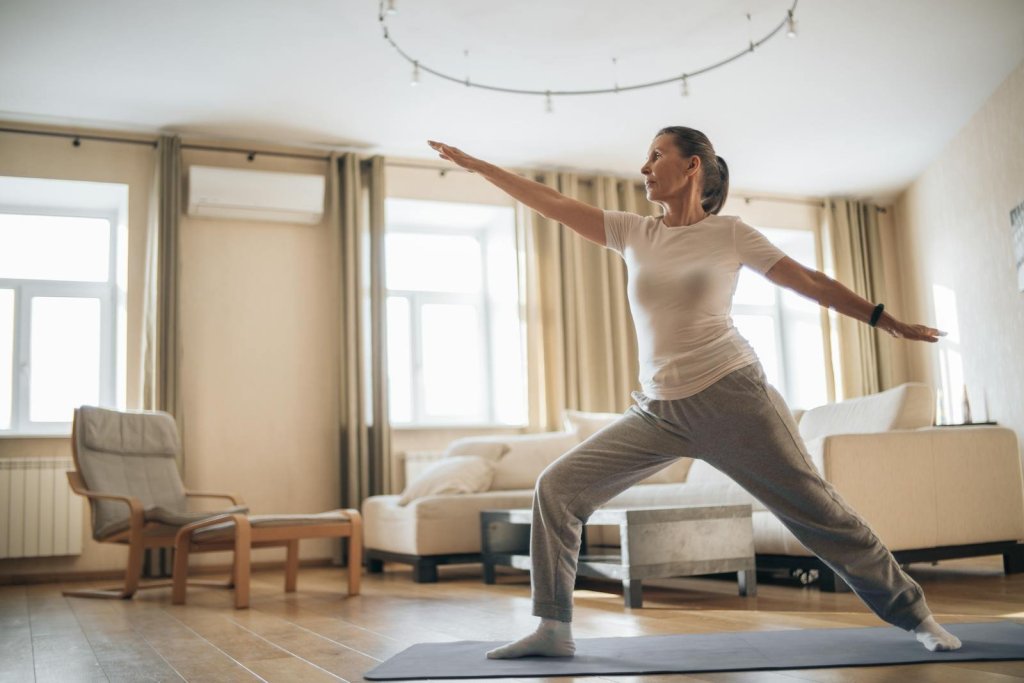
Before you start, use a sturdy chair, wall, or countertop for light support, and warm up with 5–10 minutes of easy walking or marching in place. The Mayo Clinic advises stretching gently (no bouncing), breathing normally, and stopping if you feel pain.
What Are Standing Stretches for Seniors?
Standing stretches for seniors are gentle flexibility exercises performed in an upright position, usually with support from a chair, wall, or countertop. They help maintain mobility and support balance without requiring floor work.
These stretches typically:
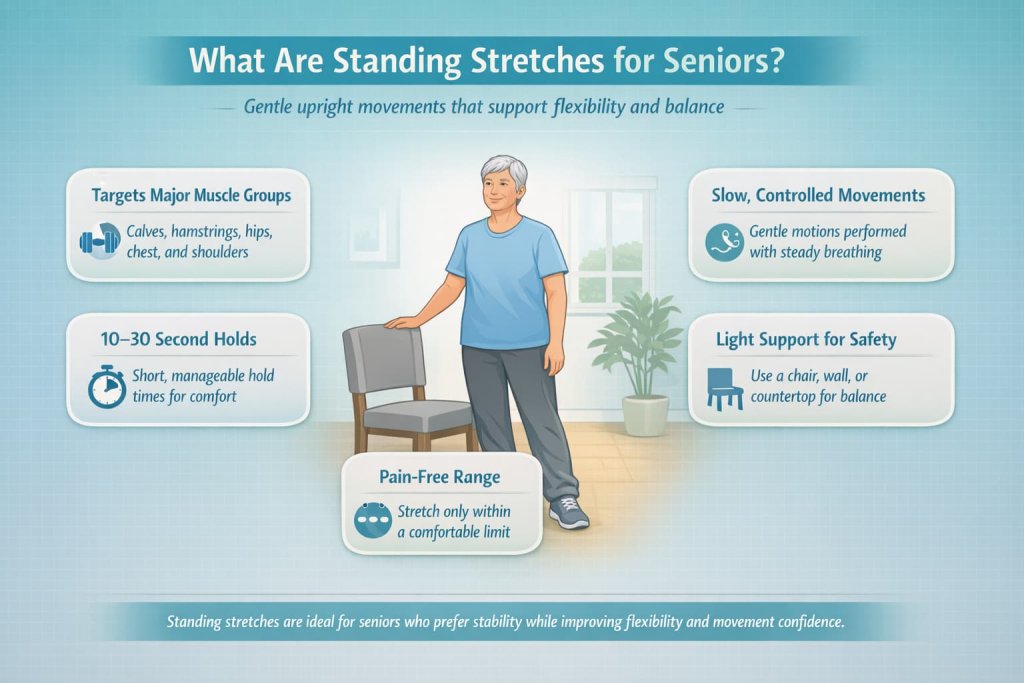
- Target major muscle groups (calves, hamstrings, hips, chest, shoulders)
- Use slow, controlled movements
- Are held for 10–30 seconds
- Stay within a comfortable, pain-free range
- Allow light support for added safety
They are ideal for seniors who prefer stability while improving flexibility and movement confidence.
Benefits of Standing Stretches for Seniors
When done consistently, standing stretches may support:
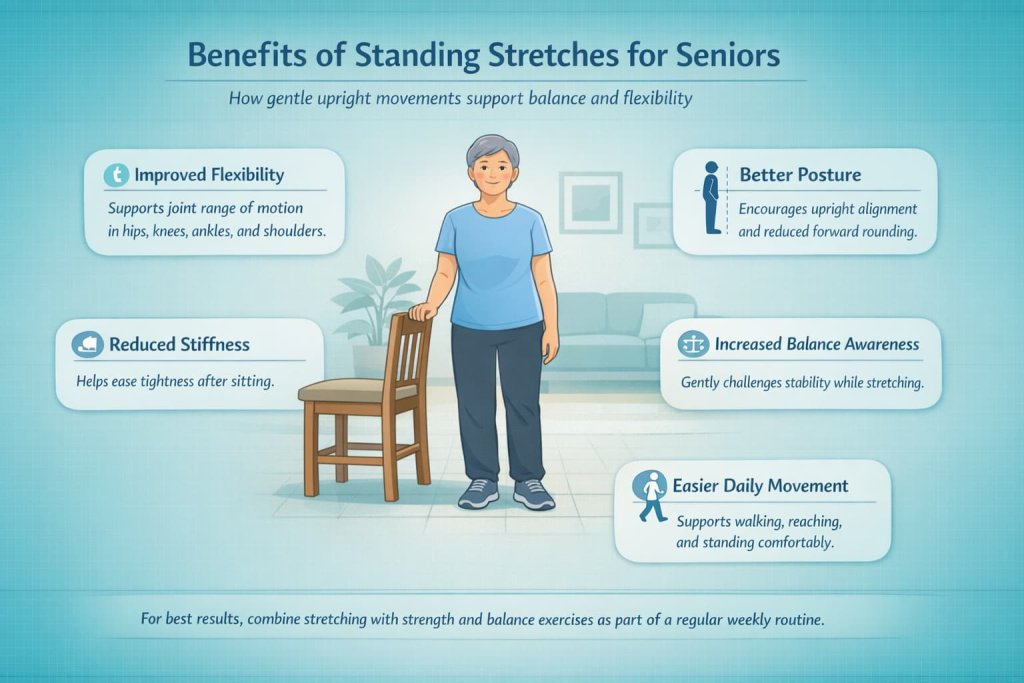
- Improved flexibility and joint range of motion
- Better posture and upright alignment
- Increased balance awareness
- Reduced stiffness after sitting
- Easier daily movements like walking and reaching
Stretching works best when combined with strength and balance exercises as part of a regular weekly routine.
8 Best Standing Stretches for Seniors
For balance confidence, do these near a wall or chair. If you ever feel dizzy or unsteady, pause and reset your stance.
1) Standing Calf Stretch Against Wall
How to do it:
- Stand facing a wall and place both hands on it at chest height
- Step one foot back and keep that heel pressed into the floor
- Bend the front knee slightly while keeping the back leg straight
- Keep toes pointing forward and hips square to the wall
- Hold for 20–30 seconds, then switch sides
Why it works: Tight calves can limit ankle mobility, which directly affects walking stability and balance reactions. Improving calf flexibility supports smoother steps, better push-off while walking, and more comfortable stair climbing.
Muscles worked: This stretch targets the gastrocnemius and soleus muscles of the calves and gently lengthens the Achilles tendon region.
Trainer Tip: Keep the back heel heavy on the floor and avoid letting the back foot turn outward, as that reduces the effectiveness of the stretch.
2) Standing Hamstring Stretch (Heel on Low Step)
How to do it:
- Place one heel on a low step, sturdy book, or curb
- Keep both hips facing straight forward
- Slightly bend the standing knee
- Hinge forward from your hips while keeping your back straight
- Stop when you feel mild tension in the back of the thigh
- Hold, then switch sides
Why it works: Hamstring tightness can affect posture, bending comfort, and stride length. Gentle stretching supports smoother walking mechanics and reduces the feeling of stiffness when standing up or reaching forward.
Muscles worked: Primarily stretches the hamstrings, with mild involvement of the calves.
Trainer Tip: Avoid rounding your back. Think “hips back, chest forward” to target the hamstrings properly instead of straining your lower back.
3) Standing Quad Stretch With Chair Support
How to do it:
- Stand beside a chair or wall for balance support
- Bend one knee and bring your heel toward your glutes
- Hold your ankle or pant leg (use a strap or towel if needed)
- Keep knees close together
- Stand tall and hold before switching sides
Why it works: The quadriceps often tighten from prolonged sitting. Stretching them supports easier stair climbing, smoother walking, and improved knee comfort during daily movement.
Muscles worked: Primarily the quadriceps, with mild stretch to the hip flexors.
Trainer Tip: If reaching your ankle feels uncomfortable, loop a towel around your foot instead of forcing the stretch.
4) Standing Hip Flexor Stretch (Split Stance)
How to do it:
- Stand in a split stance with one foot forward and one back
- Lightly hold a chair or wall for stability
- Bend the front knee slightly
- Gently tuck your pelvis under
- Shift your body weight forward until mild tension is felt in the back hip
- Hold, then switch sides
Why it works: Hip flexors may tighten from prolonged sitting, contributing to forward posture and shorter steps. This stretch supports a more upright position and smoother walking mechanics.
Muscles worked: Targets the hip flexors and lightly stretches the quadriceps of the back leg.
Trainer Tip: Focus on posture and a gentle pelvic tuck rather than pushing deeper into the stretch.
5) Standing Figure-4 Glute Stretch
How to do it:
- Hold a chair or sturdy surface for support
- Cross one ankle over the opposite thigh just above the knee
- Sit your hips back slightly like a mini squat
- Keep your chest lifted and spine long
- Hold, then switch sides
Why it works: Tight glutes and deep hip rotators can affect walking comfort and balance control. This stretch improves hip mobility, which supports steadier steps.
Muscles worked: Gluteus medius, gluteus maximus, and deep hip rotator muscles.
Trainer Tip: Keep the standing knee aligned over your toes and avoid letting it collapse inward.
6) Standing Side Bend
How to do it:
- Stand with feet hip-width apart
- Raise one arm overhead
- Gently lean to the opposite side
- Keep both feet firmly grounded
- Hold, then switch sides
Why it works: Side bending improves upper-body mobility and rib cage movement, supporting better posture and more comfortable reaching overhead.
Muscles worked: Obliques, latissimus dorsi, and muscles along the side of the torso.
Trainer Tip: Lengthen upward before bending sideways to create a longer, more effective stretch.
7) Standing Chest Opener
How to do it:
- Clasp your hands behind your back or use a doorway
- Gently lift your arms slightly or step forward
- Keep shoulders relaxed and down
- Hold and breathe slowly
Why it works: This stretch counteracts forward-rounded posture caused by sitting and screen time, helping support shoulder positioning and upright alignment.
Muscles worked: Pectoral muscles (chest) and front shoulder muscles.
Trainer Tip: Avoid shrugging your shoulders upward. Keep them gently down and back.
8) Standing Ankle Mobility Rock
How to do it:
- Face a wall and place hands on it for support
- Step one foot slightly back
- Gently bend and straighten your knees in a small range
- Keep both heels grounded
- Repeat slowly, then switch sides
Why it works: Ankle mobility plays a key role in balance reactions and walking confidence. Improving ankle movement supports steadier steps and smoother direction changes.
Muscles worked: Calves, tibialis anterior (shins), and small foot stabilizing muscles.
Trainer Tip: Keep the movement small and controlled. This drill is about smooth ankle motion, not stretching deeply.
Sample 8-Minute Standing Stretch Routine
- 2 minutes light march
- Calf stretch: 30 sec each side
- Hamstring stretch: 30 sec each side
- Quad stretch: 20–30 sec each side
- Hip flexor stretch: 30 sec each side
- Figure-4 stretch: 20–30 sec each side
- Side bend: 20 sec each side
- Chest opener: 30 sec
- Ankle mobility rock: 8–10 reps each side
For best results, combine stretching with strength and balance work during the week, as recommended for older adults by the CDC.
Quick Safety and Setup for Standing Stretches for Seniors
Use this checklist to keep every stretch steady and comfortable:
- Keep one hand near a chair or wall for balance support
- Stand tall with soft knees (avoid locking them)
- Move slowly and avoid bouncing
- Hold most stretches about 10–30 seconds (up to ~60 seconds for tight areas if comfortable)
- Repeat each stretch 2–4 times per side
- Aim to stretch major muscle groups at least 2–3 days per week, as recommended by the Mayo Clinic
How Long Should Seniors Hold Standing Stretches?
Most seniors do well with:
- Hold: 10–30 seconds (longer holds, around 60 seconds, may help tight areas if it stays pain-free)
- Repeats: 2–4 rounds per side
- Frequency: 2–3 days per week (or more if it feels good and recovery is fine)
This aligns with flexibility guidance shared by the Mayo Clinic and the American Heart Association.
Common Mistakes to Avoid
- Skipping warm-up, which the Mayo Clinic advises against
- Bouncing into stretches
- Holding your breath
- Pushing into pain instead of mild tension
- Standing too far from support if balance feels unsure
When to Check With a Professional
Consider medical guidance if you have recent falls, severe dizziness, surgery, fractures, or worsening symptoms. The National Institute on Aging encourages adapting physical activity to your abilities and health conditions.
FAQs
Are standing stretches safe for seniors?
Yes, when done slowly, with support nearby, and without pain. Safety guidance from the Mayo Clinic emphasizes gentle movement and controlled breathing.
How often should seniors stretch?
Most experts suggest at least 2–3 days per week.
How long should I hold each stretch?
Generally 10–30 seconds, repeated 2–4 times.
Should I stretch before or after walking?
Stretching after muscles are warm is often recommended by the Mayo Clinic.
Can standing stretches help reduce fall risk?
Stretching supports mobility, but balance and strength training are also important, according to the CDC.
What shoes should I wear?
Wear supportive, non-slip shoes if you feel unsteady.
Conclusion
Standing stretches for seniors are a simple, effective way to support flexibility, posture, and balance. Start with a few movements 2–3 times per week, use steady support, and move within a comfortable range.