
Seated stretches for seniors are a safe, low-impact way to improve flexibility and everyday mobility without getting on the floor. When done gently and consistently, chair-based stretching can help reduce stiffness after sitting, support better posture, and make daily movements (standing up, reaching, walking) feel easier.
Guidance from the American Heart Association recommends holding most stretches for about 10–30 seconds and repeating them several times, always staying pain-free.
What Are Seated Stretches for Seniors?
Seated stretches for seniors are gentle flexibility exercises performed while sitting on a stable chair. They help maintain mobility and reduce stiffness without requiring floor work or balance-intensive movements.
These stretches typically:
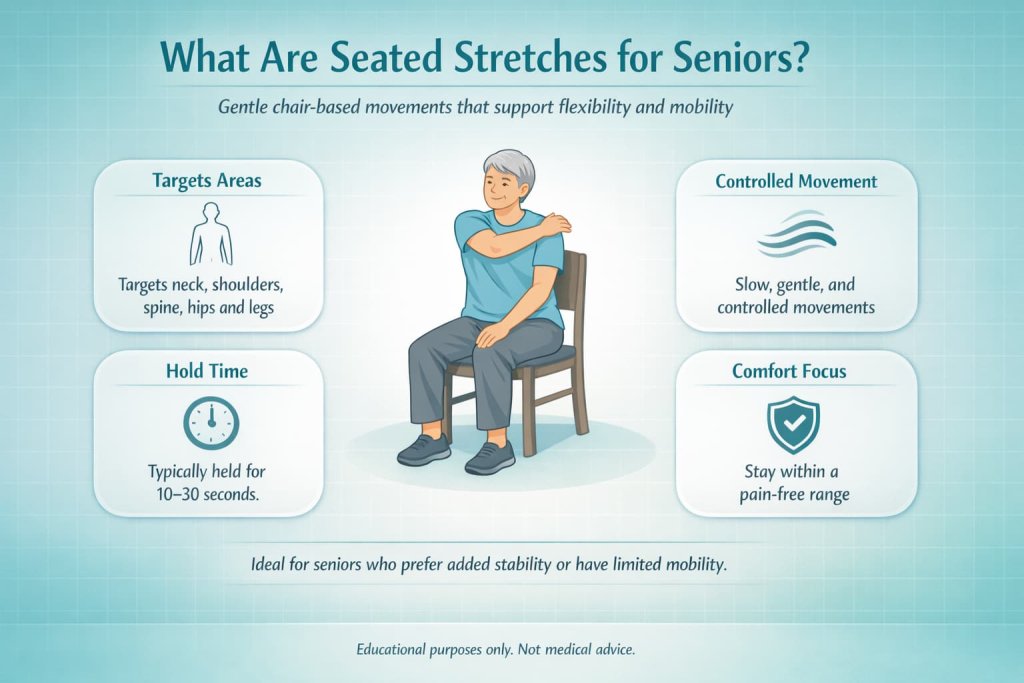
- Target major muscle groups (neck, shoulders, spine, hips, legs)
- Use slow, controlled movements
- Are held for about 10–30 seconds
- Stay within a comfortable, pain-free range
They are ideal for older adults who prefer added stability or have limited mobility.
10 best seated stretches for seniors
These 10 best seated stretches for seniors are designed to gently improve flexibility, mobility, and daily comfort using only a sturdy chair. Each movement targets key areas like the neck, shoulders, spine, hips, and legs to support safer, more confident movement.
1) Seated Neck Rotation
How to do it:
- Sit upright near the front of a sturdy chair with both feet flat on the floor
- Relax your shoulders and place your hands on your thighs
- Slowly turn your head to the right as if looking over your shoulder
- Keep your chin level with the floor
- Hold for 10–20 seconds while breathing normally
- Return to center slowly
- Repeat on the left side
- Perform 2–3 rounds per side
Why it works:
This stretch maintains gentle neck mobility and helps reduce stiffness that builds up from reading, watching TV, or sitting for long periods. Regular rotation supports everyday movements like checking traffic or turning to speak to someone beside you.
Muscles worked:
Sternocleidomastoid, scalenes, deep neck rotators, and upper cervical stabilizers.
Trainer Tip:
Move slowly and avoid forcing the turn. The goal is comfortable rotation, not maximum range.
2) Seated Upper Trapezius Stretch (Ear to Shoulder)
How to do it:
- Sit tall with your spine long and shoulders relaxed
- Gently tilt your right ear toward your right shoulder
- Keep both shoulders down — avoid shrugging
- Hold for 15–30 seconds
- Return to center slowly
- Repeat on the left side
- Perform 2–3 rounds per side
Why it works:
This stretch helps release tension in the upper shoulders and neck, an area that commonly tightens due to stress, prolonged sitting, or screen use.
Muscles worked:
Upper trapezius, levator scapulae, and side neck muscles.
Trainer Tip:
For a slightly deeper stretch, gently reach the opposite hand toward the floor — but never pull on your head.
3) Seated Chest Opener (Hands Behind or on Chair)
How to do it:
- Sit near the front edge of your chair
- Place hands behind you on the chair seat or interlace fingers behind your back
- Gently draw your shoulder blades together
- Lift your chest slightly upward
- Keep your lower back neutral (no exaggerated arch)
- Hold for 15–30 seconds while breathing deeply
- Repeat 2–3 times
Why it works:
This stretch counters rounded shoulders and forward head posture caused by sitting. It may help support easier breathing and improved upper-body alignment.
Muscles worked:
Pectoralis major and minor, anterior deltoids, front shoulder fascia.
Trainer Tip:
Think “open and tall” rather than leaning backward. Keep the stretch in your chest, not your lower back.
4) Seated Shoulder Rolls
How to do it:
- Sit tall with arms relaxed by your sides
- Slowly lift your shoulders toward your ears
- Roll them backward in a smooth circular motion
- Lower them down and relax
- Complete 6–10 slow repetitions
- Reverse direction and repeat
Why it works:
Shoulder rolls improve circulation around the shoulder joint and help reduce mild stiffness without aggressive stretching.
Muscles worked:
Upper trapezius, rhomboids, levator scapulae, and shoulder stabilizers.
Trainer Tip:
Keep movements slow and controlled. Avoid rushing through the circles.
5) Seated Cat-Cow (Spine Mobility)
How to do it:
- Sit with feet flat and hands resting on thighs
- Slowly round your upper back, tucking your chin slightly (cat)
- Then gently lift your chest and look forward (cow)
- Move with your breath: exhale as you round, inhale as you lift
- Perform 6–10 smooth repetitions
Why it works:
This gentle spinal movement improves flexibility in the mid and lower back and may reduce stiffness after prolonged sitting.
Muscles worked:
Spinal extensors, abdominals, thoracic stabilizers.
Trainer Tip:
Keep the motion controlled and comfortable. Avoid sharp or jerky movements.
6) Seated Spinal Twist
How to do it:
- Sit upright with feet flat
- Place your right hand on the outside of your left thigh
- Place your left hand on the back or side of the chair
- Gently rotate your torso to the left
- Keep hips facing forward
- Hold 15–30 seconds
- Return to center and switch sides
Why it works:
Rotational movement supports functional tasks like reaching sideways or turning while walking.
Muscles worked:
Obliques, multifidus, thoracic rotators.
Trainer Tip:
Rotate from your ribcage and shoulders, not your hips. Avoid pulling aggressively with your arms.
7) Seated Side Bend (Lat and Side-Body Stretch)
How to do it:
- Sit tall with feet grounded
- Place your right hand on the chair seat
- Raise your left arm overhead
- Gently lean to the right
- Feel the stretch along your left side
- Hold 15–30 seconds
- Return and repeat on the other side
Why it works:
This stretch improves lateral flexibility, supporting overhead reaching and posture.
Muscles worked:
Latissimus dorsi, obliques, intercostals.
Trainer Tip:
Keep both hips evenly grounded. Avoid collapsing forward.
8) Seated Hamstring Stretch
How to do it:
- Sit near the edge of the chair
- Extend one leg forward with heel on the floor
- Keep toes pointed upward
- Sit tall and hinge slightly forward from your hips
- Hold 15–30 seconds
- Switch legs
- Repeat 2–3 times per side
Why it works:
Hamstring flexibility supports upright posture and smoother walking mechanics.
Muscles worked:
Hamstrings and calf connective tissues.
Trainer Tip:
Keep your back straight. If tingling occurs, ease out of the stretch.
9) Seated Figure-4 Glute Stretch
How to do it:
- Sit tall
- Cross your right ankle over your left thigh
- Keep spine straight
- Gently lean forward
- Hold 15–30 seconds
- Switch sides
Why it works:
This stretch targets the glutes and deep hip muscles, which influence balance and walking comfort.
Muscles worked:
Gluteus maximus, gluteus medius, piriformis.
Trainer Tip:
If full crossing is uncomfortable, place the ankle lower on the shin.
10) Seated Calf Stretch with Towel or Strap
How to do it:
- Extend one leg forward
- Loop a towel or strap around the ball of your foot
- Keep knee mostly straight
- Gently pull toes toward you
- Hold 15–30 seconds
- Switch legs
Why it works:
Calf flexibility supports ankle mobility, which plays a role in walking and balance.
Muscles worked:
Gastrocnemius and soleus.
Trainer Tip:
Pull gently and steadily. Avoid bouncing. The Mayo Clinic emphasizes slow, smooth stretching without forcing into pain.
How Often Should Seniors Do Seated Stretches?
Most seniors benefit from stretching 2–3 times per week, and daily stretching is safe for many people when done gently.
General guidelines include:
- Hold each stretch 10–30 seconds
- Repeat 2–4 times per muscle group
- Move slowly and avoid bouncing
Consistency matters more than intensity. If you have a medical condition or recent surgery, consult a healthcare professional before starting.
Quick safety setup before you start
- Use a solid, stable chair (no wheels) on a non-slip surface. The NHS specifically recommends a sturdy chair for seated routines.
- Warm up for 2–3 minutes (easy marching in place while seated, gentle shoulder rolls, ankle pumps). A stretching guide from the CDC recommends a short warm-up before stretching.
- Stretch to mild tension, not pain, and don’t bounce.
- Typical hold: 10–30 seconds. Repeat: 3–5 times.
How long should seniors hold a stretch?
Most seniors do well with 10–30 seconds per stretch, repeated 3–5 times, staying comfortable and breathing normally, as recommended by the American Heart Association. If an area is especially tight, guidance from the Mayo Clinic suggests that holding closer to 60 seconds may be helpful—only if it still feels gentle and safe.
A simple 8–12 minute seated stretch routine
Use this as a practical daily flow:
- 1 minute warm-up (seated marching + shoulder rolls)
- Pick 6–8 stretches from the list above
- Hold each stretch 10–30 seconds
- Repeat 1–3 rounds depending on how you feel
This aligns with flexibility recommendations from the American Heart Association.
Benefits of Seated Stretches for Seniors
When done consistently, seated stretches may support:
- Improved flexibility and joint range of motion
- Reduced stiffness after sitting
- Better posture and alignment
- Easier daily movements (standing, reaching, walking)
- Increased comfort during activity
Stretching works best when combined with strength, balance, and light aerobic exercise.
Common mistakes to avoid
- Stretching without warming up
- Bouncing into the stretch
- Forcing into pain instead of mild tension
- Holding your breath
General flexibility safety guidance from the Mayo Clinic supports slow, controlled movement and avoiding pain.
When to stop and seek professional guidance
Stop stretching and speak with a healthcare professional if you feel sharp pain, dizziness, new numbness or tingling that does not quickly resolve, or worsening discomfort over time. The NHS also advises checking with a GP or qualified professional if you are unsure whether seated exercises are appropriate for you.
FAQs
Are seated stretches safe for seniors with limited mobility?
Often yes. Chair-based stretching is widely recommended as a low-impact option by organizations like the NHS. Always move within a comfortable range.
How long should I hold each seated stretch?
A good starting point is 10–30 seconds, as recommended by the American Heart Association.
Should I stretch every day?
Daily gentle stretching can feel beneficial, but consistency matters more than frequency. Even a few days per week supports mobility when done regularly, according to general activity guidance from the CDC.
Is stretching better before or after walking?
Stretching is typically recommended after a light warm-up or after walking, when muscles are warm.
What’s the best chair to use?
A firm, stable chair without wheels is safest, as recommended by the NHS.
Do seated stretches replace strength or balance training?
No. Stretching supports mobility, but older adults benefit most when flexibility is combined with strength, aerobic, and balance activities, according to the CDC.
Conclusion
Seated stretches for seniors are one of the simplest ways to support flexibility and mobility at home—especially if floor work is not comfortable. Choose a few stretches, keep them gentle, and stay consistent. Over time, these small daily movements can support smoother, more confident everyday activity.