
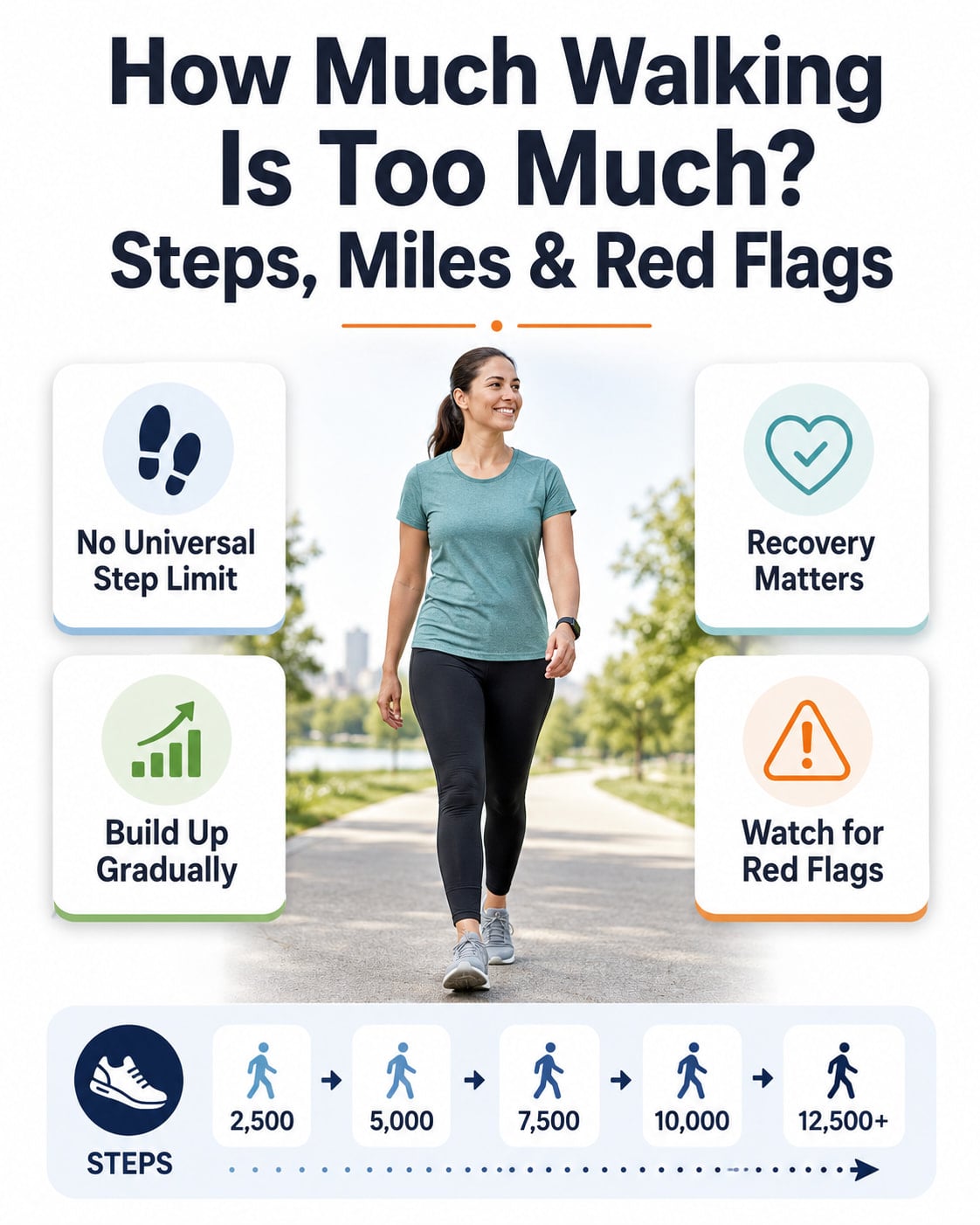
Walking is too much when the distance, pace, terrain, or frequency exceeds your current ability to recover—especially if you develop persistent pain, unusual fatigue, swelling, or changes in the way you walk. There is no universal number of steps or miles that is automatically excessive for everyone.
One person may comfortably walk 15,000 steps a day because they have gradually adapted to that workload. Another person may develop foot or knee pain after suddenly increasing from 3,000 to 8,000 daily steps.
The best way to determine how much walking is too much is to consider your recent activity level, recovery, physical symptoms, health conditions, and walking environment—not just the number on your fitness tracker.
How Much Walking Is Too Much?
Walking becomes excessive when your body is receiving more physical stress than it can currently tolerate and recover from.
Your walking volume may be too high if:
- Pain becomes worse during or after walking.
- Soreness does not improve with easier activity or rest.
- You begin limping or changing your natural walking pattern.
- Your feet, ankles, knees, or hips repeatedly swell.
- Your usual walking pace or endurance declines.
- You feel unusually tired, irritable, or unmotivated.
- Your sleep or normal daily activities are affected.
- Blisters or other foot problems continually return.
The number of steps that causes these problems varies considerably. Fitness level, age, health, previous injuries, footwear, terrain, pace, weather, and carried weight can all change how demanding a walk feels.
A Quick Guide to Walking Tolerance
| What you notice | What it may mean | Practical response |
|---|---|---|
| Mild, general muscle fatigue after a longer walk | Your muscles experienced a new but potentially manageable workload | Use an easier walking day and monitor recovery |
| Temporary soreness that steadily improves | Normal adaptation may be occurring | Avoid increasing distance again until you feel recovered |
| Repeated blisters or hot spots | Footwear, socks, moisture, or excessive distance may be contributing | Address the cause and reduce distance until the skin recovers |
| Pain that becomes worse as you continue | The current workload may be irritating a muscle, tendon, joint, or bone | Stop or shorten the walk and monitor the area |
| Limping, swelling, or focal tenderness | A possible injury may be developing | Avoid walking through it and seek medical guidance |
| Chest pain, fainting, confusion, or severe breathlessness | A potentially serious medical problem | Stop immediately and obtain urgent medical help |
Is There a Maximum Number of Steps Per Day?
No major US health organization sets a maximum safe number of daily steps for healthy adults.
The current Physical Activity Guidelines for Americans recommend that adults complete at least 150–300 minutes of moderate-intensity aerobic activity per week. Brisk walking can count toward that total. Adults are also advised to perform muscle-strengthening activities on at least two days each week.
These recommendations are health targets, not maximum limits. Some people can safely perform more activity, while others may need to begin with much less and progress gradually.
Is 7,000 Steps the Maximum Healthy Amount?
No. Seven thousand steps is not a safety ceiling.
A 2025 systematic review and dose-response meta-analysis included 57 studies from 35 cohorts. Compared with 2,000 daily steps, 7,000 daily steps was associated with:
- A 47% lower risk of death from all causes
- A 25% lower risk of developing cardiovascular disease
- A 14% lower risk of developing type 2 diabetes
- A 38% lower risk of dementia
- A 22% lower risk of depressive symptoms
Several health outcomes showed an inflection point around 5,000–7,000 steps, meaning that the additional benefit from each extra step often became smaller beyond that range. However, the researchers did not conclude that walking beyond 7,000 steps was harmful. They also noted that 10,000 steps can remain a reasonable target for more active people.
A slowdown in additional health benefits is not the same as an injury threshold.
Steps to Miles Conversion
According to the American College of Sports Medicine, approximately 2,000 steps equals one mile for an average adult.
| Daily steps | Approximate distance |
|---|---|
| 2,000 steps | 1 mile |
| 5,000 steps | 2.5 miles |
| 7,000 steps | 3.5 miles |
| 10,000 steps | 5 miles |
| 15,000 steps | 7.5 miles |
| 20,000 steps | 10 miles |
These are estimates. Your actual distance depends on your stride length, height, pace, walking technique, and the accuracy of your phone or fitness tracker.
Distance also does not describe the entire workload. Five miles on flat pavement at a relaxed pace is different from five miles involving steep hills, stairs, sand, heat, or a heavy backpack.
Is 10,000 Steps a Day Too Much?
Ten thousand steps a day is not automatically too much.
For an average adult, 10,000 steps represents approximately five miles. That may be a comfortable daily amount for someone who walks regularly, has supportive footwear, and recovers without pain or excessive fatigue.
However, it may be too much when:
- You recently increased from a much lower step count.
- You walk all five miles at a fast pace without building endurance.
- Most of the route involves hills, stairs, or uneven ground.
- You have an active job in addition to your planned walk.
- You are recovering from an illness or injury.
- You develop persistent pain or fatigue.
You do not have to reach 10,000 steps to benefit from walking. The most useful target is one you can perform consistently without worsening symptoms.
Is 15,000 Steps a Day Too Much?
Fifteen thousand steps is approximately 7.5 miles, which is a substantial daily walking volume for many people.
It may be manageable for an experienced walker, an active traveler, or someone with a physically demanding job. It may be excessive for a beginner, particularly when completed every day without easier periods.
Pay attention to how your feet, calves, shins, knees, and hips feel the following day. If discomfort is gradually accumulating rather than settling, reduce the distance before it develops into a more significant problem.
Is 20,000 Steps a Day Too Much?
Twenty thousand steps is approximately 10 miles.
Walking that distance is not inherently unsafe, but it is a high daily volume for many adults. It requires more time, energy, hydration, food, foot care, and recovery than a shorter walk.
Twenty thousand steps may be too much if you:
- Reached that amount through a sudden increase.
- Are repeatedly walking through pain.
- Feel progressively more exhausted each day.
- Develop swelling, blisters, tendon pain, or localized bone tenderness.
- Cannot maintain your normal walking pattern.
- Have a condition that affects your heart, lungs, circulation, bones, joints, or balance.
People who regularly walk 20,000 steps without symptoms do not necessarily need to reduce their activity simply because the number is high. Their recovery and physical response remain more informative than the step count alone.
Signs You May Be Walking Too Much
The clearest signs of excessive walking usually appear in your recovery, comfort, and ability to function.
Persistent or Worsening Pain
Pain that intensifies during the walk, returns every day, or begins affecting normal activities should not be ignored.
Common problem areas include the:
- Heel or arch
- Achilles tendon
- Shin
- Ankle
- Kneecap
- Outer knee
- Hip
- Lower back
A dull, general muscle ache after an unfamiliar walk is different from sharp, focal, or steadily worsening pain.
Changes in Your Walking Form
Limping or shifting your weight to avoid discomfort can place additional stress on other areas of the body.
Stop or reduce the walk if pain causes you to:
- Shorten one step
- Avoid putting weight on one foot
- Lean noticeably to one side
- Rotate your foot differently
- Hold your body in an unusual position
Correcting the movement pattern does not solve the underlying problem if pain is causing the change.
Unusual Fatigue and Poor Recovery
A long walk can naturally make you tired. The concern is fatigue that repeatedly affects your normal routine or becomes worse despite continuing to exercise.
The MedlinePlus signs of excessive exercise include needing longer recovery, declining performance, heavy or sore muscles, trouble sleeping, mood changes, repeated overuse injuries, reduced motivation, frequent illness, and unintended weight loss.
These symptoms can have many possible causes. A healthcare professional can help determine whether walking volume, inadequate recovery, nutrition, illness, medication, or another issue is contributing.
Recurring Foot Problems
Repeated blisters, calluses, toenail problems, or painful hot spots may mean your distance has increased faster than your feet can tolerate.
Other possible contributors include:
- Shoes that do not fit correctly
- Worn-out cushioning
- Damp socks
- Heat and swelling
- Friction from seams
- Long downhill sections
Do not cover a painful blister and continue walking the same distance without addressing the cause. Altering your stride to protect the area can create discomfort elsewhere.
Declining Performance
Walking more is not always better if your performance is steadily getting worse.
Possible warning signs include:
- Your normal pace feels unusually difficult.
- You need frequent unscheduled stops.
- Your legs feel heavy before beginning.
- A familiar route takes noticeably longer.
- You cannot complete distances that were previously comfortable.
One difficult day does not necessarily indicate excessive training. A repeated downward pattern is more meaningful.
Normal Soreness vs. an Injury Warning Sign
Mild muscle soreness can occur after a longer, faster, or hillier walk than usual. It should generally become less noticeable as you recover.
| More consistent with normal fatigue | More concerning for an injury |
|---|---|
| General muscle tenderness | Sharp or highly localized pain |
| Similar discomfort on both sides | Pain focused in one specific spot |
| Improves with rest or easy movement | Becomes worse with continued walking |
| Does not change your walking pattern | Causes limping or compensation |
| No significant swelling or bruising | Visible swelling, warmth, or bruising |
| Steadily improves | Continues returning or becomes more intense |
| Only noticeable in the worked muscles | Pain occurs during normal daily activities or at rest |
When uncertain, avoid using pain tolerance as the test. Reducing your workload early is usually more practical than continuing until the problem limits ordinary walking.
Bone Stress Injury Red Flags
A bone stress injury can develop when repeated physical loading exceeds the bone’s ability to repair itself. A sudden increase in activity is a common contributor.
According to the American Academy of Orthopaedic Surgeons’ stress-fracture guidance, symptoms may begin as discomfort in one specific spot near the end of activity. As the injury becomes more severe, pain may occur during regular walking, household activities, or at night. Swelling, bruising, tenderness, and limping may also develop.
Seek medical evaluation for:
- Pain directly over a bone
- Tenderness in one precise location
- Pain that becomes worse with weight-bearing
- Swelling over the painful area
- Limping
- Pain during ordinary daily activities
- Aching at rest or during the night
Continuing to walk through a suspected bone stress injury may allow it to progress.
Urgent Warning Signs During or After Walking
Some symptoms require more than a rest day.
Stop walking and obtain urgent or emergency medical help for:
- Chest pain, pressure, tightness, or heaviness
- Fainting or feeling close to fainting
- Severe or unusual shortness of breath
- Confusion or altered awareness
- A symptomatic irregular heartbeat
- Sudden severe weakness
- Inability to bear weight after an injury
- A visibly deformed or severely swollen joint
Chest pain, dizziness, irregular heartbeat, nausea, and shortness of breath during exercise can indicate that the activity is placing excessive strain on the cardiovascular system.
Heat-Related Warning Signs
Walking in hot or humid conditions can turn a normally manageable distance into a much more demanding workout.
Possible signs of heat exhaustion include:
- Headache
- Nausea
- Dizziness
- Weakness
- Irritability
- Heavy sweating
- Excessive thirst
- Reduced urine output
Stop exercising, move to a cooler location, and begin cooling down. Confusion, loss of consciousness, seizures, or very high body temperature may indicate heat stroke and require emergency care.
Dark Urine With Severe Muscle Symptoms
Severe muscle pain or weakness accompanied by dark, tea- or cola-colored urine can be a sign of rhabdomyolysis. This rare but serious condition can occur after prolonged exertion or heat exposure and requires immediate medical evaluation.
What Determines How Much Walking You Can Tolerate?
The same step count can create very different workloads for different people.
Your Current Activity Level
A person who regularly walks 8,000 steps may tolerate an increase to 9,000 more easily than someone increasing directly from 2,000 to 9,000.
Your recent baseline is more useful than another person’s daily goal.
Walking Pace
Brisk walking places greater demand on your cardiovascular system and leg muscles than relaxed walking.
Increasing your distance and speed at the same time creates a larger workload increase than changing either one alone.
Hills, Stairs, and Terrain
Uphill walking increases the demand on your calves, glutes, hamstrings, and cardiovascular system. Downhill walking can increase loading on the knees and thigh muscles.
Sand, trails, uneven pavement, and sloped roads may also require more balance and stabilization than a smooth, flat route.
Carried Weight
A backpack, groceries, occupational equipment, or a child carrier adds resistance. Ten thousand steps while carrying weight can be considerably harder than 10,000 unweighted steps.
Previous Injuries and Health Conditions
Previous foot, ankle, knee, hip, or back injuries may affect how quickly you can increase your walking volume.
People with osteoporosis, arthritis, diabetes, heart disease, circulation problems, balance difficulties, or other medical conditions may need individualized recommendations.
Walking is considered a joint-friendly activity for many people with arthritis, but it should still be adjusted when it causes significant or worsening pain.
Recovery
Your ability to tolerate walking also depends on:
- Sleep
- Nutrition
- Hydration
- Stress
- Other exercise
- Physical work
- Time between long walks
Your body responds to the total workload—not only the walking session recorded on your tracker.
How to Prevent Walking Too Much
Start From Your Current Baseline
Check your average step count over a normal week. Build from what you are already doing rather than selecting an arbitrary goal.
Someone averaging 3,000 steps should not assume that immediately jumping to 10,000 is necessary.
Increase One Variable at a Time
Avoid simultaneously increasing:
- Daily steps
- Walking pace
- Hills
- Number of walking days
- Carried weight
- Workout duration
Changing one variable makes it easier to determine what your body tolerates.
Wait for Your Body to Adapt
Do not increase your target simply because you completed it once. Repeat the new distance until it feels manageable and you recover well.
Safe exercise programs generally begin slowly and gradually increase frequency, intensity, and duration.
Use Easier Days
You do not necessarily need complete rest after every walk. An easier day may involve:
- A shorter walk
- A slower pace
- A flat route
- Gentle mobility work
- A non-weight-bearing activity such as cycling or swimming
Complete rest may be more appropriate when walking itself causes pain or changes your gait.
Wear Appropriate Footwear
Choose shoes that fit comfortably, remain secure around the heel, and provide enough room for the toes.
Replace shoes when the soles are unevenly worn or the cushioning and support no longer feel effective. The best shoe depends on your foot shape, route, comfort, and individual needs.
Include Strength Training
Strengthening the calves, thighs, hips, and core may improve your capacity to handle longer walks.
Current US guidelines recommend muscle-strengthening activity on at least two days each week in addition to aerobic activity.
Do Not Let the Tracker Control the Walk
A fitness tracker is a measurement tool, not a medical authority.
There is no need to walk through pain late at night simply to complete a round-number goal. Ending a walk below your target is more sensible than turning a manageable symptom into an injury.
When Should You Speak With a Healthcare Professional?
Consider speaking with a doctor, physical therapist, podiatrist, or another qualified healthcare professional when:
- Pain persists despite reducing your walking volume.
- Pain repeatedly returns when you resume walking.
- You have focal bone tenderness.
- Swelling, warmth, or bruising is present.
- You cannot walk normally.
- Pain occurs at rest or at night.
- You have repeated falls or balance problems.
- Fatigue affects your normal activities.
- You have a chronic condition and are unsure how much activity is appropriate.
- You are returning to activity after surgery, illness, or a significant injury.
Seek urgent care for chest pain, fainting, severe breathlessness, confusion, severe heat symptoms, inability to bear weight after an injury, or dark urine accompanied by severe muscle pain or weakness.
Frequently Asked Questions
Can Walking 20,000 Steps a Day Be Too Much?
Yes, 20,000 steps can be too much when the distance exceeds your current conditioning or causes pain, swelling, limping, poor recovery, or unusual fatigue. However, the number is not automatically dangerous for an experienced, symptom-free walker who gradually adapted to that volume.
Is Walking 10 Miles Every Day Excessive?
Ten miles is a high daily walking volume for many adults. It may be manageable for some people but excessive for others. Your recent baseline, pace, terrain, health, footwear, recovery, and symptoms are more important than the distance alone.
Can Too Much Walking Hurt Your Knees?
A sudden increase in walking volume, speed, hills, or stairs may aggravate the tissues around the knee. However, ordinary walking does not automatically damage healthy knees. The CDC classifies brisk walking as a joint-friendly activity that places relatively little stress on the joints.
Reduce your workload and seek an evaluation if knee pain is persistent, worsening, swollen, or changing the way you walk.
Should You Walk When Your Legs Are Sore?
A short, easy walk may be comfortable when soreness is mild, general, and improving. Do not continue if pain is sharp, highly localized, becoming worse, or causing you to limp.
How Many Rest Days Do Walkers Need?
There is no fixed number. Someone taking relaxed daily walks may not require scheduled complete rest days. A person doing long, fast, hilly walks may need easier or rest days more often.
Use your recovery as a guide. Persistent fatigue, worsening soreness, and declining performance suggest that the current schedule may need adjustment.
How Many Steps Should Older Adults Walk Each Day?
There is no universal step requirement for all older adults. CDC evidence summaries report that the association between steps and lower premature-mortality risk began leveling off at approximately 6,000–8,000 daily steps among adults aged 60 and older. That range is not a maximum, minimum, or personalized prescription.
Older adults should choose a target that matches their health, mobility, balance, and current activity level.
Can You Walk Too Much Even If You Take Fewer Than 10,000 Steps?
Yes. A lower step count may still be excessive for someone who is new to exercise, recovering from an injury, living with certain medical conditions, carrying weight, or walking quickly on difficult terrain.
Conclusion
There is no single answer to how much walking is too much. Ten thousand, 15,000, or 20,000 steps may be manageable for one person and excessive for another.
Focus on your current baseline, increase your workload gradually, and pay attention to recovery. Mild temporary fatigue may be expected after a challenging walk, but persistent pain, swelling, limping, declining performance, or unusual exhaustion are reasons to reduce your walking volume.
Use your step count as information—not an obligation. A sustainable routine you can recover from is more valuable than repeatedly forcing yourself to reach an arbitrary number.
References
- Physical Activity Guidelines for Americans — US Department of Health and Human Services
- Daily Steps and Health Outcomes in Adults — PubMed
- Benefits of Physical Activity — Centers for Disease Control and Prevention
- Sit Less, Move More, and Exercise — American College of Sports Medicine
- Are You Getting Too Much Exercise? — MedlinePlus
- Safe Exercise — American Academy of Orthopaedic Surgeons
- Stress Fractures — American Academy of Orthopaedic Surgeons
- Heat-Related Illnesses — CDC/NIOSH
- Signs and Symptoms of Rhabdomyolysis — CDC/NIOSH