
Most weight loss myths are based on oversimplified rules: you do not have to eliminate carbohydrates, stop eating after 8 p.m., perform endless cardio, or use a detox product to lose weight. Sustainable weight loss generally comes from maintaining an appropriate energy deficit while supporting appetite, nutrition, physical activity, sleep, stress management, and long-term consistency.

Weight management is also more complex than willpower. Medicines, medical conditions, hormones, genetics, age, stress, sleep, food access, and the surrounding environment can all affect a person’s results.
The World Health Organization’s obesity fact sheet, updated in December 2025, describes obesity as a chronic, relapsing disease caused by complex interactions among genetics, neurobiology, eating behavior, food access, market forces, and the broader environment. WHO also reported that 2.5 billion adults worldwide had overweight in 2022, including 890 million adults living with obesity.
Understanding common weight loss myths can help you avoid unnecessary food restrictions, unsafe supplements, unrealistic expectations, and plans that are too difficult to maintain.
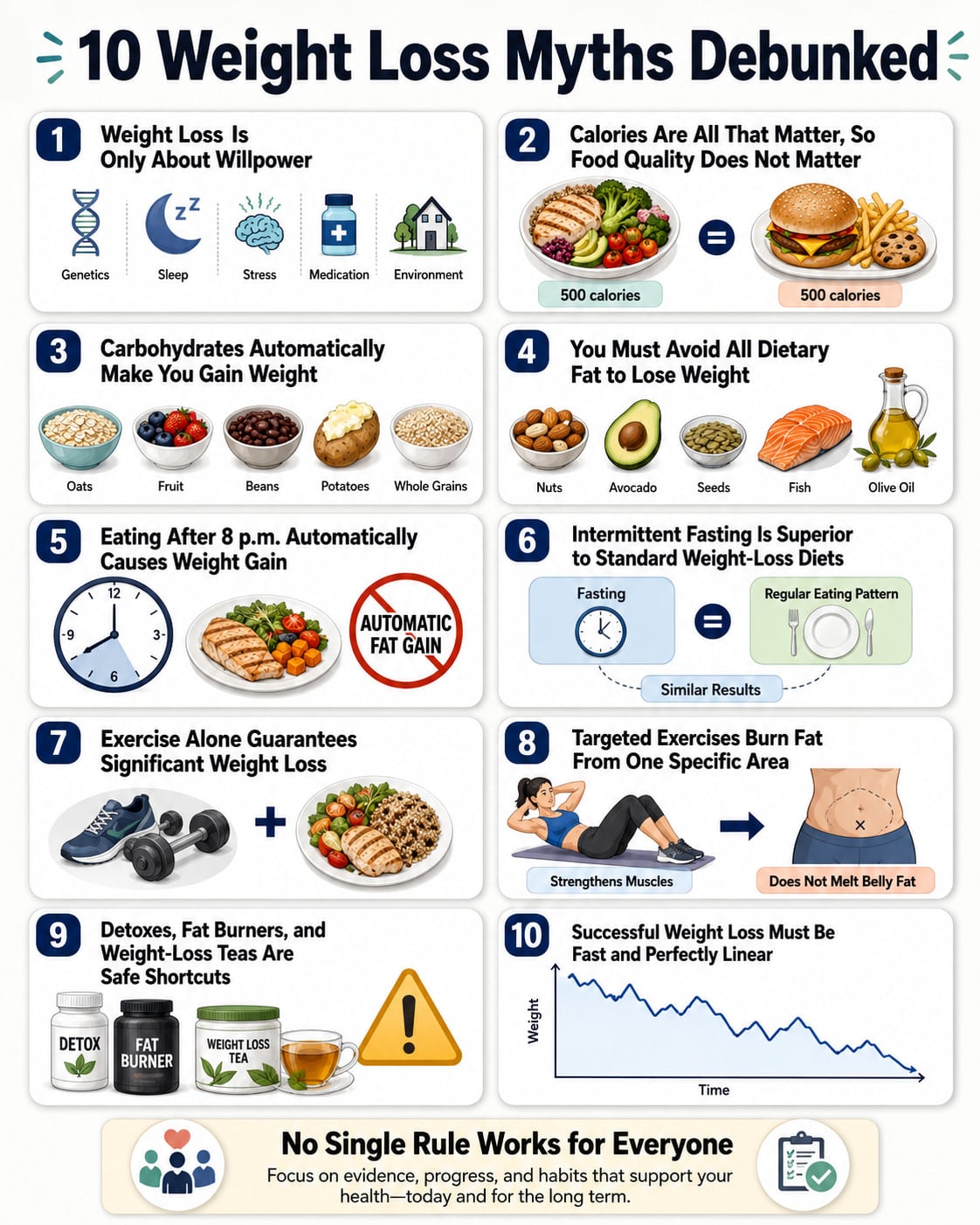
Weight Loss Myths at a Glance
| Weight loss myth | What science actually says |
|---|---|
| Weight loss is only about willpower | Behavior matters, but biology, health, medications, sleep, stress, and environment also affect weight. |
| Calories are all that matter | Energy balance matters, but food quality influences fullness, nutrition, and how easy a plan is to follow. |
| Carbohydrates automatically cause weight gain | Both low-carbohydrate and balanced-carbohydrate diets can support weight loss. |
| You must avoid all dietary fat | Healthy fats can be part of a nutritious weight-loss plan. |
| Eating after 8 p.m. causes weight gain | There is no universal clock time when food automatically becomes body fat. |
| Intermittent fasting is superior | It may work as a schedule, but it is not consistently better than conventional dietary advice. |
| Exercise alone guarantees weight loss | Exercise supports health and weight management, but scale changes may be modest without dietary adjustments. |
| Targeted exercises burn fat from one area | Exercises strengthen targeted muscles, but meaningful localized fat loss cannot be reliably promised. |
| Detoxes and fat burners are safe shortcuts | Evidence is limited, and some products contain harmful or undeclared ingredients. |
| Successful weight loss must be fast and linear | Gradual progress is usually more sustainable, and day-to-day scale changes are normal. |
Why Weight Loss Myths Are So Misleading
Weight loss myths usually isolate one factor and present it as the entire solution.
Calories matter, but counting calories alone does not explain why one meal keeps you full for several hours while another leaves you hungry soon afterward. Meal timing may influence some people’s eating habits, but eating at a certain hour does not override total intake. Exercise burns energy, but it does not automatically compensate for everything a person eats.
The most useful approach is to look at the complete pattern:
- What and how much you usually eat
- How filling your meals are
- How active you are
- How consistently you sleep
- Whether stress changes your appetite
- Whether medications or health conditions affect your weight
- Whether your plan is practical enough to maintain
The CDC’s healthy weight guidance recommends combining healthy eating, regular physical activity, adequate sleep, and stress management rather than relying on one isolated strategy.
10 Weight Loss Myths Debunked
Myth 1: Weight Loss Is Only About Willpower
This myth suggests that anyone who struggles to lose weight simply lacks discipline. That is inaccurate and can increase shame without helping a person make meaningful changes.
Daily decisions still matter. However, those decisions are influenced by many factors, including:
- Hunger and fullness signals
- Genetics and hormones
- Medicines that affect appetite or fluid balance
- Medical conditions
- Sleep quality
- Chronic stress
- Work and caregiving demands
- Food cost and availability
- Access to safe places for physical activity
- Previous dieting experiences
The CDC specifically identifies medicines, medical conditions, stress, genes, hormones, environment, and age as factors that may affect weight management. WHO also recognizes obesity as a complex chronic disease rather than a simple failure of self-control.
What to Do Instead
Focus on changing the conditions around your choices rather than depending on motivation every hour of the day.
Helpful examples include:
- Keeping convenient, filling foods available
- Planning a few repeatable meals
- Removing frequent food-delivery prompts from your phone
- Scheduling activity like an appointment
- Going to bed at a consistent time
- Asking family members for practical support
- Discussing medication-related weight changes with your healthcare professional
Personal responsibility and compassion can exist together. You can work on your habits without blaming yourself for every factor that affects your weight.
Myth 2: Calories Are All That Matter, So Food Quality Does Not Matter
A sustained energy deficit is the basic requirement for losing body mass. However, that does not mean 500 calories from every food will have the same effect on fullness, nutrition, eating speed, or future food intake.
Protein, fiber, water content, food volume, texture, and processing can all affect how satisfying a meal feels. A diet may technically fit a calorie target while still leaving you hungry, tired, or short on important nutrients.
In a controlled NIH trial, 20 adults were offered either an ultra-processed diet or an unprocessed diet for two weeks at a time. The meals offered were designed to be similar in several nutritional characteristics, but participants ate an average of approximately 508 additional calories per day during the ultra-processed phase. They gained an average of 0.9 kilograms during that phase and lost a similar amount during the unprocessed phase.
The study was small and short, so it cannot tell us how every processed food affects every person. However, it demonstrates why food quality and food structure may influence spontaneous calorie intake.
The current Dietary Guidelines for Americans, 2025–2030 emphasizes whole, nutrient-dense foods such as protein foods, dairy, vegetables, fruits, healthy fats, and whole grains while recommending a substantial reduction in highly processed foods.
What to Do Instead
Consider both calorie intake and meal quality.
Build most meals around a combination of:
- A protein source
- Vegetables or fruit
- A high-fiber carbohydrate when desired
- A reasonable portion of healthy fat
- Water or another low-calorie drink
You do not have to prepare every food from scratch. Frozen vegetables, canned beans, plain yogurt, canned fish, pre-cooked whole grains, and other convenient foods can still support a balanced plan.
Myth 3: Carbohydrates Automatically Make You Gain Weight
Carbohydrates do not automatically cause body-fat gain. Weight can increase when total energy intake consistently exceeds energy use, regardless of whether those extra calories come primarily from carbohydrates, fat, protein, or a combination.
The carbohydrate category also includes very different foods:
- Vegetables
- Fruit
- Beans and lentils
- Oats
- Brown rice
- Whole-grain bread
- Sugary drinks
- Candy
- Cookies
- Refined snack foods
Treating all these foods as metabolically identical is not useful.
A 2022 Cochrane review found little to no meaningful difference in weight loss between low-carbohydrate and balanced-carbohydrate weight-reducing diets. The average difference was approximately 1 kilogram in shorter trials and less than 1 kilogram in trials lasting one to two years. People lost weight with both approaches.
NIDDK also states that grain products are not automatically fattening and notes that replacing refined grains with whole grains may improve fullness.
What to Do Instead
Choose the amount and type of carbohydrate that supports your health, preferences, activity level, and ability to follow the plan.
Useful choices may include:
- Beans and lentils
- Whole grains
- Fruit
- Vegetables
- Potatoes
- Minimally sweetened dairy foods
Reducing sugary drinks, oversized desserts, and frequently eaten refined snacks may lower calorie intake without requiring you to eliminate every carbohydrate-containing food.
People with diabetes or those taking glucose-lowering medication should make major carbohydrate changes with appropriate professional guidance.
Myth 4: You Must Avoid All Dietary Fat to Lose Weight
Dietary fat is essential. It supports normal body functions and helps the body absorb certain nutrients.
Foods containing healthy fats can fit into a weight-loss eating pattern, including:
- Nuts and seeds
- Avocado
- Olives
- Fish
- Nut and seed butters
- Olive oil
The issue is not that these foods are inherently fattening. The practical concern is that fat is calorie-dense, making portion size important when a person is trying to reduce total energy intake.
NIDDK advises that people do not need to avoid all fats when losing weight. It recommends including modest amounts of foods such as nuts, olives, and avocados while remaining aware of portions.
What to Do Instead
Measure calorie-dense fats until you understand your usual portions.
For example:
- Pour oil into a spoon instead of directly into the pan
- Portion nuts rather than eating from a large package
- Check the serving size of nut butter
- Use avocado as part of a meal rather than adding it automatically to every dish
A “fat-free” label does not automatically make a food more nutritious or better for weight loss. Consider the complete Nutrition Facts label and ingredient list.
Myth 5: Eating After 8 p.m. Automatically Causes Weight Gain
There is no universal metabolic deadline at 8 p.m. Food does not automatically become body fat because you ate it at 8:01.
Total food intake, meal composition, activity, sleep, and the consistency of your routine are generally more important than one exact clock time.
Meal timing may still have a modest influence. A 2024 systematic review and meta-analysis evaluated 29 randomized clinical trials involving 2,485 participants. Time-restricted eating, eating fewer times per day, and consuming more calories earlier in the day were associated with small average reductions in body weight.
However, the researchers cautioned that the effects were small, their clinical importance was uncertain, and many studies had a high risk of bias.
Why Late Eating Sometimes Matters
Late eating may make weight loss more difficult when it:
- Adds unplanned calories after dinner
- Happens while watching television or using a phone
- Involves large portions of snack foods
- Replaces adequate sleep
- Occurs because too little food was eaten earlier
A planned evening meal or snack can still fit your needs. The important question is whether the timing helps or hurts your overall routine.
What to Do Instead
Choose an eating schedule that supports:
- Consistent hunger management
- Adequate nutrition
- Your work or family schedule
- Exercise performance
- Comfortable sleep
- Any medication instructions you have received
You do not have to force yourself to stop eating at an arbitrary hour if doing so causes intense hunger and later overeating.
Myth 6: Intermittent Fasting Is Superior to Standard Weight-Loss Diets
Intermittent fasting describes several schedules, including time-restricted eating, alternate-day fasting, and modified fasting days.
These schedules can help some people simplify their eating routine. However, fasting does not guarantee a calorie deficit, and it is not consistently superior to more traditional weight-loss approaches.
A February 2026 Cochrane review on intermittent fasting included 22 randomized trials. Compared with traditional dietary advice, intermittent fasting produced little to no meaningful difference in weight loss or quality of life. The authors also noted that evidence about unwanted effects was uncertain because reporting was inconsistent.
When Intermittent Fasting May Be Useful
It may be practical when you:
- Prefer fewer meals
- Are not hungry early in the morning
- Find a consistent eating window easy to maintain
- Can meet your nutritional needs within that window
- Do not compensate by eating very large portions later
When It May Be a Poor Fit
Fasting may be unhelpful when it causes:
- Persistent hunger
- Irritability or difficulty concentrating
- Low energy during work or exercise
- Overeating when the fasting period ends
- Obsessive food thoughts
- Social or family disruption
Intermittent fasting is not an appropriate do-it-yourself strategy for everyone. People who are pregnant or breastfeeding, have a history of disordered eating, are younger than 18, take glucose-lowering medication, or have relevant medical conditions should seek individualized professional guidance before restricting their eating window.
Myth 7: Exercise Alone Guarantees Significant Weight Loss
Exercise can increase energy expenditure and may support weight loss. However, it does not guarantee a large reduction on the scale.
The amount of energy used during exercise varies by body size, intensity, duration, conditioning, and exercise type. Some people also become hungrier or move less during the rest of the day after beginning a demanding exercise program.
The CDC explains that losing and maintaining weight usually requires both healthy eating patterns and regular physical activity. A high amount of exercise may be required when calorie intake is not adjusted.
That does not make exercise ineffective. Physical activity supports:
- Cardiovascular fitness
- Muscular strength
- Physical function
- Bone health
- Sleep
- Mental well-being
- Long-term weight maintenance
Current CDC guidance recommends that most adults work toward at least 150 minutes of moderate-intensity aerobic activity per week, or an equivalent amount of vigorous activity, plus muscle-strengthening activity on at least two days per week. These are general health guidelines, not a promise of a particular amount of weight loss.
What to Do Instead
Combine exercise with an eating pattern that supports your goal.
A practical weekly routine might include:
- Regular walking, cycling, swimming, or another aerobic activity
- Two or more full-body strength sessions
- Additional everyday movement, such as taking stairs or walking during breaks
- Rest days when needed
- Gradual increases in duration or intensity
Avoid judging exercise only by how many calories a machine claims you burned. Exercise provides important health benefits even when the scale changes slowly.
Myth 8: Targeted Exercises Burn Fat From One Specific Area
Abdominal exercises strengthen the abdominal muscles. Triceps exercises strengthen the triceps. Leg exercises strengthen the muscles of the legs.
However, strengthening one area does not mean your body will remove stored fat mainly from that same location.
A systematic review and meta-analysis evaluating localized exercise found no meaningful overall spot-reduction effect.
Research is not completely uniform. A small 2023 study in adult men reported greater local abdominal fat use and a reduction in abdominal fat following a specialized abdominal endurance program. However, this limited finding does not establish that ordinary crunches can reliably remove belly fat in the general population.
What to Do Instead
Use targeted exercises to build strength and muscle, not as a promise of localized fat loss.
For example:
- Train your core to improve strength and movement control
- Use resistance training for all major muscle groups
- Include aerobic activity for fitness and additional energy expenditure
- Follow an appropriate overall eating pattern
- Track waist measurements over time rather than expecting one exercise to reshape one area
Where you lose fat first is influenced partly by genetics, sex, age, and individual body-fat distribution.
Myth 9: Detoxes, Fat Burners, and Weight-Loss Teas Are Safe Shortcuts
Products described as “natural,” “herbal,” “detoxifying,” or “metabolism boosting” are not automatically effective or safe.
The NIH Office of Dietary Supplements reports that there is little scientific evidence that weight-loss supplements work. Some ingredients can cause side effects or interact with medicines, while products containing multiple ingredients may not have been adequately tested in combination.
The National Center for Complementary and Integrative Health also reports that human research on detoxes and cleanses is limited and generally low quality. Initial scale loss during a very-low-calorie cleanse does not establish lasting fat loss or prove that toxins were removed.
Safety concerns are current, not historical. In an FDA safety alert updated August, 2026, the agency reported finding toxic yellow oleander in additional botanical products marketed for weight loss. Some tested products also contained undeclared drug ingredients. The FDA continued publishing additional hidden-ingredient notifications later that month.
Warning Signs of a Questionable Product
Be cautious when a product promises:
- Rapid weight loss without dietary or activity changes
- “Melting” fat from a specific area
- A secret ingredient doctors do not want you to know about
- Guaranteed results
- Removal of unspecified toxins
- Results supported mainly by testimonials
- A “proprietary blend” with unclear ingredient amounts
Prescription weight-management medications are a separate category from over-the-counter supplements. FDA-approved medications may be appropriate for some people, but they have risks, side effects, and specific eligibility considerations that should be discussed with a qualified healthcare professional.
Myth 10: Successful Weight Loss Must Be Fast and Perfectly Linear
Rapid transformation stories are common online, but they are not a realistic standard for everyone.
The CDC states that people who lose weight at a gradual, steady pace—about 1 to 2 pounds per week—are more likely to maintain that loss than people who lose weight more quickly. This range is general guidance, not a rule that applies identically to every person or medical treatment.
Progress also rarely appears as an identical loss every week. A person may see:
- A decrease one week
- Little change the next week
- A temporary increase
- A new decrease after several stable days
One weigh-in cannot distinguish a meaningful fat change from ordinary short-term changes in body weight. Look at trends across several weeks.
The CDC also notes that modest weight loss may still support health. For someone beginning at 200 pounds, a 5% reduction equals 10 pounds and may improve blood pressure, cholesterol, and blood sugar.
What to Do Instead
Use several measures of progress:
- Weekly average weight
- Waist measurement
- Exercise performance
- Energy during daily activities
- Clothing fit
- Blood pressure or glucose when medically appropriate
- Consistency with planned habits
A plateau does not automatically mean failure. It may indicate that your current intake and activity now maintain your lower body weight, that tracking has become less consistent, or that your plan needs a modest adjustment.
What Actually Supports Sustainable Weight Loss
No single eating plan works best for everyone. However, successful approaches usually share several features.
Create a Manageable Energy Deficit
You need to consume less energy than your body uses over time to lose weight. The deficit does not have to be extreme.
Severe restriction can increase hunger, fatigue, food preoccupation, and the likelihood of abandoning the plan. Begin with changes you could realistically maintain for months rather than days.
Examples include:
- Replacing sugary drinks with lower-calorie options
- Reducing frequent restaurant portions
- Serving snacks into a bowl instead of eating from the package
- Adding vegetables or fruit to meals
- Choosing a more filling breakfast or lunch
- Planning desserts rather than eating them automatically
Prioritize Filling, Nutrient-Dense Foods
Most meals should include foods that provide protein, fiber, vitamins, minerals, or other useful nutrients.
Practical options include:
- Eggs, fish, poultry, lean meat, tofu, beans, or lentils
- Vegetables and fruit
- Plain or lightly sweetened dairy foods
- Whole grains
- Nuts, seeds, avocado, or other healthy fats
Favorite foods do not have to disappear. They can be included in amounts that fit your overall plan.
Choose an Eating Pattern You Can Repeat
A low-carbohydrate diet, Mediterranean-style pattern, plant-forward diet, calorie-controlled plan, or time-restricted schedule may all work when they help you maintain an appropriate intake.
The best plan is not necessarily the most restrictive one. It is the one that:
- Meets your nutritional needs
- Fits your health requirements
- Controls hunger reasonably well
- Works with your culture and budget
- Allows social flexibility
- Can be continued after initial weight loss
Combine Aerobic and Strength Exercise
Aerobic exercise supports cardiovascular fitness and energy expenditure. Resistance training supports muscle strength and physical function.
Begin at an appropriate level. A person who is currently inactive may start with 10-minute walks and basic resistance exercises rather than immediately attempting intense daily workouts.
Protect Your Sleep
Poor sleep may make planning, appetite regulation, and physical activity more difficult. Establishing a consistent sleep schedule can support the behaviors required for weight management.
Do not routinely sacrifice sleep to exercise very early or prepare elaborate meals. A simpler plan that allows adequate rest may be more sustainable.
Track Trends, Not Perfection
Tracking can reveal patterns, but you do not have to record every detail forever.
Useful options include:
- A food log for one or two weeks
- Regular but not obsessive weigh-ins
- A weekly waist measurement
- A step or activity record
- A meal-planning checklist
- Notes about hunger, sleep, and stress
Use the information to make decisions rather than to judge yourself.
Adjust the Plan When Necessary
Your first plan does not have to be your permanent plan.
If progress has stopped for several weeks, review:
- Portion sizes
- Drinks and small snacks
- Weekend habits
- Restaurant frequency
- Daily movement
- Sleep
- Medication changes
- Whether your goal remains appropriate
Make one or two adjustments at a time so you can tell what is helping.
When to Speak With a Health Professional
Professional support may be especially important if you:
- Have diabetes, cardiovascular disease, kidney disease, liver disease, or an endocrine condition
- Take insulin, sulfonylureas, blood pressure medicine, or other medications that may require adjustment
- Notice unexplained or rapid weight change
- Are pregnant, breastfeeding, younger than 18, or an older adult with frailty
- Have a current or previous eating disorder
- Experience dizziness, fainting, persistent weakness, chest discomfort, or other concerning symptoms
- Are considering weight-loss supplements
- Want information about prescription weight-management medication
- Are considering metabolic or bariatric surgery
- Have repeatedly lost and regained weight despite structured efforts
A registered dietitian can help create an eating plan. A physician or other qualified clinician can evaluate medications, symptoms, and medical causes that may be affecting your weight.
Frequently Asked Questions
Can You Lose Weight Without Counting Calories?
Yes. Calorie counting is one tool, not a requirement.
You may create an energy deficit by reducing portion sizes, replacing high-calorie drinks, limiting frequent snacks, eating more filling foods, or following a structured meal plan. Temporary tracking can still be useful if you are unsure where your calories are coming from.
Do Carbohydrates Cause Belly Fat?
No individual carbohydrate automatically causes belly fat.
Frequent excess calorie intake can increase body fat, and genetics influence where that fat is stored. The quality and amount of carbohydrate matter. Fruit, beans, vegetables, and whole grains should not be treated the same as sugary drinks and heavily refined snack foods.
Does Eating After 8 p.m. Make You Gain Weight?
Not automatically.
Eating late may contribute to weight gain when it adds extra calories or becomes part of a frequent snacking habit. A planned evening meal or snack can fit a weight-loss plan when your total eating pattern remains appropriate.
Is Intermittent Fasting Better Than Calorie Restriction?
Current evidence does not show a clear, clinically meaningful weight-loss advantage over traditional dietary advice.
Fasting may help some people organize their intake, but other people find it increases hunger or overeating. Choose the approach that is safe, nutritionally adequate, and sustainable for you.
Can Exercise Alone Help You Lose Weight?
It can, but the amount of weight lost from exercise alone is often modest and varies widely.
Exercise becomes more effective for weight management when combined with appropriate eating habits. It remains beneficial for cardiovascular fitness, strength, function, and overall health even when scale changes are small.
How Quickly Should You Lose Weight?
The CDC commonly recommends gradual weight loss of approximately 1 to 2 pounds per week because people losing at that pace may be more likely to maintain it.
Your appropriate rate may differ based on body size, health, age, treatment method, and medical supervision. Faster or slower progress does not automatically mean something is wrong.
Why Am I Not Losing Weight Even Though I Eat Healthy Foods?
Nutritious foods still contain calories, and portions may be larger than you realize. Drinks, cooking oils, snacks, restaurant meals, and weekend habits can also affect your average intake.
Other possibilities include reduced daily movement, poor sleep, medication effects, or a medical condition. Review your habits objectively and speak with a healthcare professional if your weight changes are unexplained or you have concerning symptoms.
Conclusion
Weight loss does not require following every restrictive rule you see online. The most common weight loss myths confuse one possible strategy with a universal requirement.
A more reliable approach is to create a manageable energy deficit, prioritize nutrient-dense foods, remain physically active, sleep consistently, and adjust the plan based on your results. Avoid detoxes, unverified supplements, and promises of effortless or localized fat loss.
Start with one practical change you can repeat this week. Small actions performed consistently are more useful than a perfect plan you cannot maintain.
This content is for informational purposes only and not medical advice.
References
- World Health Organization: Obesity and Overweight
- CDC: Steps for Losing Weight
- NIDDK: Myths About Nutrition and Physical Activity
- NIH Study: Ultra-Processed Diets, Calorie Intake, and Weight Gain
- Cochrane Review: Low-Carbohydrate vs. Balanced-Carbohydrate Diets
- JAMA Network Open: Meal Timing and Weight-Related Outcomes
- Cochrane Review: Intermittent Fasting for Adults With Overweight or Obesity