
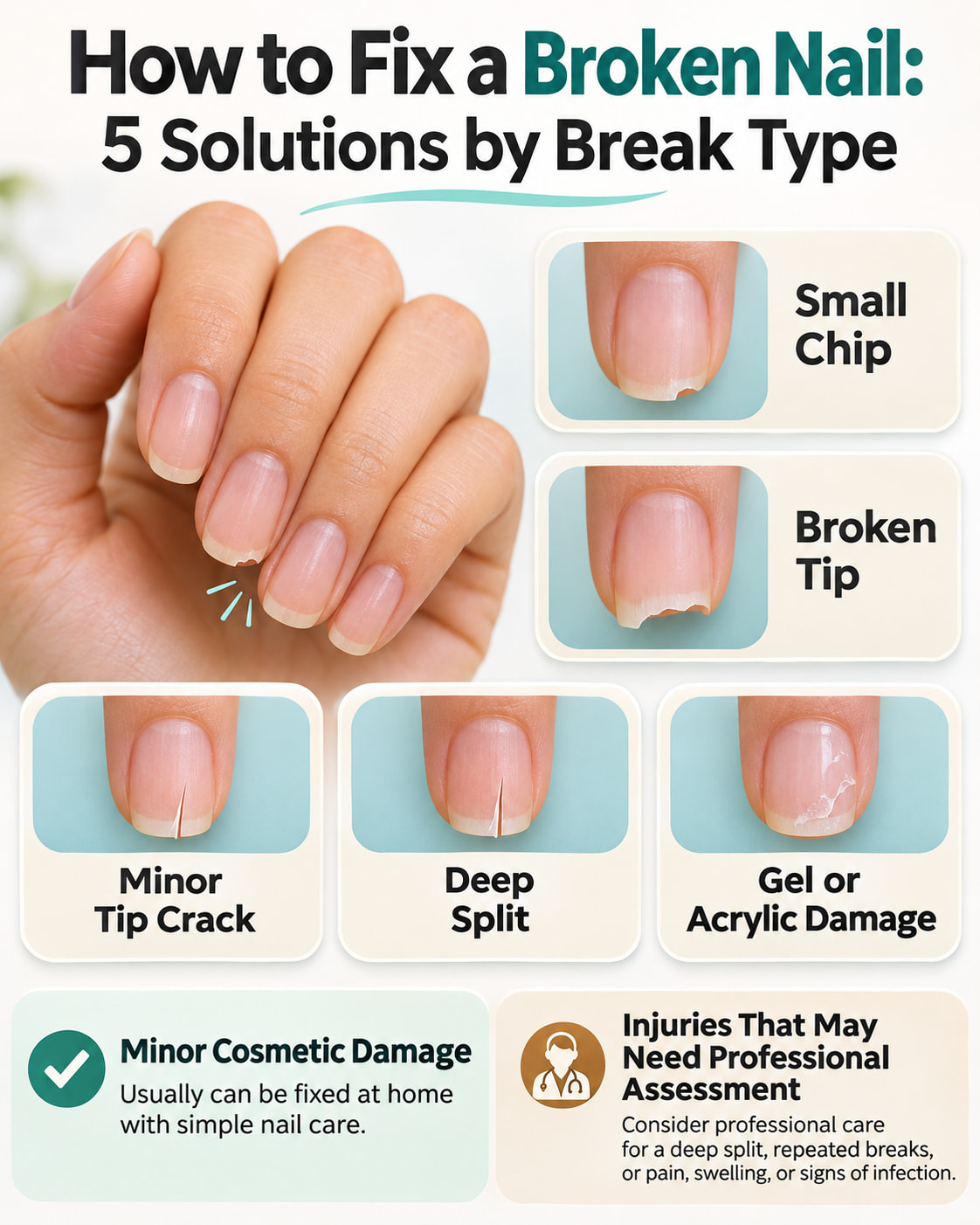
Knowing how to fix a broken nail starts with checking where it broke. A small chip or broken tip can often be filed or trimmed, while a painful, bleeding, or lifting nail needs protection and may require medical care.
The goal is to stop the nail from catching and tearing further. These five options explain when to smooth an edge, shorten a loose tip, consider a cosmetic repair, or get professional help.
Before You Fix a Broken Nail: Check the Damage
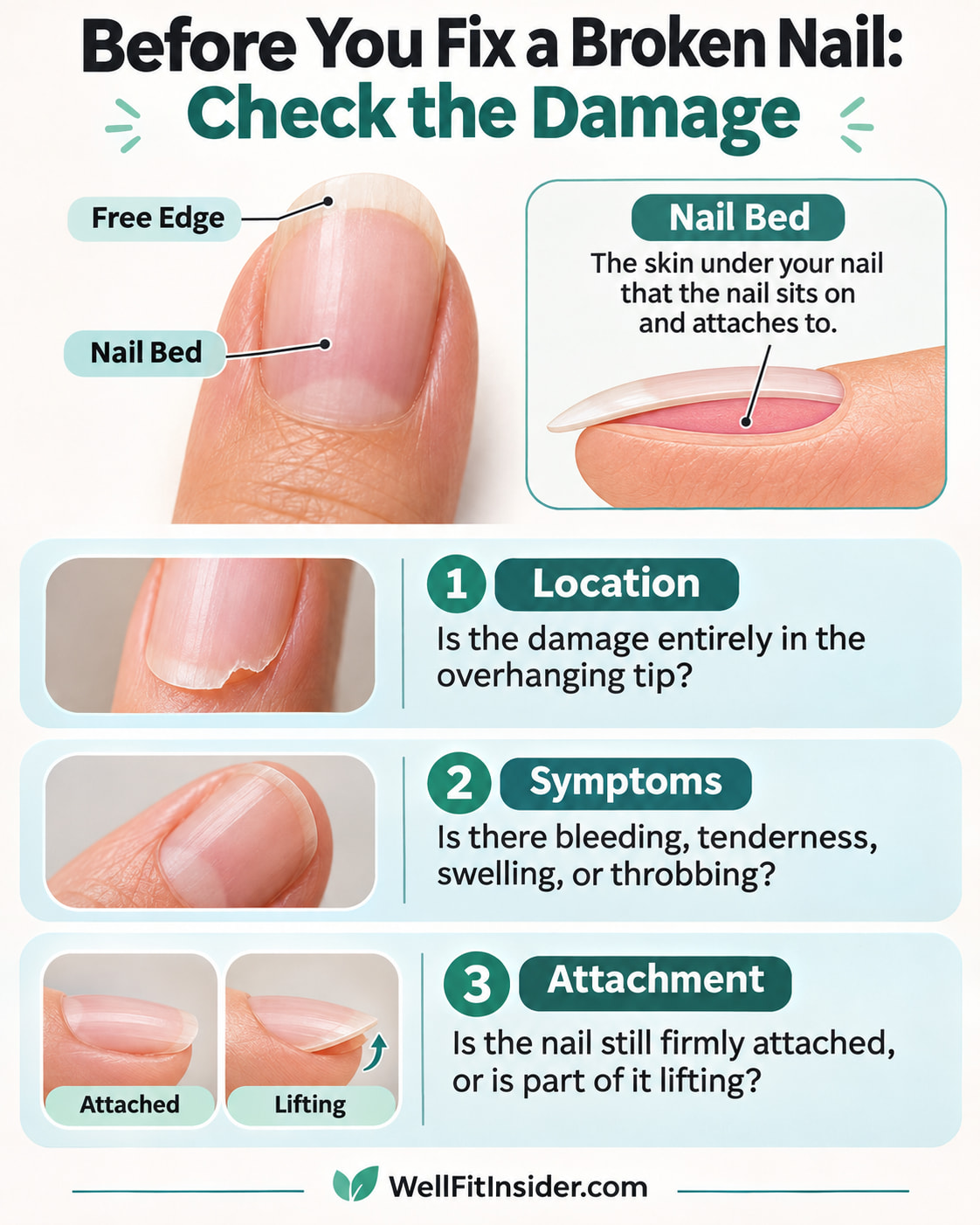
Look at the nail in good light without pulling the broken sections apart.
The free edge is the part extending beyond your fingertip. The nail bed is the skin beneath the attached nail. A break confined to the free edge is different from a split that reaches this sensitive area.
Check three things:
- Location: Is the damage entirely in the overhanging tip?
- Symptoms: Is there bleeding, tenderness, swelling, or throbbing?
- Attachment: Is the nail still firmly attached, or is part of it lifting?
If you cannot see where the crack ends, avoid cutting or gluing it until it can be assessed.
When to Get Medical Help for a Broken Nail
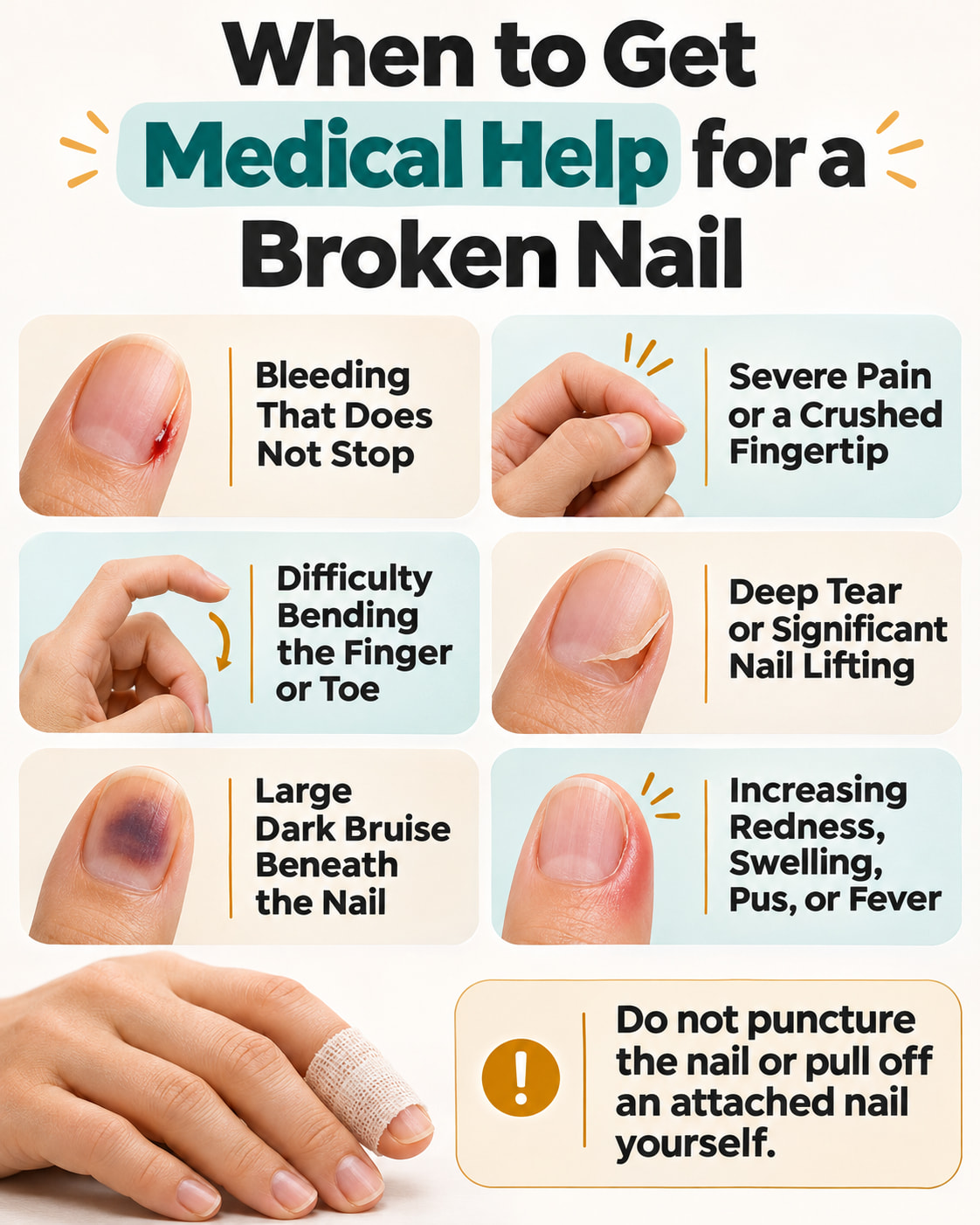
Seek prompt medical care if you have:
- Bleeding that does not stop with steady pressure.
- Severe pain, a crushed fingertip, or a finger or toe that looks misshapen.
- Difficulty bending the injured finger or toe.
- A deep tear into the attached nail, substantial lifting, or separation near the nail’s base.
- A large dark bruise beneath the nail, especially with throbbing pain.
The American Academy of Dermatology’s nail-injury guidance highlights significant pain, difficulty bending the digit, and extensive blood or dark discoloration beneath the nail as warning signs.
Increasing redness, warmth, swelling, pus, or fever also warrants medical attention. Have a persistent problem checked if it is not improving after a few days. If you have diabetes or poor circulation, seek medical advice about a nail injury sooner.
Do not puncture the nail to release trapped blood or pull off an attached nail yourself.
How to Fix a Broken Nail: 5 Solutions by Break Type
Use this quick comparison to choose the relevant option.
| What you see | Appropriate next step |
|---|---|
| A small chip or rough corner | Gently file the snag |
| A larger break entirely beyond the fingertip | Trim the loose tip and smooth it |
| A minor, painless crack in the free edge | Consider a repair kit only if its label permits that use |
| A deep split, bleeding, or partial detachment | Protect the area and seek appropriate medical assessment |
| A cracked gel or acrylic covering | Have the covering assessed; seek medical care if the natural nail is injured |
1. Smooth a Small Chip With a Nail File
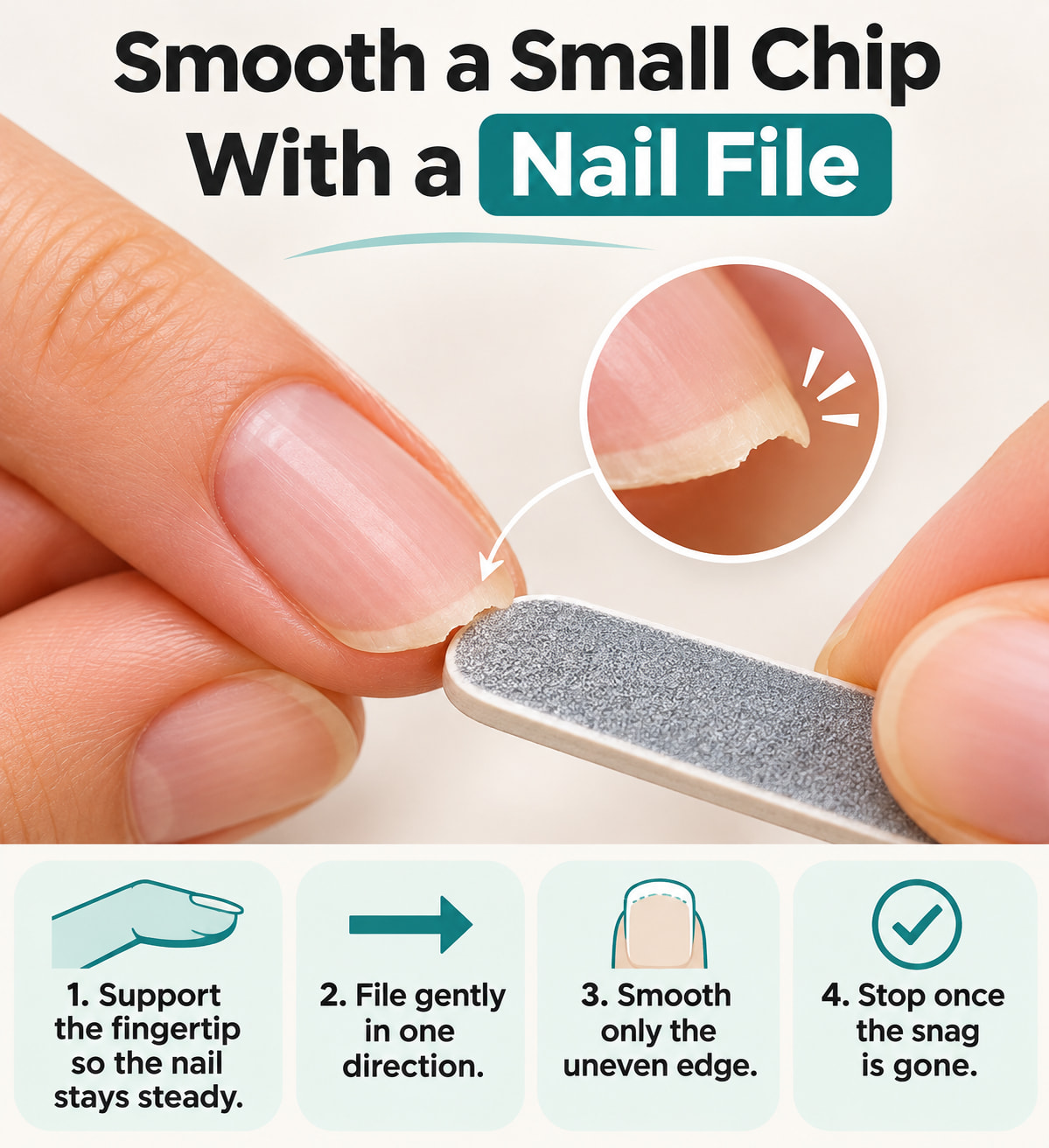
Best for: A shallow chip or uneven corner that does not involve pain, bleeding, or lifting.
Use a nail file or emery board to remove the rough spot:
- Support the fingertip so the nail stays steady.
- File gently in one direction.
- Smooth only the uneven edge.
- Stop once the snag is gone.
Avoid aggressively buffing the nail’s surface to make a chip disappear. You only need to smooth the edge.
For example, a tiny corner that catches on a sweater may need a few gentle passes with a file. It usually does not require a patch or artificial covering.
2. Trim a Larger Break at the Free Edge
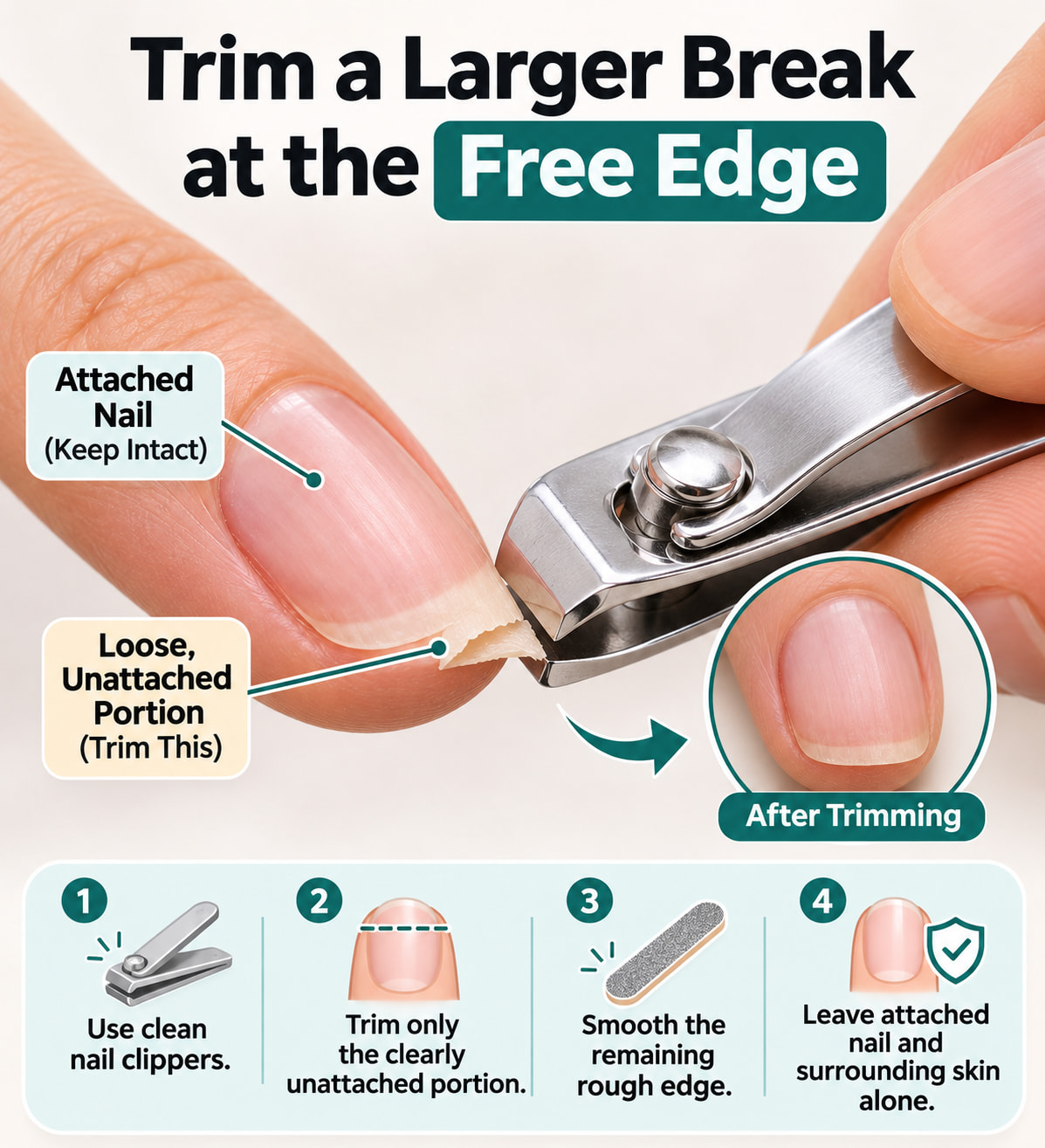
Best for: A longer broken tip that is completely beyond the attached part of the nail.
A loose tip can keep catching, so shortening it may be more practical than trying to preserve the length.
- Use clean nail clippers.
- Trim only the clearly unattached portion.
- Smooth the remaining rough edge with a file.
- Leave attached nail and surrounding skin alone.
Do not tug on the broken piece while cutting. Stop if clipping causes pain or the split extends into the attached area.
For fingernails, an almost straight cut with slightly rounded corners can reduce snagging. Toenails should be trimmed straight across rather than deeply rounded at the sides.
You do not need to make the nail perfectly even immediately. If reaching the bottom of the crack would mean cutting into attached tissue, protect it and get advice.
3. Consider a Labeled Repair Kit for a Minor Tip Crack
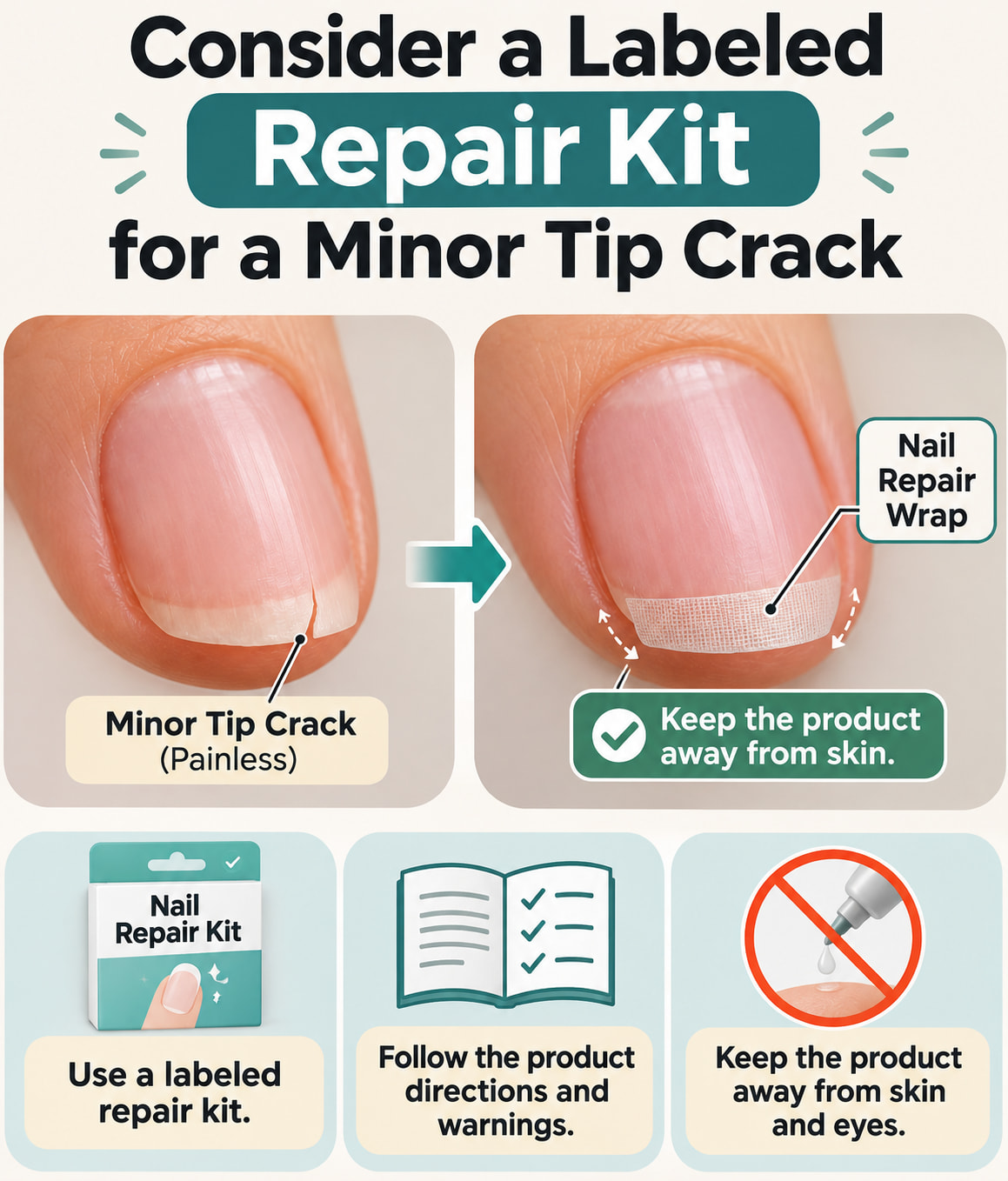
Best for: A small, painless crack limited to the overhanging tip, with no injury to the surrounding skin or nail bed.
Some cosmetic repair kits are designed to reinforce minor cracks temporarily. They may use a wrap, adhesive, or another coating. The correct application depends on the product.
Before using one:
- Confirm that its directions explicitly cover your type of crack.
- Read every warning, including restrictions on damaged nails.
- Use only the materials and application method specified.
- Keep the product away from skin and eyes.
- Follow its removal instructions rather than peeling the repair off.
If the label says not to use the product on damaged nails, or its instructions are unclear, skip it. A product advertised for nail repair can still have restrictions that rule out your situation.
The FDA’s nail-product guidance emphasizes following labels and warnings because nail products can cause irritation, allergic reactions, and other adverse effects.
Do not apply cosmetic glue to a painful or bleeding split, exposed skin, inflammation, or a nail lifting from its bed. A cosmetic patch provides temporary support; the damaged portion still needs to grow out.
4. Protect a Deep Split or Partially Detached Nail
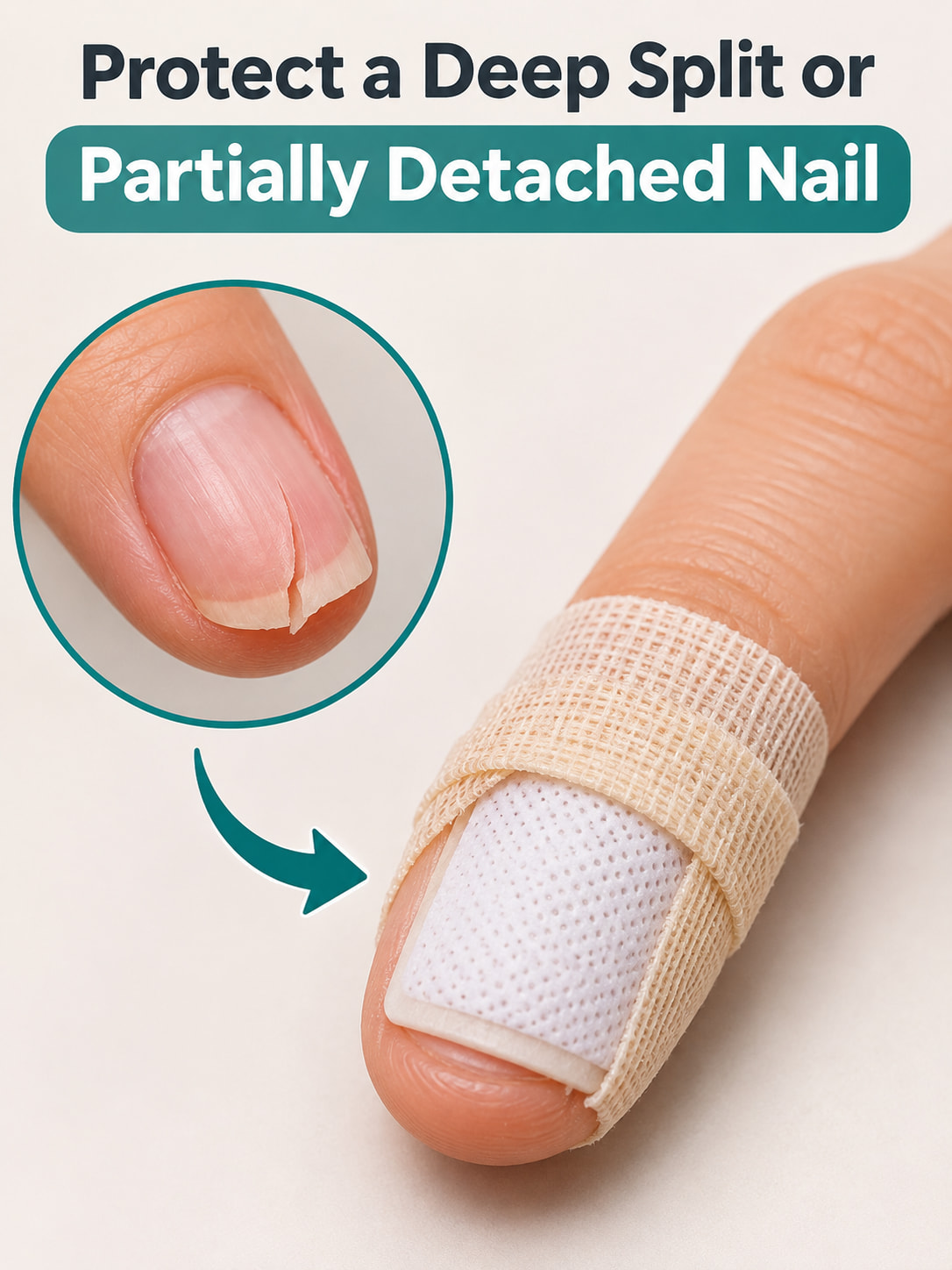
Best for: A break that reaches the attached area or involves injured skin.
A deep split or substantial detachment needs medical assessment. Until you can get help, focus on protecting the area:
- Gently clean it with soap and water.
- For a small wound once bleeding has stopped, apply a thin layer of petroleum jelly.
- Cover it with a nonstick dressing.
- Place adhesive on the surrounding skin, avoiding the injured nail.
- Replace the dressing daily and whenever it becomes wet or dirty.
Leave any attached portion in place. Avoid clipping into tender tissue, forcing the nail flat, or sealing the injury with glue.
For a low side split that cannot be shortened comfortably, a light protective dressing can reduce catching while you arrange advice. Keep it loose enough to avoid pressure.
5. Get Help With a Broken Gel or Acrylic Nail
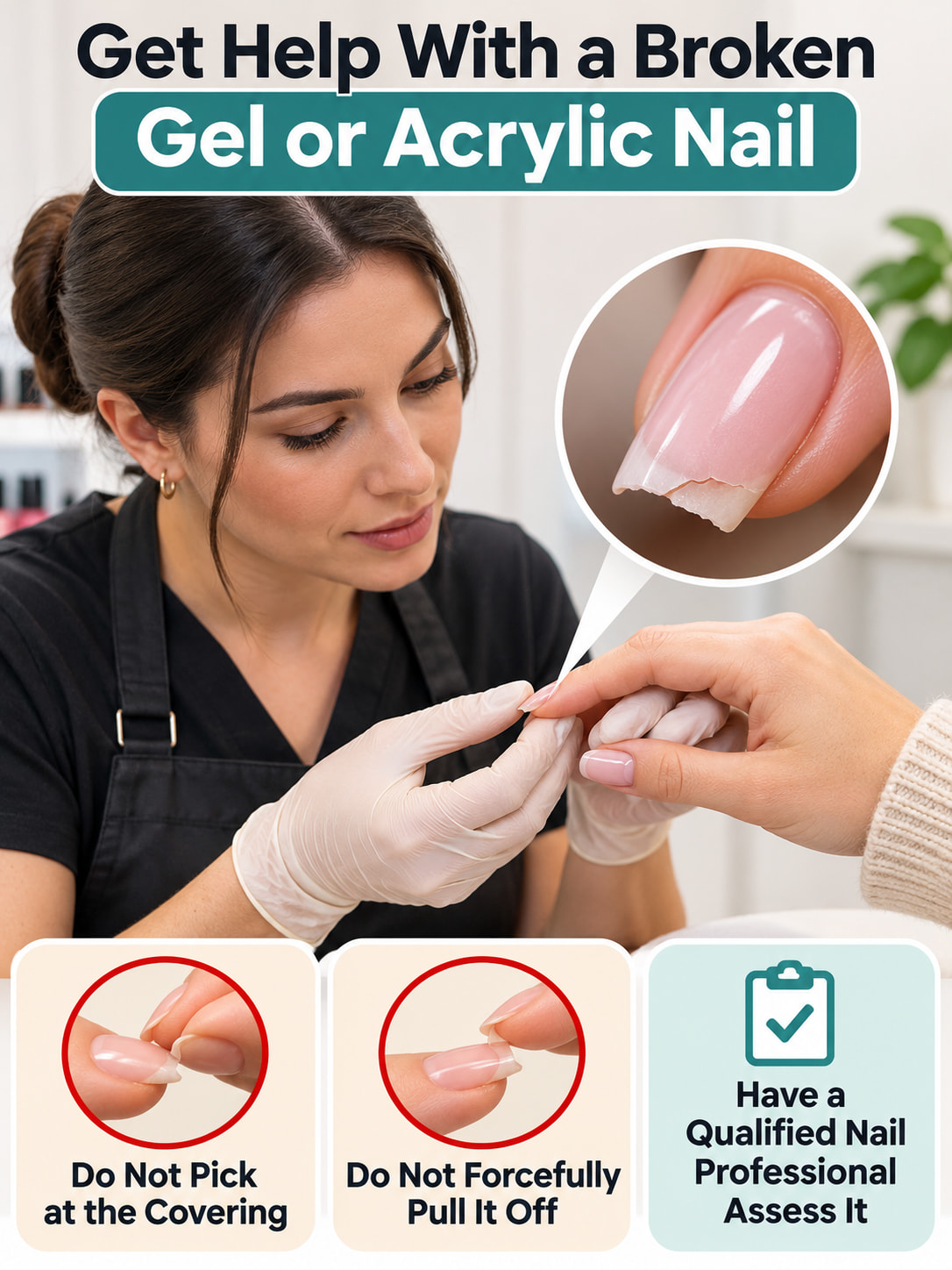
Best for: A damaged coating or extension when the natural nail underneath is comfortable and firmly attached.
Avoid picking, prying, or forcefully pulling off the covering. Do not use the extension as a handle to test whether the natural nail is loose.
A qualified nail professional can assess whether the product needs careful removal or a cosmetic repair. The appropriate method depends on the type of covering.
If the natural nail is torn, bleeding, painful, or lifting, seek medical care before having more product applied. A clinician can advise what to do with the remaining covering.
AAD guidance on artificial nails warns that covering damaged natural nails can worsen existing problems. A fresh acrylic layer or press-on nail should not be used to hide an injury.
Can You Fix a Broken Nail With a Tea Bag or Nail Glue?
Tea-bag patches are often described as a way to reinforce a small crack. However, descriptions of the method do not establish that it is appropriate for an injured nail.
There is also a material-safety concern. Many nail glues contain cyanoacrylate, which can release substantial heat when it contacts certain fibers. An ANSES safety bulletin, published in March 2021, documents burns associated with nail glue contacting cotton or wool clothing.
This does not mean every tea-bag patch will cause a burn. It does mean that improvised glue-and-fiber combinations deserve caution.
Keep liquid nail glue away from clothing and cotton pads. Do not use household superglue or a tea-bag patch to close a wound. For a minor cosmetic crack, follow the restrictions of a purpose-made repair product.
How Long Does a Broken Nail Take to Grow Out?
A small chip near the tip does not require the whole nail to be replaced. How soon you can trim away the damage depends on its location and your nail’s growth.
Complete nail replacement takes considerably longer:
| Nail | Approximate time for full replacement |
|---|---|
| Fingernail | About 4–6 months |
| Toenail | About 12 months, sometimes up to 18 months |
MedlinePlus nail-injury guidance, reviewed October, 2025, gives a fingernail estimate of four to six months and a toenail estimate of about 12 months. NHS guidance notes that toenails can take up to 18 months.
A section that has detached from the nail bed will not reattach. New growth must replace it. Significant injuries can also affect how the replacement nail looks, so ongoing changes deserve assessment.
How to Prevent Your Nails From Breaking
A few everyday habits can reduce avoidable damage:
- Keep nails manageable in length. Smooth snags before they catch.
- Use tools instead of your nails. Avoid prying open lids or scraping labels with them.
- Wear gloves for wet work. Repeated water and cleaning-product exposure can contribute to splitting.
- Moisturize after handwashing. Apply hand cream to nails and surrounding skin.
- Avoid biting and picking. Leave cuticles intact.
- Take care with manicures. Avoid peeling off coatings or repeatedly covering damaged nails.
These habits align with AAD’s healthy-nail recommendations, updated February, 2025.
If nails keep breaking, particularly with pain, thickening, discoloration, or lifting, arrange an assessment. Repeated breakage does not automatically mean you need a supplement.
Frequently Asked Questions
Can a broken nail grow back together?
A cosmetic patch can hold a crack temporarily, but the damaged nail still needs to grow out. If part of the nail has separated from the nail bed, that detached section will not reattach.
How can I fix a broken nail without glue?
File a small snag or trim a break limited to the free edge. If the split extends too low to trim comfortably, protect it with a light dressing. Pain, bleeding, or lifting calls for assessment rather than a cosmetic repair.
Can I fix a broken nail without cutting it?
Sometimes a tiny chip can be smoothed with a file. A suitable labeled repair product may temporarily support a minor tip crack. Do not preserve length by gluing a painful split or covering injured skin.
What should I do if my nail breaks at the side?
Check whether the crack is entirely beyond the fingertip. A loose free-edge piece may be shortened and smoothed. If the split reaches the attached area, avoid cutting deeper; protect it and seek advice if there is pain, bleeding, or lifting.
Can I put a press-on nail over a broken natural nail?
Avoid using a press-on nail to cover a painful, inflamed, bleeding, or lifting nail. Artificial coverings can worsen existing damage. Have the natural nail assessed before adding another covering if you are unsure how deep the break goes.
Why do my nails keep splitting?
Repeated wet work, cleaning products, biting, picking, and manicure-related damage can contribute. Persistent splitting can also occur with nail or health conditions. Unexplained changes in shape, color, thickness, or attachment should be checked rather than assumed to be a nutrient deficiency.
Conclusion
The right way to fix a broken nail starts with its location and symptoms. Smooth a minor chip, carefully shorten an unattached broken tip, and use cosmetic repair products only when their labels clearly permit it.
Check your nail before reaching for glue. If it is painful, bleeding, or lifting, protect it and get appropriate medical advice.
This content is for informational purposes only and not medical advice.
References
- American Academy of Dermatology: Tips to care for an injured nail.
- American Academy of Dermatology: How to trim your nails.
- American Academy of Dermatology: 11 dermatologists’ tips for healthy nails.
- MedlinePlus: Nail injuries.
- NHS: Nail problems.
- FDA: Nail Care Products.
- American Academy of Dermatology: Artificial nails—tips for reducing nail damage.