
Yes, creatine can be a useful and generally safe supplement for many women, especially if your goal is to improve strength, power, or repeated high-intensity exercise performance. The best evidence is for lifting, sprinting, and training adaptations over time, not long steady-state endurance work.
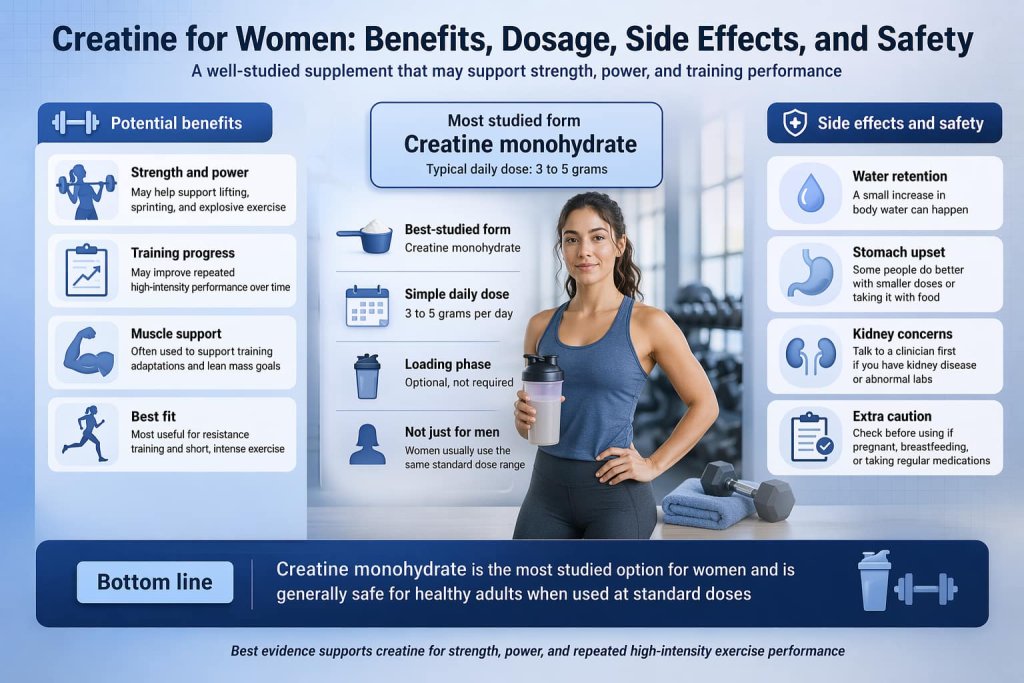
For most adult women, the standard dose is the same as for men, and the most studied form is creatine monohydrate. The NIH Office of Dietary Supplements also notes that women have historically been underrepresented in supplement research, so it is worth understanding what the evidence actually says before you start.
What creatine does in the body
Creatine helps your muscles make energy for short, hard efforts. That is why it tends to help most with activities such as weight training, sprinting, jumping, and sports that involve repeated bursts of effort with short recovery periods. NIH says creatine enhances performance during repeated short bursts of high-intensity, intermittent activity and is of little value for endurance sports that depend less on the ATP-creatine phosphate system.
In plain terms, creatine is not a “women’s supplement” or a “men’s supplement.” It is a well-studied performance supplement that can help women train harder and recover between hard efforts more effectively, particularly when it is paired with a structured resistance-training program.
Benefits of creatine for women
Strength, power, and training performance
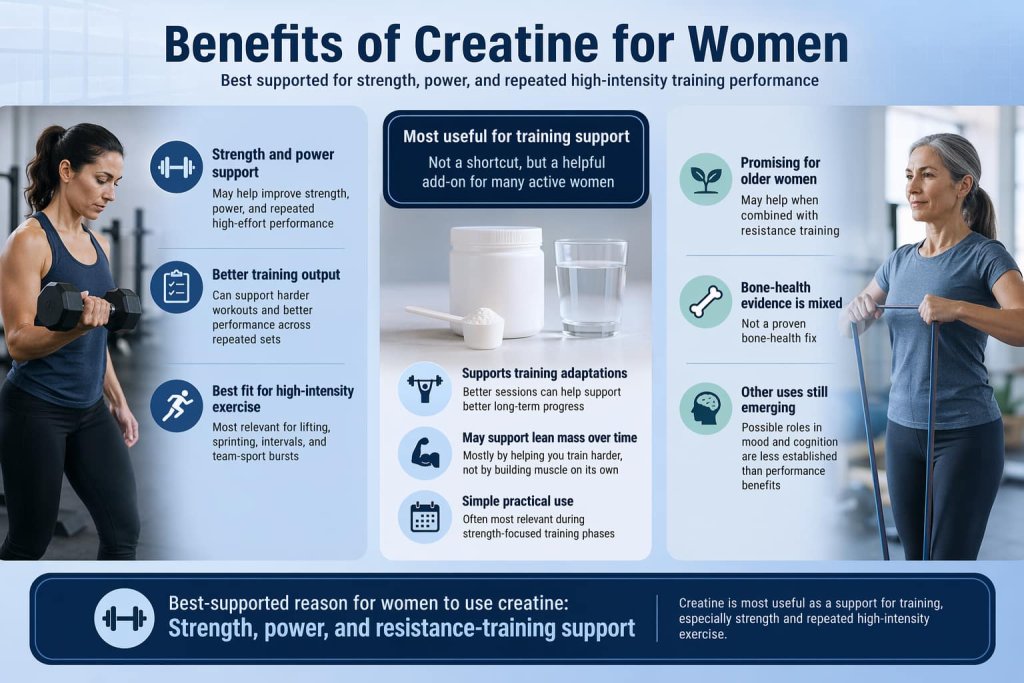
The clearest benefit of creatine for women is better performance in strength and power-focused training. NIH reports that short-term creatine use in both men and women often increases strength, power, work across repeated maximal-effort sets, and performance in activities like sprinting and soccer. Over weeks and months, it can also support better adaptation to harder training.
That matters because better training sessions usually lead to better long-term results. In one randomized study NIH cites, female collegiate soccer players who used creatine during offseason training had greater gains in bench-press and full-squat strength than the placebo group. A 2021 review on women’s health also concluded that creatine supplementation in premenopausal females appears effective for improving strength and exercise performance.
Creatine may also support lean mass gains over time
Creatine does not directly build muscle on its own, but it can support increases in lean mass over time by helping you train harder and maintain better output across sets. In practice, that means some women may see better progress from a well-designed lifting program when creatine is added consistently. This is one reason creatine is often used during strength-focused training phases rather than as a general wellness supplement.
It is especially relevant for women who lift or do repeated high-intensity exercise
If you do resistance training, CrossFit-style workouts, sprint work, intervals, or team sports with repeated bursts, creatine makes more sense than it does for long-distance cardio alone. The 2023 female athlete position statement described creatine as one of the most efficacious supplements for female athletes and recommended 3 to 5 g per day for mechanistic support of performance and training.
Menopause and healthy aging: promising, but not simple
Creatine may also be relevant for older women, especially when combined with resistance training, but the evidence is more mixed here than many supplement ads suggest. A 2015 trial in postmenopausal women found that creatine plus resistance training helped preserve femoral neck bone mineral density, while a 2023 two-year randomized trial found no effect on bone mineral density overall but did find improvements in some measures of proximal femur bone geometry. That means creatine is not a proven bone-health fix, but it may still have a role in muscle and some bone-related outcomes as part of a broader training plan.
Other women’s health uses are still emerging
Reviews have also discussed possible roles for creatine in cognition, mood, and broader women’s health across the lifespan. But those uses are still less established than the exercise and training data. At this point, the strongest reason for most women to take creatine is still physical performance and support for resistance training.
Creatine dosage for women
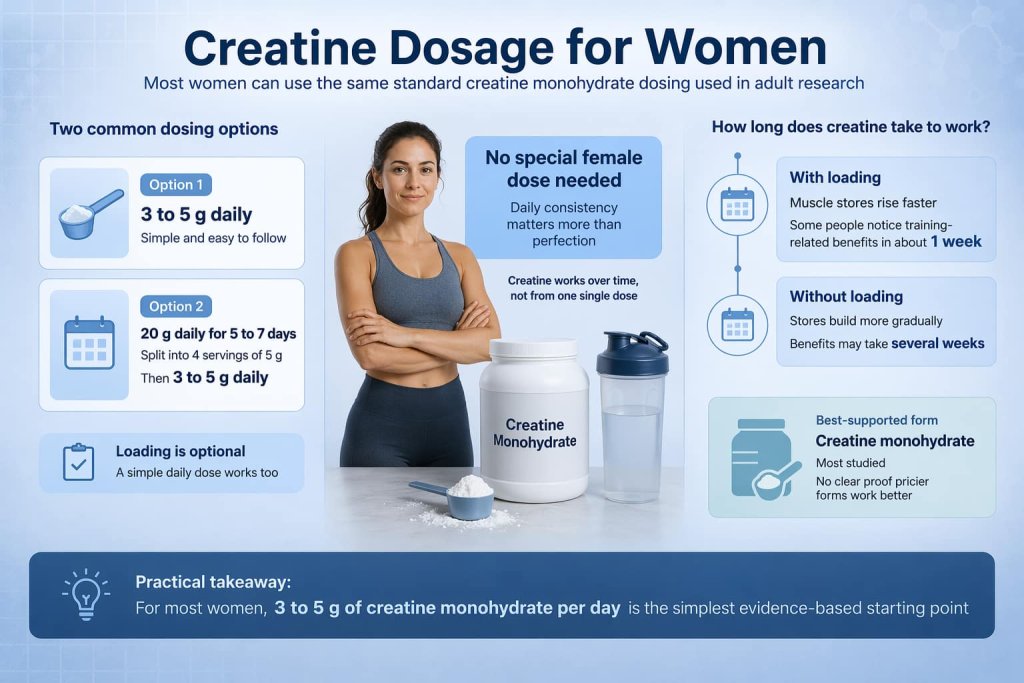
Women do not appear to need a special creatine dose. NIH says a typical adult protocol, regardless of sex or body size, is a loading phase of 20 g per day for 5 to 7 days split into four 5 g servings, followed by 3 to 5 g per day for maintenance. Another accepted option is to skip loading and take 3 to 6 g per day for 3 to 4 weeks, which also raises muscle creatine stores more gradually.
For most women, the simplest approach is:
- Option 1: 3 to 5 g of creatine monohydrate every day
- Option 2: 20 g per day for 5 to 7 days, then 3 to 5 g per day
The first option is easier for many people and avoids a large upfront loading phase. The second works faster.
How long creatine takes to work
How quickly creatine works depends on the dosing method you choose. With a loading phase, muscle stores usually rise faster, so some people notice training-related benefits within about a week. Without loading, the same benefits may take several weeks to show up because muscle creatine levels increase more gradually. Either way, the key factor is daily consistency rather than expecting an immediate effect after a single dose.
NIH also notes that creatine monohydrate is the most widely used and studied form, and that more expensive forms have not been proven superior for raising muscle creatine, improving digestibility, product stability, or safety. So if you are comparing products, a plain creatine monohydrate powder is usually the most evidence-based place to start.
Side effects of creatine for women
The most common side effect is weight gain from water retention. NIH says this is the one side effect that shows up most consistently, and some strength-training studies have found about a 1 to 2 kg increase in body weight over a month with creatine monohydrate. This does not automatically mean body fat gain. In many cases, it reflects increased water retention and the training context in which creatine is being used.
Other reported side effects include bloating or stomach discomfort, nausea, diarrhea, muscle cramps, stiffness, and heat intolerance. NIH describes many of these as anecdotal rather than a consistent pattern seen across all users, and Mayo Clinic also lists weight gain as a known side effect. Some women notice no side effects at all, while others feel better using a smaller daily dose instead of a loading phase.
If creatine upsets your stomach, a practical fix is to skip the loading phase, use a smaller daily dose, and take it with food or split it into smaller servings across the day. That will not make creatine ineffective. It simply makes the increase in muscle creatine stores more gradual, which some people find easier to tolerate.
If the scale goes up soon after you start creatine, do not assume the supplement is making you gain fat. Early scale changes are usually the part people notice first, but that is not the same thing as body-fat gain.
Is creatine safe for women?
For healthy adult women, the overall safety profile is reassuring
NIH says creatine is considered safe for short-term use in healthy adults, and it also cites evidence that use over several years is safe. Mayo Clinic similarly says creatine is likely safe for many people when taken by mouth at recommended doses for up to five years.
Women with kidney disease should be more careful
This is one of the most important caveats. Mayo Clinic says research on creatine use in people with kidney disease is limited and advises talking with your healthcare team before using it. That does not mean creatine is proven harmful for every person with kidney issues. It means this is not the group to self-prescribe casually.
Another practical point: creatine can complicate lab interpretation. Official NHS laboratory guidance notes that creatinine values vary with muscle mass and dietary intake, including creatine supplements, and creatinine is used to calculate eGFR and assess kidney function. If you use creatine, tell your clinician before bloodwork so your results are interpreted in context.
Pregnancy and breastfeeding need extra caution
For pregnancy, human evidence is still limited. Research reviews have raised interest in creatine’s possible role in maternal and fetal energy metabolism, but human use in pregnancy has not been fully evaluated and there is no clear consensus to recommend routine supplementation during pregnancy.
For breastfeeding, the guidance is more concrete. The LactMed creatine entry says creatine is a normal component of human milk, but milk levels after supplementation have not been measured in humans, and until more data are available it is probably best avoided during lactation unless prescribed by a healthcare professional.
Safety box
Talk with a healthcare professional before using creatine if you:
- are pregnant, trying to become pregnant, or breastfeeding
- have kidney disease or abnormal kidney-related lab results
- take prescription medicines and are not sure about supplement interactions
- want to use creatine alongside other performance supplements rather than as a single ingredient product
How to choose the best creatine for women
The best starting point is usually a single-ingredient creatine monohydrate product. NIH notes that many performance supplements contain multiple ingredients, and the effects and safety of those combinations are often unknown unless that exact combination has been studied. If all you want is creatine, a simple monohydrate product is easier to evaluate than a “muscle matrix,” “performance blend,” or stimulant-heavy pre-workout.
It is also smart to be realistic about supplement regulation. The FDA’s dietary supplements guidance explains that supplements do not go through premarket approval the way drugs do. Manufacturers are responsible for making sure their products are properly labeled and safe before marketing, and FDA generally acts after products reach the market.
Because of that, third-party certification matters. OPSS explains third-party certification as independent verification that a supplement’s contents and label match and that quality and manufacturing processes have been checked. It does not prove the product is effective or risk-free, but it does reduce some of the uncertainty around what is actually in the container.
Who may benefit most from creatine for women
Creatine may be especially relevant for women who have lower baseline creatine intake from food, including those who eat little or no meat or fish. Because dietary creatine intake can be lower in these groups, supplementation may be more noticeable for some people, especially when combined with resistance training.
Creatine is most likely to be worth considering if you are:
- doing resistance training and want better strength and training output
- doing sprint, interval, or team-sport training with repeated hard efforts
- in midlife or postmenopause and pairing supplementation with resistance training
- looking for a non-stimulant supplement with one of the strongest evidence bases in sports nutrition
It may be less useful if your main activity is long-duration endurance exercise and you do not want even a small increase in scale weight. NIH specifically notes that creatine has little value for endurance sports and that the associated weight gain can be a downside in some settings.
FAQ About Creatine for Women
Can women take creatine every day?
Yes. Daily use is the standard approach. NIH lists 3 to 5 g per day as a typical maintenance dose after loading, and 3 to 6 g per day without loading is also used in research.
When should women take creatine?
The most important factor is taking creatine consistently every day, not finding a perfect time of day. Some women prefer taking it after training, while others take it with a meal because that feels easier on the stomach. A routine you can stick with matters more than timing.
Will creatine make women bulky?
Not in the way this question is usually meant. Creatine can increase body weight from water retention, especially early on, but that is not the same as automatic fat gain. What it mainly does is support harder training and better high-intensity performance.
Is creatine monohydrate the best form for women?
Yes, it is the most evidence-based form. NIH says creatine monohydrate is the most widely used and studied version, and other forms have not been proven superior.
Should women take creatine while breastfeeding?
Not routinely. LactMed advises avoiding supplementation during lactation unless it is prescribed by a healthcare professional, because human milk levels after supplementation have not been measured and infant effects are not well studied.
The bottom line on creatine for women
Creatine for women is not hype, but it is also not magic. The best evidence shows it can help many women improve strength, power, and training quality, especially with resistance training and other repeated high-intensity exercise. The standard adult dose is usually the same regardless of sex, and plain creatine monohydrate is the form with the strongest support. If you are pregnant, breastfeeding, have kidney disease, or have unusual lab results, get personal medical guidance before using it.
If your goal is better gym performance, stronger training sessions, or more support for muscle-focused exercise, creatine is one of the few supplements that deserves a serious look. Choose a simple, third-party certified product, use an evidence-based dose, and keep your expectations grounded in what the research actually supports.
This content is for informational purposes only and not medical advice.
References
- Operation Supplement Safety — Why is Third-Party Certification Important for Dietary Supplements?
- Smith-Ryan et al. — Creatine Supplementation in Women’s Health: A Lifespan Perspective
- Sims et al. — Nutritional Concerns of the Female Athlete
- Chilibeck et al. — Effects of Creatine and Resistance Training on Bone Health in Postmenopausal Women
- Chilibeck et al. — A 2-yr Randomized Controlled Trial on Creatine Supplementation and Exercise in Postmenopausal Women
- Muccini et al. — Creatine Metabolism in Female Reproduction, Pregnancy and Newborn Health