
Normal progesterone levels depend on where you are in your menstrual cycle, whether you are pregnant, and whether you have reached menopause. Progesterone is usually low before ovulation, rises during the luteal phase, increases significantly throughout pregnancy, and becomes consistently low after menopause.
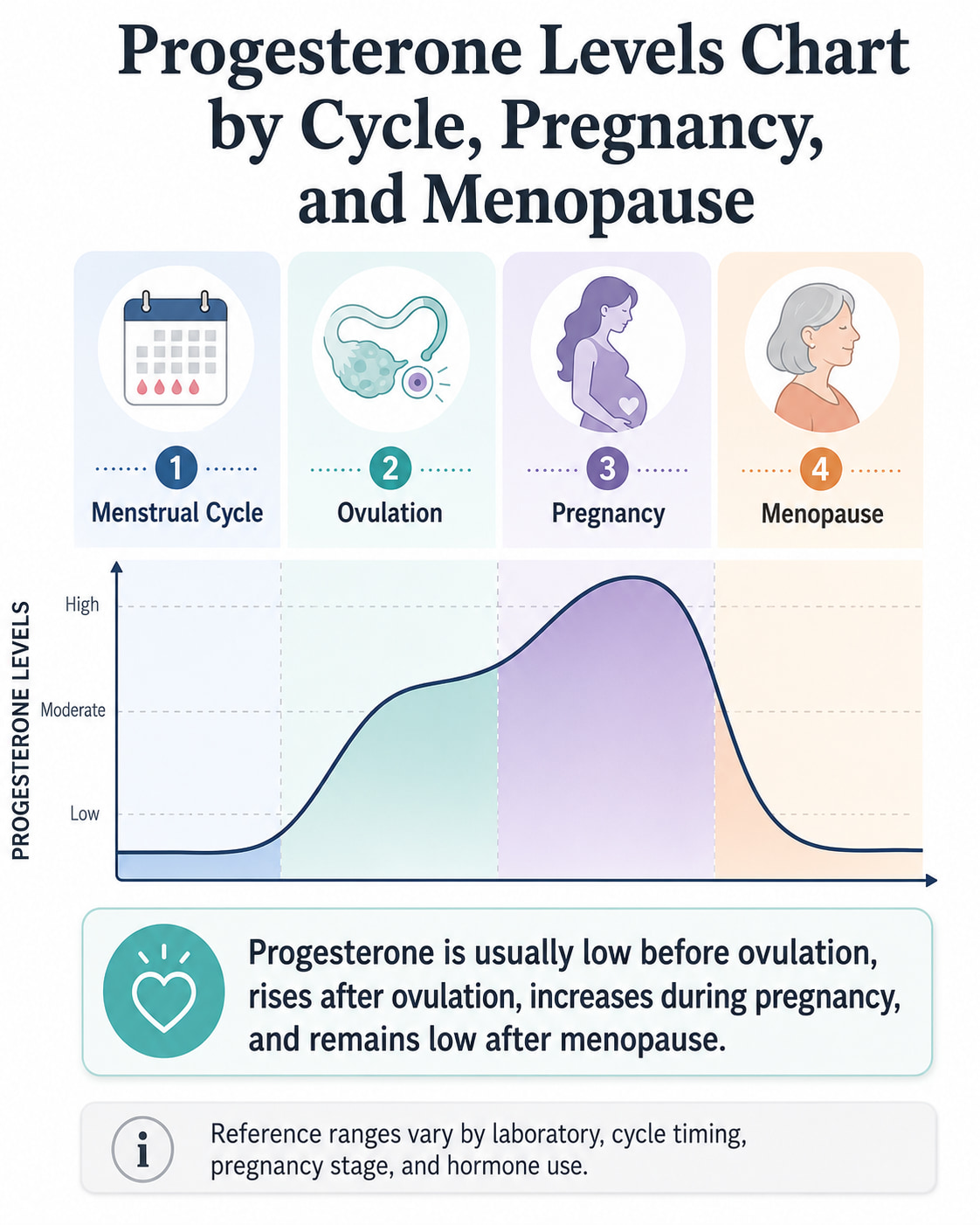
A progesterone levels chart can provide useful context, but it cannot diagnose infertility, miscarriage, menopause, or another medical condition by itself. Your result must be interpreted using the reference interval on your laboratory report, the timing of the test, your symptoms, and any hormones or fertility medicines you use.
Progesterone Levels Chart
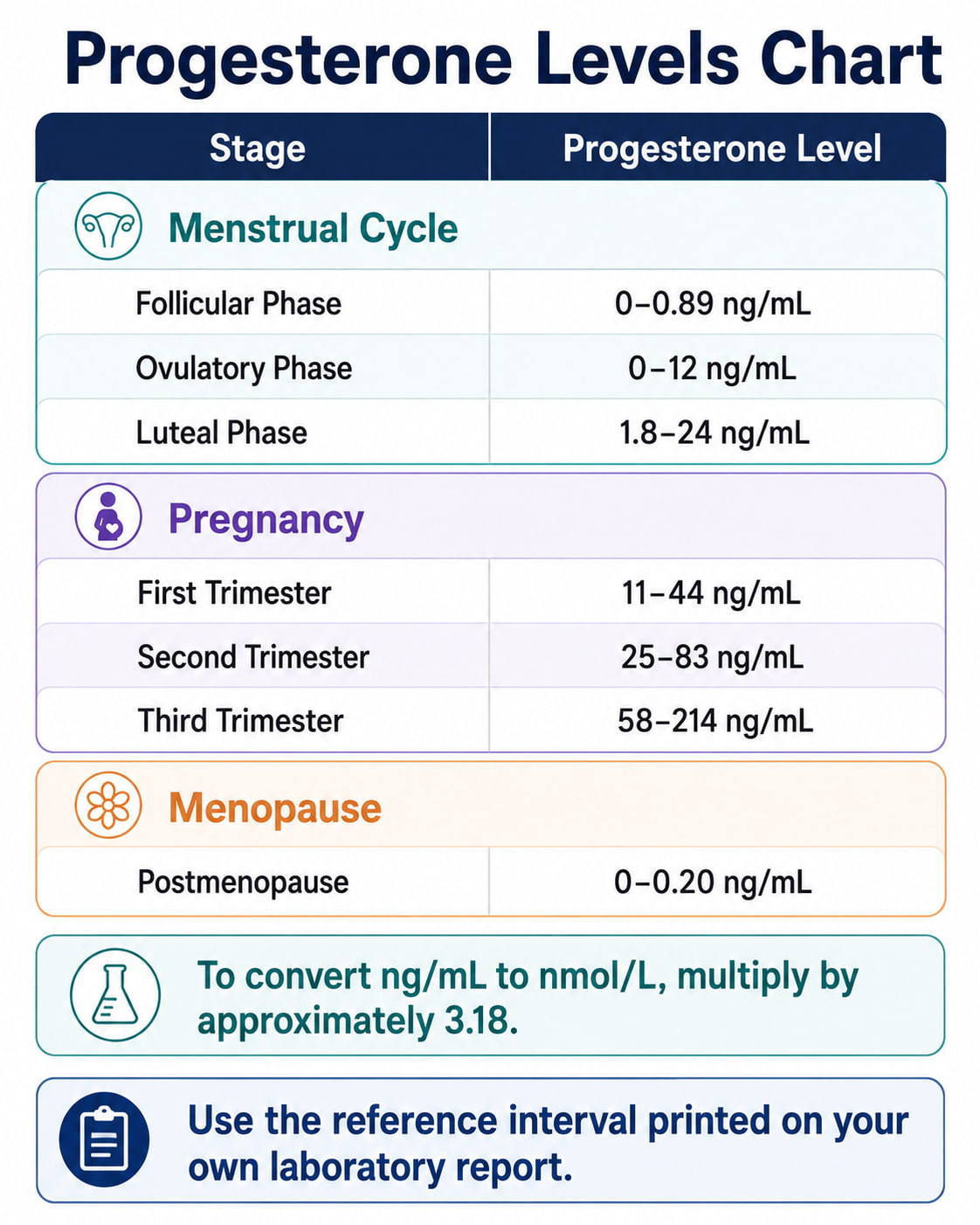
The chart below shows example adult serum progesterone reference intervals published by Mayo Clinic Laboratories. These are general laboratory ranges, not treatment targets or universal diagnostic cutoffs.
| Cycle or life stage | Progesterone in ng/mL | Progesterone in nmol/L |
|---|---|---|
| Follicular phase | 0–0.89 | 0–2.83 |
| Ovulatory phase | 0–12 | 0–38.16 |
| Luteal phase | 1.8–24 | 5.72–76.32 |
| Postmenopause | 0–0.20 | 0–0.64 |
| First trimester | 11–44 | 34.98–139.92 |
| Second trimester | 25–83 | 79.50–263.94 |
| Third trimester | 58–214 | 184.44–680.52 |
To convert progesterone from ng/mL to nmol/L, multiply by approximately 3.18.
These ranges overlap because progesterone does not rise and fall at the same time or rate in every person. Laboratory methods also differ, so the range printed beside your result should take priority over an online chart. Mayo Clinic Laboratories describes its adult reference intervals as ranges based on its healthy reference population.
What Is Progesterone?
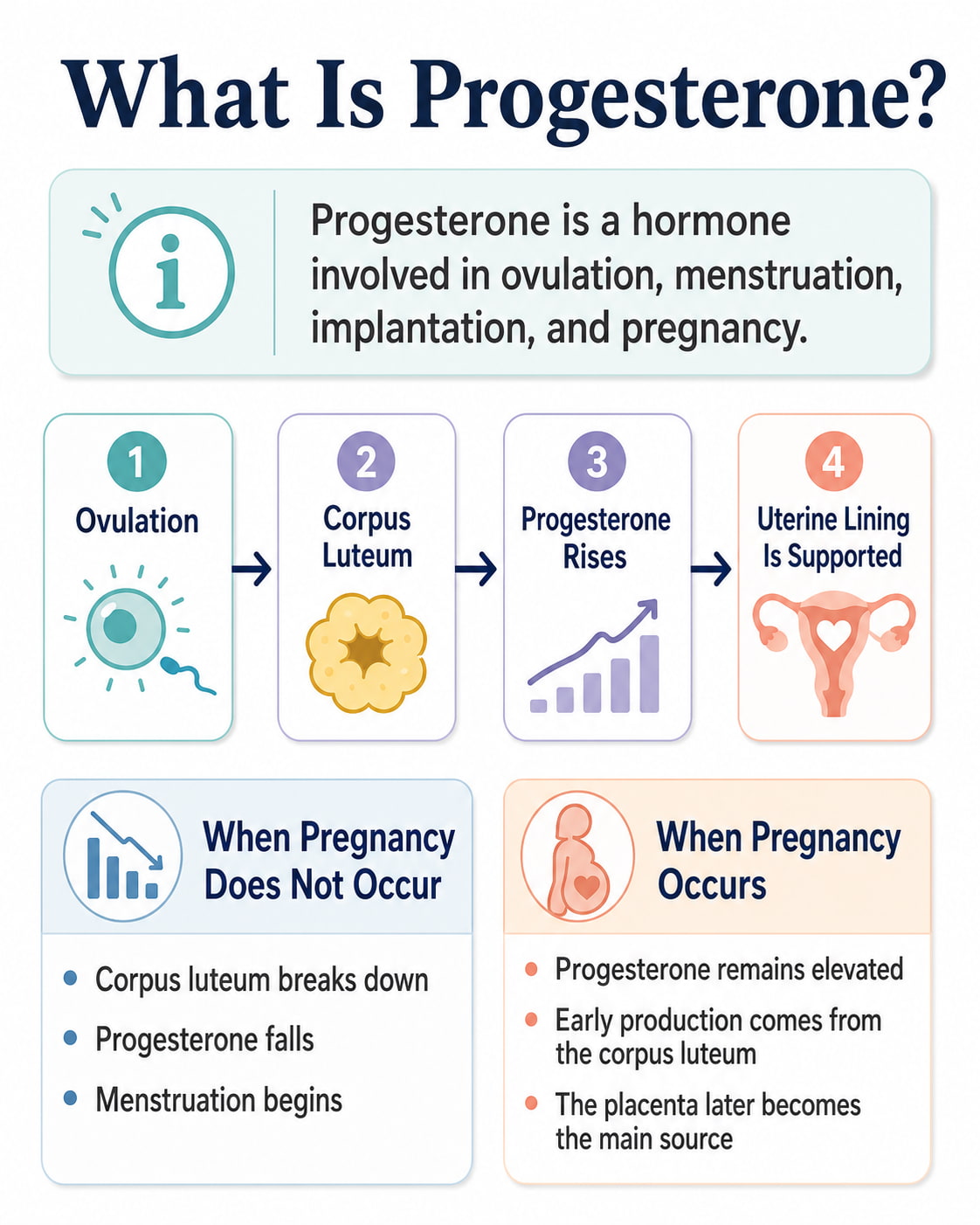
Progesterone is a hormone involved in ovulation, menstruation, implantation, and pregnancy.
After an ovary releases an egg, the emptied follicle becomes a temporary structure called the corpus luteum. The corpus luteum produces progesterone, which prepares the uterine lining for a fertilized egg.
When pregnancy does not occur, the corpus luteum breaks down. Progesterone falls, the uterine lining sheds, and the next menstrual period begins.
When pregnancy occurs, progesterone remains elevated. The corpus luteum supports progesterone production during early pregnancy, and the placenta becomes the main source by the end of the first trimester.
Progesterone Levels During the Menstrual Cycle
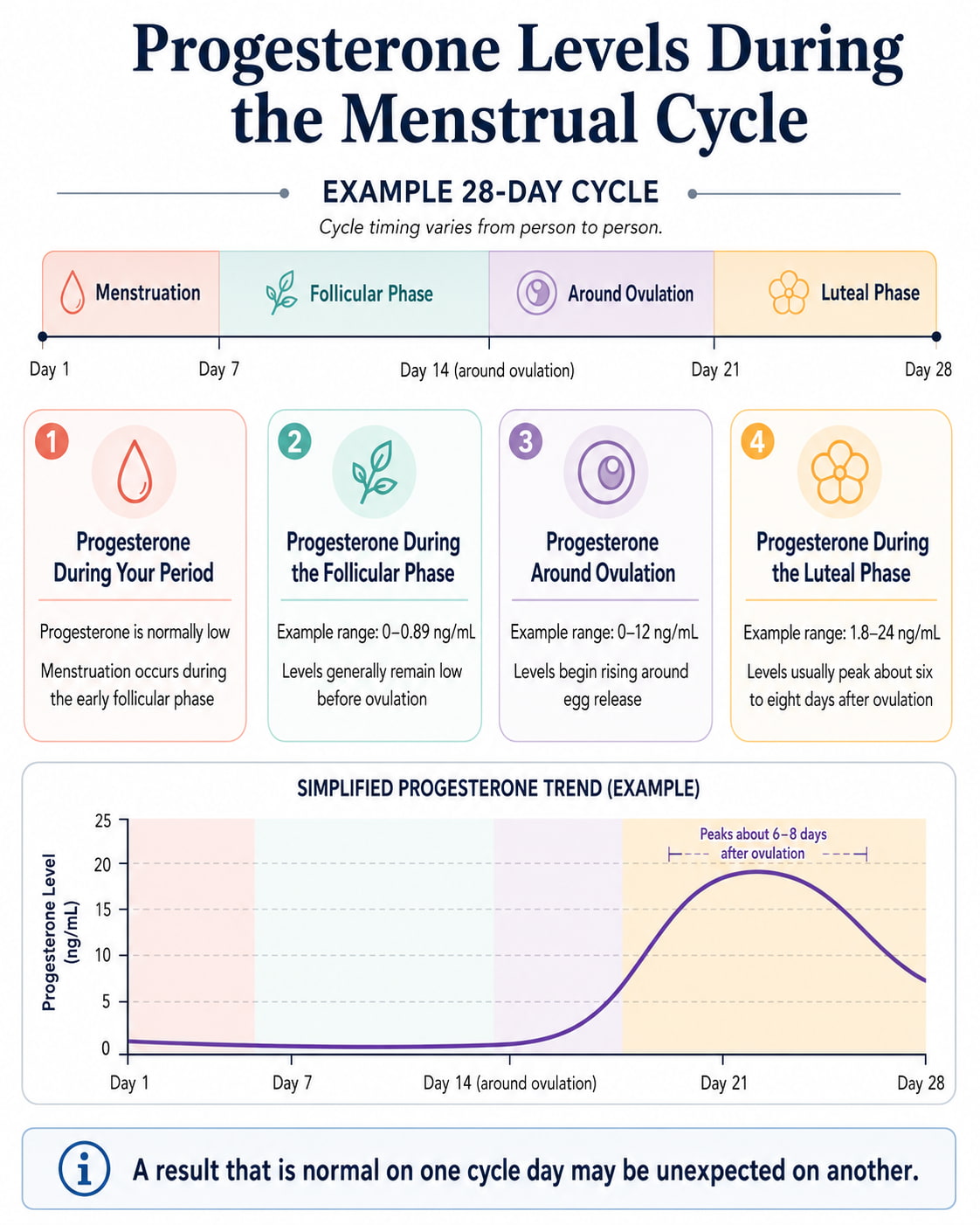
Progesterone changes significantly throughout a menstrual cycle. A result that is normal on one cycle day could be unexpected on another.
Progesterone During Your Period
Menstruation occurs during the early follicular phase. Progesterone is normally low because the corpus luteum from the previous cycle has broken down.
A level at or below approximately 0.89 ng/mL may fall within the follicular reference range used by Mayo Clinic Laboratories. A low result during menstruation is therefore usually expected and does not automatically indicate a hormone problem.
Progesterone During the Follicular Phase
The follicular phase begins on the first day of menstruation and continues until ovulation. Developing ovarian follicles mainly produce estrogen during this stage, while circulating progesterone remains relatively low.
Example follicular-phase range: 0–0.89 ng/mL
The length of the follicular phase can vary considerably. This is one reason ovulation does not always occur on cycle day 14.
Progesterone Around Ovulation
Progesterone begins to rise around the time an egg is released. However, the laboratory reference interval for the ovulatory phase is broad:
Example ovulatory-phase range: 0–12 ng/mL
Because this range overlaps with both follicular and luteal levels, a test taken on the suspected day of ovulation may not clearly confirm what happened. Progesterone is generally more useful when measured several days after suspected ovulation.
Progesterone During the Luteal Phase
The luteal phase begins after ovulation and ends when the next period starts. Progesterone rises as the corpus luteum becomes active and normally reaches its highest level approximately six to eight days after ovulation.
Example luteal-phase range: 1.8–24 ng/mL
The American Society for Reproductive Medicine notes that a luteal phase commonly lasts about 14 days, although a range of approximately 11–17 days can occur.
What Progesterone Level Confirms Ovulation?
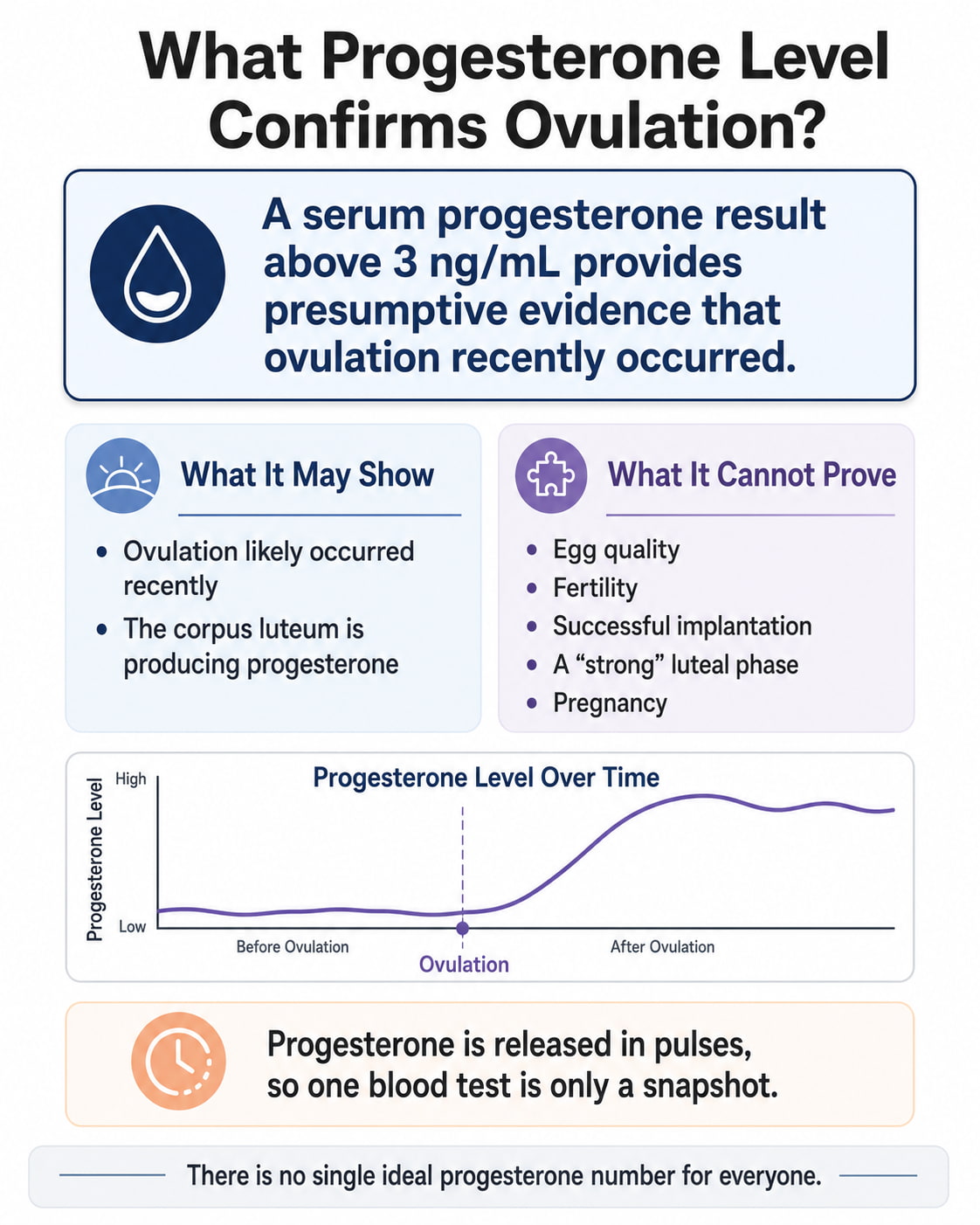
A serum progesterone result above 3 ng/mL provides presumptive evidence that ovulation recently occurred.
This threshold comes from the American Society for Reproductive Medicine. It can help confirm that an egg was likely released, but it does not measure egg quality, prove fertility, or confirm that the uterine lining is suitable for implantation.
There is no single minimum progesterone number that defines a “good,” “strong,” or fertile luteal phase. Progesterone is released in pulses and may fluctuate substantially over several hours. ASRM reports that values can vary sevenfold within a short period, making one blood draw a limited snapshot.
For example, a result below 10 ng/mL does not always mean that ovulation failed. The test may have been taken too early, too late, or between natural progesterone pulses.
When Should Progesterone Be Tested?
For ovulation assessment, progesterone should generally be tested about seven days before your next expected period.
The test is often called a “day-21 progesterone test,” but day 21 is appropriate mainly for someone with a predictable 28-day cycle who ovulates near day 14.
A more practical schedule may look like this:
| Typical cycle length | Approximate testing day |
|---|---|
| 24 days | Day 17 |
| 28 days | Day 21 |
| 30 days | Day 23 |
| 32 days | Day 25 |
| 35 days | Day 28 |
This schedule is only an estimate. When cycles are irregular, a clinician may use ovulation predictor results, ultrasound findings, cycle history, or repeated testing to choose the best date.
ASRM recommends timing the blood test according to the expected next period rather than automatically using the same cycle day for everyone.
Progesterone Levels Chart During Pregnancy
Progesterone normally increases during pregnancy, but healthy values vary widely. Trimester-based ranges are more useful than trying to match one exact number for every week.
| Pregnancy stage | Example progesterone range |
|---|---|
| First trimester | 11–44 ng/mL |
| Second trimester | 25–83 ng/mL |
| Third trimester | 58–214 ng/mL |
These ranges are based on Mayo Clinic Laboratories’ serum reference intervals. Your own laboratory may provide a wider or narrower range.
First-Trimester Progesterone Levels
During early pregnancy, human chorionic gonadotropin, or hCG, helps maintain the corpus luteum so it continues producing progesterone. The placenta gradually takes over progesterone production by the end of the first trimester.
Example first-trimester range: 11–44 ng/mL
A result outside this range does not independently confirm a pregnancy problem. Gestational age, symptoms, ultrasound findings, hCG patterns, test timing, and progesterone supplementation all affect interpretation.
Second-Trimester Progesterone Levels
The placenta is the main source of progesterone during the second trimester.
Example second-trimester range: 25–83 ng/mL
The lower end overlaps with first-trimester values, while the upper end overlaps with third-trimester values. This overlap is expected and shows why one number should not be evaluated without clinical context.
Third-Trimester Progesterone Levels
Progesterone generally reaches its highest levels during the third trimester.
Example third-trimester range: 58–214 ng/mL
A high result during pregnancy is not automatically harmful. The expected level depends on gestational age, the number of fetuses, hormone use, and the laboratory method.
Can Progesterone Confirm a Healthy Pregnancy?
A progesterone result alone cannot prove that a pregnancy is viable or confirm that it is located inside the uterus.
Low progesterone may be associated with miscarriage or ectopic pregnancy, but it does not establish the diagnosis or show whether low progesterone caused the problem. Some viable pregnancies have relatively low measurements, while some nonviable pregnancies initially have higher values.
The National Institute for Health and Care Excellence updated its ectopic pregnancy and miscarriage guideline on June, 2026. It advises against using serum progesterone alongside serial hCG measurements to diagnose either a viable intrauterine pregnancy or an ectopic pregnancy when the pregnancy location is unknown. Ultrasound, symptoms, clinical evaluation, and appropriately timed hCG testing are more informative in this situation.
Repeated progesterone testing may still be used in selected situations, including fertility treatment or high-risk pregnancy monitoring. The meaning depends on why the test was ordered. MedlinePlus notes that repeated measurements may be necessary because levels change throughout pregnancy and the menstrual cycle.
Progesterone Levels During Perimenopause
Perimenopause is the transition leading up to menopause. Ovulation becomes less predictable during this time.
Progesterone may rise during a cycle in which ovulation occurs but remain very low during a cycle without ovulation. Therefore, there is no single stable progesterone range that confirms perimenopause.
Possible changes during this transition include:
- Shorter or longer menstrual cycles
- Missed periods
- Heavier or lighter bleeding
- Hot flashes
- Night sweats
- Sleep changes
- Vaginal dryness
These symptoms have many possible causes. A single progesterone test should not be used to self-diagnose perimenopause.
Progesterone Levels After Menopause
After menopause, the ovaries no longer ovulate regularly, so progesterone remains consistently low.
Example postmenopausal progesterone range: 0–0.20 ng/mL
Natural menopause is generally recognized after 12 consecutive months without menstruation when there is no other biological, medical, or physiological explanation.
Progesterone testing is not normally required to diagnose menopause. NICE advises against routinely using laboratory hormone tests to identify perimenopause or menopause in people age 45 or older when their symptoms and menstrual history are consistent with the transition.
Different evaluation may be appropriate when periods stop before age 45, symptoms are unusual, or the person has had a hysterectomy, uses hormonal contraception, or takes menopausal hormone therapy.
What Does Low Progesterone Mean?
A progesterone result may appear low simply because the test was taken during the follicular phase or at the wrong time after ovulation.
Depending on the situation, lower-than-expected progesterone may be associated with:
- Testing before ovulation
- Delayed ovulation
- A cycle without ovulation
- Irregular ovulation
- Polycystic ovary syndrome
- Amenorrhea, or absent periods
- Perimenopause
- Reduced ovarian function
- Certain pregnancy complications
During pregnancy, low progesterone may occur with miscarriage or ectopic pregnancy, but the number alone cannot diagnose either condition. MedlinePlus recommends interpreting the result according to cycle timing, pregnancy status, symptoms, and the reason for testing.
What Does High Progesterone Mean?
Higher progesterone is normally expected:
- After ovulation
- During pregnancy
- During prescribed progesterone therapy
- During some fertility-treatment cycles
Outside these situations, a higher-than-expected result may occasionally be associated with an ovarian cyst, an adrenal gland disorder, a molar pregnancy, or another uncommon condition.
One high result does not confirm any of these conditions. The clinician may consider pregnancy status, medicines, cycle timing, symptoms, and additional laboratory or imaging results.
Factors That Can Affect a Progesterone Test
Several factors may change the number or make a standard progesterone chart less applicable.
Test Timing
Testing before the post-ovulation rise or after progesterone has started falling may produce a lower result than expected.
Natural Hormone Pulses
Progesterone is not released at a steady rate. A measurement taken a few hours later may be significantly different, even during a normally ovulatory cycle.
Hormonal Medicines
Progesterone supplements, menopausal hormone therapy, hormonal contraception, and fertility medicines can affect test results. Always tell the ordering clinician what you take and how it is administered.
Laboratory Method
Different laboratories use different testing systems and reference populations. Compare the number with the range printed on the same report rather than a range from another laboratory.
Pregnancy Timing
Progesterone generally rises as pregnancy progresses. A result cannot be interpreted accurately without knowing the estimated gestational age.
How to Read Your Progesterone Test Result
Use these five questions when reviewing the result:
- Why was the test ordered?
Ovulation confirmation, abnormal bleeding, fertility treatment, and pregnancy monitoring require different interpretations. - When was the blood drawn?
Record the cycle day, estimated ovulation day, first day of the last period, or gestational age. - What range appears on the report?
Use the testing laboratory’s own reference interval. - Are you using hormones?
Progesterone, fertility medicines, contraception, and menopausal hormone therapy can change the result. - Is this one result or part of a pattern?
Repeated hormone tests, hCG measurements, ultrasound, symptoms, and menstrual history may provide more useful information than one isolated number.
Do not stop prescribed progesterone or another hormone based only on an online chart. MedlinePlus advises patients not to discontinue medicines unless their healthcare professional instructs them to do so.
When to Contact a Healthcare Professional
Arrange a medical evaluation when you have:
- Persistently irregular or absent periods
- Difficulty becoming pregnant
- Unexpected uterine bleeding
- A progesterone result that does not match the laboratory range
- Questions about progesterone prescribed during fertility treatment or pregnancy
- Menopause-like symptoms before age 45
During pregnancy, contact a healthcare professional promptly for bleeding, persistent cramping, or pelvic pain.
Seek emergency medical care for severe abdominal or pelvic pain with bleeding, shoulder pain, extreme lightheadedness, or fainting. These can be warning signs of an ectopic pregnancy or internal bleeding and require urgent assessment.
Frequently Asked Questions
What is a normal progesterone level?
A normal level depends on cycle phase and pregnancy status. An example range is up to 0.89 ng/mL during the follicular phase, 1.8–24 ng/mL during the luteal phase, and 11–214 ng/mL across the three pregnancy trimesters. Always use your laboratory’s reference range.
Is a progesterone level above 3 ng/mL good?
A result above 3 ng/mL provides presumptive evidence that ovulation recently occurred. It does not prove fertility, successful implantation, or adequate luteal-phase function.
Is 10 ng/mL a good progesterone level?
A result of 10 ng/mL may fit within a normal luteal-phase range, but there is no universal “ideal” number. Test timing and natural hormone fluctuations matter. One result should not be used alone to rate ovulation quality.
What should progesterone be on day 21?
There is no single number that applies to everyone on day 21. Testing on day 21 is most relevant for a 28-day cycle with ovulation near day 14. For longer or shorter cycles, test approximately seven days before the expected next period.
Does low progesterone always mean miscarriage?
No. A low result can occur because of incorrect test timing, natural fluctuations, inaccurate pregnancy dating, or other factors. Miscarriage cannot be diagnosed from one progesterone measurement alone.
What is a normal progesterone level after menopause?
Mayo Clinic Laboratories lists a postmenopausal reference value of up to 0.20 ng/mL. People taking hormone therapy may have different results.
Can progesterone levels confirm pregnancy?
No. Pregnancy is usually confirmed by detecting hCG in urine or blood. Progesterone may provide additional clinical information, but it cannot independently confirm pregnancy viability or location.
Conclusion
A progesterone levels chart is most useful when it is matched to the correct menstrual-cycle phase, pregnancy trimester, or menopausal stage. Progesterone is normally low before ovulation, rises after ovulation, increases throughout pregnancy, and remains low after menopause.
Do not judge your result by one universal target. Check the reference interval on your laboratory report, confirm when the sample was taken, and discuss unexpected values with a qualified healthcare professional—especially when pregnancy symptoms, irregular cycles, fertility concerns, or hormone medicines are involved.
This content is for informational purposes only and not medical advice.