
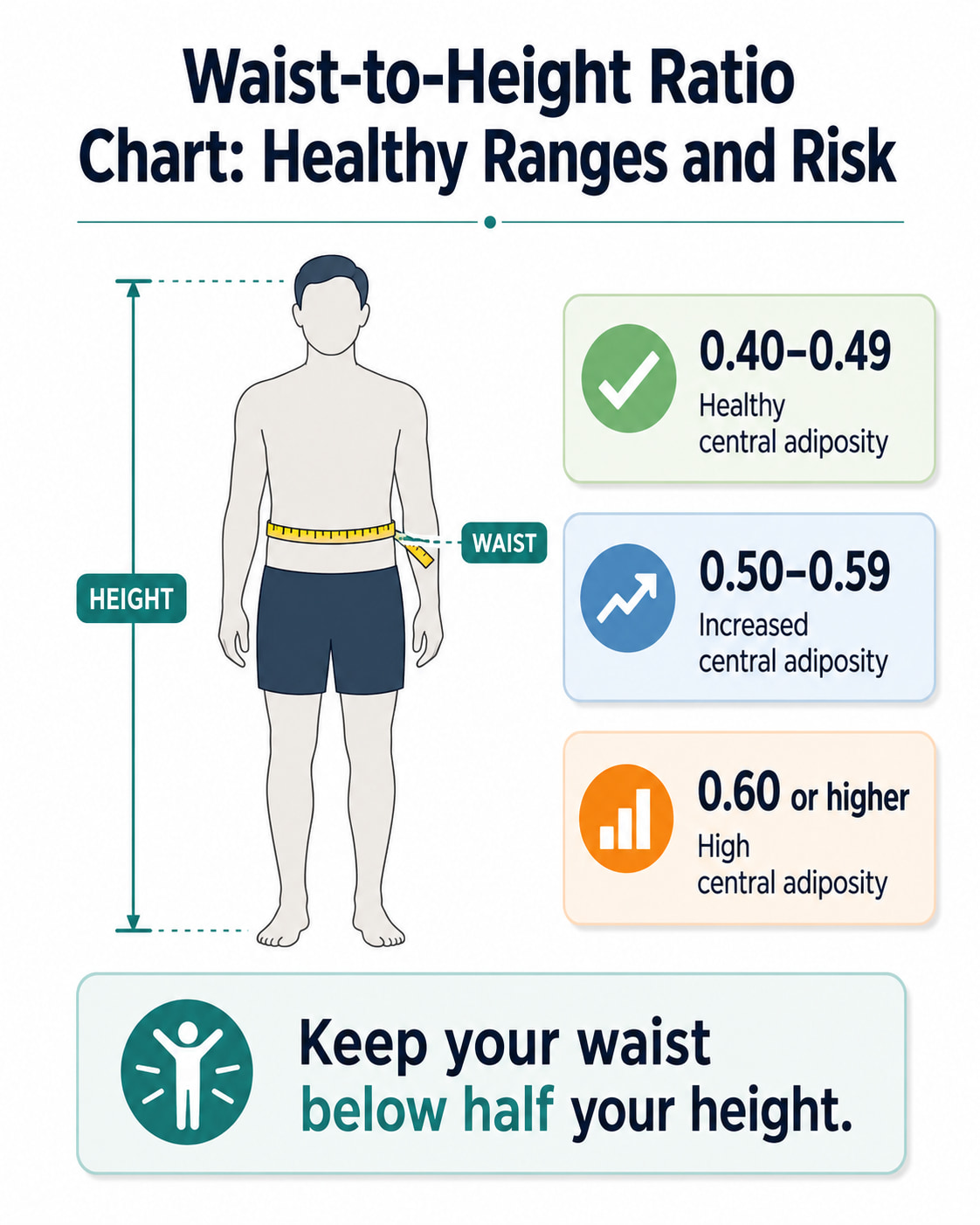
A healthy waist-to-height ratio is generally 0.40 to 0.49, meaning your waist should measure less than half your height. A result from 0.50 to 0.59 indicates increased central abdominal fat and associated health risk, while 0.60 or higher indicates a further increase in risk.
The waist-to-height ratio chart provides a quick way to assess abdominal fat relative to your body size. You only need your waist circumference and height, measured in the same unit.
Waist-to-Height Ratio Chart
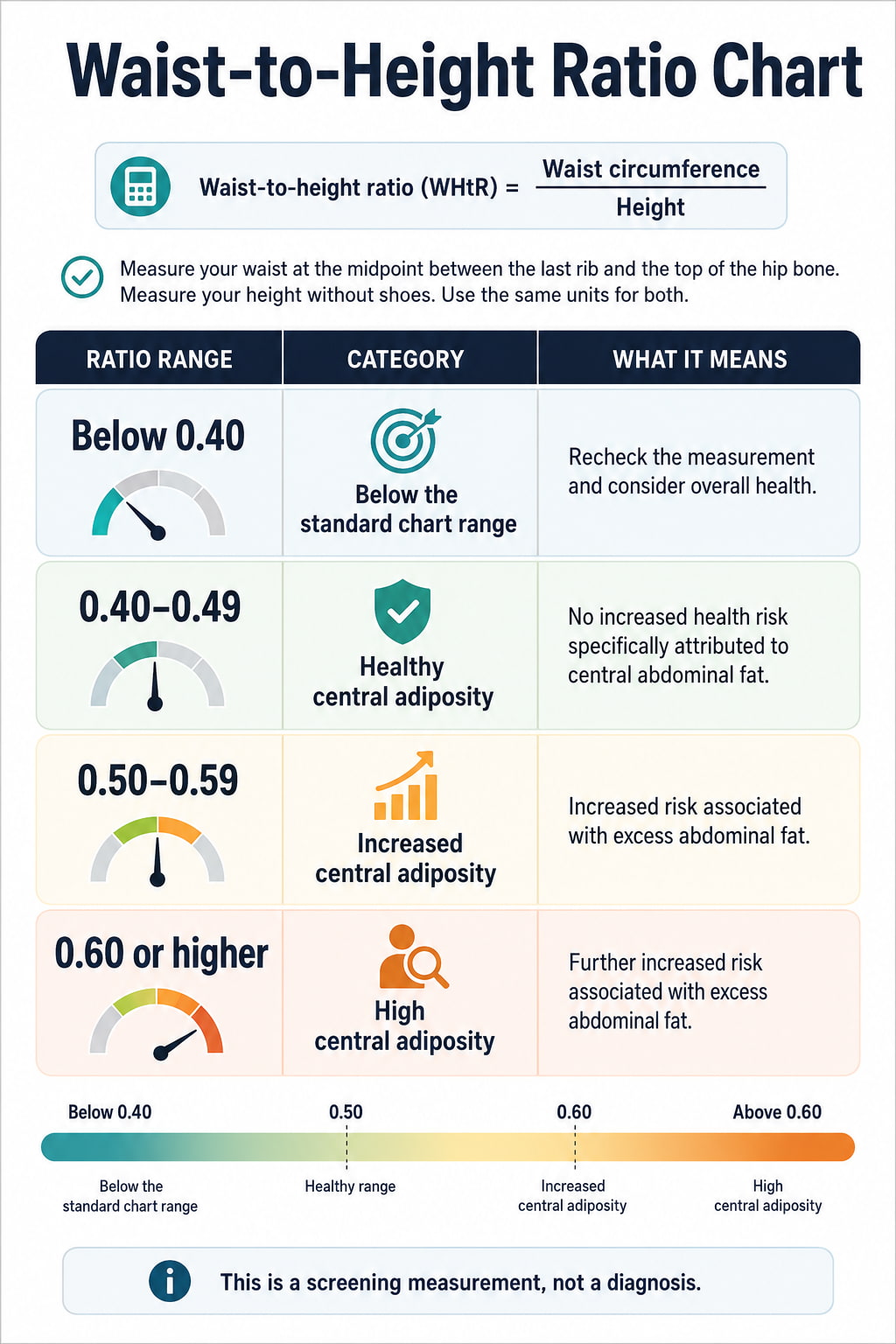
| Waist-to-height ratio | Classification | What it generally means |
|---|---|---|
| Below 0.40 | Below the standard chart range | Not classified as a healthy central-adiposity range by current NICE guidance; recheck the measurement and consider overall health |
| 0.40–0.49 | Healthy central adiposity | No increased health risk specifically attributed to central abdominal fat |
| 0.50–0.59 | Increased central adiposity | Increased risk associated with excess abdominal fat |
| 0.60 or higher | High central adiposity | Further increased risk associated with excess abdominal fat |
The National Institute for Health and Care Excellence uses these categories for adults with a BMI below 35. The same boundaries apply to men and women and across ethnic groups.
A result in the healthy range does not prove that you have no health risks. It only indicates that your waist size is not elevated relative to your height under this screening method.
The “Keep Your Waist Below Half Your Height” Rule
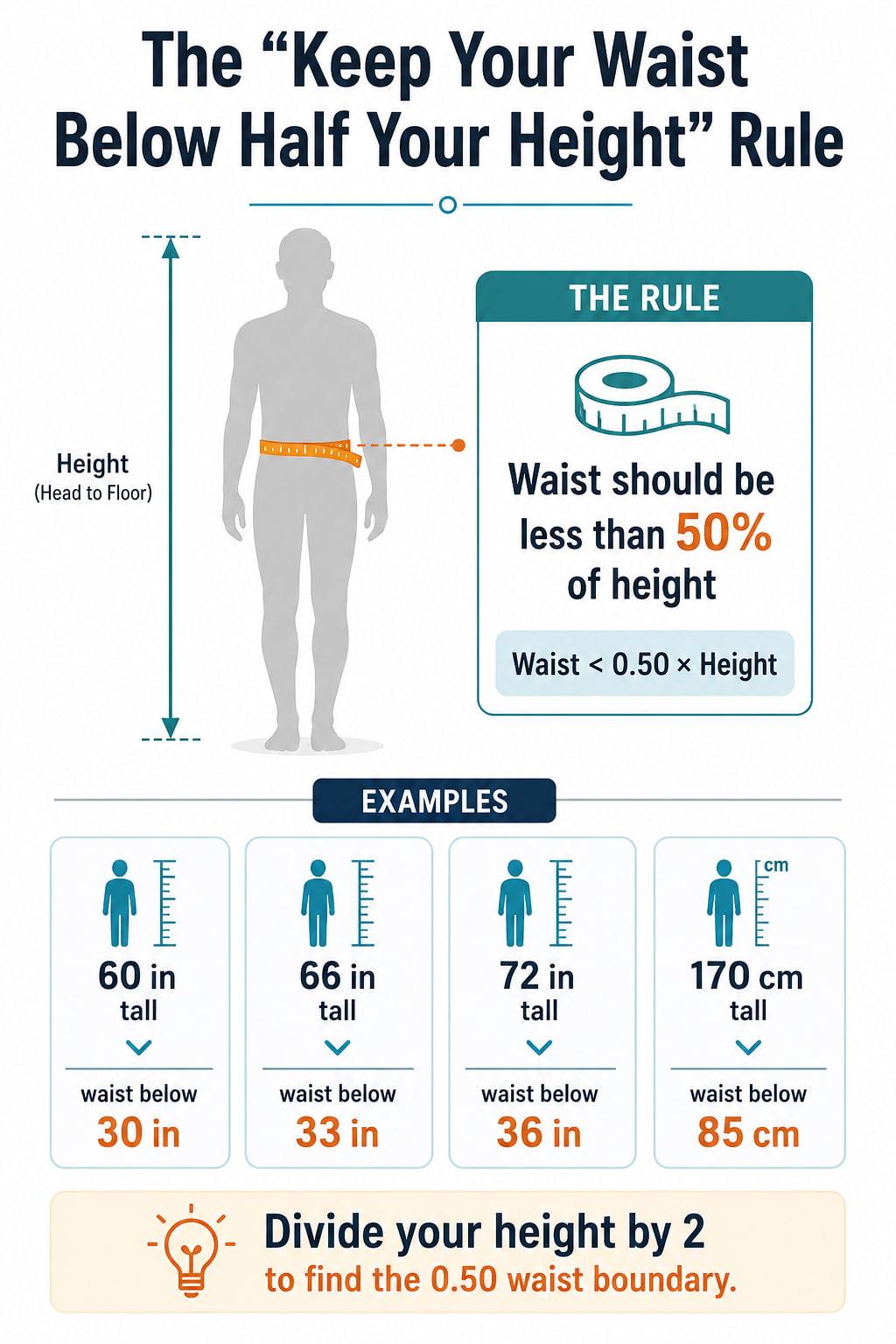
The easiest way to remember the waist-to-height ratio is:
Keep your waist circumference below half your height.
For example:
- At 60 inches tall, aim for a waist below 30 inches.
- At 66 inches tall, aim for a waist below 33 inches.
- At 72 inches tall, aim for a waist below 36 inches.
- At 170 centimeters tall, aim for a waist below 85 centimeters.
The NHS waist-to-height ratio calculator uses this same practical recommendation. It also emphasizes that the ratio is a screening tool and should not be used to diagnose a medical condition.
Waist Size Chart by Height
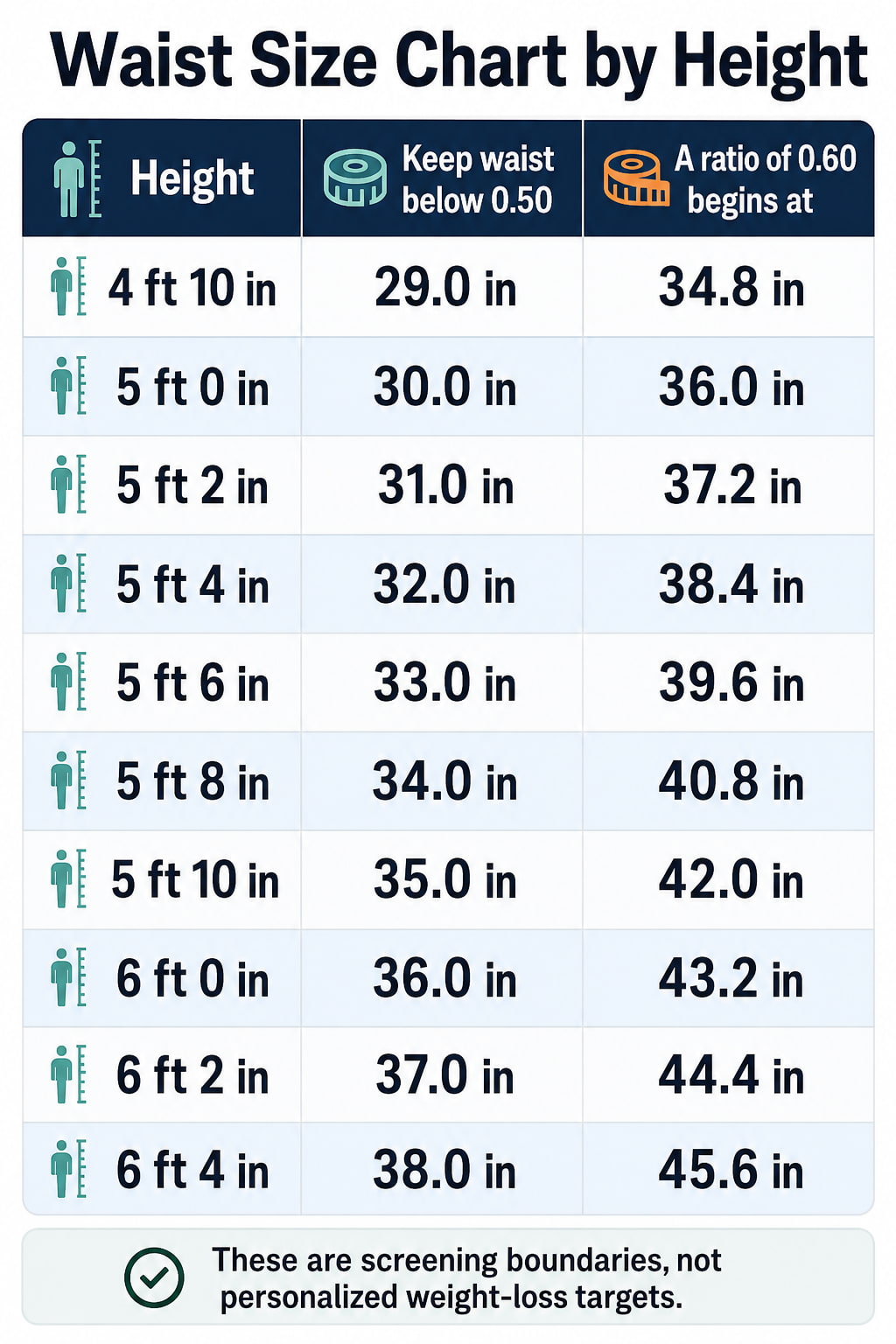
The following values are calculated from the 0.50 and 0.60 ratio boundaries.
| Height | Keep waist below 0.50 | A ratio of 0.60 begins at |
|---|---|---|
| 4 ft 10 in | 29.0 in | 34.8 in |
| 5 ft 0 in | 30.0 in | 36.0 in |
| 5 ft 2 in | 31.0 in | 37.2 in |
| 5 ft 4 in | 32.0 in | 38.4 in |
| 5 ft 6 in | 33.0 in | 39.6 in |
| 5 ft 8 in | 34.0 in | 40.8 in |
| 5 ft 10 in | 35.0 in | 42.0 in |
| 6 ft 0 in | 36.0 in | 43.2 in |
| 6 ft 2 in | 37.0 in | 44.4 in |
| 6 ft 4 in | 38.0 in | 45.6 in |
These figures are screening boundaries, not personalized weight-loss targets. Body composition, health history, age, pregnancy status, medications, and existing medical conditions may affect how a result should be interpreted.
How to Calculate Waist-to-Height Ratio
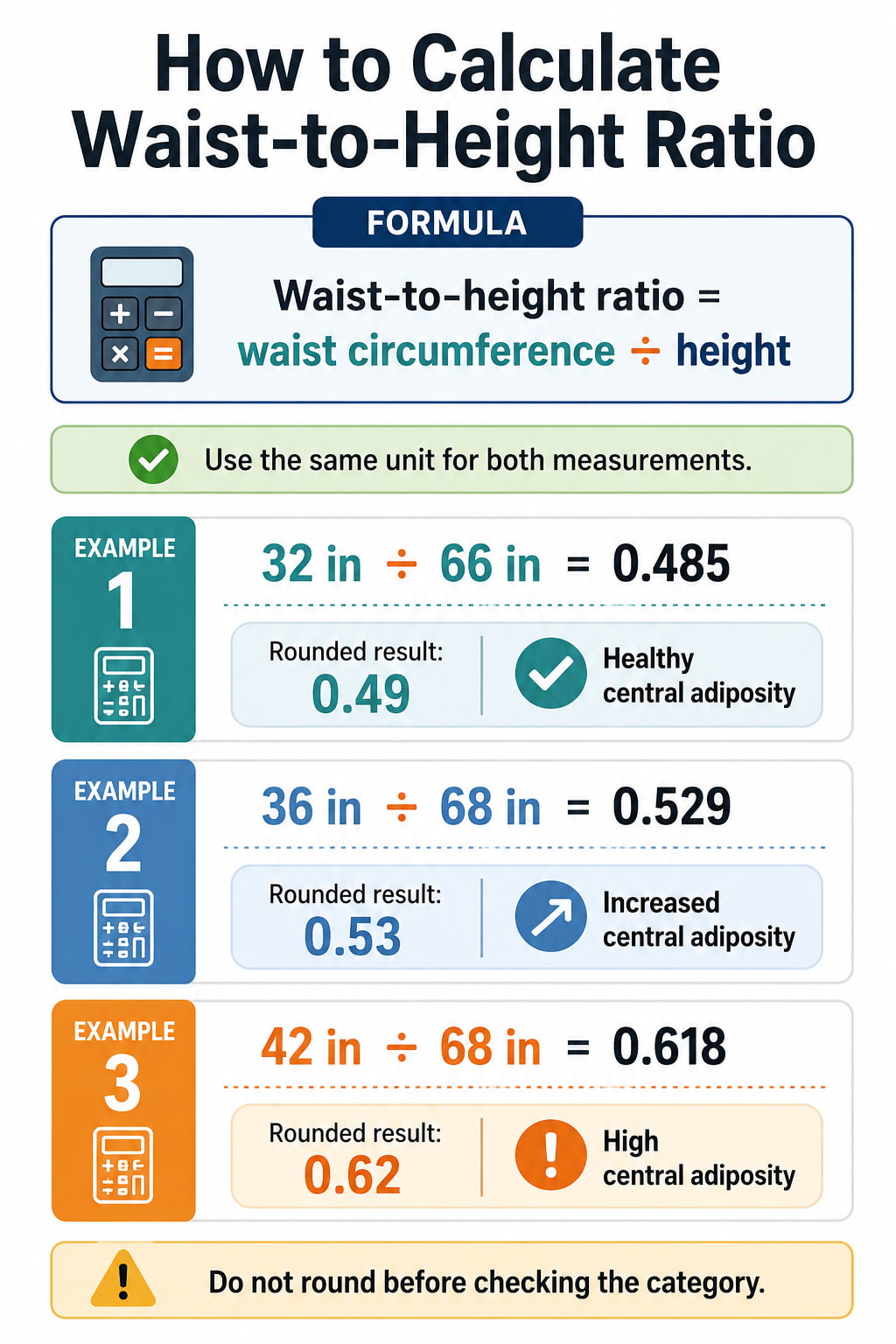
Use this formula:
Waist-to-height ratio = waist circumference ÷ height
Your waist and height must use the same unit. You can use inches or centimeters, but do not divide an inch measurement by a centimeter measurement.
Example 1: Healthy Range
- Waist: 32 inches
- Height: 66 inches
- Calculation: 32 ÷ 66 = 0.485
- Result: approximately 0.49
- Classification: healthy central adiposity
Example 2: Increased Range
- Waist: 36 inches
- Height: 68 inches
- Calculation: 36 ÷ 68 = 0.529
- Result: approximately 0.53
- Classification: increased central adiposity
Example 3: High Range
- Waist: 42 inches
- Height: 68 inches
- Calculation: 42 ÷ 68 = 0.618
- Result: approximately 0.62
- Classification: high central adiposity
Use the unrounded calculation when checking the category. Rounding too early could misclassify a result close to 0.50 or 0.60.
How to Measure Your Waist Correctly
An incorrect tape position can noticeably change your result. Measure your waist at a consistent anatomical point rather than simply choosing the narrowest part of your torso.
The British Heart Foundation recommends the following method:
- Stand upright with your abdomen relaxed.
- Find the bottom of your ribs.
- Find the top of your hip bones.
- Place the measuring tape halfway between these two points, usually just above the belly button.
- Keep the tape horizontal around your body.
- Pull it snugly without pressing it into your skin.
- Breathe out naturally.
- Record the measurement without holding in your stomach.
- Measure your height in the same unit.
- Divide your waist by your height.
For more consistent tracking, use the same tape, measurement location, posture, and time of day each time.
Common Measurement Mistakes
Results may be inaccurate when you:
- Measure over thick clothing.
- Pull the tape too tightly.
- Allow the tape to slope upward or downward.
- Measure after deliberately holding in your stomach.
- Measure at the waistband of your pants rather than the correct anatomical location.
- Use different waist locations each time.
- Mix inches and centimeters in the calculation.
Temporary bloating may also affect the measurement. If a result appears unusual, repeat it under similar conditions before drawing conclusions.
Why Waist-to-Height Ratio Matters
Waist-to-height ratio estimates central adiposity, which means fat stored around the abdomen relative to height.
Some abdominal fat lies directly beneath the skin. Visceral fat is stored deeper in the abdomen around internal organs. Higher levels of abdominal and visceral fat are associated with health concerns such as:
- High blood pressure
- Unhealthy cholesterol or triglyceride levels
- Insulin resistance
- Type 2 diabetes
- Coronary heart disease
The ratio cannot directly measure visceral fat or confirm that any of these conditions are present. Blood pressure readings, blood glucose tests, cholesterol tests, medical history, and other clinical assessments provide information that a tape measurement cannot.
What Does a Ratio Below 0.40 Mean?
Current NICE categories identify 0.40 to 0.49 as the healthy central-adiposity range but do not provide a separate standard risk category below 0.40.
A result below 0.40 does not automatically indicate a problem. However, it may be appropriate to:
- Check that the waist and height were measured correctly.
- Confirm that both measurements used the same unit.
- Consider whether you have experienced unintended weight loss.
- Review your BMI and general nutritional status.
- Speak with a healthcare professional if you have weakness, poor appetite, unexplained weight loss, or another health concern.
Waist-to-height ratio is not designed to diagnose underweight, malnutrition, or an eating disorder.
What Does a Ratio of 0.50 to 0.59 Mean?
A ratio from 0.50 to 0.59 indicates increased central adiposity.
For example, a 34-inch waist and a 68-inch height produce a ratio of exactly 0.50. This is the beginning of the increased category, not the upper end of the healthy category.
A result in this range does not mean that you have diabetes or heart disease. It suggests that abdominal fat may be contributing to your long-term cardiometabolic risk.
Useful next steps include:
- Confirming the measurement.
- Checking your blood pressure.
- Discussing glucose and cholesterol testing with a healthcare professional when appropriate.
- Reviewing eating, physical activity, sleep, alcohol use, and other lifestyle factors.
- Setting realistic health goals rather than using crash diets.
What Does a Ratio of 0.60 or Higher Mean?
A ratio of 0.60 or higher indicates high central adiposity and a further increase in health risk associated with abdominal fat.
This result deserves attention, especially when combined with:
- High blood pressure
- Prediabetes or diabetes
- Abnormal cholesterol or triglycerides
- Sleep apnea
- Fatty liver disease
- A family history of cardiovascular disease or diabetes
- Limited physical activity
The ratio still cannot determine whether a health condition is present. A clinician can review the measurement alongside laboratory results, symptoms, medications, family history, and other risk factors.
Waist-to-Height Ratio vs. BMI
BMI and waist-to-height ratio measure different aspects of body size.
| Measurement | What it uses | Main purpose | Important limitation |
|---|---|---|---|
| BMI | Weight and height | Estimates overall weight category | Does not show where fat is stored or distinguish fat from muscle |
| Waist-to-height ratio | Waist and height | Estimates abdominal fat relative to body size | Does not directly measure body fat or diagnose disease |
| Waist circumference | Waist measurement only | Screens for abdominal fat | Does not adjust for height |
A muscular person may have a high BMI without having a high level of body fat. Another person may have a BMI in the healthy range but carry more fat around the abdomen.
The American Diabetes Association’s Obesity Association announced updated adult obesity screening guidance on June, 2026. It recommends combining BMI with waist measurements and population-specific thresholds rather than relying on BMI alone.
Therefore, waist-to-height ratio is best viewed as a complement to BMI—not a replacement for every other assessment.
Waist-to-Height Ratio vs. Fixed Waist Cutoffs
Fixed waist-circumference cutoffs are another common screening approach.
The National Institute of Diabetes and Digestive and Kidney Diseases states that obesity-related health risks increase at approximately:
- 35 inches or more for women
- 40 inches or more for men
These thresholds do not adjust for height.
That difference matters. For example, a woman who is 5 feet tall reaches a waist-to-height ratio of 0.50 at a 30-inch waist, which is below the fixed 35-inch cutoff. A person’s ratio and fixed waist cutoff may therefore provide different information.
Neither method should be treated as a diagnosis by itself.
Do Men and Women Use the Same Ratio?
Yes. Current NICE waist-to-height categories use the same ratio boundaries for men and women:
- 0.40–0.49: healthy central adiposity
- 0.50–0.59: increased central adiposity
- 0.60 or higher: high central adiposity
This differs from fixed waist-circumference screening, which uses different thresholds for men and women.
Does Ethnicity Change the Waist-to-Height Ratio Range?
NICE applies the same waist-to-height ratio categories across ethnic groups because the approximate 0.50 risk boundary was broadly consistent across the evidence it reviewed.
Ethnicity can still affect overall cardiometabolic risk and the interpretation of BMI. A healthcare professional may consider ancestry, family history, blood pressure, blood glucose, cholesterol, and other risk factors when assessing your health.
Can Children Use a Waist-to-Height Ratio Chart?
Current NICE guidance allows waist-to-height ratio to help classify central adiposity in children and young people age 5 and older.
However, it should be interpreted alongside an age- and sex-appropriate childhood BMI assessment. Children are still growing, so an adult-style weight assessment should not be used alone.
The NHS advises that anyone age 17 or younger use its calculator with a parent or caregiver. Children younger than 5 should not use the standard calculator.
Speak with a pediatrician, family doctor, school nurse, or registered dietitian if you are concerned about a child’s growth or waist measurement.
Who Should Not Use the Standard Calculator?
The NHS advises against using its standard waist-to-height calculator when:
- The person is younger than 5.
- You are pregnant.
- You have a diagnosed or suspected eating disorder.
- You have a growth disorder or another condition that affects height.
- You are an adult with a BMI above 35.
Waist measurements may also be misleading when abdominal size is affected by fluid accumulation, significant swelling, a mass, or another medical condition.
What to Do If Your Waist-to-Height Ratio Is High
Start by repeating the measurement correctly. One inaccurate reading should not drive health decisions.
If the result remains 0.50 or higher, focus on sustainable habits that support overall cardiometabolic health:
Build Balanced Meals
Emphasize vegetables, fruits, beans, whole grains, lean protein sources, nuts, seeds, and unsaturated fats. Limit sugary drinks, heavily processed foods, and frequent oversized portions.
Increase Physical Activity Gradually
Choose activities that match your current fitness and health status. Walking, cycling, swimming, resistance training, and active daily tasks can all contribute to better health.
Include Strength Training
Strength training helps maintain or increase muscle mass. This is especially important during weight loss and as people age.
Improve Sleep and Stress Management
Poor sleep and chronic stress may make appetite, activity, and weight-management habits more difficult to maintain.
Avoid Trying to “Spot Reduce” Belly Fat
Abdominal exercises can strengthen your core, but they cannot selectively remove fat from the waist. Changes in waist size generally occur through broader changes in energy balance, physical activity, body composition, and health.
Review Your Health With a Professional
A clinician may recommend checking:
- Blood pressure
- Fasting glucose or A1C
- Cholesterol and triglycerides
- Liver health
- Sleep apnea risk
- Medications or medical conditions that may affect weight
Health improvements can occur even before a person reaches a particular waist measurement.
When to Seek Medical Advice
Consider discussing your result with a healthcare professional when:
- Your ratio is 0.50 or higher and you have other cardiovascular or diabetes risk factors.
- Your waist size is increasing despite no clear change in eating or activity.
- You have rapid or unexplained weight changes.
- Your abdomen becomes suddenly enlarged, swollen, painful, or firm.
- You are pregnant or have a condition that makes ordinary waist measurement unreliable.
- Concerns about weight or measurement are affecting your eating habits or emotional well-being.
The goal is a complete and respectful health assessment, not judgment based on one number.
Frequently Asked Questions
What is the ideal waist-to-height ratio?
The commonly recommended healthy central-adiposity range is 0.40 to 0.49. The practical goal is to keep your waist below half your height.
Is a waist-to-height ratio of 0.50 considered high?
A result of exactly 0.50 is classified as increased central adiposity. It is the beginning of the increased-risk category, although it does not diagnose a disease.
Is 0.60 a dangerous waist-to-height ratio?
A ratio of 0.60 or higher is classified as high central adiposity and is associated with a further increase in health risk. It should be reviewed alongside blood pressure, glucose, cholesterol, medical history, and other risk factors.
Is waist-to-height ratio better than BMI?
It may provide useful information that BMI misses because it accounts for abdominal fat distribution. However, neither measurement is perfect. Current guidance supports using waist measurements and BMI together.
Can I calculate the ratio using centimeters?
Yes. Divide your waist in centimeters by your height in centimeters. You will receive the same ratio as you would using inches.
How often should I measure my waist?
There is usually no need to measure it every day. Repeat it occasionally under similar conditions when monitoring long-term changes. Small short-term differences may reflect tape placement, breathing, meals, or bloating rather than a meaningful body-composition change.
Can I have a healthy BMI but a high waist-to-height ratio?
Yes. BMI does not show where body fat is stored. Someone can have a BMI in the healthy range while carrying a greater proportion of fat around the abdomen.
Conclusion
A waist-to-height ratio chart offers a quick and inexpensive way to screen for excess abdominal fat. The main goal is straightforward: keep your waist below half your height.
A ratio from 0.40 to 0.49 is generally considered healthy, 0.50 to 0.59 indicates increased central adiposity, and 0.60 or higher indicates high central adiposity. Use the result alongside BMI, blood pressure, laboratory testing, medical history, and professional advice rather than treating it as a diagnosis.
Measure carefully, focus on sustainable health habits, and discuss persistent or concerning results with a qualified healthcare professional.
This content is for informational purposes only and not medical advice.
References
- National Institute for Health and Care Excellence: Identifying and assessing overweight, obesity, and central adiposity
- NHS: Calculate your waist-to-height ratio
- British Heart Foundation: Measuring your waist
- American Diabetes Association: Updated obesity screening and diagnostic standards
- National Institute of Diabetes and Digestive and Kidney Diseases: Am I at a healthy weight?