
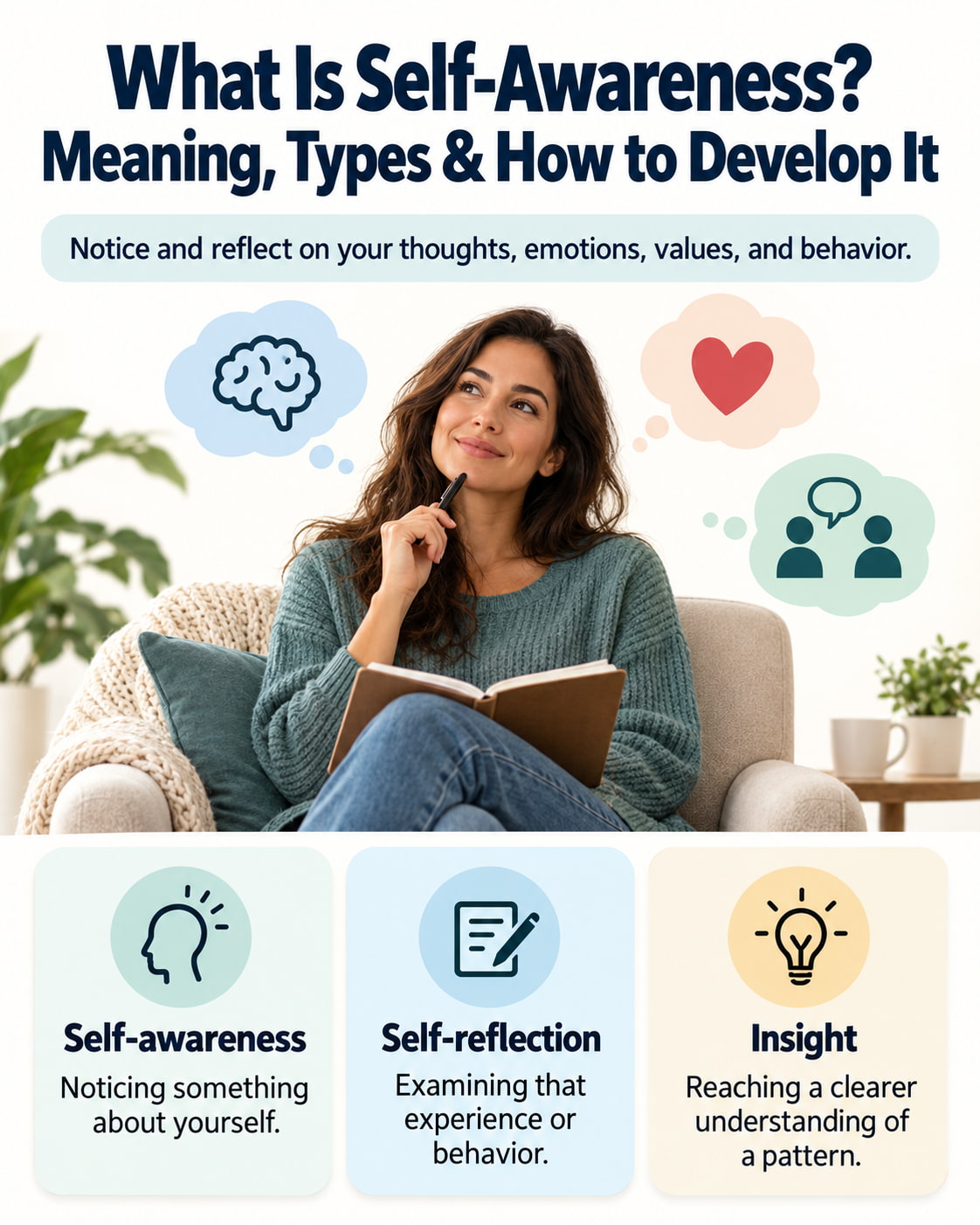
Self-awareness is the ability to notice and reflect on your thoughts, emotions, values, and behavior, including how your actions affect other people. It gives you a starting point for understanding your reactions and deciding what you want to do differently.
You can practice self-awareness through brief check-ins, structured reflection, and specific feedback. The goal is to develop a clearer, more balanced understanding of yourself while staying open to new information.
What Is Self-Awareness?
Self-awareness involves paying attention to your inner experience and recognizing patterns in how you act. You might notice that you become defensive when receiving feedback, feel energized by certain activities, or agree to requests before considering your limits.
It also involves checking your interpretations. Noticing “I feel tense” is an observation. Deciding “I feel tense because everyone dislikes me” adds an explanation that may be inaccurate.
Three related ideas help clarify the process:
- Self-awareness: Noticing something about yourself.
- Self-reflection: Examining that experience or behavior.
- Insight: Reaching a clearer understanding of a pattern.
For example, you notice that you interrupt during conversations. You reflect on when it happens and recognize that you often rush to contribute when you are excited. That gives you a specific behavior to work on.
Accurate understanding can vary across different parts of your life. A 2026 consensus statement on self-knowledge, published in Nature Reviews Psychology, emphasizes that people may understand themselves well in one area while having blind spots in another. It also distinguishes accurate understanding from simply feeling certain about yourself.
Types of Self-Awareness
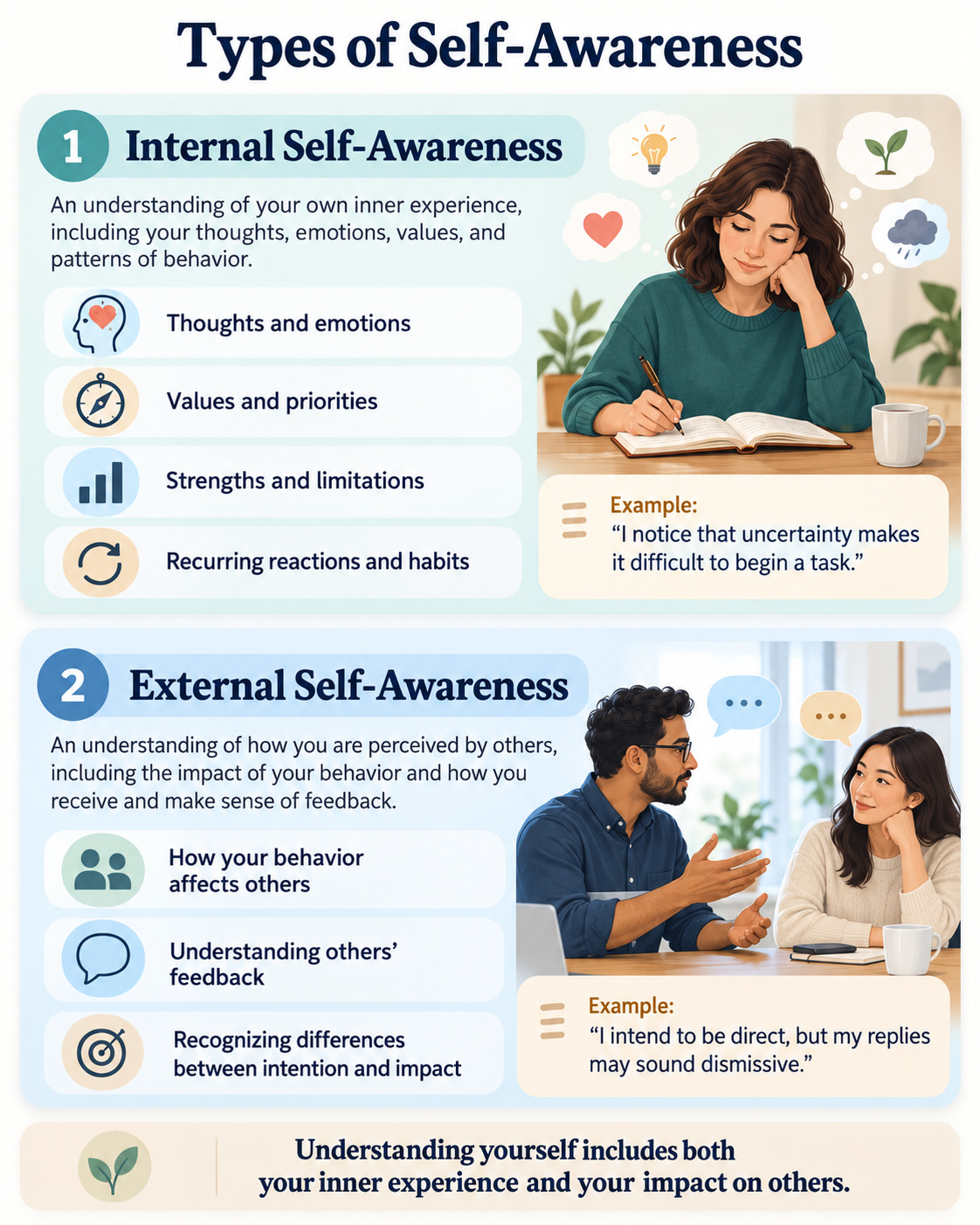
A practical way to understand self-awareness is to consider two perspectives: your inner experience and your impact on other people. Researchers use several frameworks, so these are useful categories rather than the only scientific classification.
Internal Self-Awareness
Internal self-awareness concerns what is happening within you, including your:
- Thoughts and emotions.
- Values and priorities.
- Motivations and preferences.
- Strengths and limitations.
- Recurring reactions and habits.
For example, you might recognize that you avoid a task because you are uncertain how to begin. That observation gives you something more specific to address than calling yourself lazy.
External Self-Awareness
External, or interpersonal, self-awareness concerns how your behavior comes across to others and affects them.
You might see yourself as direct, while a colleague experiences your rushed replies as dismissive. Understanding that difference requires checking what happened and listening to feedback.
External self-awareness does not require accepting every opinion about you. Consider the example, context, and whether similar feedback appears repeatedly.
What About Private and Public Self-Awareness?
You may also encounter the terms private and public self-consciousness. Private self-consciousness concerns attention to inner experiences. Public self-consciousness concerns attention to observable aspects of yourself, such as your behavior or appearance.
These terms overlap with the perspectives above, but researchers do not always use them in the same way. In psychology, self-consciousness can refer neutrally to self-focused attention; it does not always mean embarrassment.
Why Is Self-Awareness Important?
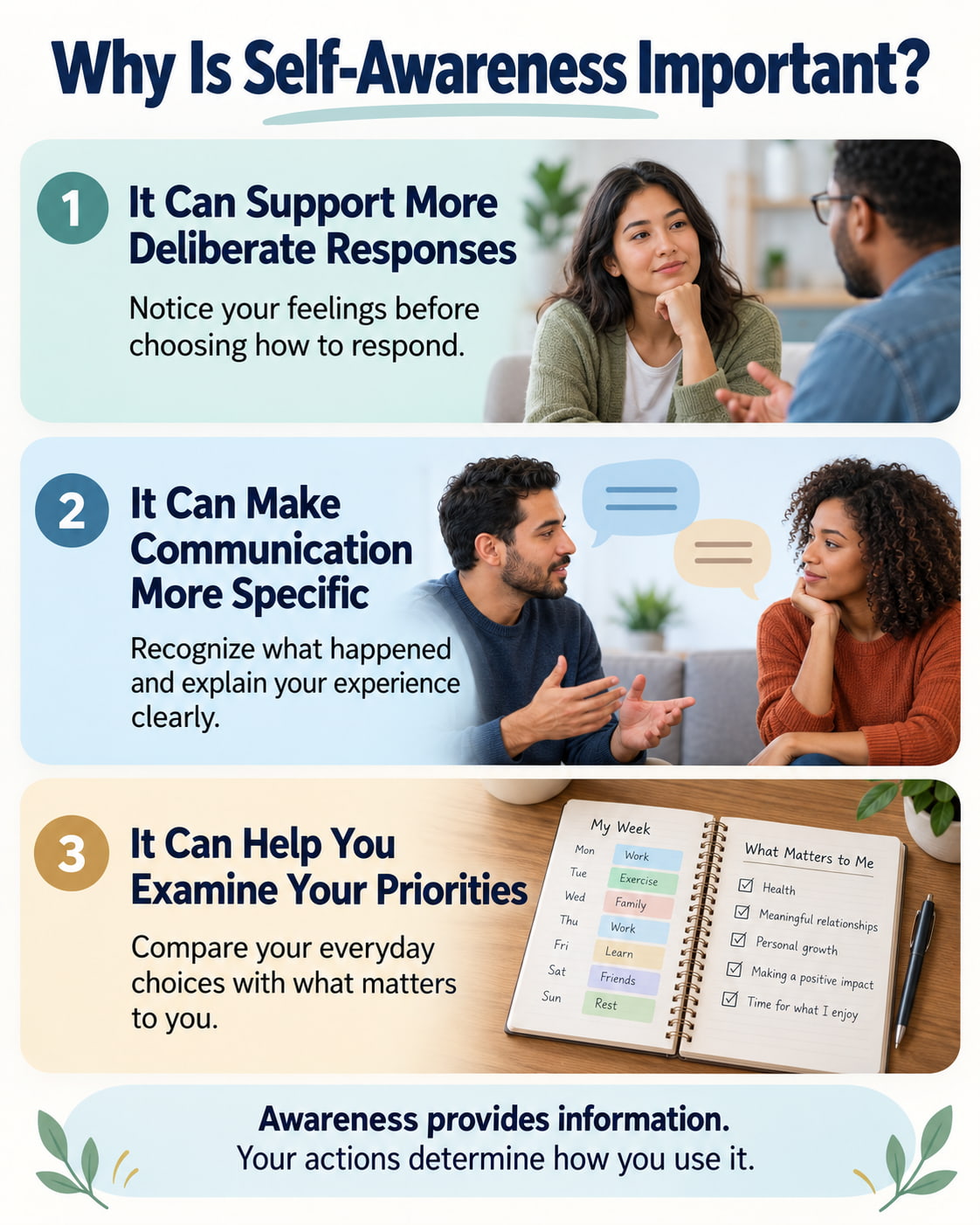
Self-awareness provides information you can use when making choices. Its value depends partly on whether you use that information to respond differently.
It Can Support More Deliberate Responses
If you notice that you are frustrated, you have an opportunity to pause before replying. You may still feel frustrated, but you can consider how you want to express it.
Recognizing the emotion is awareness. Choosing your response is a separate step.
It Can Make Communication More Specific
Instead of saying, “You never listen,” you might recognize and explain what happened: “I felt overlooked when I was interrupted before finishing.”
You can also consider your own contribution, such as speaking over someone or offering advice before understanding their concern.
It Can Help You Examine Your Priorities
Awareness gives you a way to compare what matters to you with how you spend your time and energy.
For example, if rest matters to you but you repeatedly accept late commitments, you can examine what makes saying no difficult and decide which commitment to change.
These are practical opportunities, not guarantees. Awareness alone does not ensure better relationships, greater confidence, or lasting behavior change.
Examples of Self-Awareness in Everyday Life
The following examples show how an observation can lead to a practical response.
| Situation | Self-aware observation | Possible next step |
|---|---|---|
| You receive constructive feedback. | “I want to defend myself before hearing the full explanation.” | Listen first, then ask for a specific example. |
| You keep accepting extra tasks. | “I agree before checking whether I have time.” | Review your schedule before answering. |
| A conversation becomes tense. | “I am raising my voice because I feel unheard.” | Slow down and explain the point you want understood. |
| You finish a satisfying activity. | “I enjoyed working with others more than I expected.” | Look for another opportunity to try that kind of activity. |
Self-awareness includes noticing what works well for you. Reflection does not need to focus only on mistakes.
How to Develop Self-Awareness
A 2023 review of self-awareness development discusses reflection, feedback, mindfulness, and coaching. It also highlights gaps in how development is measured and the limits of existing intervention research.
The practices below offer ways to explore your experiences. Use them flexibly; there is no established schedule that guarantees a particular level of self-awareness.
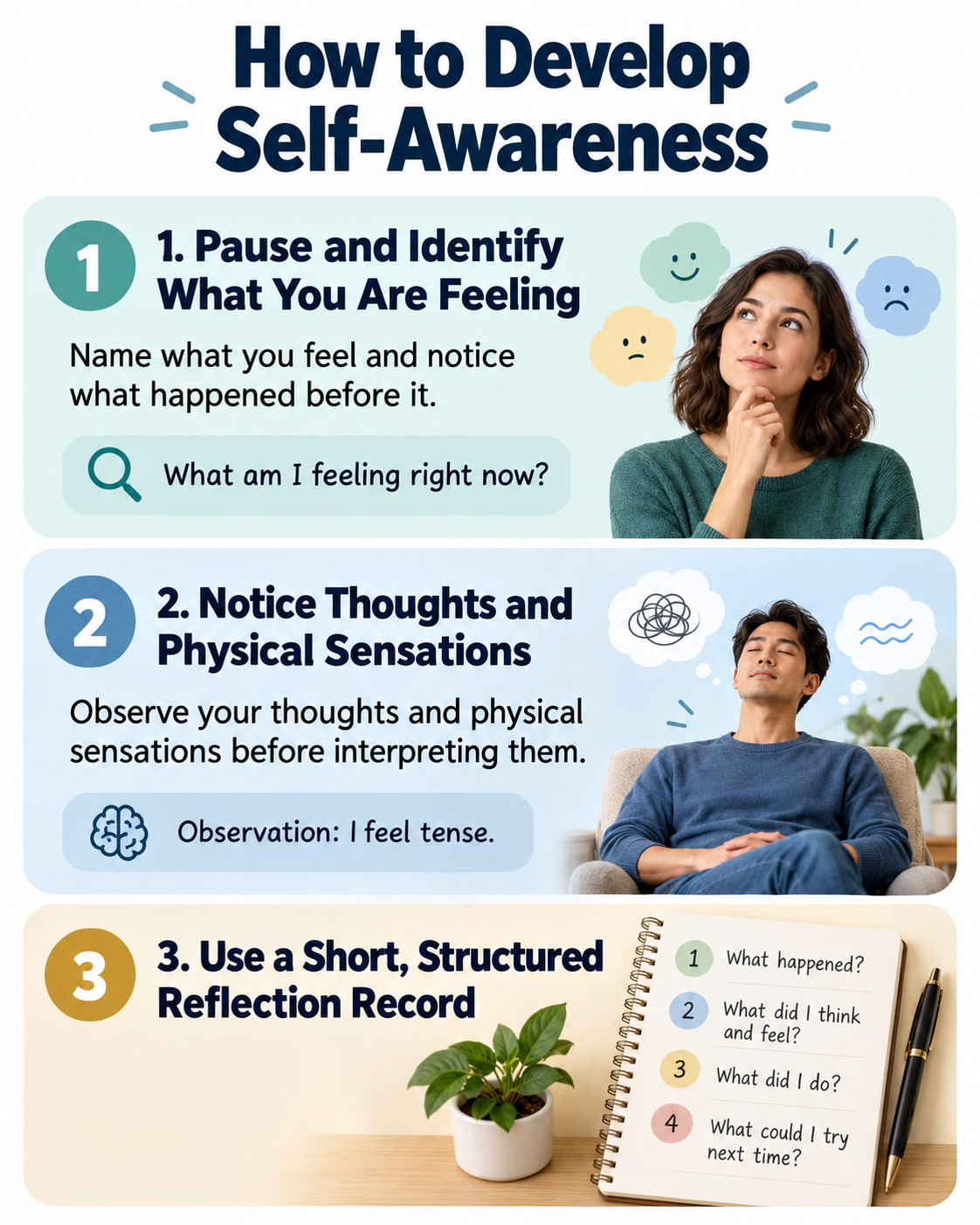
1. Pause and Identify What You Are Feeling
When you notice a change in your mood, pause and try to name the emotion.
Instead of stopping at “I feel bad,” consider whether you feel disappointed, worried, irritated, lonely, or overwhelmed. More than one emotion may fit, and you do not need to find a perfect label.
Ask yourself:
- What am I feeling right now?
- What happened shortly before this feeling?
- What do I feel an urge to do?
The NHS suggests naming thoughts and feelings as one mindfulness practice. Naming an emotion is a way to notice it; it does not guarantee that the feeling will immediately change.
2. Notice Thoughts and Physical Sensations
Pay attention to the experience before deciding what it means.
You might notice a clenched jaw, tense shoulders, or a thought such as “I must get this right.” Write down the observation in plain language.
Then separate it from your interpretation:
- Observation: “I kept checking whether my message had been read.”
- Interpretation: “I may have been looking for reassurance.”
- Question to explore: “Does this happen mainly when the conversation feels uncertain?”
This approach leaves room to revise an explanation rather than treating your first guess as a fact.
3. Use a Short, Structured Reflection Record
Choose one recent event and write a few sentences about it.
| Prompt | Example |
|---|---|
| What happened? | A coworker asked me to revise something. |
| What did I think and feel? | I thought I had failed and felt embarrassed. |
| What did I do? | I started explaining myself before asking what needed changing. |
| What else could explain the situation? | The request may have concerned one detail rather than the quality of all my work. |
| What could I try next time? | Ask which change would be most useful. |
This is a simple reflection example. For a more detailed approach, the NHS thought-record exercise uses seven prompts to examine a situation, thoughts, feelings, and evidence.
Keep the exercise focused. Writing more pages is not necessarily the same as reaching greater understanding.
4. Ask for Specific Feedback
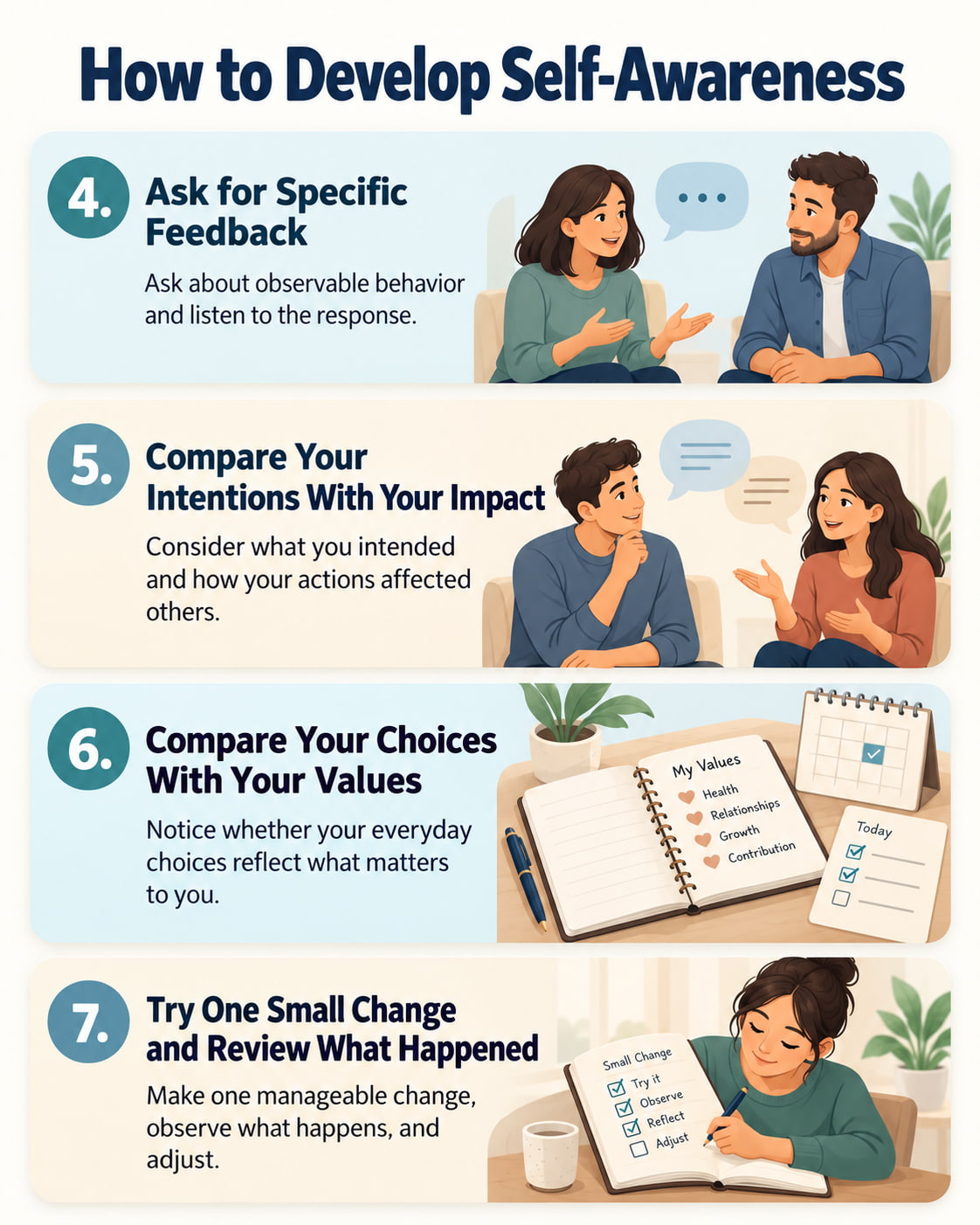
Choose someone who knows you reasonably well and can discuss an example respectfully.
Ask about a particular behavior:
- “Did I give you enough time to explain your point?”
- “Was anything unclear about how I communicated that?”
- “What did I do that helped our conversation?”
- “Can you give me an example of when I seemed distracted?”
Listen before explaining your intentions. If the feedback is vague, ask what the person observed.
Then consider it alongside your own observations. One person’s opinion is information to evaluate, not a complete description of who you are.
5. Compare Your Intentions With Your Impact
You can mean well and still have an effect you did not intend.
Perhaps you offered advice to reassure a friend, but they wanted you to listen. Perhaps you sent a brief message to save time, but it sounded abrupt.
Consider three questions:
- What was I trying to do?
- What did I actually say or do?
- What response or feedback did I receive?
Where appropriate, ask the other person about their experience. Avoid deciding that you know how they felt without checking.
6. Compare Your Choices With Your Values
Choose a few values that matter to you, such as honesty, reliability, learning, rest, or connection.
Then examine one recent decision. How did it reflect those priorities? Were two values competing?
For example, you may value helping others and protecting time with your family. Agreeing to every request may make it difficult to honor both.
A useful question is: “What would a realistic choice look like that respects my priorities?”
Aim to understand a tradeoff and make a workable adjustment. You do not need to evaluate every decision as a personal success or failure.
7. Try One Small Change and Review What Happened
Turn an observation into a manageable experiment.
If you notice that you interrupt, practice allowing the other person to finish before responding. If you accept commitments too quickly, try saying, “Let me check my schedule first.”
Afterward, ask:
- What did I try?
- What happened?
- What did I learn?
- What should I adjust?
Progress might mean noticing the pattern sooner, asking a clearer question, or responding differently once. Use those observations to choose your next step.
Self-Awareness vs. Overthinking
Constructive reflection examines an experience to understand it or decide what to do. Rumination repeatedly circles around distressing thoughts, often without reaching useful resolution.
Research in Europe’s Journal of Psychology has found different associations for reflection, insight, and rumination. In a questionnaire-development study, reflection and insight were associated with beneficial outcomes, while rumination was associated with greater costs. These findings do not establish cause and effect.
| Constructive reflection | Unhelpful overthinking |
|---|---|
| “What happened during that conversation?” | “Why do I always get everything wrong?” |
| Considers a specific behavior. | Expands one event into a judgment about your whole character. |
| Allows alternative explanations. | Repeats the same assumption. |
| Identifies a next step or accepts uncertainty. | Keeps searching for certainty without new information. |
If reflection becomes repetitive, try writing one useful observation and one possible next step, then return to another activity. You can also leave a question unanswered for now.
The goal is a balanced view of yourself that includes strengths, difficulties, and uncertainty.
When to Seek Support
Consider talking with a qualified mental health professional if repetitive thoughts, anxiety, self-criticism, or low mood persist, worsen, or interfere with sleep, relationships, work, or daily activities.
The National Institute of Mental Health explains when to seek help based on symptoms, their duration, and their effects on daily functioning.
Mindfulness is optional. The NHS guidance on mindfulness notes that it does not help everyone and can make some people feel worse. If an exercise increases distress, pause it and consider seeking guidance.
You do not need to become better at self-reflection before asking for support.
Frequently Asked Questions
What Does Self-Awareness Mean in Simple Terms?
Self-awareness means noticing what you think, feel, and do, then considering what those observations tell you about yourself. It also includes checking how your behavior affects other people.
What Are the Main Types of Self-Awareness?
Two useful perspectives are internal awareness, which concerns your inner experiences, and external or interpersonal awareness, which concerns your impact on others. Research uses several classifications, so there is no single universal list of types.
Can Self-Awareness Be Developed?
You can practice observing your reactions, reflecting on specific experiences, seeking feedback, and testing small changes. Improvement varies across people and situations. There is no established number of days or minutes that guarantees lasting improvement.
How Is Self-Awareness Different From Self-Consciousness?
In everyday speech, being self-conscious often means feeling awkward or worried about judgment. In psychological research, self-consciousness can also refer neutrally to attention directed toward yourself. The terms overlap, so their meaning depends on context.
Does Journaling Improve Self-Awareness?
Journaling provides a place to record experiences and examine patterns, especially when you use focused prompts. However, writing frequently does not automatically produce accurate insight. Consider whether it helps you identify something useful or repeatedly revisit the same distress.
Can You Have Too Much Self-Awareness?
Constant self-monitoring and repetitive self-criticism can become unhelpful. More attention to yourself does not always mean better understanding. Consider whether reflection helps you engage with daily life or keeps you stuck evaluating yourself.
Conclusion
Developing self-awareness involves noticing your experiences, checking your interpretations, and using what you learn. Start with one recent situation: identify what you felt, describe what you did, and choose one small adjustment to try.
Keep your observations specific and your approach curious. You can learn about yourself while allowing room for mistakes, strengths, and change.
This content is for informational purposes only and not medical advice.
References
- American Psychological Association — Self-Awareness
- Journal of Management Education — Defining Self-Awareness in the Context of Adult Development
- Nature Reviews Psychology — A Consensus Statement on Self-Knowledge
- Annual Review of Organizational Psychology and Organizational Behavior — Developing Self-Awareness
- Macquarie University — The Self-Reflection and Insight Scale
- Europe’s Journal of Psychology — Measuring the Effects of Self-Awareness
- NHS — Mindfulness
- NHS — Thought Record
- National Institute of Mental Health — My Mental Health: Do I Need Help?