
A superset is a strength-training method in which you perform one set of each of two different exercises back-to-back, with little or no rest between them, then rest before repeating the pair. For example, you might do biceps curls followed by triceps pushdowns.
Supersets can help you fit strength training into a busy schedule. To use them well, choose exercises you can perform confidently, select manageable weights, and allow enough recovery to maintain your technique. The five pairs below give you practical options for your next gym session.
What Is a Superset?
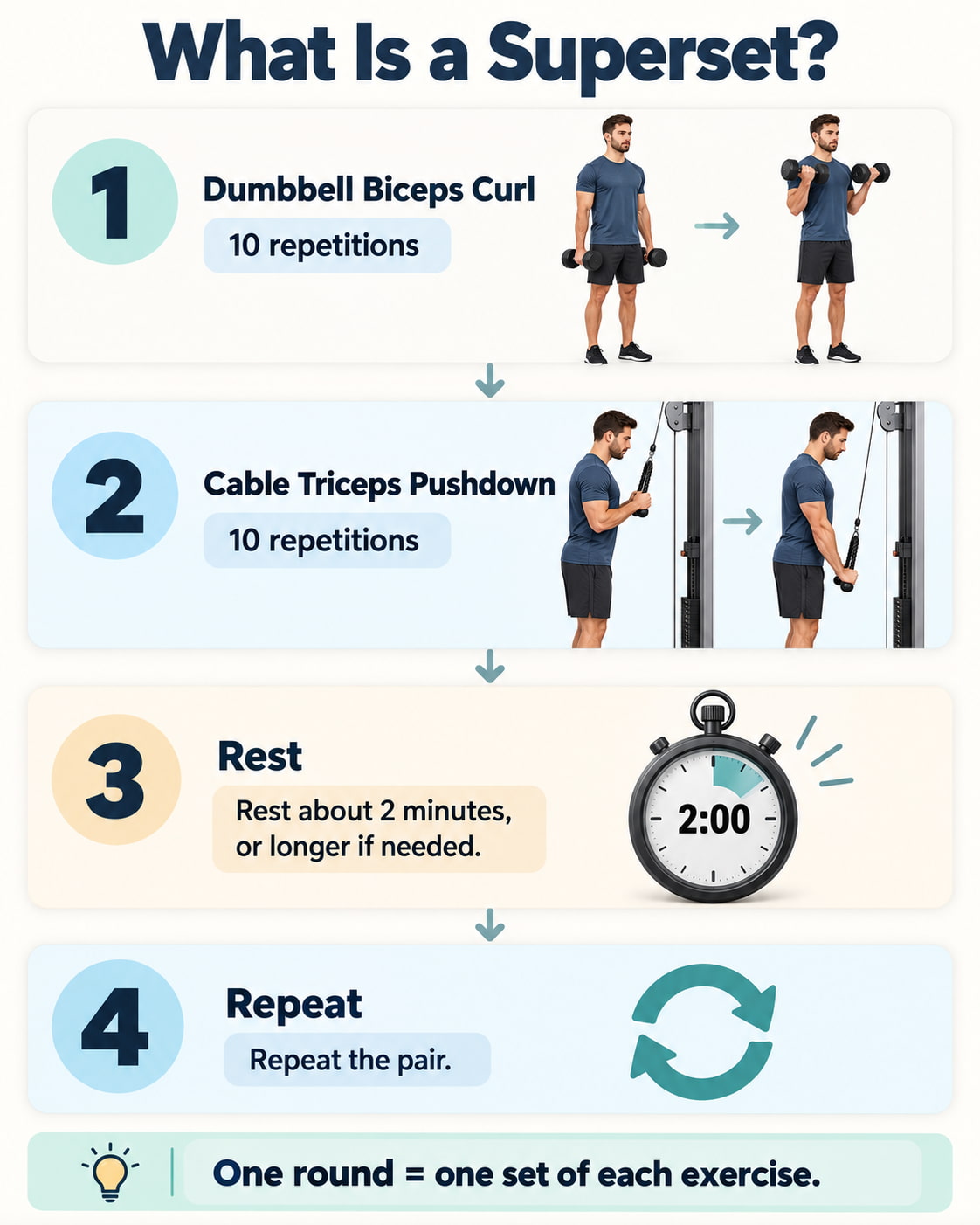
In a traditional straight-set workout, you usually complete a set, rest, and repeat the same exercise before moving on. A superset places a second exercise before that rest period.
Here is a simple example:
- Perform 10 dumbbell biceps curls.
- Put the dumbbells down and perform 10 cable triceps pushdowns.
- Rest for about two minutes, or longer if needed.
- Repeat the pair.
Completing both exercises is one round. Three rounds give you three sets of curls and three sets of pushdowns.
“Little or no rest” does not mean rushing. Take the time needed to change position, adjust equipment, and begin the next exercise with control.
What Are the Different Types of Supersets?
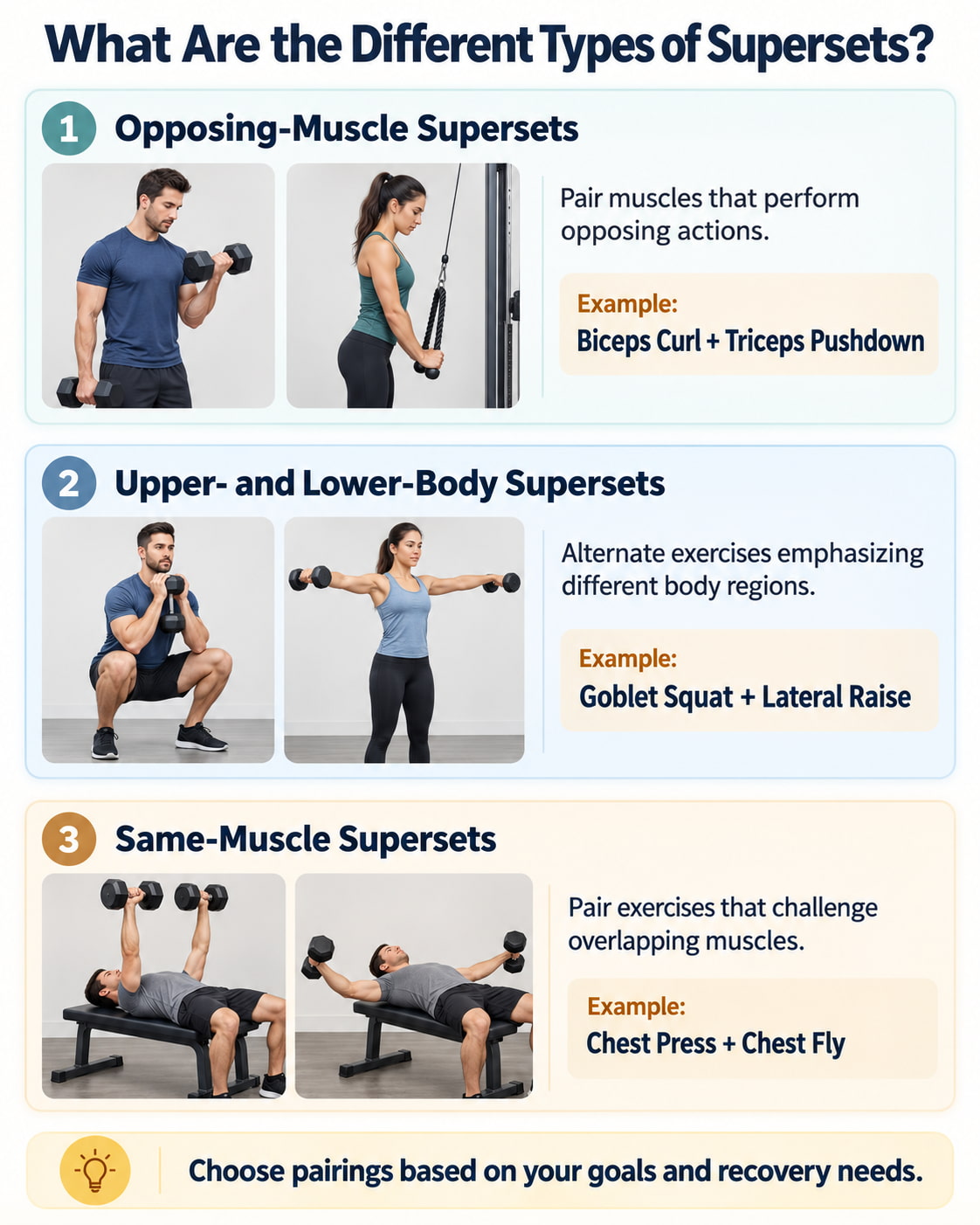
Opposing-Muscle Supersets
These pair muscles that perform opposing actions. Biceps curls bend your elbows, while triceps pushdowns straighten them.
Other examples include chest presses with rows and leg extensions with leg curls. One muscle group gets a break from being the main mover while another works, although your whole body and supporting muscles still experience fatigue.
Upper- and Lower-Body Supersets
These alternate exercises emphasizing different body regions, such as a goblet squat and a dumbbell lateral raise.
They can be convenient when both exercises use equipment in the same area. However, different target muscles do not guarantee complete recovery: holding a goblet squat weight also involves your arms, shoulders, and trunk.
Same-Muscle Supersets
These combine exercises that substantially overlap in the muscles they challenge. A chest press followed by a chest fly is one example.
Often called compound sets, these pairings can make the second exercise harder because the target muscles are already fatigued. Some coaches reserve “superset” for opposing-muscle pairs, so terminology varies.
What Are the Benefits of Supersets?
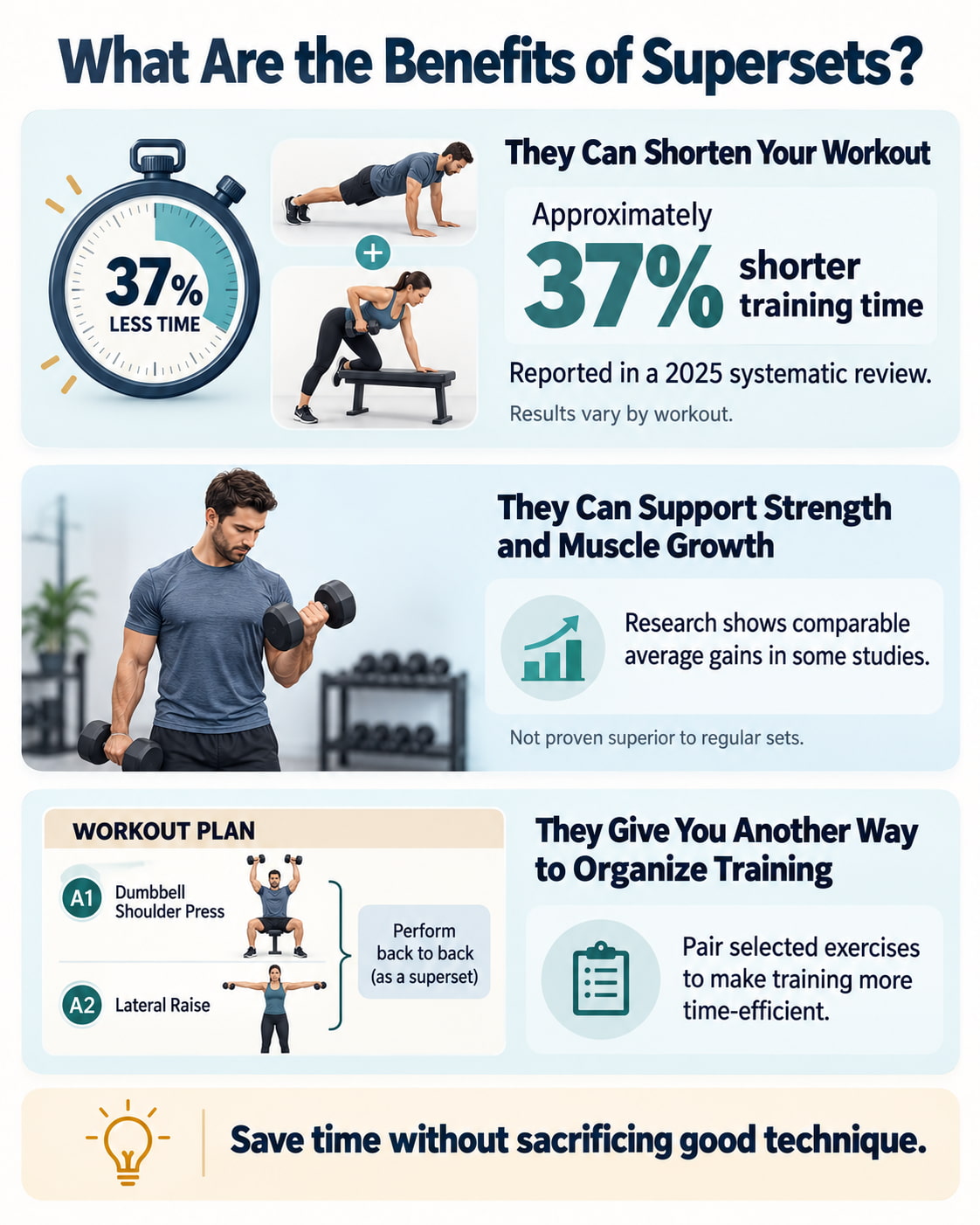
They Can Shorten Your Workout
Time savings are the clearest benefit.
A 2025 systematic review and meta-analysis in Sports Medicine included 19 studies involving 313 participants. The authors reported that supersets reduced training time by approximately 37% compared with traditional sets.
That percentage is a research finding, not a promise for every session. Equipment availability, exercise selection, and recovery needs affect how much time you save.
They Can Support Strength and Muscle Growth
Supersets can be an effective way to organize resistance training.
In a trial published in the January 2026 issue of Science & Sports, 43 resistance-trained men and women followed superset or traditional programs for eight weeks. Average improvements in muscle size and several performance measures were generally similar, while superset sessions took 36% less time.
The broader evidence does not establish that supersets build more muscle than regular sets. The 2025 review included only three studies examining longer-term adaptations, so its findings should not be read as proof that every pairing produces identical results.
They Give You Another Way to Organize Training
You can use supersets for selected parts of a workout without changing the entire session.
For example, you could perform your main strength exercise with regular rest, then pair two accessory movements. This is a practical option when you want to prioritize a particular lift and save time later.
Expect supersets to feel more demanding. If the second exercise consistently suffers, adjust the load, allow more recovery, or choose a different pairing.
5 Superset Exercise Pairs to Try at the Gym
Treat these as options to choose from, rather than a requirement to complete all five. Start with one pair whose individual exercises you already know.
The repetition ranges are practical starting examples. Use a separate, appropriate weight for each movement.
| Superset | Exercise A | Exercise B | Repetitions per round |
|---|---|---|---|
| 1 | Dumbbell bench press | Bench-supported single-arm row | 8–12 presses; 8–12 rows per side |
| 2 | Lat pulldown | Seated dumbbell shoulder press | 8–12 of each |
| 3 | Dumbbell biceps curl | Cable triceps pushdown | 10–15 of each |
| 4 | Seated leg extension | Seated leg curl | 10–15 of each |
| 5 | Goblet squat | Dumbbell lateral raise | 8–12 squats; 10–15 raises |
Begin with two rounds of your chosen pair and approximately two minutes of rest after both exercises. Extend recovery whenever needed.
Before lifting, warm up. Mayo Clinic recommends five to 10 minutes of brisk walking or another aerobic activity, along with learning proper technique and reducing the weight if you cannot maintain it. Practice unfamiliar exercises separately before combining them.
1. Dumbbell Bench Press + Bench-Supported Single-Arm Row
This pairs a horizontal pushing movement with a pulling movement. It is convenient because both exercises can use the same flat bench.
Dumbbell bench press:
- Lie on a flat bench with your feet supported and your head, upper back, and hips stable.
- Hold the dumbbells near your chest with your wrists aligned above your forearms.
- Press upward under control, then lower through a comfortable range.
- Finish the set and put the weights down securely before repositioning.
Bench-supported single-arm row:
- Place one hand and the same-side knee on the bench, with your other foot on the floor.
- Hold a dumbbell in the free hand and brace your torso.
- Pull your elbow back toward your hip without twisting your body.
- Lower slowly, complete the repetitions, and switch sides.
Practical tip: Complete the row on both sides before taking your post-superset rest. Choose weights you can position and put down safely; ask for assistance when needed.
2. Lat Pulldown + Seated Dumbbell Shoulder Press
This combines a vertical pull with a vertical push. It works best when a pulldown station and a suitable bench are nearby and available.
Lat pulldown:
- Adjust the thigh pad so it holds your legs securely.
- Grip the bar and sit tall with a slight, steady backward lean.
- Pull the bar toward your upper chest, driving your elbows downward.
- Return the bar upward under control without letting the weight pull you out of position.
Seated dumbbell shoulder press:
- Sit on a bench with a supportive backrest and your feet firmly on the floor.
- Bring the dumbbells to about shoulder height, with your elbows slightly forward.
- Press overhead through a comfortable range without excessively arching your lower back.
- Lower the weights slowly.
Practical tip: Both exercises involve your shoulders and supporting muscles. Use manageable loads, and separate the exercises if fatigue makes the press unstable. Use a proper bench for pressing rather than improvising on the pulldown seat.
3. Dumbbell Biceps Curl + Cable Triceps Pushdown
This is a straightforward opposing-muscle pairing for the upper arms. Set up the cable attachment and weight before beginning the round.
Dumbbell biceps curl:
- Stand with a dumbbell in each hand and your arms near your sides.
- Bend your elbows to lift the weights without swinging your torso.
- Keep your upper arms relatively still.
- Lower the dumbbells under control.
Cable triceps pushdown:
- Face a high cable with a rope or bar attachment.
- Keep your upper arms close to your torso and your wrists aligned with your forearms.
- Straighten your elbows to move the attachment downward.
- Bend your elbows slowly to return, keeping your body steady.
Practical tip: Place the dumbbells in a clear space outside the cable’s working area. Choose each exercise’s load independently; cable-stack numbers and dumbbell weights are not directly comparable.
4. Seated Leg Extension + Seated Leg Curl
This pairs the quadriceps at the front of the thighs with the hamstrings at the back.
Seated leg extension:
- Adjust the seat and pads according to the machine’s instructions, aligning your knee with its pivot.
- Keep your back and hips supported.
- Straighten your knees smoothly without forcefully snapping them straight.
- Lower the weight under control.
Seated leg curl:
- Adjust the seat, thigh restraint, and lower-leg pad for your body.
- Check knee alignment with the machine’s pivot and keep your hips against the seat.
- Bend your knees to move the lower-leg pad down and back.
- Return slowly without letting the weight stack crash.
Practical tip: This works best with adjacent available machines or a combination machine. Changing settings is part of the transition. If equipment is occupied, perform regular sets instead of trying to reserve several stations.
5. Goblet Squat + Dumbbell Lateral Raise
This pairs a lower-body movement with an exercise emphasizing the shoulders. You can usually perform both in one small free-weight area.
Goblet squat:
- Hold a dumbbell close to your chest and stand in a comfortable squat stance.
- Brace your torso and bend your hips and knees.
- Lower as far as you can control while keeping your feet stable and knees tracking with your toes.
- Push through your feet to stand.
Dumbbell lateral raise:
- Put the squat weight down and pick up lighter dumbbells.
- Stand tall with a slight bend in your elbows.
- Raise your arms out to the sides toward shoulder height, staying within a comfortable range.
- Lower slowly without swinging or leaning backward.
Practical tip: Use a squat load that does not exhaust your shoulders before the raises. An unloaded squat is an option while you learn the movement.
How Many Sets and Reps Should You Do?
For your first attempt, use the table’s repetition ranges and complete two rounds of one pair. That gives you two sets of each exercise.
Choose weights that feel challenging while allowing consistent technique. Aim to stop when you estimate you could perform another two or three controlled repetitions. This is called leaving repetitions in reserve.
The 2026 ACSM position stand explains that training to momentary muscular failure is unnecessary for benefits and identifies two or three repetitions in reserve as one way to achieve sufficient effort.
Once both exercises feel controlled across the planned repetitions, progress gradually. You might add a repetition within the range or use the smallest practical weight increase. Keep a record of each exercise’s load and repetitions.
An extra round may eventually fit your program, but consider the other work you already do for those muscles. Supersets change how sets are arranged; they do not require adding more exercises to an already demanding session.
How Long Should You Rest Between Supersets?
About two minutes after completing both exercises is a useful starting example, not a maximum. You may need longer after demanding movements or as fatigue builds.
Between exercises, take enough time to move and set up safely. If you need an additional pause to regain control of your breathing or position, take it.
A September 2026 systematic review found that paired-set performance depended on the exercise sequence and rest arrangement. Shorter sessions sometimes came with fewer repetitions or less total weight lifted. The studies examined immediate workout responses, rather than establishing one ideal rest interval for long-term results.
Before starting the next round, ask:
- Can I get into a stable position?
- Has my breathing settled enough to lift with control?
- Can I perform the planned repetitions without swinging, twisting, or straining to maintain form?
If not, rest longer or reduce the load. There is little value in saving a minute if the next set becomes poorly controlled.
Common Superset Mistakes to Avoid
Choosing Two Exercises That Exhaust the Same Supporting Muscles
Different exercise names do not always mean different demands. For example, combining a heavy deadlift with an unsupported bent-over row asks a great deal of your grip and trunk.
When learning supersets, choose familiar movements and consider how the first exercise affects the second.
Keeping the Same Weight Despite Losing Control
The weight you use for regular sets may be too demanding when recovery is shorter. Reduce it if you begin swinging, twisting, or cutting repetitions short because of fatigue.
Turning Every Round Into a Race
Set up equipment before starting, but take the time needed to adjust benches, pads, and attachments. Short transitions should still be deliberate.
Choose another pair or use regular sets when the gym is crowded.
Treating All Five Pairs as a Complete Workout
These examples overlap in the muscles they train, especially the shoulders and arms. Select pairings that fit your existing plan rather than automatically combining the entire list.
Pushing Through Pain
Stop an exercise that causes pain. If discomfort keeps returning, or you are unsure how an existing injury affects a movement, get advice from a qualified healthcare or fitness professional.
A trainer can also help you learn the individual exercises and identify whether fatigue is changing your technique.
Frequently Asked Questions
Can Beginners Do Supersets?
Beginners can introduce them after learning the individual exercises. Start with one familiar pair, light-to-moderate weights, and enough rest to maintain control. If coordinating two movements feels difficult, practice regular sets first.
Are Supersets Better Than Regular Sets?
It depends on your priorities. Supersets can save time, while regular sets make it easier to focus on one exercise and manage its recovery. Both can be useful within the same program.
Can Supersets Build Muscle?
Yes. Research supports supersets as a way to organize training that can increase muscle size. They are not proven to produce more growth than regular sets, and exercise selection, effort, recovery, and overall training still matter.
Should a Superset Work the Same Muscle Group?
It can, but it does not have to. Opposing-muscle and upper/lower-body pairings are other options. Same-muscle pairings, often called compound sets, place consecutive demands on overlapping muscles.
What Is the Difference Between a Superset and a Drop Set?
A superset switches from one exercise to another before resting. A drop set usually continues the same exercise after reducing the weight. Changing dumbbell weights between two different exercises does not automatically make the pair a drop set.
Does a Superset Count as One Set or Two?
One completed round contains one set of each exercise. For example, two rounds of curls and pushdowns give you two sets for the curls and two sets for the pushdowns. Record the exercises separately in your training log.
Conclusion
Supersets offer a practical way to organize strength training when time is limited. Start with one familiar pair, use weights you can control, and rest long enough to repeat both movements well.
Try two rounds during your next suitable gym session and record how each exercise feels. Use that information to adjust your weights, rest, and exercise choices over time.
References
- Sports Medicine: Superset versus traditional resistance training
- Science & Sports: Less time, same gains
- Review of paired-set configurations and rest intervals
- ACSM position stand on resistance-training prescription
- NSCA guidance on rest intervals, supersets, and drop sets
- ACE guidance on opposing-muscle supersets
- ACE exercise instructions: chest press, single-arm row, lat pulldown, overhead press, triceps pushdown, and lateral raise