
If you’re searching for the best barbell exercises for beginners, here’s the short answer: the most effective beginner barbell lifts are simple, foundational movements like squats, deadlifts, presses, and rows that train your entire body safely and efficiently. These exercises build strength, muscle, coordination, and confidence even if you’ve never lifted before.
Barbell training is one of the most efficient ways to get stronger because it uses natural movement patterns, allows gradual progression, and targets multiple muscle groups at once. With the right technique and a beginner-friendly routine, anyone can start safely—even without prior gym experience.
This guide covers the 10 best barbell exercises for beginners, how to do them properly, safety tips and real-world examples.
Why Are Barbell Exercises Important?
Barbell exercises are important because they help beginners build strength efficiently using simple, scalable movements. They train major muscle groups at once, improve posture and stability, and allow gradual weight increases that support safe long-term progress.
Benefits include:
- Full-body strength development
- Improved posture and core stability
- Better balance and coordination
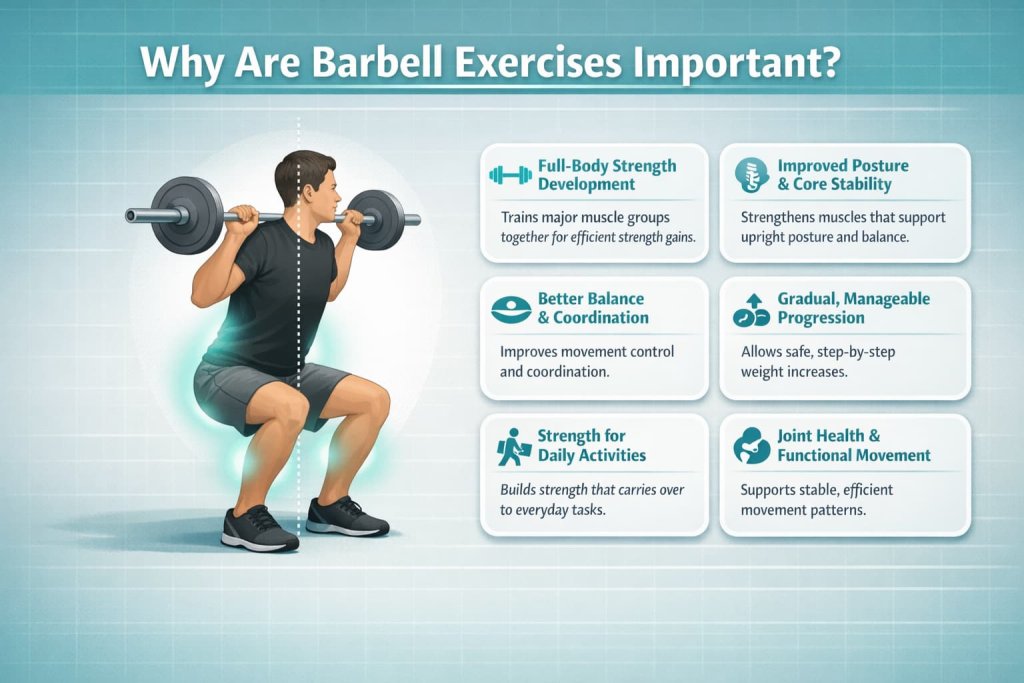
- Small, manageable weight progression
- Strength carryover to daily activities
- Supports joint health and functional movement
Why Barbell Exercises Are Great for Beginners
Barbell training gives beginners a structured, effective way to build full-body strength. Research from ACSM (2024) and Harvard Health shows that strength training may support:
- Improved muscle growth and strength
- Higher metabolism and healthier body composition
- Better posture and joint stability
- Increased bone density (important for long-term health)
- Reduced risk of chronic diseases such as diabetes and heart disease
Because the barbell allows precise load increments, beginners can progress steadily without needing advanced techniques.
Key advantages for beginners:
- Easy to track progress
- Works multiple muscles at once
- Builds foundational strength for all other exercises
- Highly customizable for different fitness levels
- Can be performed with light loads until technique improves
The 10 Best Barbell Exercises for Beginners
The exercises below are the most effective and beginner-friendly barbell movements for building full-body strength safely and efficiently. Each lift teaches proper technique, improves functional movement, and helps you progress with confidence.
1. Barbell Back Squat
Why it works:
The back squat trains your entire lower body while also improving core stability and posture. It strengthens the muscles used for walking, climbing stairs, lifting objects, and maintaining balance, making it one of the best foundational movements for beginners.
Muscles worked:
Quadriceps, glutes, hamstrings, core, lower back, calves.
How to do it:
- Stand with the bar placed across your upper back (not on your neck).
- Take a shoulder-width stance with toes slightly turned out.
- Brace your core before moving.
- Push hips back and bend your knees to lower into a squat.
- Go to parallel or your comfortable depth.
- Push through your heels to return to standing.
Trainer Tip:
Focus on keeping your chest lifted and core braced. Use only the empty bar until you can squat with control and consistent depth.
2. Barbell Deadlift
Why it works:
The deadlift builds full-body strength, teaches proper hip hinge mechanics, and improves your ability to lift safely in daily life. It enhances grip strength and posterior-chain development, crucial for posture and injury prevention.
Muscles worked:
Glutes, hamstrings, lower back, lats, traps, core, forearms.
How to do it:
- Stand with feet hip-width and the bar over your midfoot.
- Bend your knees slightly and hinge at the hips to grip the bar.
- Keep your back flat and shoulders above the bar.
- Push through your heels and stand tall while pulling the bar close to your body.
- Lower the bar by hinging back at the hips with control.
Trainer Tip:
Think “push the floor away” rather than “pull the bar up”—this helps you avoid rounding your back.
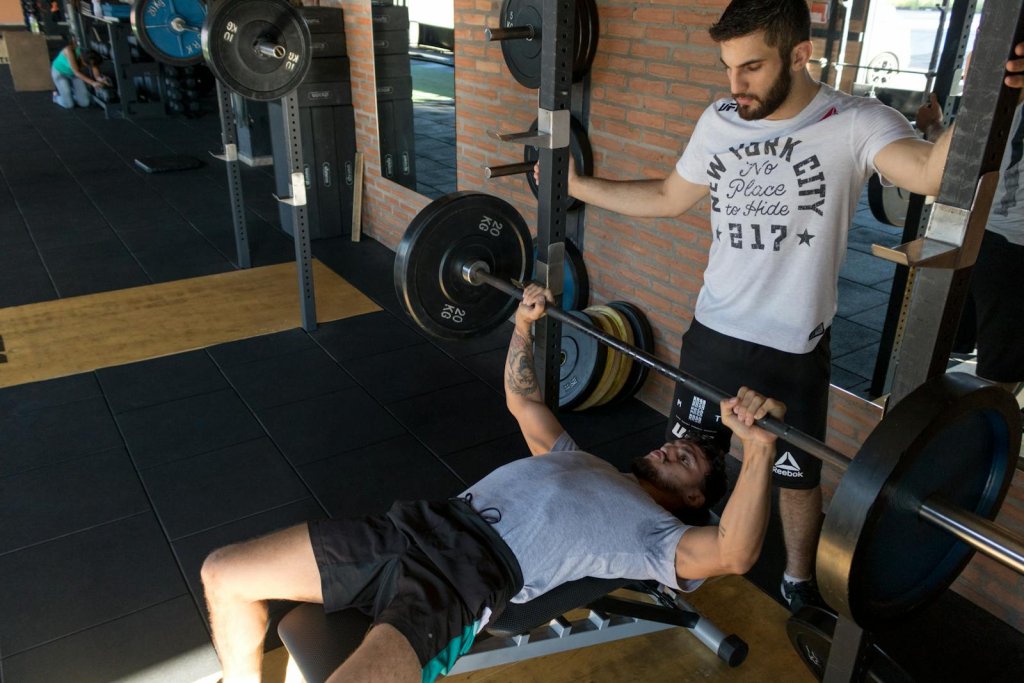
3. Barbell Bench Press
Why it works:
The bench press strengthens your chest, shoulders, and triceps, improving pushing power for daily movements and upper-body strength development. It’s a beginner-friendly introduction to barbell pressing.
Muscles worked:
Chest (pectorals), triceps, front shoulders, upper back (stabilizers).
How to do it:
- Lie on the bench with feet planted firmly.
- Grip the bar slightly wider than shoulder-width.
- Lower the bar to mid-chest while keeping elbows at a 45° angle.
- Press the bar upward until arms are straight.
Trainer Tip:
Keep your shoulders pulled back on the bench to protect the joints and improve power. Use a spotter when learning.
4. Barbell Overhead Press
Why it works:
This lift strengthens your shoulders while training the core to stabilize your spine. It improves posture and upper-body control, making it one of the best beginner barbell pressing movements.
Muscles worked:
Shoulders (deltoids), triceps, upper chest, upper back, core.
How to do it:
- Stand with the bar resting at your shoulders.
- Brace your core and squeeze your glutes.
- Press the bar straight overhead.
- Lower the bar to the starting position with control.
Trainer Tip:
Avoid arching your lower back—keep your ribs pulled down and glutes tight to maintain a neutral spine.
5. Barbell Bent-Over Row
Why it works:
This exercise strengthens the upper back and improves posture, helping counteract the effects of sitting and rounded shoulders. It also trains grip strength and stabilizes the core.
Muscles worked:
Lats, rhomboids, traps, rear delts, biceps, core.
How to do it:
- Hinge forward at the hips with a neutral spine.
- Grip the bar shoulder-width.
- Pull the bar toward your lower ribs.
- Lower the bar under control.
Trainer Tip:
Imagine squeezing your shoulder blades together on each rep—this improves upper-back engagement and prevents arm-dominant pulling.
6. Barbell Romanian Deadlift (RDL)
Why it works:
The RDL isolates the hamstrings and glutes more than a traditional deadlift. It teaches safe hip hinging, improves mobility, and strengthens the posterior chain for long-term back health.
Muscles worked:
Hamstrings, glutes, lower back, core, forearms.
How to do it:
- Stand tall holding the bar with straight arms.
- Push hips back while keeping a soft bend in your knees.
- Lower the bar to mid-shin, keeping it close to your legs.
- Drive hips forward to stand tall.
Trainer Tip:
Think “hips back, not down”—this ensures you hinge rather than squat the weight.
7. Barbell Hip Thrust
Why it works:
Hip thrusts target the glutes more than almost any other barbell exercise. Strong glutes support lower-back health, improve athletic performance, and help beginners build posterior strength safely.
Muscles worked:
Glutes, hamstrings, core.
How to do it:
- Sit with your upper back supported on a bench.
- Roll the barbell into your hip crease.
- Drive hips upward until thighs are parallel to the floor.
- Lower your hips slowly.
Trainer Tip:
Keep your chin slightly tucked to avoid arching your lower back and to maintain better glute activation.
8. Barbell Front Squat
Why it works:
The front squat encourages an upright torso, reduces lower-back strain, and shifts the emphasis to the quads. It also improves mobility and posture—ideal for beginners learning squat mechanics.
Muscles worked:
Quadriceps, glutes, core, upper back.
How to do it:
- Hold the bar across your front shoulders in a front-rack position.
- Keep elbows lifted high.
- Squat down with chest tall.
- Drive through your heels to stand.
Trainer Tip:
If mobility limits your front-rack position, practice with just the bar or use a cross-arm hold until flexibility improves.
9. Barbell Lunges
Why it works:
Barbell lunges build unilateral strength, improve balance, and reduce strength imbalances between legs. They also enhance hip stability and control.
Muscles worked:
Quads, glutes, hamstrings, calves, core.
How to do it:
- Place the barbell across your upper back.
- Step forward into a lunge.
- Bend both knees to lower your body.
- Push through the front heel to return.
Trainer Tip:
Start with reverse lunges—they are easier to balance and place less stress on the knees.
10. Barbell Floor Press
Why it works:
The floor press reduces shoulder strain by limiting range of motion. It strengthens the chest and triceps while teaching control, making it a safe introduction to barbell pressing.
Muscles worked:
Chest, triceps, shoulders, upper back stabilizers.
How to do it:
- Lie on the floor with knees bent.
- Hold the bar above your chest.
- Lower elbows until they gently touch the floor.
- Press the bar back up.
Trainer Tip:
Pause briefly with elbows on the floor to reinforce control and reduce momentum—ideal for beginners mastering pressing mechanics.
How Many Sets, Reps, and Days per Week?
Based on ACSM and current strength guidelines:
For beginners:
- 2–3 days per week
- 1–3 sets per exercise
- 8–12 reps per set (muscle and strength building)
- Increase weight by 2–10% when reps feel easier than the target range.
Common Mistakes Beginners Should Avoid
Beginners often make avoidable errors that slow progress or increase injury risk. Knowing what to avoid helps ensure safer, more effective training with better technique from day one.
Mistakes to avoid:
- Lifting too heavy too soon
- Rounding the back during squats or deadlifts
- Arching the lower back during overhead presses
- Skipping warm-ups
- Using momentum instead of control
- Forgetting to brace the core
- Poor bar or grip positioning
- Ignoring mobility limitations
When to See a Healthcare Professional
While barbell training is generally safe, certain symptoms or conditions require medical guidance. Paying attention to warning signs helps protect your long-term health and ensures safe participation in strength training.
Seek professional help if you experience:
- Sharp or persistent pain
- Joint discomfort that worsens with lifting
- Dizziness or shortness of breath during exercise
- Numbness, tingling, or unusual weakness
- Recent injury or surgery affecting mobility
- Known heart, metabolic, or orthopedic conditions
Safety Guidelines for Barbell Beginners
To stay safe and support long-term progress:
- Warm up 5–7 minutes before lifting.
- Start with the empty bar until technique is stable.
- Keep movements slow and controlled.
- Stop if you feel sharp pain.
- If you have medical conditions, consult a healthcare professional before beginning strength training.
- Use safety pins or a spotter when bench pressing.
Common Questions Beginners Ask (FAQ)
1. How much weight should beginners start with?
Start with the empty bar (20 kg/45 lb) or lighter training bars until form improves.
2. Can beginners lift barbells safely?
Yes—research shows barbell training is safe when performed with proper technique and gradual progression.
3. How long before I see results?
Most beginners notice strength improvements within 2–4 weeks.
4. Should I train full body or split?
Full-body routines 2–3 days per week are ideal for beginners.
5. Can barbell training help with weight loss?
Strength training may increase metabolic rate and muscle mass, supporting fat loss when combined with proper nutrition.
6. Do I need a personal trainer?
Not required, but helpful for learning technique.
7. Should I avoid barbell lifts if I have joint pain?
Seek medical guidance first, especially for unresolved pain or medical conditions.
Conclusion
Barbells are one of the most powerful tools for beginners to build strength, confidence, and long-term fitness. By starting with simple, effective lifts, focusing on form, and progressing gradually, anyone can lift safely and achieve noticeable results.
Ready to build strength? Start with these 10 beginner barbell exercises and train consistently 2–3 times per week.
References
- American College of Sports Medicine (ACSM) – Progression Models in Resistance Training for Healthy Adults
- Centers for Disease Control and Prevention (CDC) – Physical Activity Guidelines for Adults
- World Health Organization (WHO) – Be Active: Physical Activity Guidelines (Includes Muscle-Strengthening)
- Westcott WL – Resistance Training Is Medicine: Effects of Strength Training on Health
- Harvard Health Publishing – Strength Training Builds More Than Muscles
- Mayo Clinic – Strength Training: Get Stronger, Leaner, Healthier
- Better Health Channel – Resistance Training: Health Benefits