
The best vertigo exercises are the ones that match the cause of your dizziness, especially whether you have BPPV (benign paroxysmal positional vertigo) or a different vestibular issue. If your vertigo is triggered by rolling in bed, looking up, or quick head turns, BPPV is a common reason—and specific repositioning maneuvers are often used to help. Clinical guidance also stresses that diagnosis matters because the “right” maneuver depends on which ear and canal are involved, as outlined in the American Academy of Otolaryngology–Head and Neck Surgery (AAO-HNS) BPPV guideline.
This guide covers five evidence-based options, how to do them safely, and when to stop and get medical evaluation.
What are vertigo exercises?
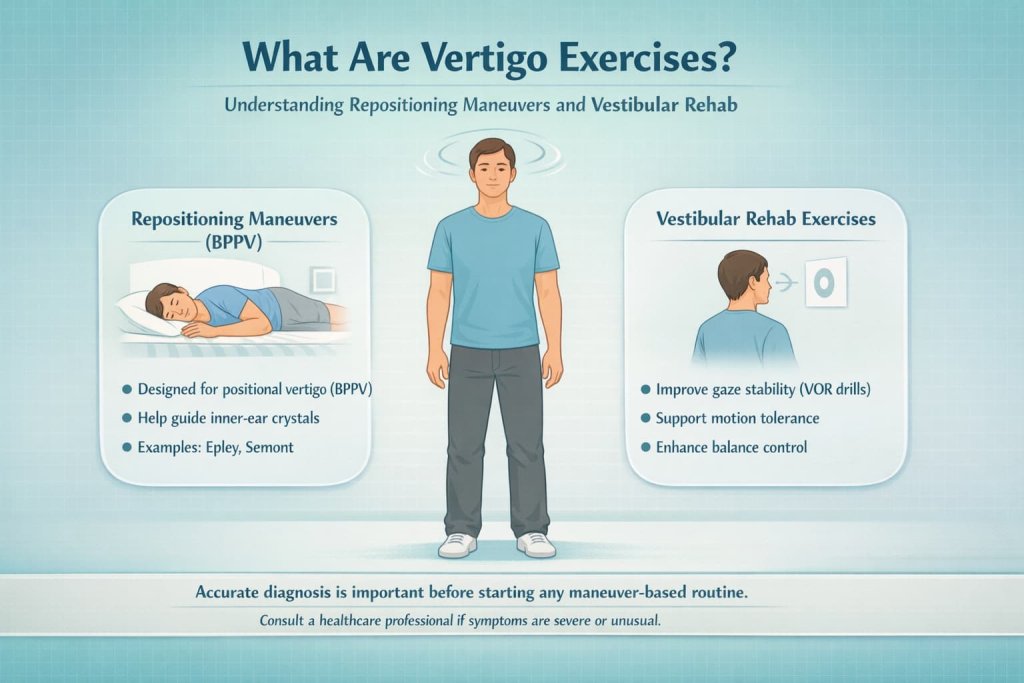
Vertigo exercises are targeted movements and drills designed to support inner-ear function, reduce dizziness triggers, and improve balance confidence. They generally fall into two categories:
- Repositioning maneuvers for BPPV (aimed at moving inner-ear crystals back to where they belong)
- Vestibular rehab exercises (aimed at improving gaze stability, motion tolerance, and balance control)
Accurate diagnosis is important before starting any maneuver-based routine.
Important Safety Guidelines Before Trying Vertigo Exercises
Vertigo exercises can help in many cases, but they are not suitable for every type of dizziness. Always prioritize safety and proper diagnosis before starting.
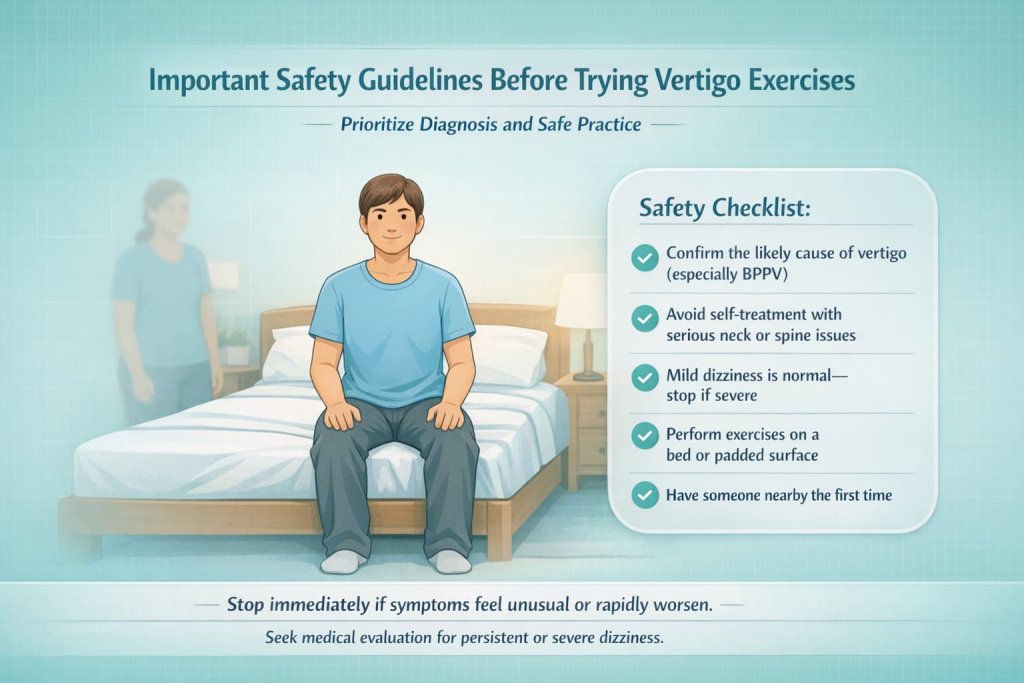
Keep these key guidelines in mind:
- Confirm the likely cause of your vertigo, especially if BPPV is suspected, as recommended by the American Academy of Otolaryngology–Head and Neck Surgery (AAO-HNS).
- Avoid self-treatment if you have serious neck, spine, or vascular conditions.
- Expect mild, brief dizziness — stop if symptoms are severe or unusual.
- Perform exercises on a bed or padded surface to reduce fall risk.
- Have someone nearby the first time you try a maneuver.
If symptoms feel different from your usual pattern or worsen quickly, stop and seek medical advice.
5 Best Vertigo Exercises
These 5 best vertigo exercises are designed to help reduce dizziness and improve balance safely at home. They include repositioning maneuvers for BPPV and simple vestibular drills to support stability and confidence.
1) Epley Maneuver (for common posterior canal BPPV)
Why it works:
The Epley is a canalith repositioning maneuver commonly used for posterior canal BPPV. It uses a sequence of head and body positions to help guide displaced inner-ear crystals back to a less sensitive area, which may reduce spinning triggered by position changes. The Cleveland Clinic describes this approach as a common first-line option for posterior canal BPPV.
Muscles worked:
Minimal direct strengthening effect; this is a positional maneuver. Some neck stabilizers activate lightly to hold positions.
How to do it:
- Start seated on a bed with a pillow positioned so it will support your shoulders when you lie back.
- Turn your head 45 degrees toward the affected side.
- Quickly lie back so your shoulders are on the pillow and your head is slightly extended; stay 30–60 seconds (or until spinning settles).
- Turn your head 90 degrees to the opposite side (without lifting it); hold 30–60 seconds.
- Roll your body onto the side you’re facing so your nose points slightly downward; hold 30–60 seconds.
- Slowly sit up and remain seated for a minute.
Trainer Tip:
If you’re unsure which side is affected or you have neck/back issues, follow medically reviewed instructions such as those from Johns Hopkins Medicine before attempting this at home.
2) Semont Maneuver (alternative for BPPV in some cases)
Why it works:
The Semont maneuver is another repositioning approach used for certain BPPV presentations. It relies on rapid side-to-side positioning to help move crystals out of a sensitive canal when clinically appropriate.
Muscles worked:
Minimal direct strengthening; light involvement of neck and trunk stabilizers for position changes.
How to do it:
- Sit on a bed with your head turned 45 degrees away from the affected side.
- Quickly lie down onto the affected side; keep the head turned and hold 30–60 seconds.
- In one motion, move quickly to the opposite side without changing head angle (your face will point down); hold 30–60 seconds.
- Return slowly to sitting and rest.
Trainer Tip:
Speed and correct setup matter here. If you feel unsafe doing quicker transitions, choose a slower home option or get supervised instruction.
3) Brandt-Daroff Exercises (home routine for positional dizziness)
Why it works:
Brandt-Daroff exercises are commonly provided as a home program to help reduce positional dizziness over time. Temporary dizziness during practice can happen, which is why safety setup matters, as described in patient guidance from the NHS.
Muscles worked:
Core and neck stabilizers lightly; the balance system is trained more than muscles.
How to do it:
- Sit upright on the edge of a bed.
- Turn your head 45 degrees to one side.
- Quickly lie down on the opposite side (your nose angled slightly up); hold 30 seconds or until dizziness eases.
- Return to sitting; wait 30 seconds.
- Repeat to the other side.
- Perform multiple repetitions as tolerated.
Trainer Tip:
If symptoms spike strongly or don’t settle between reps, shorten the range, slow down, and stop for the day.
4) Half Somersault (Foster Maneuver)
Why it works:
The Half Somersault is discussed as an at-home alternative for some people with BPPV, particularly those who find the Epley difficult to self-apply. Educational reporting from the University of Colorado Anschutz Medical Campus highlights it as a home-based option in certain cases.
Muscles worked:
Shoulders, arms, and core support in kneeling; light neck stabilization.
How to do it:
- Kneel and place your hands on the floor.
- Tuck your chin and bring your head down so the top of your head points toward the floor.
- Turn your head toward the affected side and hold briefly.
- Lift your head to back-flat level while keeping the head turned; hold briefly.
- Raise your torso to upright kneeling, then sit back to rest.
Trainer Tip:
Avoid this variation if kneeling or bending causes instability or strong blood-pressure changes.
5) Gaze Stabilization (VOR x1) for non-BPPV dizziness
Why it works:
If dizziness feels more like imbalance or visual blurring with head movement, vestibular rehabilitation may focus on gaze stabilization. Programs such as those described by Michigan Medicine use VOR drills to improve eye–head coordination.
Muscles worked:
Neck stabilizers lightly; the primary training effect is neuro-sensory coordination.
How to do it:
- Place a target at eye level (for example, a letter on paper).
- Keep eyes fixed on the target while slowly turning your head left and right.
- Maintain visual clarity as much as possible.
- Rest and repeat with up-and-down head movements if tolerated.
- Progress gradually to standing or busier environments.
Trainer Tip:
Symptoms should be mild and short-lived. If they escalate or linger, reduce speed and duration.
How to choose the right vertigo exercise
- Spinning with rolling in bed or looking up often suggests BPPV.
- General imbalance or motion sensitivity may respond better to gaze and balance training.
- Dizziness with hearing changes requires medical evaluation before self-treatment.
Quick safety checklist before you try vertigo exercises
Vertigo exercises should feel challenging but controlled. Stop and seek medical advice first if you have:
- New one-sided weakness, facial droop, trouble speaking, or severe headache
- Fainting, chest pain, or severe shortness of breath
- Sudden hearing loss, new ringing in one ear, or ear drainage
- Recent head/neck trauma
- Neck or spine problems that make head positioning unsafe
Many maneuvers can briefly worsen dizziness or nausea. Do them on a bed or padded surface, move slowly, and consider having someone nearby.
When to See a Doctor for Vertigo
Many positional vertigo cases improve with proper exercises, but some symptoms require medical evaluation.
Seek urgent care if you have:
- Sudden weakness, facial droop, or trouble speaking
- Severe or sudden headache
- Double vision or vision loss
- Fainting or chest pain
Schedule a doctor visit if you notice:
- Vertigo lasting more than 1–2 weeks
- New or one-sided hearing loss
- Persistent ringing in one ear
- Worsening or recurring episodes
As explained by Johns Hopkins Medicine, vertigo can sometimes be linked to conditions that require proper diagnosis and treatment.
FAQs About Vertigo Exercises
Do vertigo exercises work for everyone?
They may help many people, but effectiveness depends on the cause of vertigo.
Can I do the Epley maneuver at home?
Some individuals can safely perform it at home using medically reviewed guidance.
Why do I feel worse during the exercise?
Temporary symptom increases can happen. Stop if symptoms are severe or persistent.
How long does it take to see improvement?
Some BPPV cases improve quickly, while vestibular rehab may take consistent practice over weeks.
When should I see a doctor?
Seek urgent care for stroke-like symptoms or persistent, worsening, or unusual dizziness.
Conclusion
Vertigo exercises can support balance and reduce dizziness when correctly matched to the underlying cause. Focus on safety, move slowly, and stop if symptoms feel unusual or severe. If you’re unsure of the cause or not improving, professional evaluation ensures you’re using the right approach.
This content is for informational purposes only and not medical advice.