
A burpee is a full-body bodyweight exercise that quickly raises your heart rate while training your legs, core, and upper body at the same time.
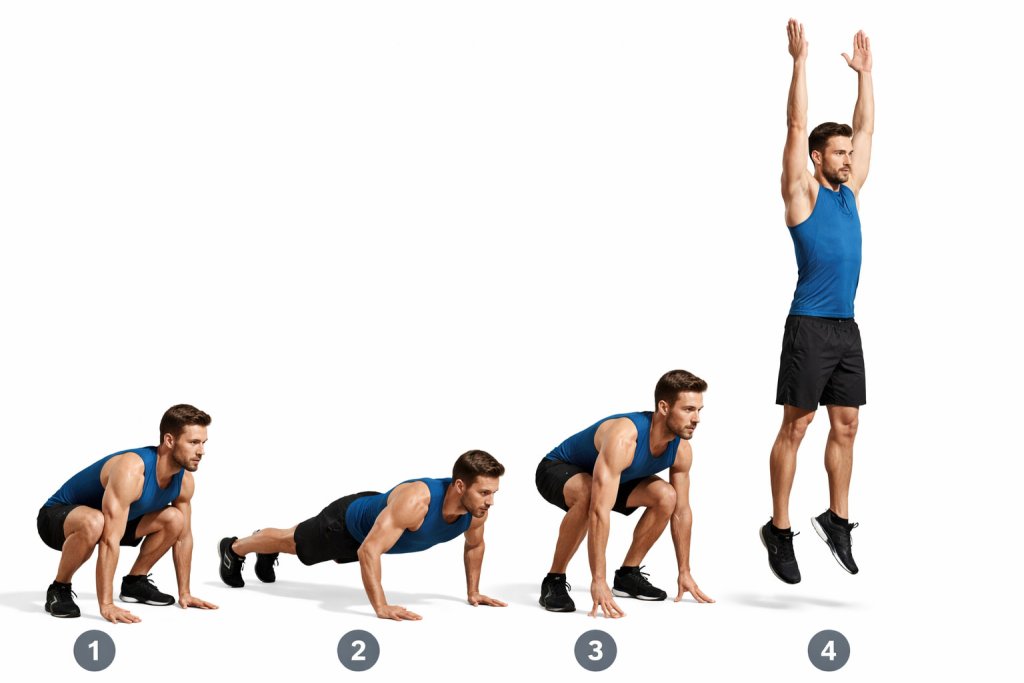
Because it blends strength-style positions (squat and plank/push-up) with fast transitions, burpees are a simple way to build conditioning with zero equipment when you use good form and scale the intensity to your level.
What Is a Burpee
A standard burpee is a repeating sequence of bodyweight positions that moves from standing to the floor and back up again.
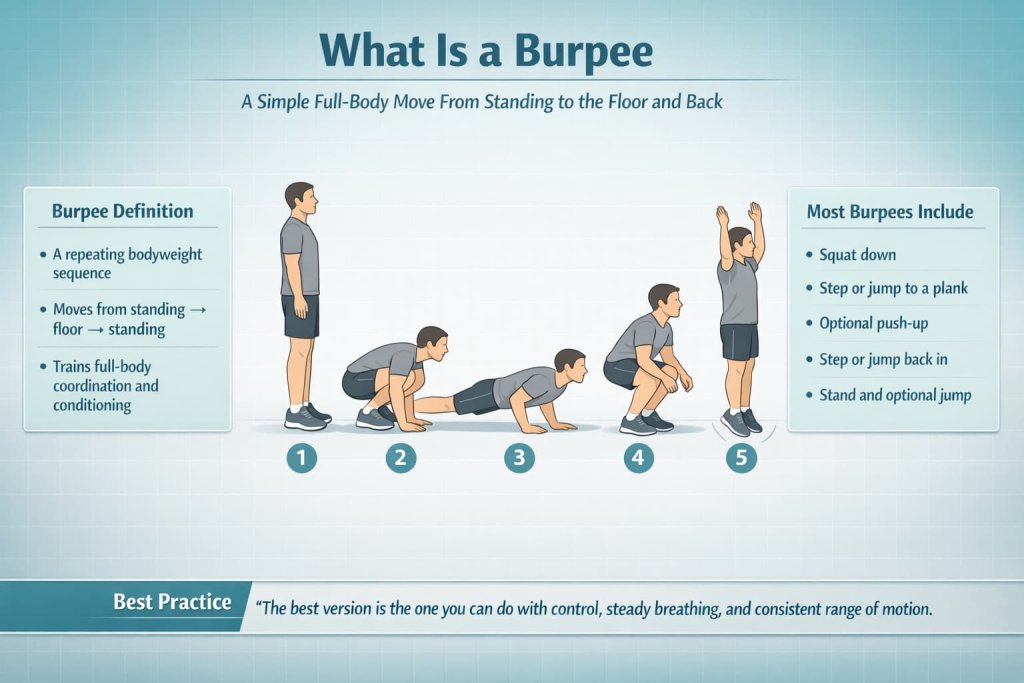
Most versions include:
- A squat down
- A step or jump to a plank
- An optional push-up
- A step or jump back in
- A stand and optional jump
The “best” version is the one you can perform with control, consistent range of motion, and steady breathing—especially when you start getting tired.
How to Do a Burpee With Proper Form
Use this sequence as your “clean rep” standard.
Key form cues
- Keep your ribs stacked over your pelvis as you squat down (avoid excessive low-back arching).
- Put your hands down under your shoulders (not too far forward).
- Step back to a solid plank first if you’re learning (jumping back too soon often causes sagging hips).
- Keep your neck neutral (look slightly ahead of your hands, not straight up).
- Land softly if you jump (quiet feet, knees tracking over toes).
Common mistakes to avoid
- Collapsing into the lower back in the plank
- Letting knees cave in during the squat or landing
- “Worming” up from the floor (arching then snapping hips up)
- Rushing reps so fast that range of motion disappears
What Muscles Do Burpees Work
Burpees are “full-body” because different parts of the movement load different muscle groups:
- Lower body: quads, glutes, hamstrings, calves (squat + stand/jump)
- Core: abs and deeper trunk stabilizers (plank stability + transitions)
- Upper body: chest, shoulders, triceps (plank and push-up portions)
If you remove the push-up or jump, you reduce stress and intensity while still training a lot of the same muscles.
Benefits of Burpees for Strength and Cardio
Burpees are popular because they train multiple qualities at once.
Burpees build cardiovascular fitness fast
Burpees usually feel intense because they involve large muscle groups and quick transitions. In the Adult Compendium of Physical Activities, vigorous “burpees/Tabata-style” conditioning work is commonly listed around 11 METs, which helps explain why your heart rate climbs quickly during sets, as shown in the Physical Activity Compendium.
Burpees train full-body strength endurance
Burpees reinforce basic patterns (squat, plank, push-up) under fatigue. That can build strength endurance that transfers well to general fitness and sports conditioning.
Burpees are time-efficient
If you have limited time, burpees can combine strength and conditioning in one short session. This is one reason HIIT-style training is widely used; a practical overview is available from the American College of Sports Medicine (ACSM).
Burpee Variations and Modifications
Scaling burpees is normal. Choose a version that matches your joints, fitness level, and goals. Below are the most useful variations, written in the exact format you requested.
1. Step-Back Burpee (No Jump)
Why it works:
This is the best “learning” burpee because it slows the floor transition, helps you maintain a solid plank, and reduces impact while still training the full-body pattern.
Muscles worked:
Quads, glutes, hamstrings, calves (less than jumping versions), core stabilizers, shoulders, chest, triceps (mostly plank support).
How to do it:
- Stand tall with feet about hip-width
- Squat down and place hands under shoulders
- Step one foot back, then the other into a firm plank
- Hold a tight core (no sagging hips), then step one foot in, then the other
- Stand up tall and reset (no jump)
Trainer Tip:
Think “plank first, speed second.” If your hips dip when you step back, slow down and brace harder before moving your feet.
2. No-Jump Burpee + Stand Tall
Why it works:
You keep the full burpee flow while removing the highest-impact part (the jump and landing). This makes it more joint-friendly while still keeping your heart rate up.
Muscles worked:
Quads, glutes, hamstrings, core stabilizers, shoulders and chest (plank support), calves (minimal).
How to do it:
- Squat down and put hands on the floor under your shoulders
- Step or hop back into a stable plank (choose your level)
- Step or hop back in so feet return under hips
- Stand up tall and squeeze glutes at the top (no jump)
Trainer Tip:
Stand fully at the top every rep. That simple “finish” keeps the movement honest and improves conditioning without needing impact.
3. Elevated Hands Burpee (Bench or Couch)
Why it works:
Elevation reduces the load on your upper body and decreases wrist extension. It’s a great option if standard floor burpees bother your wrists, shoulders, or low back.
Muscles worked:
Quads and glutes, core stabilizers, shoulders/chest/triceps (reduced compared to floor), plus hip flexors during the step-in.
How to do it:
- Place hands on a sturdy bench/couch, shoulder-width
- Walk feet back into a straight-line plank (body rigid)
- Step or hop feet in toward your hands
- Stand up tall and repeat
Trainer Tip:
Use a height that lets you keep a flat back and strong plank. If your hips sag, raise the surface or switch to step-backs.
4. Fast-Feet Burpee (Cardio Emphasis)
Why it works:
Fast-feet burpees keep your heart rate high with less vertical jumping. It’s often easier to maintain rhythm and breathing compared to full jump-high reps.
Muscles worked:
Quads, glutes, calves, core stabilizers, shoulders (plank support), plus high cardiovascular demand.
How to do it:
- Drop hands to the floor and step/jump back to plank
- Quickly step one foot in, then the other (like “running feet”)
- Pop up to standing (optional small hop)
- Repeat with a steady, fast rhythm
Trainer Tip:
Keep your hips level during the “running feet.” If your hips twist side to side, slow down and shorten the step.
5. Burpee With Strict Push-Up (Strength Emphasis)
Why it works:
Adding a strict push-up shifts the burpee toward strength endurance, especially for the chest, shoulders, and triceps, while also forcing better trunk stiffness.
Muscles worked:
Chest, shoulders, triceps, core stabilizers, plus quads and glutes for the squat and stand/jump.
How to do it:
- Squat down, hands under shoulders
- Step or jump back into plank
- Perform one strict push-up (body in one line)
- Step or jump feet in
- Stand up (optional jump) and repeat
Trainer Tip:
If your push-up turns into a “worm,” remove the push-up or elevate your hands. A clean rep is the goal.
6. Burpee Broad Jump (Power Emphasis)
Why it works:
This variation adds horizontal power output. It’s a useful athletic progression, but only if your knees, ankles, and hips tolerate impact well.
Muscles worked:
Glutes, quads, hamstrings, calves (powerful jump), core stabilizers, plus shoulders/chest for plank support.
How to do it:
- Perform a standard burpee up to the point you return your feet under you
- Instead of a vertical jump, explode forward into a broad jump
- Land softly with knees over toes
- Turn around, reset, and repeat
Trainer Tip:
Keep jumps short and controlled at first. If you can’t stick the landing quietly, reduce distance or switch back to no-jump reps.
7. Tuck-Jump Burpee (Power and Conditioning)
Why it works:
This is a high-intensity option that spikes heart rate and demands explosive control. It’s advanced and not necessary for most people.
Muscles worked:
Quads, glutes, calves, hip flexors (tuck), core stabilizers, plus shoulders/chest for plank support.
How to do it:
- Perform a standard burpee
- At the top, jump and pull knees up toward your torso (controlled tuck)
- Land softly and go straight into the next rep
Trainer Tip:
Only use tuck jumps if your landing mechanics are excellent. If knees cave in or landings get loud, switch to a regular jump or no-jump burpee.
Common Burpees Mistakes and Quick Fixes
Burpees work best when every rep stays controlled. Use these quick, simple fixes.
- Hands too far forward: Put hands under shoulders before stepping/jumping back.
- Hips sag in plank: Brace + squeeze glutes; switch to step-back or elevate hands if needed.
- “Worming” off the floor: Move as one unit; remove the push-up until you can stay rigid.
- Knees cave in: Keep knees tracking over toes; slow down and drop the jump.
- Loud landings: Land soft and quiet with knees slightly bent.
- Half reps/rushed tempo: Hit a real plank, bring feet under hips, then stand tall every rep.
- Breath holding: Exhale up, inhale down; rest longer if breathing breaks.
- Too much volume: Start with small sets (3–5 reps) and stop when form slips.
How Many Burpees Should You Do
There isn’t one perfect number. Use your goal and current fitness to guide volume.
Practical starting points
- Beginners: 3–5 sets of 5 reps (rest as needed, keep form strict)
- Intermediate: 6–10 reps per set for 4–6 sets
- Conditioning blocks: 20–60 seconds of work with 60–120 seconds rest
If reps get sloppy, stop the set. Quality burpees beat “ugly” burpees every time.
Sample Burpee Workouts You Can Use
These are simple templates you can plug into a week.
Workout A: Beginner burpee builder (10–12 minutes)
- 5 reps (step-back, no jump)
- Rest 60–90 seconds
- Repeat 6–8 rounds
Workout B: Cardio interval burpees (12–16 minutes)
- 20 seconds burpees
- 70 seconds easy walk/breathing
- Repeat 10–12 rounds
Workout C: Strength-leaning burpees (10–15 minutes)
- 6 reps burpee + strict push-up
- Rest 90 seconds
- Repeat 6–8 rounds
Safety Tips and Who Should Modify Burpees
Burpees can be a great tool, but the combination of impact, floor transitions, and pushing can be uncomfortable for some people.
Consider modifying if you have:
- Wrist pain with weight-bearing on hands
- Shoulder irritation with push-ups
- Knee discomfort with jumping or fast squatting
- Low-back discomfort when holding a plank under fatigue
A simple, safer default is: step back, step in, no jump, and/or elevate your hands until you can hold strong positions comfortably.
How Burpees Fit Into Weekly Fitness Goals
If you’re using burpees as vigorous cardio, they can contribute toward general weekly activity targets like 150 minutes of moderate-intensity exercise or 75 minutes of vigorous-intensity exercise (plus strength training), as summarized by the American Heart Association (AHA). Keep in mind that total weekly training should be balanced with recovery.
FAQs About Burpees
Are burpees good for weight loss?
Burpees can help you burn more energy because they’re vigorous and use large muscle groups. Long-term results still depend on overall weekly activity, nutrition, sleep, and consistency.
Do burpees build muscle?
Burpees build strength endurance and can support muscle maintenance or growth, especially in beginners. For bigger strength and muscle gains, pair them with progressive resistance training.
Are burpees bad for your knees?
They can be irritating if you jump and land hard or collapse inward at the knees. Try no-jump burpees, step-backs, and slower reps while improving squat and landing mechanics.
Are burpees bad for your back?
They can be if your plank position sags or you “worm” up from the floor. Step back to a tight plank, keep ribs stacked, and stop sets when form breaks.
What’s the best burpee variation for beginners?
A step-back burpee with no jump is usually the most beginner-friendly because it reduces impact and helps you learn plank control.
How often should I do burpees?
2–4 times per week works for many people, depending on recovery and your total training. Start with fewer reps, keep form clean, and build gradually.
Do I need to do the push-up in a burpee?
No. Removing the push-up is a valid modification. Add it back when your plank and push-up form stay strong under fatigue.
Conclusion
Burpees are a simple, equipment-free way to train your whole body and boost cardio in a short time. Start with a scaled version you can control, keep reps clean, and progress slowly by adding reps, adding a push-up, or shortening rest.
References
- PubMed Central (PMC) — Herrmann SD, et al. (2024). 2024 Adult Compendium of Physical Activities: A third update of the Compendium of Physical Activities. Journal of Sport and Health Science.
- PubMed Central (PMC) — Atakan MM, et al. (2021). Evidence-Based Effects of High-Intensity Interval Training on Exercise Capacity and Health. Sports Medicine.
- Centers for Disease Control and Prevention (CDC) — Adult Physical Activity Guidelines (Overview).
- PubMed Central (PMC) — Bull FC, et al. (2020). World Health Organization 2020 Guidelines on Physical Activity and Sedentary Behaviour. British Journal of Sports Medicine.