
Osteoporosis exercises are safe, targeted movements that help maintain bone strength, improve balance, and reduce fracture risk when performed correctly. Regular exercise is a core part of osteoporosis management because bones respond to controlled loading, muscles support fragile joints, and better balance lowers the risk of falls.
This guide explains the 10 best osteoporosis exercises, why they matter, and how to use them safely at home or in a structured program.
What Are Osteoporosis Exercises?
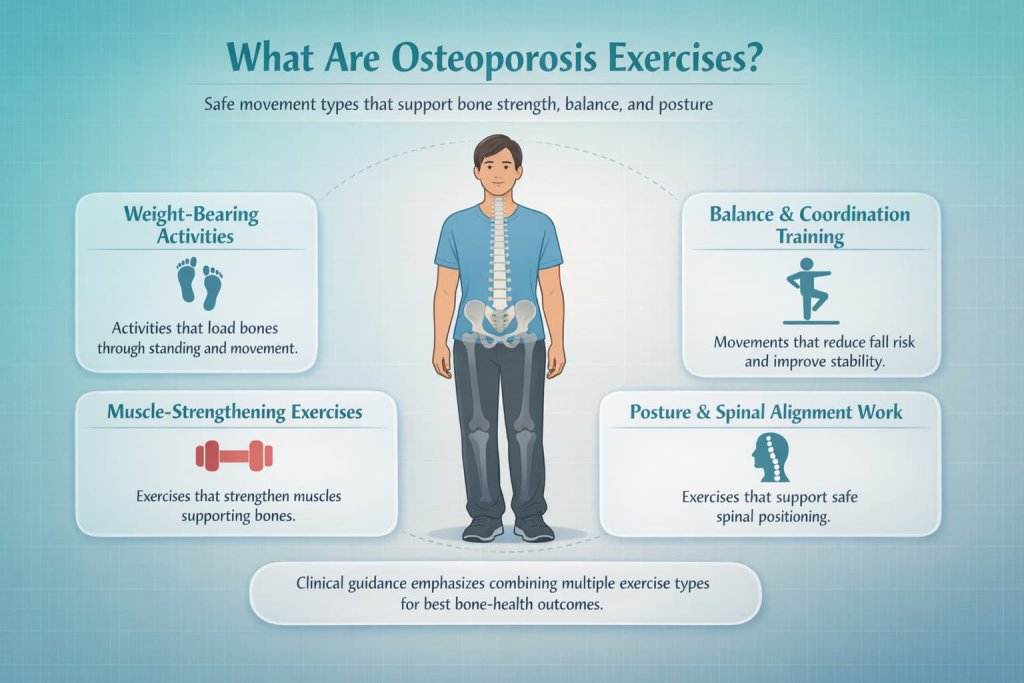
Osteoporosis exercises are movements designed to place safe, controlled stress on bones and muscles to support bone maintenance and functional strength. They typically fall into four evidence-based categories:
- Weight-bearing activities
- Muscle-strengthening (resistance) exercises
- Balance and coordination training
- Posture and spinal alignment work
Clinical guidance from the Mayo Clinic and the American College of Sports Medicine emphasizes that no single exercise type is enough on its own—a combination produces the best outcomes.
Why Osteoporosis Exercises Matter
Osteoporosis weakens bone structure, increasing the risk of fractures from minor falls or daily movements. Proper exercise may help:
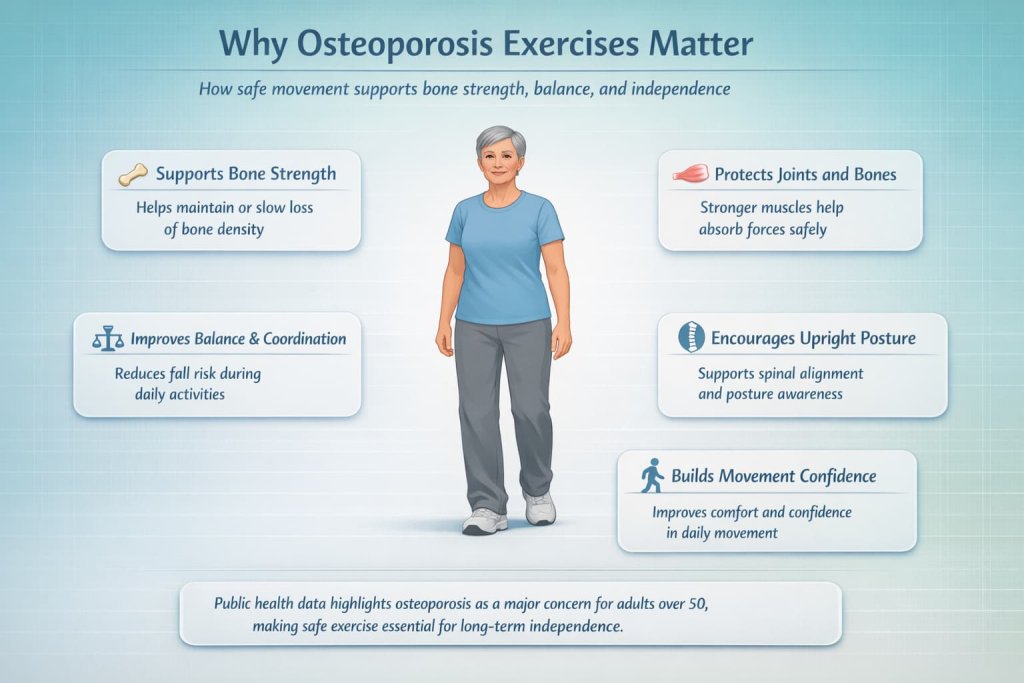
- Maintain or slow loss of bone density
- Improve muscle strength that protects joints and bones
- Enhance balance and coordination to reduce fall risk
- Support upright posture and spinal alignment
- Improve confidence in daily movement
According to public health data summarized by the Centers for Disease Control and Prevention, osteoporosis affects millions of adults over age 50, making safe movement strategies a critical part of long-term independence.
10 Best Osteoporosis Exercises
These osteoporosis exercises focus on safe, weight-bearing, strength, balance, and posture movements that help support bone health. When performed with proper form and progression, they may improve stability, reduce fall risk, and support daily movement confidence.
1. Brisk Walking (Weight-Bearing)
How to do it:
- Walk upright with your head tall, shoulders relaxed, and eyes forward
- Take purposeful steps, allowing your arms to swing naturally
- Aim for a pace that slightly increases breathing but still allows conversation
- Start with 10–15 minutes and gradually increase duration as tolerated
Why it works:
Brisk walking is a low-impact, weight-bearing activity that applies repeated, gentle loading through the hips, legs, and spine. This mechanical stress signals bones to maintain strength while also supporting cardiovascular health and endurance, making it a foundational exercise for osteoporosis management.
Muscles worked:
Glutes, quadriceps, hamstrings, calves, hip stabilizers, and core support muscles.
Trainer Tip:
Avoid shuffling or overly short steps—slightly longer, controlled strides increase bone loading without adding impact.
2. Sit-to-Stand (Chair Squats)
How to do it:
- Sit tall on a sturdy chair with feet hip-width apart
- Lean slightly forward from the hips while keeping your spine neutral
- Press through your heels to stand up
- Slowly lower back to the chair under control
Why it works:
Sit-to-stand trains a movement pattern used multiple times per day. It loads the hips and thighs safely while reinforcing proper alignment, helping maintain functional strength essential for independence and fall prevention.
Muscles worked:
Quadriceps, glutes, hamstrings, core stabilizers.
Trainer Tip:
Use your hands only as needed. Reducing hand support over time safely increases bone and muscle stimulus.
3. Standing Heel Raises
How to do it:
- Stand holding a chair or counter for support
- Slowly rise onto the balls of your feet
- Pause briefly at the top
- Lower your heels back to the floor with control
Why it works:
Heel raises place controlled load through the ankle and lower leg bones, which are common fracture sites. They also strengthen muscles essential for walking stability and balance.
Muscles worked:
Gastrocnemius, soleus, intrinsic foot muscles, ankle stabilizers.
Trainer Tip:
Lowering slowly is just as important as lifting—controlled eccentric movement improves strength and stability.
4. Resistance Band Rows
How to do it:
- Anchor a resistance band at chest height
- Hold the band with arms extended and chest lifted
- Pull elbows back toward your sides while squeezing shoulder blades together
- Slowly return to the start position
Why it works:
Band rows strengthen the upper-back muscles that support spinal alignment. Improving posture reduces excessive spinal flexion stress, which is particularly important for people with osteoporosis.
Muscles worked:
Upper back (rhomboids, trapezius), rear shoulders, biceps, spinal stabilizers.
Trainer Tip:
Focus on posture, not resistance level. Proper alignment matters more than band tension.
5. Wall Push-Ups
How to do it:
- Stand facing a wall with hands at chest height
- Step feet slightly back to create a gentle incline
- Bend elbows to bring chest toward the wall
- Press away to return to the starting position
Why it works:
Wall push-ups strengthen the upper body while keeping spinal load low. They provide bone-loading stimulus through the arms and shoulders without requiring floor transitions.
Muscles worked:
Chest, shoulders, triceps, core stabilizers.
Trainer Tip:
The farther your feet are from the wall, the more challenging the exercise—progress gradually.
6. Single-Leg Balance Hold
How to do it:
- Stand near a chair or counter for support
- Shift weight onto one leg
- Lift the opposite foot slightly off the floor
- Hold for 10–30 seconds, then switch sides
Why it works:
Balance training improves neuromuscular control and reduces fall risk, which is one of the most important factors in preventing osteoporotic fractures.
Muscles worked:
Ankle stabilizers, glutes, hip abductors, core muscles.
Trainer Tip:
Balance quality matters more than duration—stay upright and controlled rather than holding longer with poor form.
7. Step-Ups (Low Height)
How to do it:
- Stand facing a low step or platform
- Step one foot onto the platform
- Press through the heel to stand up
- Step back down slowly and repeat
Why it works:
Step-ups safely load the hips and thighs while mimicking stair climbing, a common daily activity. They improve leg strength and coordination with controlled impact.
Muscles worked:
Glutes, quadriceps, hamstrings, calves.
Trainer Tip:
Keep the step height low to avoid excessive joint stress—control is more important than height.
8. Standing Hip Abduction
How to do it:
- Stand holding a chair for balance
- Shift weight onto one leg
- Slowly move the other leg out to the side
- Return to center without leaning
Why it works:
Hip abduction strengthens muscles that stabilize the pelvis during walking. Strong hip stabilizers may help reduce sideways falls, which are linked to hip fractures.
Muscles worked:
Gluteus medius, gluteus minimus, hip stabilizers.
Trainer Tip:
Avoid leaning your torso—small, controlled movement is most effective.
9. Back Extension (Neutral Spine)
How to do it:
- Stand tall or lie face down with a neutral spine
- Gently engage your back muscles to lift your chest slightly
- Keep the movement small and controlled
- Return slowly to the starting position
Why it works:
Neutral-spine extension strengthens muscles that support upright posture without placing the spine into risky flexion. This is especially important for vertebral fracture prevention.
Muscles worked:
Spinal extensors, glutes, postural muscles.
Trainer Tip:
Think “lengthen” rather than “bend”—the goal is support, not range of motion.
10. Tai Chi or Controlled Movement Flow
How to do it:
- Perform slow, continuous movements
- Shift weight smoothly from one leg to the other
- Maintain upright posture throughout
- Coordinate breathing with movement
Why it works:
Tai chi emphasizes balance, coordination, and body awareness. Research and public-health guidance show it can significantly reduce fall risk, making it highly valuable for people with osteoporosis.
Muscles worked:
Leg muscles, core stabilizers, postural muscles, balance systems.
Trainer Tip:
Move slowly enough that you can feel control at every transition—speed reduces the balance benefit.
How Often Should You Do Osteoporosis Exercises?
Most clinical guidance recommends:
- Weight-bearing activity: most days of the week
- Strength training: 2–3 days per week
- Balance training: daily or near-daily
- Posture exercises: frequently throughout the week
Programs reviewed by the International Osteoporosis Foundation suggest that consistency over several months is more important than intensity.
Who Should and Should Not Do Osteoporosis Exercises
Who should do osteoporosis exercises:
- Adults diagnosed with osteoporosis or low bone density
- Postmenopausal women and men over age 50
- Older adults aiming to improve balance, strength, and mobility
- Individuals cleared for exercise by a healthcare professional
Who should seek medical guidance first:
- People with recent spine, hip, or wrist fractures
- Those with severe or rapidly progressing osteoporosis
- Individuals with significant balance problems or unexplained back pain
- Anyone unsure which exercises are safe for their condition
Guidance from organizations such as the Bone Health and Osteoporosis Foundation emphasizes that exercise should be individualized when fracture risk is high.
Exercises and Movements to Avoid With Osteoporosis
Certain movements may increase fracture risk and are generally discouraged for people with osteoporosis.
Common exercises and movements to avoid:
- Repeated or forceful spinal flexion (deep forward bending)
- Twisting motions of the spine under load
- High-impact activities such as jumping or running on hard surfaces
- Fast, uncontrolled movements that challenge balance
- Heavy lifting with a rounded or flexed spine
Clinical guidance from the Mayo Clinic stresses prioritizing controlled, posture-focused movement to protect the spine and hips.
Safety Guidelines Before You Start
Before beginning osteoporosis exercises, keep these evidence-based precautions in mind:
- Avoid repeated or forceful spinal flexion (deep forward bending), especially under load
- Move with slow, controlled tempo—no jerking or twisting
- Use support (chair, wall, rail) for balance as needed
- Start with bodyweight before adding resistance
- Consult a healthcare professional if you have a history of fractures or severe osteoporosis
Consensus statements such as the UK “Strong, Steady and Straight” guidelines stress that poorly chosen exercises may increase fracture risk, while well-designed programs improve safety and outcomes.
Frequently Asked Questions
Can exercise increase bone density with osteoporosis?
Exercise may help maintain bone density and slow bone loss, particularly when it includes weight-bearing and resistance training.
Are high-impact exercises safe for osteoporosis?
High-impact exercises may not be appropriate for everyone. Risk level depends on fracture history and bone density.
Is yoga safe for osteoporosis?
Some yoga poses may be safe, but deep spinal flexion or twisting should be avoided unless specifically modified.
How long does it take to see benefits?
Balance and strength improvements may appear within weeks, while bone-related changes take several months.
Should I exercise if I already have fractures?
Exercise is often still recommended but should be supervised and carefully selected.
Can seniors with osteoporosis exercise at home?
Yes, many osteoporosis exercises are home-friendly when performed with proper technique and support.
Conclusion
Osteoporosis exercises play a vital role in maintaining strength, balance, and confidence while protecting fragile bones. When chosen carefully and performed consistently, they support safer movement and long-term independence. Start conservatively, focus on quality over intensity, and build a routine that aligns with clinical guidance and your individual needs.
Next step: Choose 3–5 exercises from this list and perform them consistently, or consult a qualified professional to design a personalized osteoporosis exercise plan.
References
- International Osteoporosis Foundation: Exercise and Osteoporosis Brochure (PDF)
- Strong, Steady and Straight: UK Consensus Statement on Safe Exercise for Osteoporosis (Peer-Reviewed)
- CDC FastStats: Osteoporosis
- CDC: Physical Activity Guidelines for Older Adults
- ACSM: Physical Activity Guidelines Resources