
Pilates mat exercises for beginners are a low-impact way to build core strength, improve posture control, and learn safer movement patterns using your body weight and breath. Starting with simple, well-cued mat exercises helps you build the control-first foundation Pilates is known for—without equipment or advanced choreography.
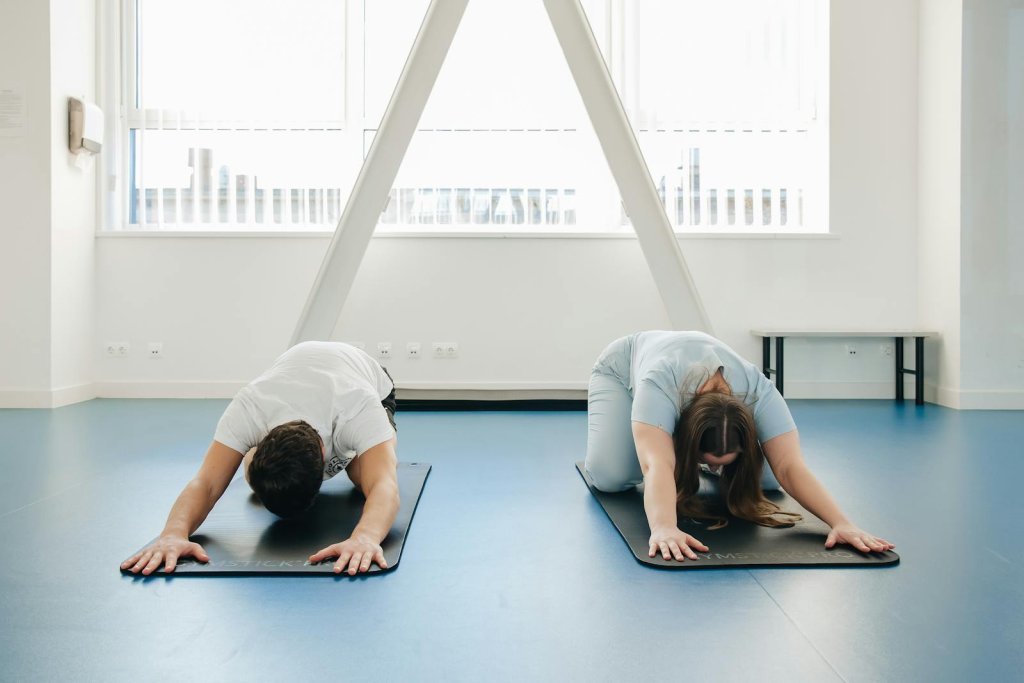
Pilates is commonly described as a full-body method that emphasizes controlled movement, breathing, and stability.
What Are Pilates Mat Exercises for Beginners?
Pilates mat exercises for beginners are floor-based movements that use body weight, breathing, and controlled motion to develop strength, stability, and body awareness. Unlike advanced Pilates routines, beginner mat exercises focus on simple positions, slower pacing, and smaller ranges of motion.
These exercises are designed to:
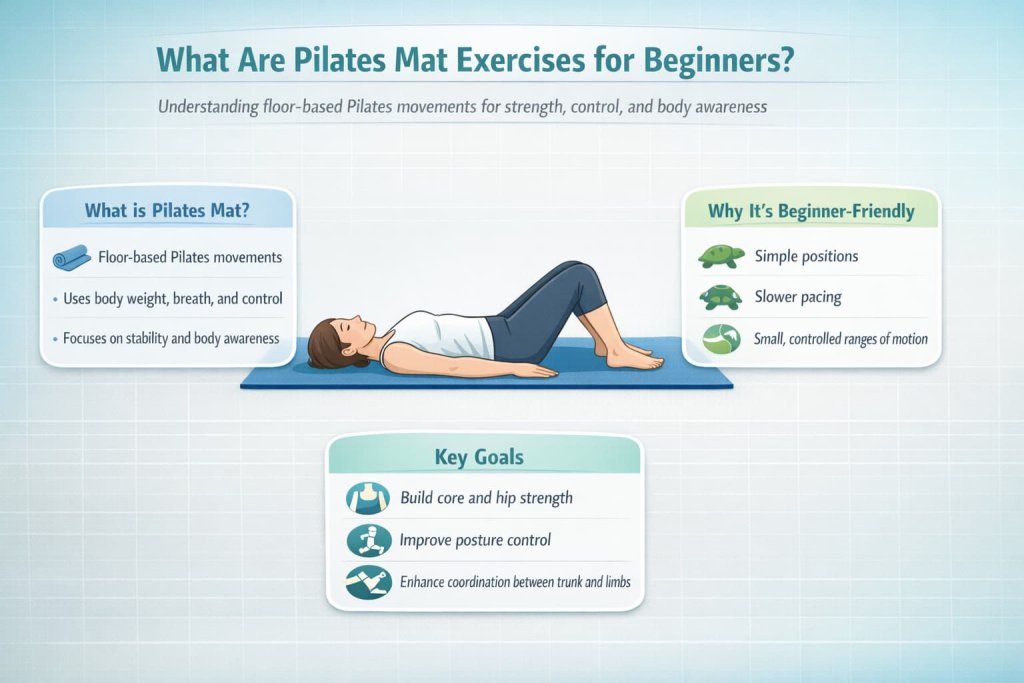
- Teach proper breathing and posture control
- Build foundational core and hip strength
- Improve coordination between the trunk and limbs
- Emphasize movement quality over intensity
Because mat Pilates requires minimal equipment and can be easily modified, it is often recommended as a starting point for people new to structured movement or returning to exercise after a break.
What beginners should know before starting Pilates mat exercises
Pilates may look gentle, but it still challenges strength and coordination. The goal is not speed—it’s control.
Keep these principles in mind:
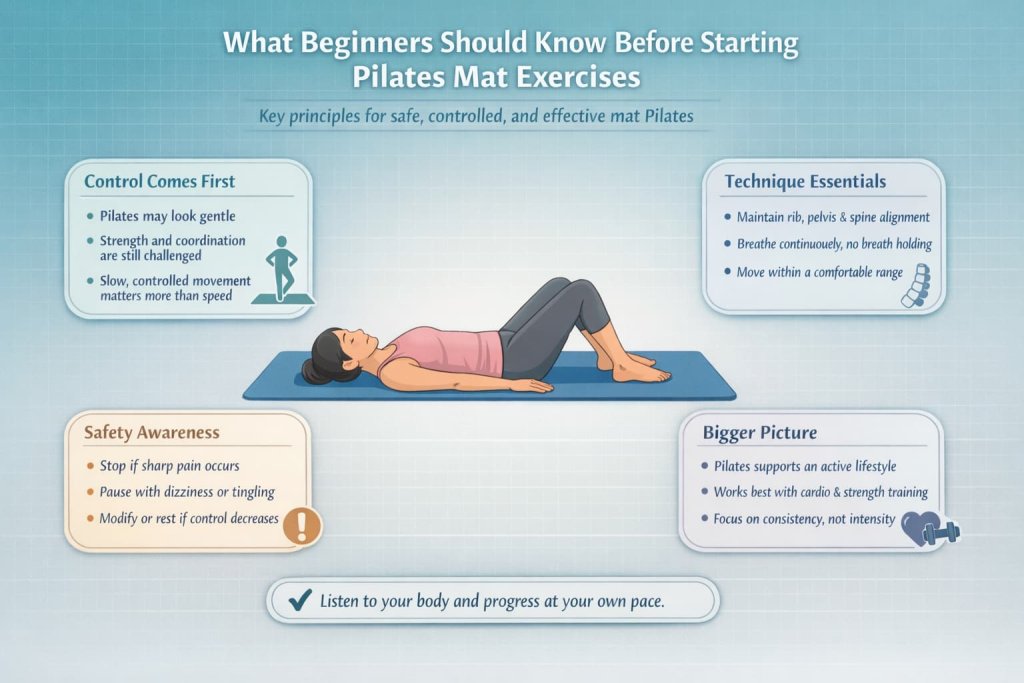
- Move slowly enough to maintain rib, pelvis, and spine alignment
- Breathe continuously without holding your breath
- Stop if you feel sharp pain, dizziness, numbness, tingling, or weakness
- Begin with small ranges of motion and increase only when control improves
For general health, Pilates can contribute to an active lifestyle when combined with aerobic activity and other strength training, as outlined in adult movement recommendations from the CDC.
15 Best Pilates mat exercises for beginners
These beginner Pilates mat exercises focus on strength, control, and movement quality. Perform them in order during your first few weeks.
1. Diaphragmatic Breathing (Pilates Breathing)
Why it works:
Pilates is built on breath control and movement precision. Diaphragmatic breathing teaches you how to exhale without rib flare, which supports gentle core engagement and improves coordination between breathing and movement.
Muscles worked:
Diaphragm, pelvic floor, transverse abdominis, deep abdominal support system.
How to do it:
- Lie on your back with knees bent and feet flat on the mat
- Place one hand on your ribcage and one on your abdomen
- Inhale slowly through your nose, allowing the ribs to expand outward
- Exhale gradually through the mouth, letting the ribs soften downward
- Repeat for 5–8 slow, controlled breaths
Trainer Tip:
If your shoulders rise as you inhale, slow the breath and focus on expanding the ribs sideways rather than lifting the chest.
2. Pelvic Tilt to Neutral
Why it works:
This movement improves pelvic awareness and helps you identify a neutral spine position, which is essential for safe and effective Pilates mat exercises.
Muscles worked:
Abdominals, gluteals, deep spinal stabilizers.
How to do it:
- Lie on your back with knees bent and feet hip-width apart
- Gently tilt the pelvis to flatten the lower back into the mat
- Slowly return to a small, natural lower-back arch
- Move smoothly between positions for 6–10 repetitions
Trainer Tip:
Keep the motion subtle and controlled—avoid pressing forcefully into the mat.
3. Knee Folds (Marching)
Why it works:
Knee folds challenge the core to stabilize the pelvis while the legs move independently, a key foundation for more advanced Pilates patterns.
Muscles worked:
Deep core stabilizers, hip flexors.
How to do it:
- Lie on your back with the spine in neutral alignment
- Lift one foot a few inches off the mat while keeping the pelvis still
- Lower the foot with control and switch sides
- Perform 6–10 repetitions per side
Trainer Tip:
If the pelvis rocks or the lower back arches, reduce the lift height.
4. Dead Bug (Pilates-Style)
Why it works:
This exercise trains trunk stability during limb movement, reinforcing controlled core engagement principles commonly highlighted in core fitness education from the Mayo Clinic.
Muscles worked:
Abdominals, deep stabilizers, hip flexors.
How to do it:
- Lie on your back with knees bent or lifted into tabletop
- Exhale as you slowly lower one heel toward the mat
- Return to the starting position with control
- Alternate sides for 5–8 repetitions per side
Trainer Tip:
Keep the ribs down and shorten the movement range if control is lost.
5. Glute Bridge
Why it works:
Glute bridges strengthen hip extension while teaching the body to share load between the hips and core rather than overusing the lower back.
Muscles worked:
Gluteus maximus, hamstrings, trunk stabilizers.
How to do it:
- Lie on your back with feet hip-width apart
- Exhale and press through your heels to lift the hips
- Pause briefly at the top
- Lower slowly with control for 8–12 repetitions
Trainer Tip:
Avoid arching the lower back at the top of the bridge.
6. Bridge Hold With Breathing
Why it works:
Adding a static hold builds muscular endurance and reinforces breathing control under light load.
Muscles worked:
Glutes, hamstrings, core stabilizers.
How to do it:
- Lift into a comfortable bridge position
- Hold the position for 10–20 seconds while breathing smoothly
- Lower with control
- Repeat 2–3 times
Trainer Tip:
If hamstrings dominate, bring the feet slightly closer to the hips.
7. Side-Lying Clamshell
Why it works:
Clamshells activate the lateral hip muscles that help stabilize the pelvis and support proper lower-body alignment.
Muscles worked:
Gluteus medius and minimus.
How to do it:
- Lie on your side with knees bent and feet together
- Keep hips stacked and spine neutral
- Open the top knee slightly without rolling back
- Lower with control for 10–15 reps per side
Trainer Tip:
Keep your waist gently lifted off the mat to avoid collapsing through the torso.
8. Side-Lying Leg Lift
Why it works:
This exercise strengthens lateral hip control, which supports balance, walking, and daily movement stability.
Muscles worked:
Hip abductors, lateral glute muscles.
How to do it:
- Lie on your side with the top leg straight
- Lift the leg to hip height with control
- Lower slowly for 8–12 reps per side
Trainer Tip:
Keep toes pointing forward to avoid compensating with hip rotation.
9. Quadruped Rock Back
Why it works:
This movement reinforces hip motion while keeping the spine relatively stable, promoting controlled movement patterns.
Muscles worked:
Core stabilizers, hips.
How to do it:
- Start on hands and knees with spine neutral
- Slowly rock hips back toward heels
- Return to the starting position with control
- Perform 8–10 repetitions
Trainer Tip:
Place padding under the wrists if pressure is uncomfortable.
10. Bird Dog (Modified)
Why it works:
Bird dog variations encourage cross-body coordination and postural control.
Muscles worked:
Core stabilizers, glutes, upper-back stabilizers.
How to do it:
- Begin on hands and knees
- Slide one leg back while keeping hips steady
- Optionally add the opposite arm reach
- Hold briefly and switch sides for 5–8 reps per side
Trainer Tip:
Start with leg movement only if balance is limited.
11. Cat–Cow
Why it works:
Cat–cow promotes controlled spinal mobility and improves awareness of spinal positioning.
Muscles worked:
Spinal movers and stabilizers.
How to do it:
- Move slowly between spinal flexion and extension
- Coordinate movement with steady breathing
- Complete 6–10 controlled cycles
Trainer Tip:
Avoid forcing the end range of motion.
12. Pilates Ab Prep
Why it works:
Ab prep builds anterior core strength while minimizing strain on the neck and shoulders.
Muscles worked:
Rectus abdominis, obliques.
How to do it:
- Lie on your back with knees bent
- Exhale and lift head and shoulders slightly
- Lower with control for 6–10 reps
Trainer Tip:
Keep hands light behind the head and avoid pulling the neck.
13. Single-Leg Stretch (Beginner Range)
Why it works:
This exercise introduces alternating leg movement while maintaining core control.
Muscles worked:
Abdominals, hip flexors.
How to do it:
- Keep head down or lightly lifted
- Alternate legs slowly and smoothly
- Perform 6–10 reps per side
Trainer Tip:
Head-down variations are always acceptable for beginners.
14. Seated Spine Twist
Why it works:
Encourages controlled rotational movement while maintaining upright posture.
Muscles worked:
Obliques, postural stabilizers.
How to do it:
- Sit tall with arms extended
- Rotate gently from the torso
- Alternate sides for 5–8 reps per side
Trainer Tip:
Focus on growing taller before rotating.
15. Child’s Pose With Breathing
Why it works:
This position encourages relaxation, controlled breathing, and gentle mobility.
Muscles worked:
Gentle stretch for hips and back muscles.
How to do it:
- Sit back toward the heels
- Rest the torso forward and breathe slowly
- Hold for 20–40 seconds
Trainer Tip:
Use cushions under hips or knees if needed for comfort.
Quick setup cues for better control
Most beginner technique issues come from losing alignment under effort.
Use this checklist before every set:
- Stack ribs directly over the pelvis
- Keep the neck long and jaw relaxed
- Draw shoulders down away from ears
- Exhale gently during the hardest part of each movement
- Choose the smallest range where you can stay steady
How to Prepare for Pilates Mat Exercises as a Beginner
Preparation helps you get more benefit from Pilates while reducing unnecessary strain. Before starting your session, focus on awareness rather than effort.
Key preparation steps include:
- Choosing a firm but comfortable mat that supports the spine
- Wearing clothing that allows free movement without restriction
- Practicing a few slow diaphragmatic breaths to establish control
- Finding a neutral spine position where ribs are stacked over the pelvis
- Accepting small, controlled movements instead of forcing range
Taking a few minutes to prepare mentally and physically helps reinforce the Pilates principle of precision from the very first repetition.
How Often Should Beginners Do Pilates Mat Exercises?
Most beginners benefit from 2 to 4 Pilates mat sessions per week, depending on experience level, recovery, and overall activity. Consistency matters more than session length or intensity.
General guidelines:
- Start with shorter sessions (15–25 minutes)
- Allow at least one rest day between sessions if muscles feel fatigued
- Progress gradually by improving control, not by rushing difficulty
- Combine Pilates with other forms of movement as part of a balanced routine
Listening to your body and prioritizing movement quality helps support steady progress over time.
When to Stop or Seek Professional Guidance
Pilates mat exercises should feel controlled and challenging—but not painful. Stop exercising and consider professional guidance if you experience symptoms that feel unusual or concerning.
Seek support if you notice:
- Sharp, persistent, or worsening pain during or after exercise
- Dizziness, fainting, or shortness of breath with light movement
- Numbness, tingling, or weakness
- Difficulty maintaining balance or coordination
- Symptoms that do not improve with rest or modification
Getting guidance from a qualified instructor or healthcare professional can help ensure exercises are appropriate for your individual needs and movement history.
Beginner workout plan (15–25 minutes)
Perform 2–4 times per week:
- Breathing: 5–8 breaths
- Pelvic tilt: 6–10 reps
- Knee folds: 6–10 per side
- Glute bridge: 8–12 reps
- Clamshell: 10–15 per side
- Bird dog: 5–8 per side
- Ab prep: 6–10 reps
- Spine twist: 5–8 per side
- Child’s pose: 20–40 seconds
Progress gradually by increasing reps, hold time, or range—only if control remains steady.
Common mistakes beginners make
- Moving too fast
- Overarching the lower back
- Holding breath
- Using excessive range before control improves
Who should be cautious before starting Pilates mat exercises
Extra guidance is recommended if you have:
- Recent injury or surgery
- Worsening back or joint symptoms
- Dizziness, fainting, or neurological symptoms
- Pregnancy or postpartum considerations
Clinical guidance from the Cleveland Clinic emphasizes that checking with a healthcare professional and starting with proper instruction can help ensure a safer entry into Pilates.
FAQs
How often should beginners do Pilates mat exercises?
Two to four sessions per week works well for most beginners.
Is Pilates suitable if I’m not flexible?
Yes. Flexibility often improves as control improves.
Do I need equipment?
No. A mat is enough.
How soon will I notice results?
Many people notice better control within a few weeks; visible strength gains vary.
Can Pilates replace strength training?
Pilates builds strength and control, but many people benefit from combining it with other strength and aerobic activities as part of a balanced routine.
Conclusion
Pilates mat exercises for beginners work best when you focus on breathing, alignment, and slow, controlled movement. Master the basics, stay consistent, and progress gradually—your strength and control will follow.
References
- NHS — Pilates for Beginners
- Cleveland Clinic — Pilates Overview and Beginner Guidance
- Mayo Clinic — Core Strength Basics
- CDC — Adult Physical Activity Guidelines
- U.S. Department of Health and Human Services — Physical Activity Guidelines for Americans (PDF)
- American College of Sports Medicine (ACSM) — Physical Activity Guidelines Resource Hub
- PubMed Central — Systematic Review on Pilates and Posture (2024)
- Journal of Orthopaedic & Sports Physical Therapy (JOSPT) — Pilates-Based Therapeutic Exercise RCT (2006)