
Foam rolling may help reduce back tightness and improve short-term mobility, but it isn’t a cure for back pain. Used the right way, it can feel great as part of a warm-up or recovery routine and may help you move more comfortably, especially when stiffness is the main issue.
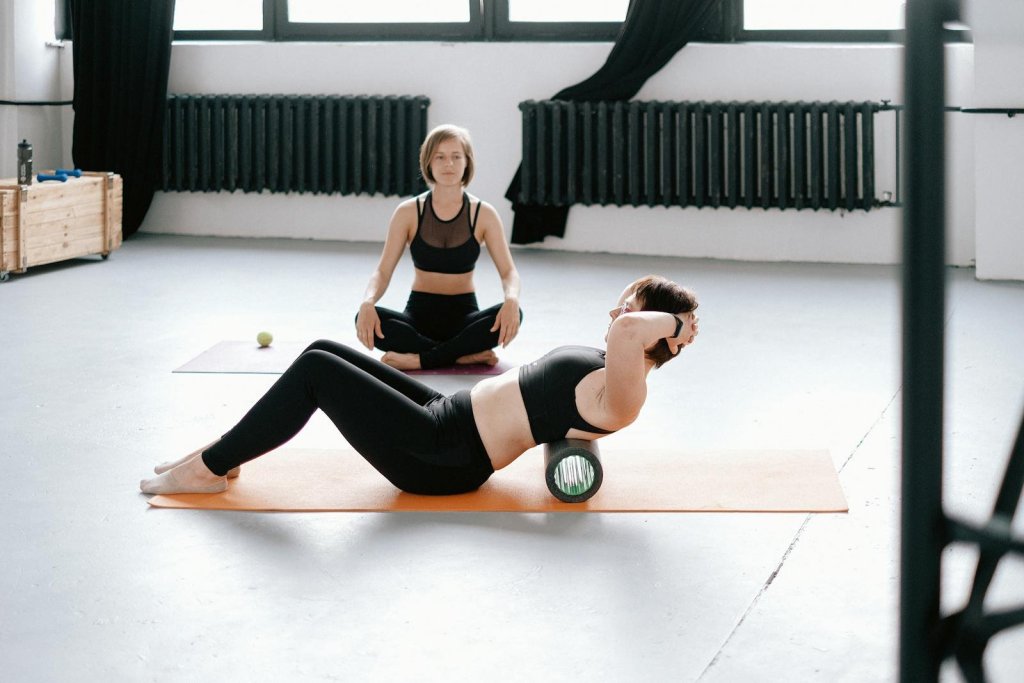
This guide covers the safest way to use a foam roller for your back, plus 8 beginner-friendly exercises you can do at home.
Foam roller for back pain relief: what to expect
Foam rolling is a form of self-myofascial release (self-massage). Research summaries have found it can improve range of motion in the short term and may help with soreness or tight-feeling muscles, which is why many people use it before workouts or after long sitting.
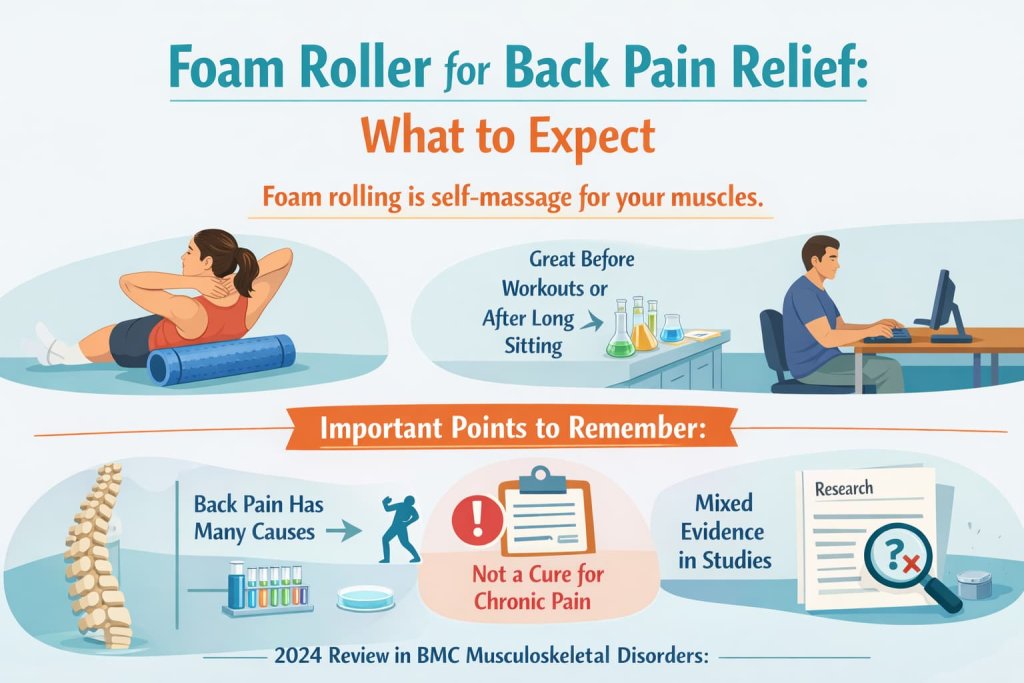
Important: back pain has many causes. Evidence reviews in pain-related populations show mixed results overall, so foam rolling should be treated as a comfort and mobility tool, not a diagnosis or a standalone solution for chronic pain. A 2024 review in BMC Musculoskeletal Disorders highlights that pain outcomes across trials are not consistently positive.
Safety first: how to foam roll your back without making it worse
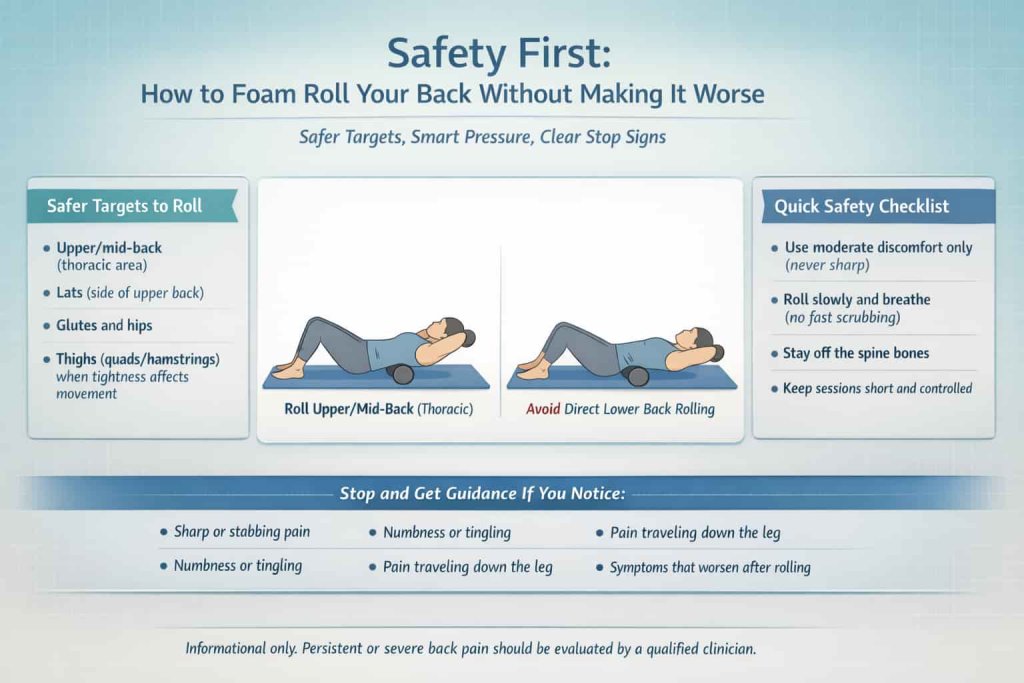
A key rule is don’t roll directly across your lower back (lumbar spine) the way people often do (roller perpendicular under the low back). The American Council on Exercise (ACE) commonly recommends avoiding direct lumbar rolling and instead targeting the upper/mid-back and surrounding areas like the glutes and hips.
Also, if you feel sharp pain, stop and get medical guidance. The Cleveland Clinic notes foam rolling should not create sharp pain and that ongoing or intense symptoms should be discussed with a clinician.
Quick safety checklist
- Keep pressure at a “moderate discomfort” level (never sharp).
- Roll slowly and breathe—no fast scrubbing.
- Avoid rolling directly on the spine bones.
- Stop if symptoms spread (numbness, tingling, pain down the leg).
8 Best Foam Roller Exercises for Back Pain Relief
These focus on the upper/mid-back, lats, glutes, and hip muscles (often linked with how your back feels). If your back pain is severe, new, or worsening, get checked by a qualified professional first.
1) Thoracic Spine Roll (Upper Back)
How to do it:
- Sit on the floor with the roller behind you.
- Place it under your upper back (mid-back, not low back).
- Support your head with your hands; elbows slightly forward.
- Lift hips slightly and roll from mid-back to upper back slowly.
- Pause 10–20 seconds on tight spots and breathe.
Why it works:
The thoracic spine (upper/mid-back) often gets stiff from sitting. Gentle rolling can improve how your upper back extends, which may reduce “overwork” in the lower back during daily movement.
Muscles worked:
Thoracic extensors, mid traps, rhomboids, lats (lightly)
Trainer Tip:
Keep your ribs “down” (don’t flare) and avoid rolling up into your neck.
2) Thoracic Extension on Roller (Back Opener)
How to do it:
- Place the roller across your upper back (again, not low back).
- Keep feet flat, knees bent.
- Support your head and gently lean back over the roller.
- Hold 10–20 seconds, then move the roller slightly higher/lower.
- Repeat 3–5 positions.
Why it works:
This is a controlled way to practice thoracic extension, which can help posture and overhead mobility.
Muscles worked:
Thoracic spine tissues, lats (indirect), chest tightness relief (indirect)
Trainer Tip:
Make it gentle—this is an “open and breathe” drill, not a hard stretch.
3) Lat Roll (Side of Upper Back)
How to do it:
- Lie on your side with the roller under your armpit/side ribs.
- Bottom arm can reach overhead; top foot planted for control.
- Roll slowly from armpit area down toward mid ribs.
- Spend extra time on tender spots (10–20 seconds).
Why it works:
Tight lats can pull on the ribcage and affect how your upper back and shoulders move.
Muscles worked:
Latissimus dorsi, teres major, side body tissues
Trainer Tip:
Stay off the front ribs and avoid rolling directly on bony edges.
4) Glute Roll (One Side at a Time)
How to do it:
- Sit on the roller and shift weight onto one glute.
- Cross the same-side ankle over the opposite knee (optional).
- Roll slowly over the meaty glute area.
- Pause on tight points, breathing slowly.
Why it works:
Glutes that feel “locked up” can change how your pelvis moves, which can influence lower-back comfort.
Muscles worked:
Glute max, glute med, deep hip rotators
Trainer Tip:
If it’s too intense, keep both feet on the floor and reduce pressure.
5) Piriformis-Friendly Glute Roll (Small Area Focus)
How to do it:
- Sit on the roller with one ankle crossed over the other knee.
- Slightly lean toward the crossed-leg side.
- Make small, slow rolls (1–2 inches) over the back-pocket area.
- Keep the movement controlled and short.
Why it works:
This targets a common “hot spot” in the back of the hip that can feel tight with lots of sitting.
Muscles worked:
Deep hip rotators (including piriformis region), glute med
Trainer Tip:
If you feel tingling or symptoms traveling down the leg, stop and get evaluated.
6) Hip Flexor and Quad Roll (Front of Hip/Thigh)
How to do it:
- Lie face down with the roller under one hip crease (then upper thigh).
- Support yourself on forearms.
- Roll slowly from hip crease to mid-thigh.
- Turn slightly inward/outward to find tight areas.
Why it works:
Tight hip flexors can affect pelvic position and how your low back feels during standing and walking.
Muscles worked:
Hip flexors (upper area), quadriceps
Trainer Tip:
Don’t jam the roller into the front hip bone—keep it on muscle.
7) Hamstring Roll (Back of Thigh)
How to do it:
- Sit with the roller under one hamstring.
- Hands behind you for support.
- Roll from just above the knee toward the sit bone.
- Rotate the leg slightly to hit inner/outer hamstrings.
Why it works:
Stiff hamstrings can change how you hinge at the hips, sometimes making the low back do extra work.
Muscles worked:
Hamstrings (biceps femoris, semitendinosus, semimembranosus)
Trainer Tip:
Keep your core lightly braced so you’re not slumping into your low back.
8) Calf Roll (Lower-Leg Tension Release)
How to do it:
- Sit with the roller under one calf.
- Lift hips slightly and roll from ankle toward knee.
- Cross the other leg on top to increase pressure (optional).
- Pause 10–20 seconds on tight spots.
Why it works:
Calves influence ankle mobility, which affects walking mechanics and lower-body movement quality.
Muscles worked:
Gastrocnemius, soleus
Trainer Tip:
If you cramp, reduce pressure and shorten the rolling range.
Beginner-friendly sets, reps, and weekly schedule
Try this simple plan:
- Pick 4–6 exercises from the list (based on where you feel tight).
- Do 30–60 seconds per area
- Complete 1–2 rounds
- Use it 3–5 days per week
A quick session could be: thoracic roll → lat roll → glute roll → hip flexor roll (about 6–10 minutes total).
Common form mistakes that can make back pain feel worse
- Rolling directly across the lumbar spine with high pressure
- Moving too fast (your nervous system stays “guarded”)
- Holding your breath (increases tension)
- Staying on one painful spot too long (can irritate the area)
- Treating foam rolling as a replacement for strengthening and movement practice
Signs an exercise is safe for your back
- Discomfort stays local and eases as you breathe
- You can keep pressure at a 3–6 out of 10
- You feel looser afterward (not worse the next day)
- No sharp pain, numbness, tingling, or radiating symptoms
If foam rolling repeatedly flares symptoms, pause it and get individualized help.
FAQ
Is a foam roller good for back pain?
It may help reduce tightness and improve short-term mobility, but results vary. It works best when combined with regular movement and a gradual strengthening plan.
Should I foam roll my lower back?
Usually, no—avoid rolling directly across the lumbar spine. Roll the upper/mid-back and nearby muscles like glutes and hips instead.
How often should I foam roll for back tightness?
Many people do well with 3–5 days per week, 5–10 minutes per session, adjusting pressure and time to tolerance.
What kind of foam roller is best for back tightness?
Start with a smooth, medium-density roller. Very firm or spiky rollers can be too intense if you’re sensitive.
How long should I foam roll each area?
A good starting range is 30–60 seconds per muscle area, rolling slowly and pausing briefly on tight spots.
When should I stop foam rolling and get help?
Stop and seek medical guidance if you notice sharp pain, numbness, tingling, weakness, fever, unexplained weight loss, or pain that worsens over time.
Can foam rolling replace stretching or strengthening?
Not really. Foam rolling can be a helpful “prep” tool, but long-term improvement usually comes from consistent strengthening, gradual loading, and better movement habits.
Conclusion
Foam rolling can be a simple way to feel looser and move better—especially when you focus on the upper back, lats, glutes, and hips instead of pressing hard into the low back. Start gentle, roll slowly, and keep sessions short and consistent.
This content is for informational purposes only and not medical advice.
References
- Cheatham, S. W., Kolber, M. J., Cain, M., & Lee, M. (2015). The effects of self-myofascial release using a foam roll or roller massager on joint range of motion, muscle recovery, and performance: A systematic review. PubMed Central (PMC)
- Konrad, A., Glashüttner, C., Reiner, M. M., Bernsteiner, D., & Tilp, M. (2022). Foam rolling training effects on range of motion: A systematic review and meta-analysis. PubMed Central (PMC)
- Wiewelhove, T., Döweling, A., Schneider, C., Hottenrott, L., & Meyer, T. (2019). A meta-analysis of the effects of foam rolling on performance and recovery. PubMed Central (PMC)
- Fijavž, J., Frangež, M., & Vauhnik, R. (2024). Effects of lower back foam rolling on the pressure pain threshold and the range of motion of the lumbar spine in healthy individuals. Frontiers in Physiology
- Bartsch, K. M., Schleip, R., Baumgart, C., & colleagues. (2021). Foam rolling—Contraindications and cautions: An international Delphi study. PubMed Central (PMC)