
If you’re looking for the best foot exercises, here’s the short answer: the most effective exercises strengthen your intrinsic foot muscles, improve ankle mobility, and stretch the plantar fascia and calf complex — all of which support better movement and help reduce discomfort.
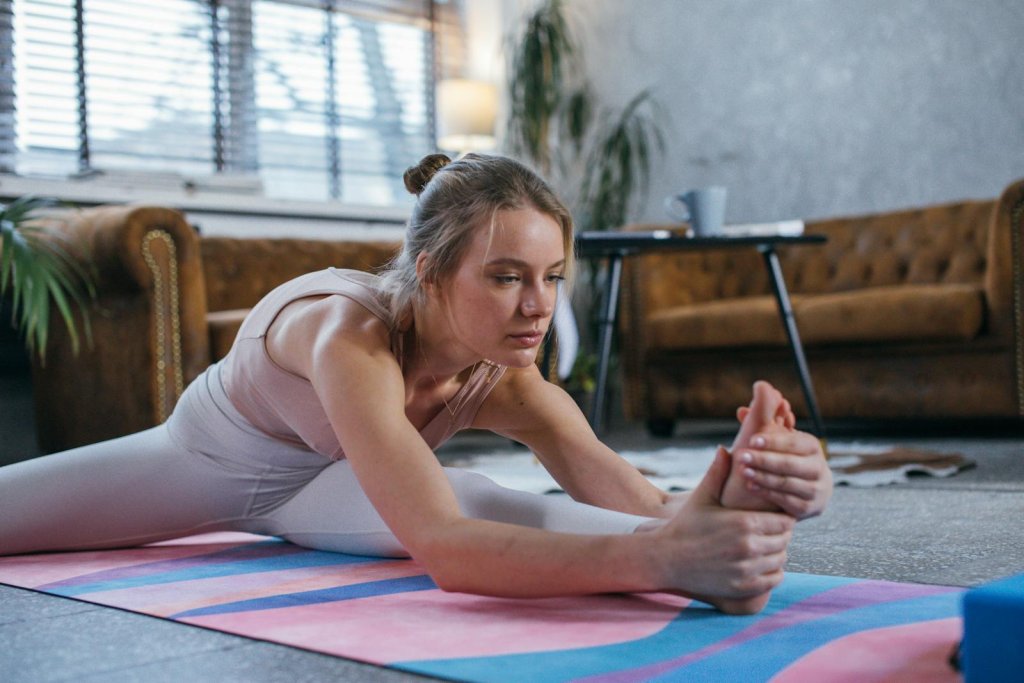
Strong, mobile feet are essential for walking, standing, balance, and athletic performance. Many people experience foot pain due to weakness, tightness, or limited range of motion, but simple daily exercises may help improve strength, function, and stability.
This guide covers 12 research-backed foot exercises, why they work, how to do them safely, and which options are best for pain relief, arch support, balance, and lower-body control.
Why Foot Exercises Matter
Foot exercises play an important role in improving strength, balance, and functional mobility. Research shows that intrinsic foot muscle training may help enhance arch support, reduce strain on the plantar fascia, and improve dynamic balance. Foot exercises also help counteract stiffness from long periods of standing or sitting and provide foundational strength for safe walking and daily activities.
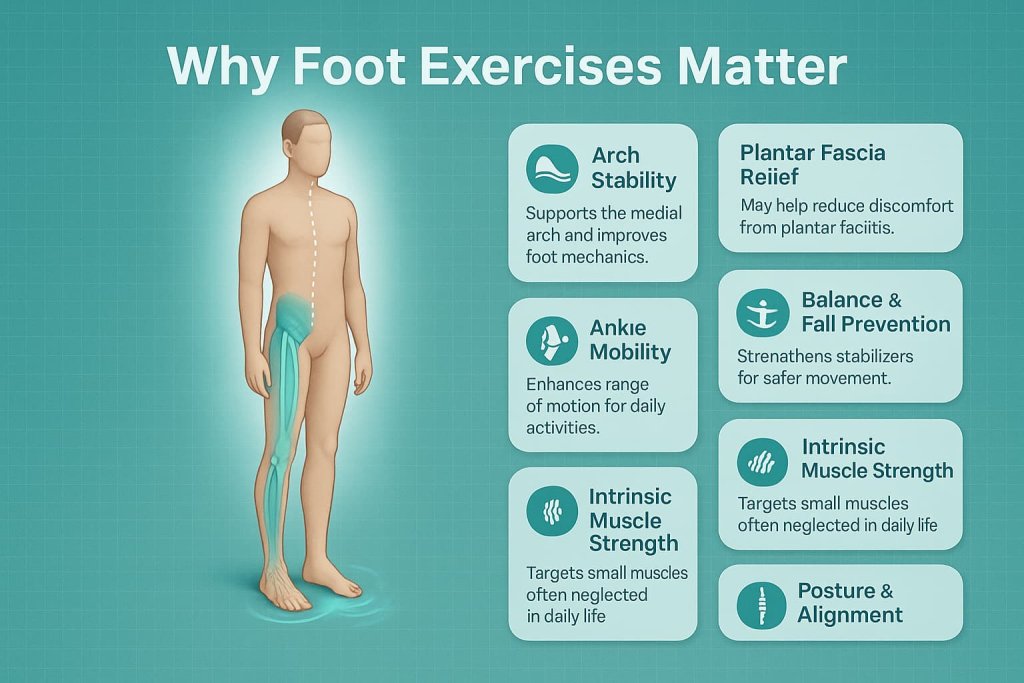
Benefits include:
- Supports arch stability
- May help reduce discomfort from plantar fasciitis
- Improves balance and fall prevention
- Enhances ankle mobility
- Strengthens small (intrinsic) muscles often neglected in daily movement
- Supports proper posture and lower-body alignment
Official resources:
American Academy of Orthopaedic Surgeons (AAOS) recommend basic stretching and strengthening routines for maintaining healthy feet.
12 Best Foot Exercises
A simple mobility drill that improves ankle movement in all directions. Helps reduce stiffness and prepares the joint for walking and balance work.
1. Ankle Circles
Why it works:
Improves ankle joint mobility, increases synovial fluid movement, and helps reduce stiffness from sitting or limited activity. This foundational mobility drill prepares the foot and ankle for weight-bearing exercises.
Muscles worked:
Tibialis anterior, gastrocnemius, soleus, peroneals, intrinsic ankle stabilizers.
How to do it:
- Sit or stand with one foot lifted.
- Draw slow, controlled circles with your toes.
- Rotate clockwise, then counter-clockwise.
- Keep the movement smooth and avoid moving the entire leg.
Trainer Tip:
Imagine you’re drawing the biggest circle possible without losing control — slow movement builds better mobility.
2. Ankle Pumps (Point & Flex)
Why it works:
Improves dorsiflexion and plantarflexion—two essential ankle motions needed for walking, running, and squatting. Also promotes circulation in the lower leg.
Muscles worked:
Tibialis anterior, gastrocnemius, soleus, foot flexors and extensors.
How to do it:
- Sit with legs extended or relaxed in a chair.
- Gently point your toes forward.
- Flex them back toward your shin.
- Move slowly and avoid rushing.
Trainer Tip:
Keep your heel grounded while pumping—this isolates the muscles better and enhances control.
3. Ankle Alphabet
Why it works:
Moves the ankle through all available planes of motion, helping restore mobility, coordination, and neuromuscular control after stiffness or injury.
Muscles worked:
All ankle movers: tibialis anterior/posterior, peroneals, calf complex, intrinsic stabilizers.
How to do it:
- Lift one foot off the ground.
- Use your big toe to “draw” the letters A–Z in the air.
- Keep your leg steady and move only the ankle.
Trainer Tip:
Keep the letters large for maximum mobility — small letters reduce the benefits.
4. Calf Stretch (Wall Stretch)
Why it works:
Lengthens the gastrocnemius and soleus, reducing strain on the plantar fascia and improving ankle dorsiflexion.
Muscles worked:
Gastrocnemius, soleus, Achilles tendon, plantar fascia (indirect).
How to do it:
- Stand facing a wall.
- Step one foot back and press the heel into the floor.
- Lean forward gently until you feel a calf stretch.
- Hold 20–30 seconds per side.
Trainer Tip:
For deeper stretching, slightly bend the back knee to target the soleus muscle.
5. Plantar Fascia Stretch
Why it works:
Reduces tension in the plantar fascia, which can help ease discomfort from tightness or early-morning stiffness.
Muscles worked:
Plantar fascia, intrinsic arch muscles, toe flexors.
How to do it:
- Sit and cross one leg over the other.
- Gently pull your toes backward until you feel a stretch in the arch.
- Hold 15–20 seconds.
Trainer Tip:
Do this stretch before standing in the morning — it helps reduce first-step stiffness.
6. Toe Curls (Towel Scrunches)
Why it works:
Strengthens the small muscles that support the arch, improving stability and control.
Muscles worked:
Flexor digitorum longus/brevis, intrinsic foot muscles, lumbricals.
How to do it:
- Place a towel on the floor.
- Curl your toes to pull the towel toward you.
- Repeat 10–15 scrunches.
Trainer Tip:
Try adding a small weight on the towel for extra resistance once it becomes easy.
7. Marble Pickups
Why it works:
Enhances fine motor control, strengthens intrinsic foot muscles, and improves coordination.
Muscles worked:
Toe flexors, lumbricals, intrinsic stabilizers.
How to do it:
- Set 10–15 marbles on the floor.
- Pick up each marble with your toes.
- Place them into a cup or container.
Trainer Tip:
Use smaller objects (like beans) for a challenge once marbles become easy.
8. Short-Foot Exercise (Arch Doming)
Why it works:
Directly activates the muscles responsible for lifting and supporting the arch, improving balance and posture.
Muscles worked:
Abductor hallucis, flexor hallucis brevis, intrinsic arch muscles.
How to do it:
- Stand with feet hip-width apart.
- Without curling your toes, gently lift the arch upward.
- Hold 5–10 seconds.
- Repeat 8–10 reps.
Trainer Tip:
Think “lift the arch, don’t grip the toes”—proper technique is subtle but powerful.
9. Heel Raises
Why it works:
Strengthens calf muscles and ankle stabilizers essential for walking, stair climbing, and overall balance.
Muscles worked:
Gastrocnemius, soleus, intrinsic foot muscles, Achilles tendon.
How to do it:
- Stand tall holding a wall or counter.
- Slowly lift your heels up.
- Lower them with full control.
- Complete 12–15 reps.
Trainer Tip:
Pause for one second at the top to increase muscle activation.
10. Toe Raises
Why it works:
Strengthens toe extensors and improves gait mechanics by teaching better toe-off and foot lifting patterns.
Muscles worked:
Extensor hallucis longus, extensor digitorum longus, tibialis anterior.
How to do it:
- Stand tall with your feet flat.
- Lift only your toes while keeping heels down.
- Repeat 10–15 reps.
Trainer Tip:
Spread your toes wide as you lift to activate more intrinsic muscles.
11. Resistance Band Foot Flexion (Plantarflexion/Dorsiflexion)
Why it works:
Builds ankle strength in controlled patterns, improving stability for walking, running, and stair navigation.
Muscles worked:
Tibialis anterior, gastrocnemius, soleus, peroneals, tibialis posterior.
How to do it:
- Loop a band around your foot.
- Point your toes forward against resistance.
- Then flex them back toward you.
- Perform 12–15 reps each direction.
Trainer Tip:
Keep the knee slightly bent to avoid compensations and keep all focus on the ankle.
12. Single-Leg Balance
Why it works:
Strengthens proprioception, ankle stability, and overall balance—important for fall prevention and athletic performance.
Muscles worked:
Peroneals, tibialis posterior/anterior, intrinsic foot stabilizers, glutes (as stabilizers).
How to do it:
- Stand tall on one foot.
- Keep hips level and core engaged.
- Progress by closing eyes or using a foam pad.
- Hold 20–30 seconds per leg.
Trainer Tip:
Focus on gripping the floor lightly with your toes—this activates stabilizers for better balance.
How Often Should You Do Foot Exercises?
Consistency is key when improving foot strength, flexibility, and balance. Most people benefit from:
- Mobility exercises (ankle circles, pumps, alphabet):
Daily or at least 5–7 days per week. - Stretching exercises (calf stretch, plantar fascia stretch):
Daily, especially in the morning or after walking. - Strengthening exercises (toe curls, short-foot, heel raises):
3–4 days per week, with rest in between sessions. - Balance exercises (single-leg stand):
3–5 days per week, starting with short holds and progressing gradually.
You should increase reps or difficulty only when exercises feel easy and pain-free.
Trainer Tip:
A simple routine of 5–8 minutes per day is enough for noticeable improvements in 2–4 weeks, especially when combined with supportive footwear and gradual progression.
Common Mistakes to Avoid When Doing Foot Exercises
Avoiding common errors helps protect your joints and ensures you get the full benefit of each exercise. These are the most frequent mistakes people make:
- Moving too quickly
Rushing through movements reduces muscle activation and limits mobility gains. - Curling the toes during arch-lifting exercises
Toe gripping compensates for weak intrinsic foot muscles and reduces the effectiveness of the short-foot exercise. - Skipping mobility work before strengthening
Tight ankles or calves restrict how well the foot can function during balance or strengthening exercises. - Letting the knee or hip compensate
Many people move the whole leg during ankle drills — the goal is to isolate the ankle and foot. - Doing exercises on pain
Mild stretching tension is normal, but sharp or increasing pain means the exercise should stop immediately. - Overloading too soon
Adding resistance bands or unstable surfaces too early can strain the foot and ankle.
Trainer Tip:
Focus on slow, controlled movements and maintain proper alignment. Quality matters more than quantity for improving foot strength and mobility.
Safety Guidelines Before Starting Foot Exercises
To stay safe and protect your joints:
- Avoid any movement that causes sharp or worsening pain.
- Start with easy mobility exercises before progressing to strengthening.
- If you have diabetes, neuropathy, severe arthritis, or foot deformities, consult a clinician first.
- Warm up gently with 1–2 minutes of ankle mobility before strengthening work.
- Increase load slowly — especially for balance and resistance band work.
Who Should Avoid or Modify Foot Exercises
Some individuals should proceed with caution:
- Anyone with recent foot or ankle surgery
- People diagnosed with severe neuropathy
- Those with unexplained swelling, redness, or sudden pain
- Individuals with fractures or severe tendon injuries
- Anyone advised by a medical professional to limit weight-bearing
Modifications include doing exercises seated, reducing reps, or avoiding high-load movements.
FAQ — Foot Exercises
1. How often should I do foot exercises?
Most people benefit from 3–5 sessions per week. Mobility exercises can be done daily.
2. Can foot exercises help with plantar fasciitis?
They may help reduce tension and improve support when combined with calf stretching and proper footwear.
3. How long until I see results?
Many people notice improvements in 2–4 weeks with consistent practice.
4. Can these exercises improve balance?
Yes — strengthening intrinsic muscles and improving ankle stability directly supports better balance control.
5. Are foot exercises safe for older adults?
Yes, when started slowly and performed with proper support. Balance exercises may need supervision.
6. Should I do these exercises before or after walking?
Mobility drills are great before walking, while stretching helps after.
Conclusion
Healthy feet are the foundation of comfortable movement, proper posture, and confident balance. By practicing these foot exercises consistently, you may help strengthen weak muscles, improve mobility, and support better daily function. Start with a few simple exercises and build up gradually — even small improvements can make walking, standing, and daily activity feel better.
This content is for informational purposes only and not medical advice.
References
- AAOS – Foot and Ankle Conditioning Program PDF (detailed rehab protocol)
- Mattacola CG, Dwyer MK. – Rehabilitation of the ankle after acute sprain or chronic instability (Journal of Athletic Training)
- Koc TA Jr et al. (2023) – Heel Pain / Plantar Fasciitis Clinical Practice Guideline (JOSPT / Orthopaedic Section)
- NHS – Plantar Fasciitis: Symptoms, self-care and exercise advice
- Washington University Orthopedics – Plantar Fasciitis Exercises (towel stretch, calf stretch, calf raise, etc.)
- National Institute on Aging (NIA) – Exercise and Physical Activity for Older Adults