
Love handle exercises can strengthen your obliques, deep core, hips, and waist muscles, but they cannot directly burn fat from only the sides of your waist. The best approach is to use love handle exercises to build a stronger core while also doing full-body strength training, cardio, and healthy eating habits.
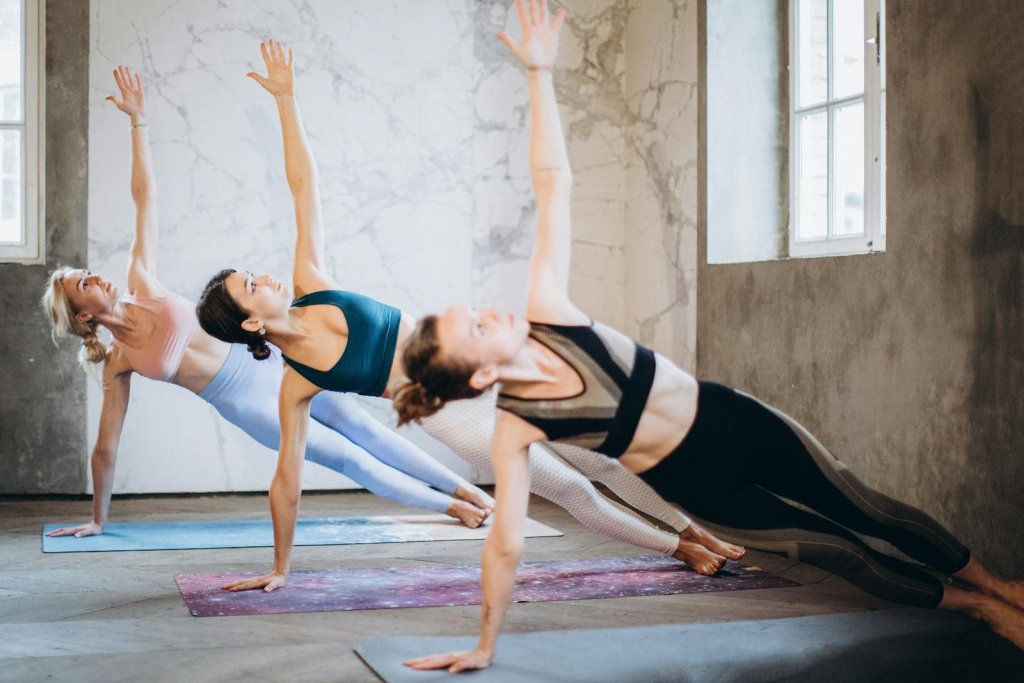
This matters because the area people call “love handles” is usually body fat stored around the sides of the waist. Core training can make the muscles underneath stronger and more defined, but overall fat loss depends on your full lifestyle. The Mayo Clinic explains that aerobic activity is needed to burn stomach fat, while core exercises strengthen and tone the muscles underneath.
Love Handle Exercises: The Quick Answer
The best love handle exercises train the obliques, transverse abdominis, rectus abdominis, hips, glutes, and trunk stabilizers.
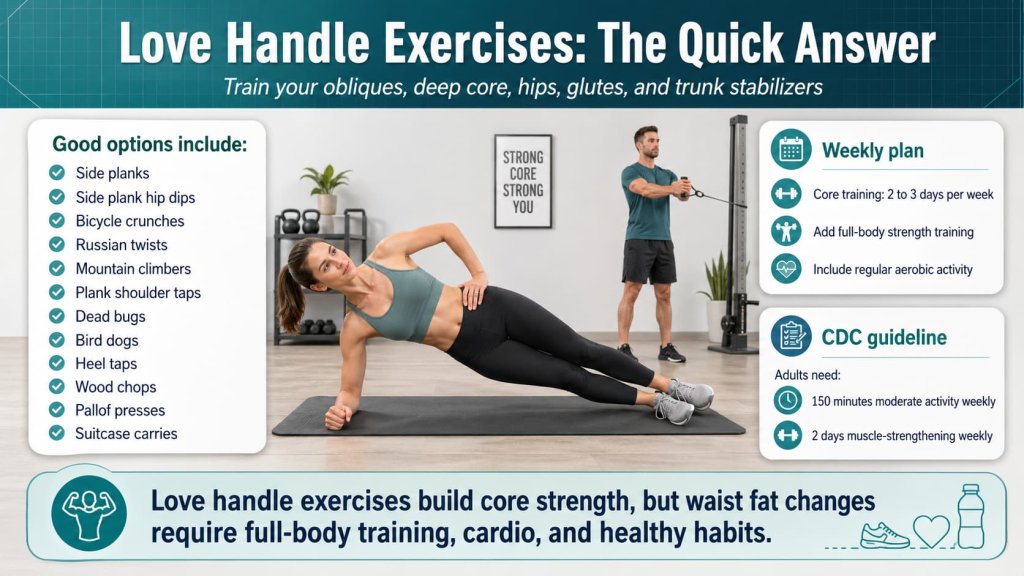
Good options include:
- Side planks
- Side plank hip dips
- Bicycle crunches
- Russian twists
- Mountain climbers
- Plank shoulder taps
- Dead bugs
- Bird dogs
- Heel taps
- Wood chops
- Pallof presses
- Suitcase carries
For best results, do core training 2 to 3 days per week, add full-body strength training, and aim for regular aerobic activity. The CDC says adults need 150 minutes of moderate-intensity physical activity per week and 2 days of muscle-strengthening activity.
What Are Love Handles?
“Love handles” is a common nickname for the soft area of fat that can sit around the sides of the waist, lower back, and hips.
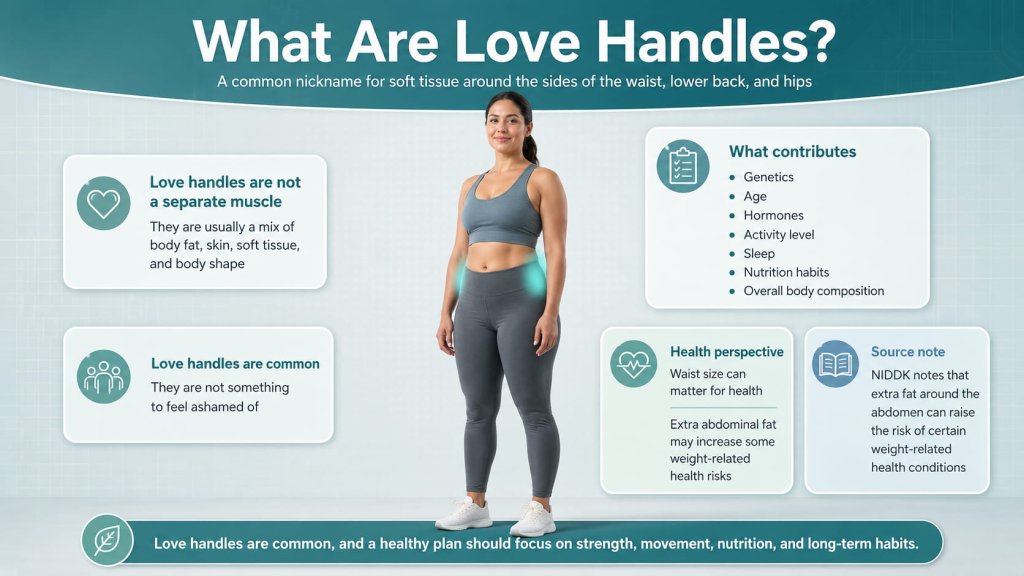
They are not a separate muscle. They are usually a mix of:
- Body fat around the waist
- Skin and soft tissue
- The shape of your hips, torso, and pelvis
- Genetics and body-fat distribution
Love handles are very common and are not something to feel ashamed of. Many people store fat around the waist because of genetics, age, hormones, activity level, sleep, nutrition habits, and overall body composition.
From a health perspective, waist size can matter because extra fat around the abdomen may increase the risk of some health problems. The NIDDK notes that gaining extra fat around the abdomen can raise the risk of certain weight-related health conditions.
Can Love Handle Exercises Really Reduce Side Fat?
Love handle exercises can help build a stronger, tighter-feeling core, but they do not directly remove fat from one exact area.
This is important: you cannot choose where your body loses fat first. Side planks, twists, and crunches can train the waist muscles, but fat loss happens through an overall calorie balance, regular movement, strength training, sleep, and sustainable eating habits.
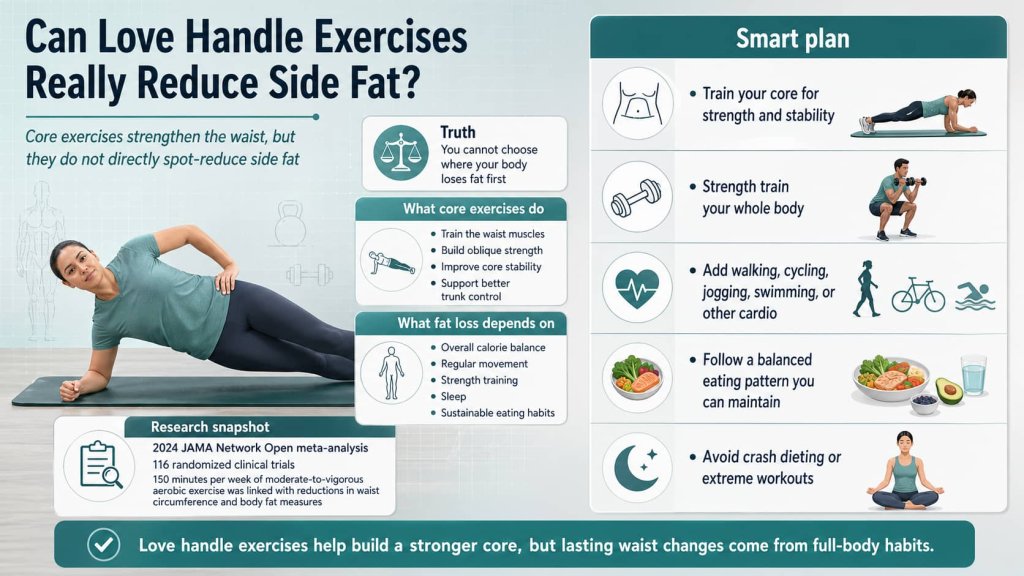
A 2024 JAMA Network Open meta-analysis of 116 randomized clinical trials found that at least 150 minutes per week of moderate-to-vigorous aerobic exercise was linked with clinically important reductions in waist circumference and body fat measures.
So the smartest plan is:
- Train your core for strength and stability
- Strength train your whole body
- Add walking, cycling, jogging, swimming, or other cardio
- Follow a balanced eating pattern you can maintain
- Avoid crash dieting or extreme workouts
Before You Start Love Handle Exercises
Start with control, not speed. Core exercises work best when your ribs, hips, and spine stay organized.
Use these simple rules:
- Warm up for 5 to 10 minutes first
- Move slowly enough to control your body
- Keep your core gently braced
- Avoid pulling on your neck
- Breathe during each rep
- Stop if you feel sharp, worsening, or unusual pain
- Choose easier versions before harder ones
If you are new to exercise, recovering from an injury, pregnant, postpartum, under 18, or managing a health condition, get guidance from a qualified professional before starting a fat-loss or intense core program.
12 Best Love Handle Exercises for a Tighter, Stronger Core
1. Side Plank
How to do it:
- Lie on your side with your elbow under your shoulder.
- Stack your feet or place the top foot slightly in front for balance.
- Brace your core and lift your hips off the floor.
- Keep your body in a straight line from head to heels.
- Hold for 15 to 30 seconds.
- Lower with control and switch sides.
Why it works: Side planks are one of the best love handle exercises because they train the side waist without fast twisting. They help build endurance in the obliques and deep core.
Muscles worked: Obliques, transverse abdominis, glutes, shoulders, and hip stabilizers.
Trainer Tip: If the full version feels too hard, bend your knees and do a knee-supported side plank first.
2. Side Plank Hip Dips
How to do it:
- Start in a side plank position.
- Keep your elbow under your shoulder.
- Slowly lower your hips toward the floor.
- Lift your hips back up by squeezing your side waist.
- Repeat for 8 to 12 reps.
- Switch sides.
Why it works: This adds movement to the side plank, making your obliques work harder through a controlled range of motion.
Muscles worked: Obliques, transverse abdominis, glutes, shoulders, and hip stabilizers.
Trainer Tip: Keep the movement small and controlled. Do not drop your hips quickly.
3. Bicycle Crunches
How to do it:
- Lie on your back with your knees bent.
- Place your hands lightly behind your head.
- Lift your shoulders slightly off the floor.
- Bring one knee toward your chest.
- Rotate your opposite shoulder toward that knee.
- Switch sides slowly.
- Repeat for 10 to 16 total reps.
Why it works: Bicycle crunches train trunk rotation, which makes them useful for targeting the obliques and front abs.
Muscles worked: Obliques, rectus abdominis, deep core, and hip flexors.
Trainer Tip: Do not yank your neck. Think about turning your rib cage, not just moving your elbow.
4. Russian Twists
How to do it:
- Sit on the floor with your knees bent.
- Lean back slightly while keeping your chest lifted.
- Hold your hands together in front of your body.
- Rotate your torso to one side.
- Return to center and rotate to the other side.
- Repeat for 10 to 20 total reps.
Why it works: Russian twists train the obliques through rotation, which can help improve waist strength and trunk control.
Muscles worked: Obliques, rectus abdominis, transverse abdominis, and hip flexors.
Trainer Tip: Keep your feet on the floor if you are a beginner. Skip this exercise if it bothers your lower back.
5. Mountain Climbers
How to do it:
- Start in a high plank with your hands under your shoulders.
- Keep your body in a straight line.
- Drive one knee toward your chest.
- Step it back and switch sides.
- Move slowly for control or faster for conditioning.
- Continue for 20 to 30 seconds.
Why it works: Mountain climbers combine core stability with cardio. They train the abs while raising your heart rate.
Muscles worked: Core, hip flexors, shoulders, chest, quads, and glutes.
Trainer Tip: Keep your hips from bouncing. A slower mountain climber is often better than a fast, messy one.
6. Plank Shoulder Taps
How to do it:
- Start in a high plank position.
- Place your feet slightly wider than hip-width.
- Brace your core.
- Lift one hand and tap the opposite shoulder.
- Place it back down.
- Repeat on the other side.
- Do 10 to 20 total taps.
Why it works: Plank shoulder taps train anti-rotation, meaning your core works to stop your hips from twisting.
Muscles worked: Obliques, transverse abdominis, shoulders, chest, glutes, and spinal stabilizers.
Trainer Tip: Move slowly. If your hips rock side to side, widen your feet or lower your knees to the floor.
7. Dead Bug
How to do it:
- Lie on your back with arms reaching toward the ceiling.
- Bring your knees over your hips.
- Brace your core so your lower back stays controlled.
- Slowly lower one arm and the opposite leg.
- Return to the start.
- Repeat on the other side.
- Do 8 to 12 reps per side.
Why it works: Dead bugs teach deep core control without stressing the neck or lower back as much as many crunch variations.
Muscles worked: Transverse abdominis, rectus abdominis, obliques, hip flexors, and pelvic stabilizers.
Trainer Tip: Only lower your arm and leg as far as you can while keeping your back controlled.
8. Bird Dog
How to do it:
- Start on your hands and knees.
- Keep your hands under your shoulders and knees under your hips.
- Brace your core gently.
- Extend one arm forward and the opposite leg back.
- Pause for 1 to 2 seconds.
- Return with control.
- Repeat for 8 to 12 reps per side.
Why it works: Bird dogs train balance, spinal control, and core stability without heavy loading.
Muscles worked: Deep core, obliques, glutes, lower back stabilizers, and shoulders.
Trainer Tip: Imagine balancing a glass of water on your lower back. Keep your hips level.
9. Heel Taps
How to do it:
- Lie on your back with knees bent and feet flat.
- Lift your shoulders slightly off the floor.
- Reach your right hand toward your right heel.
- Return to center.
- Reach your left hand toward your left heel.
- Repeat for 12 to 20 total reps.
Why it works: Heel taps train side bending and help beginners feel the obliques working without needing equipment.
Muscles worked: Obliques, rectus abdominis, and deep core muscles.
Trainer Tip: Keep your chin relaxed and avoid curling your neck forward too much.
10. Wood Chops
How to do it:
- Use a cable machine, resistance band, or light dumbbell.
- Stand with feet about shoulder-width apart.
- Hold the handle or weight with both hands.
- Start high on one side of your body.
- Rotate and pull diagonally across your body.
- Return slowly.
- Do 8 to 12 reps per side.
Why it works: Wood chops train the core the way it often works in real life: transferring force through the trunk while the hips and shoulders move together.
Muscles worked: Obliques, transverse abdominis, shoulders, lats, glutes, and hips.
Trainer Tip: Rotate through your torso and hips, but do not twist aggressively through your lower back.
11. Pallof Press
How to do it:
- Attach a resistance band or cable at chest height.
- Stand sideways to the anchor point.
- Hold the handle at the center of your chest.
- Brace your core.
- Press your hands straight forward.
- Pause, then bring your hands back.
- Do 8 to 12 reps per side.
Why it works: The Pallof press is one of the best core exercises for anti-rotation. Your obliques work hard to stop your body from being pulled sideways.
Muscles worked: Obliques, transverse abdominis, glutes, shoulders, and deep trunk stabilizers.
Trainer Tip: Use a light resistance at first. The goal is control, not heavy pulling.
12. Suitcase Carry
How to do it:
- Hold one dumbbell or kettlebell at your side.
- Stand tall with your shoulders level.
- Brace your core.
- Walk slowly for 20 to 40 seconds.
- Keep your body from leaning toward the weight.
- Switch sides and repeat.
Why it works: Suitcase carries train your obliques to resist side bending. They also build grip strength, posture, and full-body stability.
Muscles worked: Obliques, transverse abdominis, traps, grip muscles, glutes, and spinal stabilizers.
Trainer Tip: Choose a weight that challenges you but still lets you walk tall without leaning.
Beginner Love Handle Workout Plan
Use this simple plan 2 to 3 days per week. Rest at least one day between harder core sessions.
| Exercise | Sets | Reps or Time |
|---|---|---|
| Side Plank | 2 | 15 to 25 seconds per side |
| Dead Bug | 2 | 8 to 10 reps per side |
| Heel Taps | 2 | 12 to 16 total reps |
| Bird Dog | 2 | 8 to 10 reps per side |
| Mountain Climbers | 2 | 20 to 30 seconds |
Rest 30 to 60 seconds between exercises. Focus on clean form before adding more reps.
How Often Should You Do Love Handle Exercises?
Most people can do love handle exercises 2 to 3 times per week as part of a balanced fitness routine.
A good weekly structure looks like this:
- Core exercises: 2 to 3 days per week
- Full-body strength training: 2 to 3 days per week
- Cardio or brisk walking: most days, if possible
- Rest or lighter movement: as needed
Strength training also supports body composition. The Mayo Clinic notes that strength training can help manage weight and increase metabolism by helping the body burn more calories.
Common Mistakes to Avoid
Expecting Spot Reduction
Love handle exercises strengthen the waist muscles, but they do not directly burn side fat. Use them as part of a complete plan.
Twisting Too Fast
Fast twisting can make exercises feel harder, but it often reduces control. Slow down and rotate with purpose.
Pulling on the Neck
During bicycle crunches or heel taps, your hands should support your head lightly. Do not yank your neck forward.
Holding Your Breath
Exhale during the hard part of the movement. Better breathing helps you brace your core without unnecessary tension.
Only Training Abs
A stronger waist also depends on full-body strength. Train your legs, glutes, back, chest, and shoulders too.
Doing Too Much Too Soon
More is not always better. Start with a few exercises and build gradually.
Tips to Support Fat Loss Around the Waist
Love handle exercises are useful, but waist changes usually require a full-body approach.
Try these habits:
- Build your meals around protein, fiber-rich carbs, fruits, vegetables, and healthy fats
- Walk more throughout the day
- Add 2 to 3 full-body strength workouts per week
- Include moderate cardio such as brisk walking, cycling, swimming, or jogging
- Sleep consistently
- Limit crash diets and extreme calorie restriction
- Track progress with strength, energy, waist fit, and consistency, not only scale weight
The NIDDK says the key to weight loss is choosing a healthy eating plan you can maintain over time, while physical activity helps you use more calories and maintain progress.
For adults who are trying to lose weight, the CDC says gradual weight loss of about 1 to 2 pounds per week is more likely to be maintained than faster weight loss.
Who Should Be Careful Before Starting?
Love handle exercises are generally safe when done with good form, but some people should be more careful.
Get guidance first if you have:
- Current or recent back pain
- A hernia or suspected hernia
- Recent abdominal, hip, or spine surgery
- Pregnancy or recent childbirth
- Wrist, shoulder, or neck pain during planks
- Dizziness, balance issues, or pain during exercise
- A history of disordered eating or extreme dieting
- Any medical condition that affects exercise safety
If an exercise causes sharp pain, numbness, pressure, or symptoms that feel unusual, stop and choose a gentler option.
FAQs About Love Handle Exercises
What is the best exercise for love handles?
Side planks, Pallof presses, suitcase carries, bicycle crunches, and wood chops are among the best love handle exercises because they train the obliques and deep core. For fat loss, combine them with full-body training and cardio.
Can love handle exercises get rid of love handles?
Not by themselves. They can strengthen your waist muscles, but reducing love handles requires overall fat loss through regular activity, strength training, sustainable eating habits, and recovery.
How many times a week should I do love handle exercises?
Most beginners can start with 2 to 3 core sessions per week. Each session can include 4 to 6 exercises for 10 to 20 minutes.
Are Russian twists good for love handles?
Russian twists can train the obliques, but they should be done slowly and with control. If they bother your lower back, choose side planks, Pallof presses, or dead bugs instead.
Can beginners do love handle exercises?
Yes. Beginners should start with side planks from the knees, dead bugs, bird dogs, heel taps, and slow mountain climbers before trying harder twisting exercises.
Do I need equipment for love handle exercises?
No. Many effective exercises use only body weight. However, a resistance band, cable machine, dumbbell, or kettlebell can help with moves like Pallof presses, wood chops, and suitcase carries.
How long does it take to see results?
Core strength can improve within a few weeks if you train consistently. Visible waist changes usually take longer and depend on overall body fat, nutrition, sleep, training, stress, and genetics.
Conclusion
Love handle exercises are best used to build a stronger, more stable core, not as a quick fix for side fat. Start with controlled movements like side planks, dead bugs, bird dogs, and heel taps. Then progress to Pallof presses, wood chops, and suitcase carries as your strength improves.
For the best results, combine these exercises with full-body strength training, regular cardio, balanced eating, and realistic expectations. Stay consistent, move with control, and focus on building a body that feels stronger and healthier.
References
- Mayo Clinic: Why You Should Strengthen Your Core Muscles
- CDC: Adding Physical Activity as an Adult
- JAMA Network Open: Aerobic Exercise and Weight Loss in Adults
- Cleveland Clinic: Abdominal Muscles
- Mayo Clinic: Strength Training
- NIDDK: Understanding Adult Overweight and Obesity
- NIDDK: Eating and Physical Activity to Lose or Maintain Weight
- CDC: Steps for Losing Weight