
Hip circles are a quick dynamic mobility drill that warms up your hip joints by moving them through controlled circular motion, which can help you feel looser and more stable before training or long periods of sitting. If your hips feel stiff before squats, lunges, running, or even a long workday, hip circles are an easy “do anywhere” move that helps your body get ready to move.

Because hip circles are a dynamic (moving) drill, they fit naturally into a warm-up routine that raises temperature and prepares joints and muscles for activity, which is the core goal of a well-designed warm-up, as explained by the National Strength and Conditioning Association (NSCA).
What Are Hip Circles
Hip circles are controlled circular movements at the hip joint. They’re usually done in one of three ways:
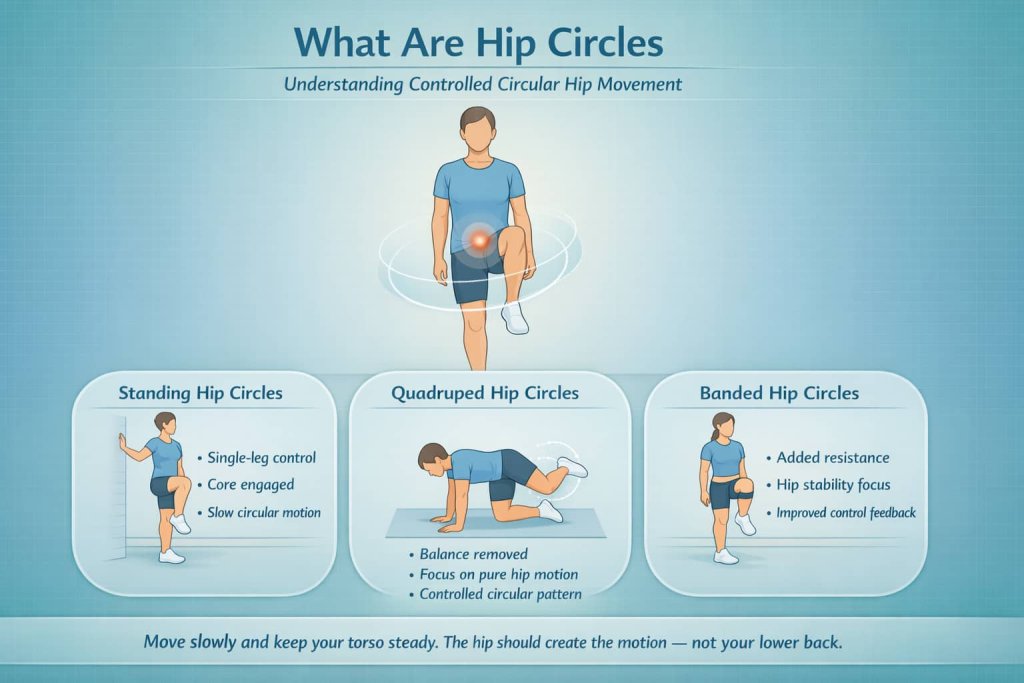
- Standing (single-leg hip circle, knee lifted)
- Hands-and-knees (quadruped hip circles)
- With a mini band (banded hip circles for extra control and feedback)
The key is control. You’re not swinging your leg around. You’re moving slowly enough to keep your torso steady while your hip does the work.
Hip Circles Exercise: How to Do It Correctly
Use this version first because it’s simple and easy to control.
How to do it:
- Stand tall and hold a wall or rack lightly for balance.
- Shift weight onto your left leg and brace your core.
- Lift your right knee to about hip height (comfortable range).
- Make a slow circle with the knee: out to the side, back, in, and up.
- Keep your torso quiet (no leaning or twisting to cheat the circle).
- Do all reps, then switch directions.
- Switch legs and repeat.
Trainer Tip: Make the circle smaller if your low back moves or your standing knee collapses inward. Clean, controlled circles beat big sloppy ones every time.
Hip Circles Variations
Explore simple hip circles variations to improve control, stability, and joint comfort. Choose the version that matches your balance level and mobility goals.
1. Quadruped Hip Circles (Hands-and-Knees)
Why it works:
This variation removes the balance challenge, allowing you to isolate pure hip movement. Because your hands and opposite knee support your body, you can focus on smooth rotation, joint control, and staying stable through your core. It’s especially useful for beginners or anyone who struggles to control standing hip circles.
Muscles worked:
Gluteus maximus, gluteus medius and minimus, deep hip rotators, hip flexors (light), and core stabilizers that prevent spinal movement.
How to do it:
- Start on hands and knees with wrists under shoulders and knees under hips.
- Brace your core lightly and keep your spine neutral (no sagging or rounding).
- Lift one knee about 1–2 inches off the floor.
- Slowly draw a circle with your knee: out to the side, slightly back, around, and in.
- Keep your hips as level as possible throughout the motion.
- Complete all reps, then reverse the direction.
- Switch sides and repeat.
Trainer Tip:
If your low back arches or your hips shift side-to-side, your circle is too big. Reduce the range and slow the tempo to regain control.
2. Banded Hip Circles (Mini Band)
Why it works:
Adding a mini band increases lateral tension, which challenges hip stability—especially the glute medius. The resistance gives you feedback, helping you maintain proper knee alignment and stronger single-leg control.
Muscles worked:
Gluteus medius and minimus (primary), gluteus maximus, deep hip stabilizers, standing-leg stabilizers, and core muscles.
How to do it:
- Place a mini band above your knees (easier) or around your ankles (more challenging).
- Stand tall and lightly brace your core.
- Shift weight to one leg while keeping the standing knee aligned over the foot.
- Lift the opposite knee and perform small, controlled circles.
- Avoid letting the standing knee collapse inward.
- Complete reps in one direction, then reverse.
- Switch sides and repeat.
Trainer Tip:
Choose band tension that allows full control. If you’re wobbling excessively or losing posture, use a lighter band and tighten up your form.
3. Seated Hip Circles (Desk-Friendly)
Why it works:
This low-load variation gently moves the hip joint without placing stress on balance or weight-bearing structures. It’s ideal for movement breaks during long sitting periods and helps restore circulation and joint motion.
Muscles worked:
Hip flexors, deep hip rotators, and small stabilizing muscles around the hip joint, with light engagement of postural muscles.
How to do it:
- Sit tall near the front edge of a chair with feet flat.
- Brace your core lightly and avoid leaning back.
- Lift one knee slightly off the floor.
- Draw small, slow circles with your knee.
- Reverse the direction after completing your reps.
- Switch legs and repeat.
Trainer Tip:
Keep the circles small and controlled. This variation is meant to refresh movement, not create fatigue.
Why Hip Circles Help Tight Hips
Most people use hip circles for one main reason: they improve how the hips feel and move right before activity.
A warm-up is meant to prepare you mentally and physically by increasing blood flow, raising body temperature, and improving joint range of motion. Hip circles match that goal because they gently take your hip through multiple directions in one drill, which aligns with dynamic warm-up principles outlined by the NSCA.
Dynamic stretching is also commonly recommended in warm-ups, often after 5–10 minutes of easy cardio or movement, according to the Hospital for Special Surgery (HSS).
Benefits of Hip Circles for Training and Daily Movement
Hip circles may help you:
- Feel less stiff before lower-body workouts
- Improve control in single-leg positions (walking, stairs, lunges)
- Wake up your hips before squats, deadlifts, running, or sports
- Practice smoother hip motion without forcing a deep stretch
Research on warm-ups and dynamic stretching shows they can support immediate performance readiness, and a 2023 review indexed in PubMed found dynamic stretching is often associated with improved explosive performance when included in a proper warm-up.
How Many Hip Circles Should You Do
Most people get the best results when hip circles are part of a short warm-up, not a long workout.
A simple starting point:
| Goal | Sets | Reps per side | Pace |
|---|---|---|---|
| Quick warm-up | 1–2 | 6–10 each direction | Slow and controlled |
| Extra stiffness days | 2–3 | 8–12 each direction | Controlled, slightly bigger range |
| Balance + control focus | 2–3 | 6–8 each direction | Very strict form |
If you also plan to do longer stretching, reputable guidance from the Mayo Clinic recommends warming up first with light activity for about 5–10 minutes before stretching.
Common Mistakes That Make Hip Circles Less Effective
- Going too fast
- Twisting the torso instead of isolating the hip
- Letting the standing knee collapse inward
- Forcing range of motion into discomfort
- Skipping the reverse direction
When to Do Hip Circles
Hip circles work best:
- Before leg day (squats, lunges, deadlifts)
- Before running or field and court sports
- After sitting for long periods
- Before mobility sessions
A typical warm-up structure includes light movement first, followed by dynamic drills like hip circles, as described by the Hospital for Special Surgery (HSS). For general warm-up and cool-down principles, the Mayo Clinic provides practical guidance.
Who Should Be Careful With Hip Circles
Hip circles are generally low risk, but use caution if you have:
- Sharp hip pain, catching, or locking
- Pain that worsens with hip rotation
- A recent hip, groin, or low-back injury
- Post-surgery movement restrictions
As a simple safety rule, avoid pushing into pain and keep movements controlled, consistent with guidance from the Mayo Clinic.
Frequently Asked Questions
Do hip circles loosen tight hips fast?
They can help you feel looser quickly because they prepare the joint for movement. Most people notice the biggest difference right before activity.
Are hip circles dynamic stretching or mobility?
They are best described as a dynamic mobility drill because you are moving through range rather than holding a stretch.
Should I do hip circles before or after a workout?
Usually before, as part of a warm-up. Many guidelines place dynamic drills before training and longer static stretching after.
How many reps of hip circles should I do?
A practical range is 6–12 reps per direction per side for 1–3 sets, depending on how stiff you feel.
Why does one side feel tighter?
Side-to-side differences are common and usually reflect differences in control or range. Keep the movement smaller and more controlled on the tighter side.
Can hip circles help squat depth?
They may help you feel more prepared and comfortable before squatting, but they are not a guaranteed fix by themselves.
What if I feel pinching in the front of my hip?
Reduce the range of motion first. If discomfort continues, stop and consider individualized guidance.
Conclusion
Hip circles are one of the simplest ways to make your warm-up more effective and your hips feel smoother before training or daily movement. Keep them slow, controlled, and consistent, and use them right before lower-body workouts or long sitting days.
If you want, I can also create a 5-minute hip warm-up routine built around hip circles for your site.