
The sit to stand exercise is a chair-based movement that builds lower-body strength and balance by practicing the exact action of standing up and sitting down with control. Because it trains a real-life task you do every day, it’s one of the most practical functional exercises you can use to support mobility, confidence, and independence—especially as you get older.
This guide explains how to do the sit to stand exercise safely, how many reps to start with, the most effective progressions, and who should modify it.
What Is the Sit to Stand Exercise?
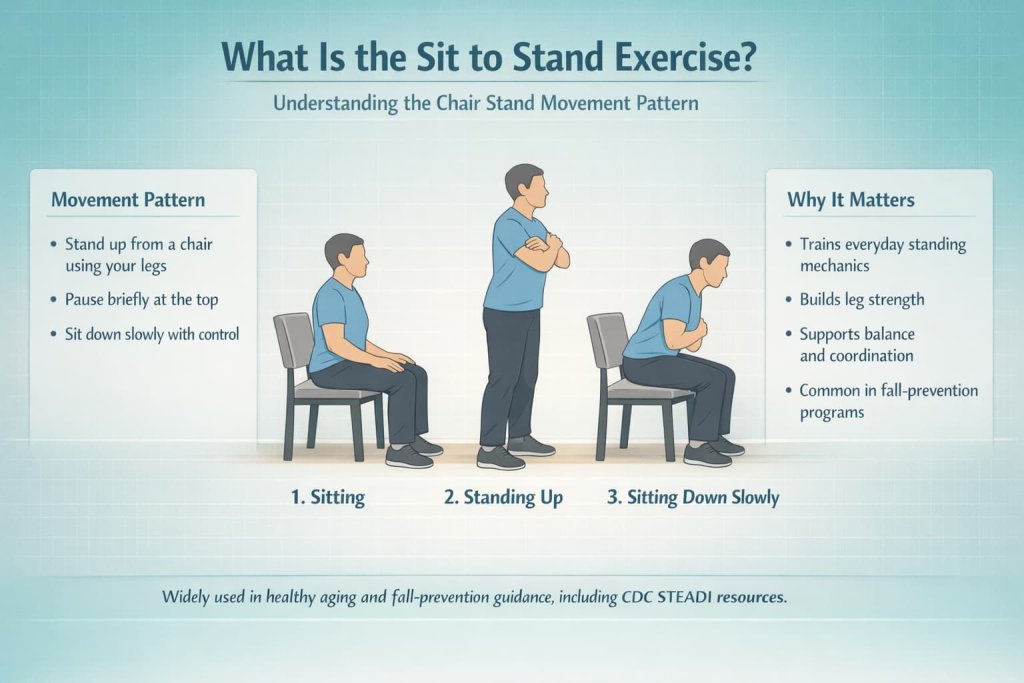
The sit to stand exercise (also called a chair stand or chair rise) is a repeated pattern of:
- Standing up from a chair using your legs
- Pausing briefly
- Sitting down slowly with control
It’s widely used in fall-prevention education and healthy-aging guidance because standing up well depends on leg strength, coordination, and balance, as highlighted in resources from the CDC STEADI.
How to Do the Sit to Stand Exercise Correctly
How to do it:
- Use a sturdy chair on a non-slip surface (place it against a wall if extra stability is needed)
- Sit toward the front of the chair with feet flat, about hip- to shoulder-width apart
- Keep your chest up and back long
- Lean your torso slightly forward so your weight shifts over your feet
- Press through your feet and stand up smoothly (use hands lightly only if needed)
- Pause briefly at the top
- Sit down slowly with control—avoid dropping into the chair
Why the Sit to Stand Exercise Strengthens Legs and Improves Balance
The sit to stand exercise strengthens your legs by repeatedly training hip and knee extension, the same actions used when standing up and climbing stairs. Each repetition challenges the quadriceps and glutes to lift your body weight, helping build functional lower-body strength.
It also improves balance because you must shift your weight forward and control your body as you stand and sit. This trains coordination and postural stability. The National Institute on Aging highlights practicing standing from a chair as a practical way to improve physical function.
Why it works:
- Trains real-life standing mechanics
- Strengthens hips and thighs
- Improves weight shifting and balance control
- Builds confidence in everyday movement
Sit to Stand Exercise Benefits
Builds real-world leg strength
Standing up challenges the muscles that help you climb stairs, get out of a car, and rise from a couch. The CDC STEADI program includes chair rise exercises as a simple way to strengthen the thighs and hips.
Improves balance and stability
Practicing a controlled stand and controlled sit teaches your body to manage weight shifts smoothly. For older adults, balance-focused activity is also part of public health guidance outlined in the CDC Physical Activity Guidelines for Older Adults.
Supports independence as you age
The National Institute on Aging specifically lists practicing standing from a sitting position as a way to improve physical function and support healthy aging.
Muscles Worked in the Sit to Stand Exercise
Sit to stands primarily train:
- Quadriceps (front of thighs)
- Glutes (hips)
- Hamstrings (back of thighs)
- Calves (support)
- Core and upper back (posture and control)
How Many Reps Should You Do?
A simple starting point commonly used in public health guidance is up to 10 controlled repetitions per set, as shown in the NHS Scotland Super Six Program.
Practical starting options:
- Beginner: 1–2 sets of 5–8 reps
- Building strength: 2–3 sets of 8–12 reps
- Balance and stamina focus: 1–3 sets of up to 10–15 controlled reps
On a weekly level, major health organizations such as the World Health Organization recommend including muscle-strengthening activity at least 2 days per week.
Sit to Stand Progressions and Regressions
If it feels too hard (make it easier)
- Use your hands lightly on the chair
- Choose a higher chair (higher seat = easier)
- Reduce the range of motion and stand partway
- Perform fewer reps with longer rest periods
If it feels too easy (make it harder)
- Cross your arms over your chest
- Slow down the lowering phase (3–5 seconds down)
- Pause just above the chair before sitting
- Use a slightly lower chair only if you can maintain control
Common Mistakes to Avoid
- Placing feet too far forward
- Letting knees collapse inward
- Rounding the back excessively
- Standing quickly but dropping down uncontrolled
- Using momentum instead of controlled leg drive
Each repetition should look smooth and controlled.
Safety Tips and Who Should Modify
Sit to stands are generally low-impact and adaptable, but you should be cautious if you have:
- Recent hip, knee, ankle, or back surgery
- Severe balance issues or dizziness
- Chest pain or unusual shortness of breath during activity
- A history of frequent falls
If you’re unsure whether this exercise is appropriate for you, consider speaking with a qualified healthcare professional before beginning.
The Sit to Stand Test and Why It’s Mentioned So Often
The movement is also used as a functional fitness assessment. The CDC STEADI 30-Second Chair Stand Test measures how many times a person can stand up and sit down in 30 seconds, often using a standard chair height of about 17 inches. This test is widely used to evaluate lower-body strength and functional ability in older adults.
Frequently Asked Questions
Is sit to stand the same as squats?
It’s similar in movement pattern, but sit to stand uses a chair for guidance and safety, making it more accessible for many people.
Is the sit to stand exercise good for seniors?
Yes. It’s commonly recommended because it directly trains a daily-life movement and can be modified by adjusting chair height or using hands for support.
How often should I do sit to stands?
Many people perform them 2–4 days per week. Strength-focused guidance from organizations like the World Health Organization supports muscle-strengthening activities at least twice weekly.
What chair height should I use?
Choose a height that allows you to stand without rocking or straining. Standard assessments often reference a 17-inch seat height, but comfort and control matter most.
Should my knees go past my toes?
A small amount can happen depending on body proportions and chair height. Focus more on control and keeping knees aligned over your feet.
What if I can’t stand up without using my hands?
That’s a common starting point. Use light hand assistance and gradually reduce reliance on your hands over time, following guidance similar to that provided by the CDC STEADI.
Conclusion
The sit to stand exercise is simple, practical, and highly functional. With consistent practice, it can help strengthen your legs, improve balance, and make everyday tasks feel easier. Start with a sturdy chair, focus on controlled movement, and progress gradually as your strength improves.