
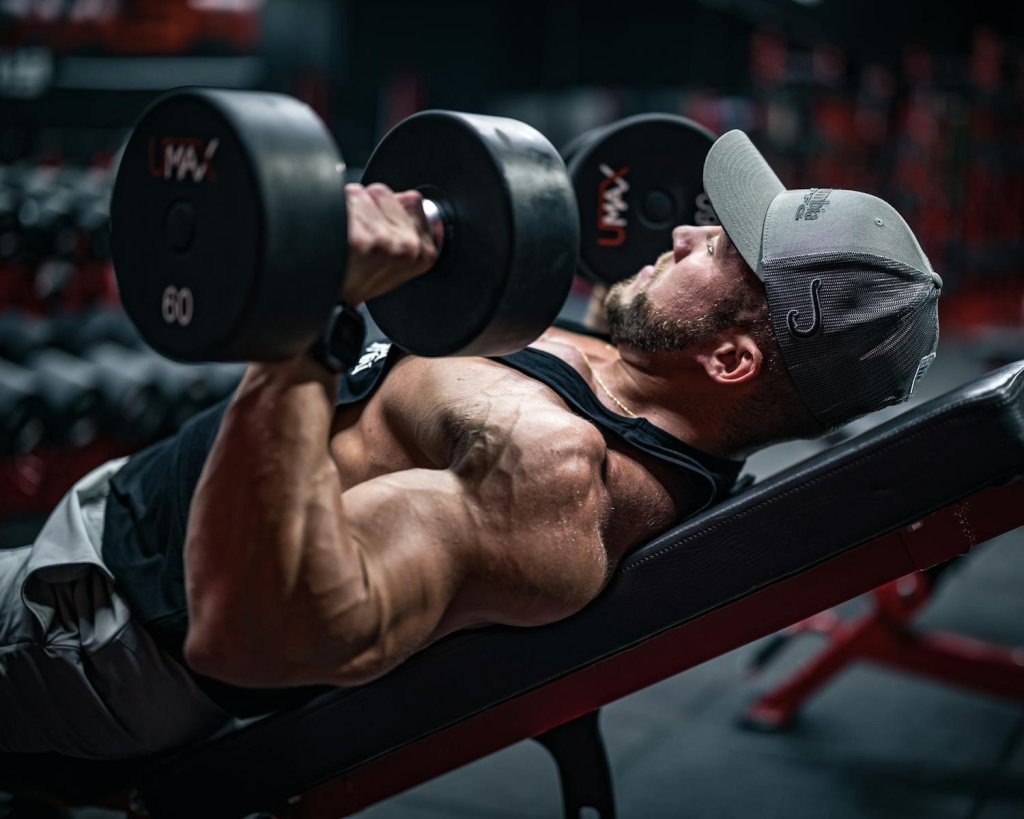
The incline dumbbell press is one of the best exercises for building the upper chest because it shifts more work toward the clavicular, or upper, portion of the pectoralis major while also training the front shoulders and triceps. Understanding how to set the bench, control the dumbbells, and avoid common form errors matters because small setup mistakes can turn a great chest exercise into a shoulder-dominant one. Current guidance from NASM and ACE makes the key priorities clear: use a moderate incline, keep your feet planted, retract your shoulder blades, and lower the weights with control.
What Is the Incline Dumbbell Press?
The incline dumbbell press is a compound upper-body pressing exercise performed on an adjustable bench. Unlike a flat dumbbell press, the incline setup changes the shoulder angle so the upper chest contributes more to the movement. NASM describes it as a foundational press for upper-chest development and pressing strength, while ACE lists it as a beginner-friendly chest-and-shoulders dumbbell exercise.
Because each arm controls its own dumbbell, the incline dumbbell press also demands more side-to-side control than a barbell version. That can make it useful for noticing strength differences between the left and right sides.
How to Do the Incline Dumbbell Press With Proper Form
Use this step-by-step setup for clean, controlled reps. It combines cues from NASM, ACE, and Mayo Clinic.
- Set the bench to a moderate incline, usually around 30 to 45 degrees.
- Sit back with your feet flat on the floor.
- Hold the dumbbells at chest level with your elbows about 45 degrees from your body.
- Retract your shoulder blades and keep your spine neutral.
- Press the dumbbells upward and slightly forward in a controlled path.
- Stop short of aggressively locking out the elbows.
- Lower the dumbbells slowly back toward the upper chest.
- Keep your wrists neutral and your forearms stacked under the weights.
Trainer tip: Think about keeping your chest proud and your shoulders “down and back” as you press. If your shoulders roll forward or your low back starts over-arching, the weight is probably too heavy for clean reps.
Incline Dumbbell Press Variations and Alternatives
The standard incline dumbbell press works well for many people, but it is not the only option. Variations and alternatives can help if you want a different training stimulus, need a more joint-friendly setup, or do not have access to the same equipment. From a practical standpoint, the best choice is the one that lets you train the upper chest with good control, stable shoulder position, and a pain-free range of motion.
1. Neutral-Grip Incline Dumbbell Press
This variation uses a palms-facing grip instead of the more common forward-facing grip. For some people, that position feels more comfortable on the shoulders because it reduces how much external rotation is required at the joint.
Why it can help:
- May feel easier on irritated shoulders
- Can improve pressing comfort for some beginners
- Still trains the upper chest, front shoulders, and triceps
A neutral grip does not automatically make the exercise better, but it can be a smart adjustment if the standard incline dumbbell press feels awkward or uncomfortable.
2. Single-Arm Incline Dumbbell Press
The single-arm version increases the stability challenge because your torso has to resist twisting while one side presses. It is not the best first variation for beginners, but it can be useful for more experienced lifters who want to challenge side-to-side control.
Why it can help:
- Increases core and anti-rotation demand
- Can expose left-to-right strength differences more clearly
- Lets you focus on one side at a time
Use lighter weight than you would for the two-arm version, and keep your rib cage and hips steady throughout the set.
3. Incline Barbell Press
The incline barbell press is the most common alternative if your main goal is to move heavier loads. A barbell usually gives you more stability than dumbbells, which is why many lifters can press more total weight with it.
Why it can help:
- Easier to load progressively
- More stable pressing path
- Useful for strength-focused chest training
The tradeoff is that the barbell does not allow each arm to move as independently as dumbbells do. That means it may hide side-to-side imbalances more easily.
4. Machine Incline Press
An incline chest press machine can be a good option for beginners, for people training close to fatigue without a spotter, or for those who want a more controlled path. Because the machine guides the movement, it reduces some of the stabilization demand.
Why it can help:
- Easier to learn for some beginners
- Useful for safer hard sets when training alone
- Can help you focus on chest effort without balancing dumbbells
This can be especially useful if your goal is hypertrophy and you want to train the upper chest hard with less setup complexity.
5. Incline Push-Up
If you do not have dumbbells or a bench, an incline push-up is a simple alternative. In this version, your hands are elevated on a bench, box, or sturdy surface. That usually makes the movement easier than a floor push-up, which is why it is often a good stepping-stone for beginners.
Why it can help:
- Requires little or no equipment
- Beginner-friendly
- Helps build pressing strength and control
It does not match the incline dumbbell press exactly, but it can still help someone develop the basic pressing pattern before progressing to loaded chest work.
Incline Dumbbell Press Muscles Worked
According to NASM, the incline dumbbell press mainly trains the upper chest while also involving the triceps and several supporting muscles around the shoulder and trunk.
Primary muscles worked:
- Pectoralis major, especially the clavicular or upper portion
- Triceps brachii
Secondary or supporting muscles:
- Anterior deltoid
- Pectoralis minor
- Serratus anterior
- Core stabilizers
That mix is one reason the exercise feels more demanding than a simple chest isolation move. It is still a chest press first, but the shoulders and trunk have to help stabilize the load throughout the set.
Incline Dumbbell Press Benefits
One of the biggest incline dumbbell press benefits is that it gives the upper chest more emphasis than a flat press. NASM notes that the incline angle shifts mechanical tension toward the clavicular head of the pectoralis major, which is why this variation is often included in chest-building programs.
Other practical benefits include:
- More upper-chest emphasis than flat pressing
- Independent arm work, which can help expose side-to-side strength differences
- More stabilizer demand than a fixed bar path
- Easy progression from light technique work to harder strength sets
- Useful carryover to broader pressing strength
NASM also notes that dumbbells allow each side to work independently, while barbells make it easier to load heavier. That makes incline dumbbell pressing a strong option for balanced development, especially if one side tends to take over during barbell work.
Best Bench Angle for the Incline Dumbbell Press
Bench angle is one of the most important setup choices. A PubMed indexed 2010 EMG study found that activation of the clavicular head of the pectoralis major was significantly greater at 44 degrees and 56 degrees than at flat, while the more mid-to-lower sternocostal portion was more active on the flat bench.
A newer 2025 study published in the European Journal of Sport Sciences found that 32 degrees and 43 degrees produced significantly higher clavicular-pec activation than 20 degrees during the incline barbell bench press, with 43 degrees producing the highest average activation in that trial.
In real-world training, that makes a moderate incline of about 30 to 45 degrees a smart starting range for most people. NASM’s current exercise library also recommends a 45-degree setup and warns that angles above 45 degrees shift more emphasis to the anterior deltoids. It is worth noting that the bench-angle studies were done on barbell bench press variations and in young male participants, so they are best used as practical guidance rather than a perfect rule for every lifter.
Form Tips That Make a Big Difference
Good incline dumbbell press form is usually about control, not just strength. ACE advises keeping the elbows under the wrists and lowering the dumbbells in unison without bouncing, while Mayo Clinic warns against locking the elbows and letting them drop too far below the body line during chest pressing.
Use these form tips on every set:
- Keep your feet planted so your torso stays stable
- Lower the weights slowly instead of letting gravity take over
- Keep your wrists stacked over your forearms
- Let the chest and triceps drive the press, not a hard push from the feet
- Stop the set if you lose shoulder position or range control
These details sound small, but they usually separate productive chest work from reps that mostly irritate the shoulders or turn into sloppy front-delt pressing.
Common Incline Dumbbell Press Mistakes
NASM highlights a few mistakes that show up over and over in gyms. Most of them are easy to fix once you know what to watch for.
Bench too steep
If the bench is set too high, the exercise shifts away from the chest and toward the anterior deltoids. A moderate incline usually keeps the movement closer to an upper-chest press instead of a shoulder press.
Elbows too wide or too tucked
NASM notes that elbows positioned too wide or too close can hurt shoulder mechanics and reduce chest contribution. A middle ground of roughly 45 degrees from the body is usually easier to control.
Lowering the weights too fast
Dropping the dumbbells quickly reduces control and time under tension. ACE and NASM both emphasize a controlled lowering phase rather than bouncing or rushing the bottom of the rep.
Excessive lower-back arch
A hard arch often shows up when someone tries to force more weight than they can really control. NASM flags excessive low-back arching as a common mistake because it reduces core stability and changes the movement pattern.
Aggressive lockout at the top
Mayo Clinic advises against locking the elbows during dumbbell chest pressing, and NASM makes the same point in its incline version. Finishing the rep with control keeps tension where you want it and can feel better on the joints.
Incline Dumbbell Press vs Flat Dumbbell Press
The incline dumbbell press and flat dumbbell press are both useful, but they are not identical. NASM notes that incline pressing places greater emphasis on the upper chest and anterior deltoids, while flat pressing spreads the load more evenly across the pectoral muscle.
Choose the incline dumbbell press when your goal is:
- More upper-chest emphasis
- A chest press that feels slightly more shoulder-flexion dominant
- Balanced dumbbell work for left and right sides
Choose the flat dumbbell press when your goal is:
- More general chest pressing
- A flatter pressing path with less incline-specific shoulder demand
- A simple base press to pair with incline work
For many people, the best answer is not one or the other. It is using both at different points in the week or the training cycle.
How Many Sets and Reps Should You Do?
For general strength training, Mayo Clinic recommends training all major muscle groups at least two times per week and using a resistance level heavy enough to tire the muscles after about 12 to 15 repetitions. Its dumbbell chest-press guidance also notes that for many people, one set of 12 to 15 repetitions is adequate as a starting point.
A practical beginner approach is:
- Start with a weight you can control for 12 to 15 good reps
- Do 1 to 2 hard working sets
- Train chest on nonconsecutive days
- Add weight only after your form stays consistent
More experienced lifters may use different loading schemes, but clean technique still matters more than chasing heavier dumbbells with poor range or shoulder position.
Who Should Be Careful Before Starting?
Mayo Clinic advises talking with a healthcare professional before starting strength training if you have health problems, and NASM’s bench-press biomechanics guidance recommends a slow, progressive approach with light loads when learning the movement.
Be extra careful with the incline dumbbell press if:
- You have current shoulder pain
- You recently had upper-body surgery or injury
- You cannot lower the weights under control
- You are new to pressing and do not have a safe way to set up and finish the set
If you are a beginner, lighter loads and a spotter are a smart idea while you learn the path of the exercise.
FAQs About the Incline Dumbbell Press
Is the incline dumbbell press good for the upper chest?
Yes. That is its main reason for being in most chest programs. NASM says it emphasizes the upper chest, and bench-angle studies show greater clavicular-pec activation at moderate inclines than at flatter setups.
What is the best angle for incline dumbbell press?
A moderate incline around 30 to 45 degrees is a practical starting range. Research supports moderate inclines for upper-chest activation, and NASM specifically recommends 45 degrees while warning that steeper angles shift more work to the front delts.
Is incline dumbbell press better than flat bench press?
Not across the board. Incline pressing is better for upper-chest emphasis, while flat pressing distributes the load more evenly across the chest. They do different jobs well.
Are dumbbells better than barbells for incline pressing?
Dumbbells are often better for independent arm control and spotting strength imbalances. Barbells are often better for heavier loading and stability. The better choice depends on your goal.
How low should I lower the dumbbells?
Lower them with control to a range you can own without losing shoulder position. Mayo Clinic advises not letting the elbows drop too far below the body line during chest pressing, and ACE emphasizes a controlled lowering phase without bouncing.
How often should I do incline dumbbell press?
A common beginner-friendly approach is to place it within a chest or upper-body routine on nonconsecutive days. Mayo Clinic recommends strength training major muscle groups at least twice weekly and avoiding the same muscle group on back-to-back days.
Conclusion
The incline dumbbell press earns its place in a chest workout because it can build upper-chest strength, challenge stabilizers, and help you train each side more evenly. Start with a moderate bench angle, keep your shoulder blades set, lower the weights with control, and do not let a too-steep bench or sloppy elbow position turn it into a shoulder-heavy press. When your form stays solid, this exercise can be one of the most effective upper-chest moves in your program.
References
- NASM: Two-Arm Incline Dumbbell Chest Press
- ACE Fitness: Incline Chest Press
- Mayo Clinic: Chest Press With Dumbbell
- Mayo Clinic: Strength Training Basics
- Trebs et al., 2010: An Electromyography Analysis of 3 Muscles Surrounding the Shoulder Joint During a Chest Press Exercise at Several Angles
- Lauver et al., 2016: Influence of Bench Angle on Upper Extremity Muscular Activation During Bench Press Exercise
- Rodríguez-Ridao et al., 2020: Effect of Five Bench Inclinations on the Electromyographic Activity of the Pectoralis Major, Anterior Deltoid, and Triceps Brachii During the Bench Press Exercise
- NASM: Single-Arm Incline Dumbbell Chest Press