
Yes—rowing is a good exercise for building cardiovascular fitness and muscular endurance while working your legs, hips, back, core, and arms. Its low-impact movement makes it an appealing alternative to activities involving repeated landing impacts, but good technique and a manageable workload matter.
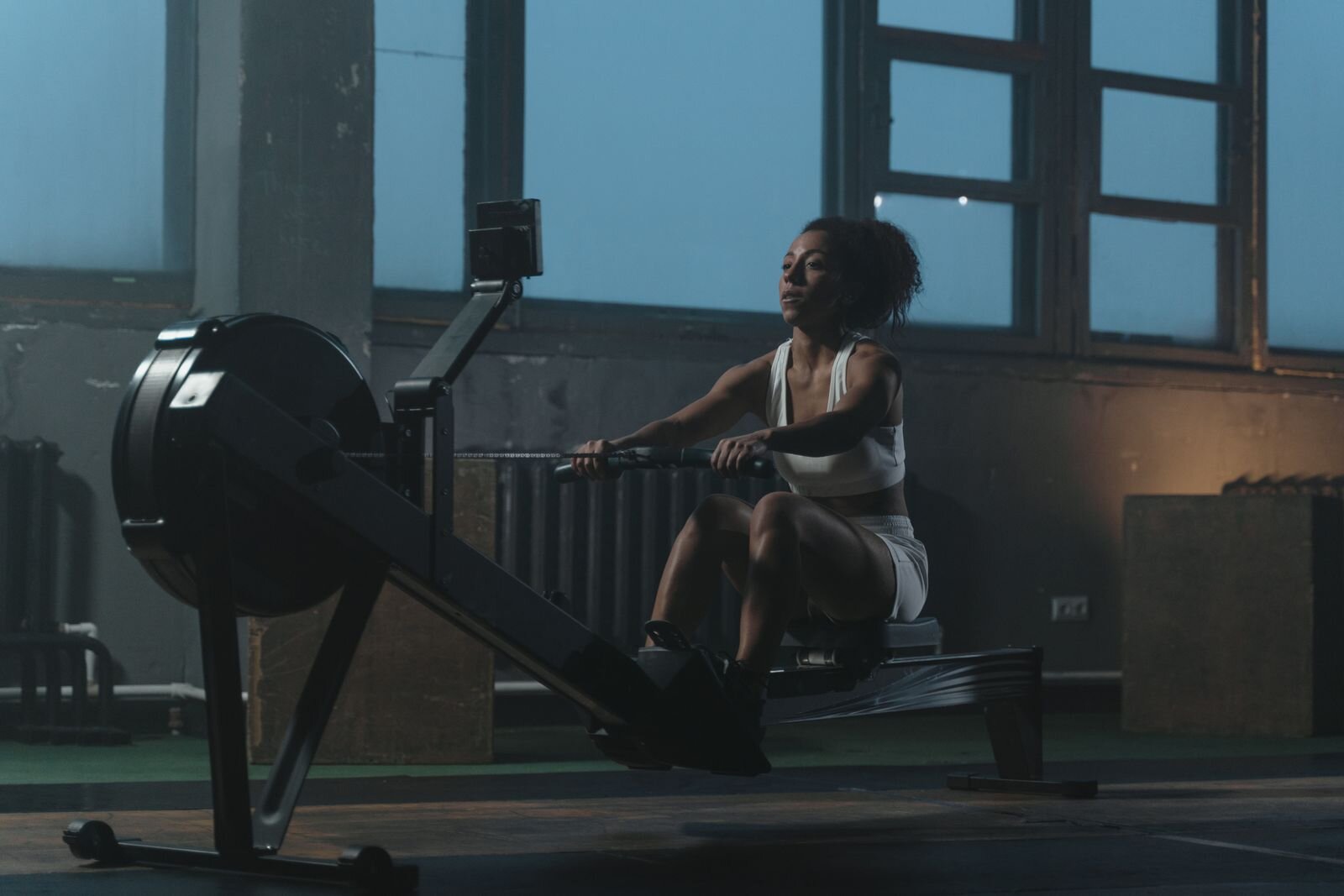
If you are wondering, “Is rowing a good exercise for me?” consider your goals, comfort, and current fitness. Start with short, easy sessions, learn the stroke, and build gradually. This guide focuses on indoor rowing machines, also called rowing ergometers.
Why Is Rowing a Good Exercise?
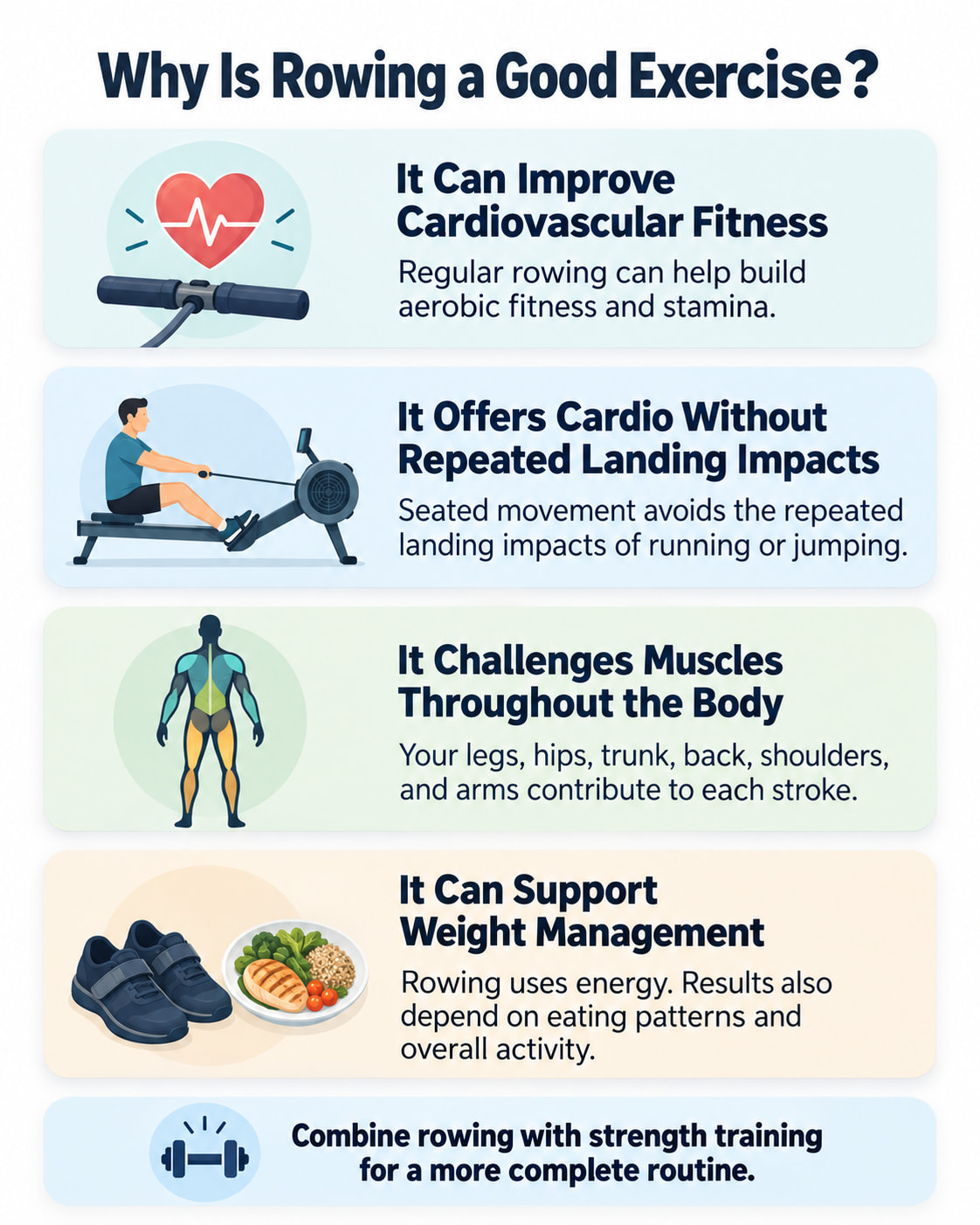
Rowing combines repeated leg pushes, hip movement, and upper-body pulling. You can adjust your effort from gentle practice to demanding cardio, making the same machine useful across different fitness levels.
It Can Improve Cardiovascular Fitness
Rowing raises your breathing rate and challenges your heart and lungs. With consistent training, it can help you sustain activity with less fatigue.
A small randomized study published in 2023 involving 23 postmenopausal women found improvements in aerobic fitness after 10 weeks of indoor rowing. The training involved three weekly 30-minute sessions.
This supports rowing as a useful cardio option. However, a small study in one population cannot establish that rowing is better than other exercise or predict exactly when you will notice results.
It Offers Cardio Without Repeated Landing Impacts
On a rowing machine, you remain seated while your feet stay supported. There is no repeated landing phase like there is when running or jumping.
That can make rowing comfortable for people who prefer low-impact exercise. However, your knees still bend, your hips move, and your back transfers force. Low impact does not mean zero strain, particularly if a movement already causes pain.
It Challenges Muscles Throughout the Body
Rowing involves much more than pulling with your arms. The legs initiate the drive, while the trunk and upper body help transfer and finish the movement.
| Body area | Examples of muscles involved | Main role |
|---|---|---|
| Legs and hips | Quadriceps, glutes, and hamstrings | Contribute to leg drive and hip movement |
| Trunk | Abdominal and spinal muscles | Support the torso and transfer force |
| Back and shoulders | Latissimus dorsi, upper-back muscles, and rear shoulders | Contribute to pulling and shoulder control |
| Arms and hands | Biceps and forearm muscles | Bend the elbows and maintain grip |
Repeated strokes challenge muscular endurance. Some beginners may also gain strength, but rowing does not train every movement equally. Include separate resistance exercises if your goals include comprehensive strength or substantial muscle growth.
It Can Support Weight Management
Rowing uses energy and can contribute to the overall activity that supports weight management. Results also depend on eating patterns, total activity, and consistency.
It does not selectively remove belly fat. Working your abdominal muscles and losing fat from your abdomen are different processes.
For context, these calculations use activity values from the 2024 Adult Compendium of Physical Activities:
| Rowing effort | Estimated calories in 30 minutes for a 155-pound adult |
|---|---|
| Moderate effort, below 100 watts | About 185 |
| Vigorous effort, 100–149 watts | About 277 |
These are rough estimates using a body weight of about 70.3 kilograms and the standard MET calculation. They include resting energy expenditure during that time. Actual expenditure varies, and these watt ranges are examples—not beginner targets. Machine calorie displays are estimates, too.
Rowing Exercise Risks and Drawbacks
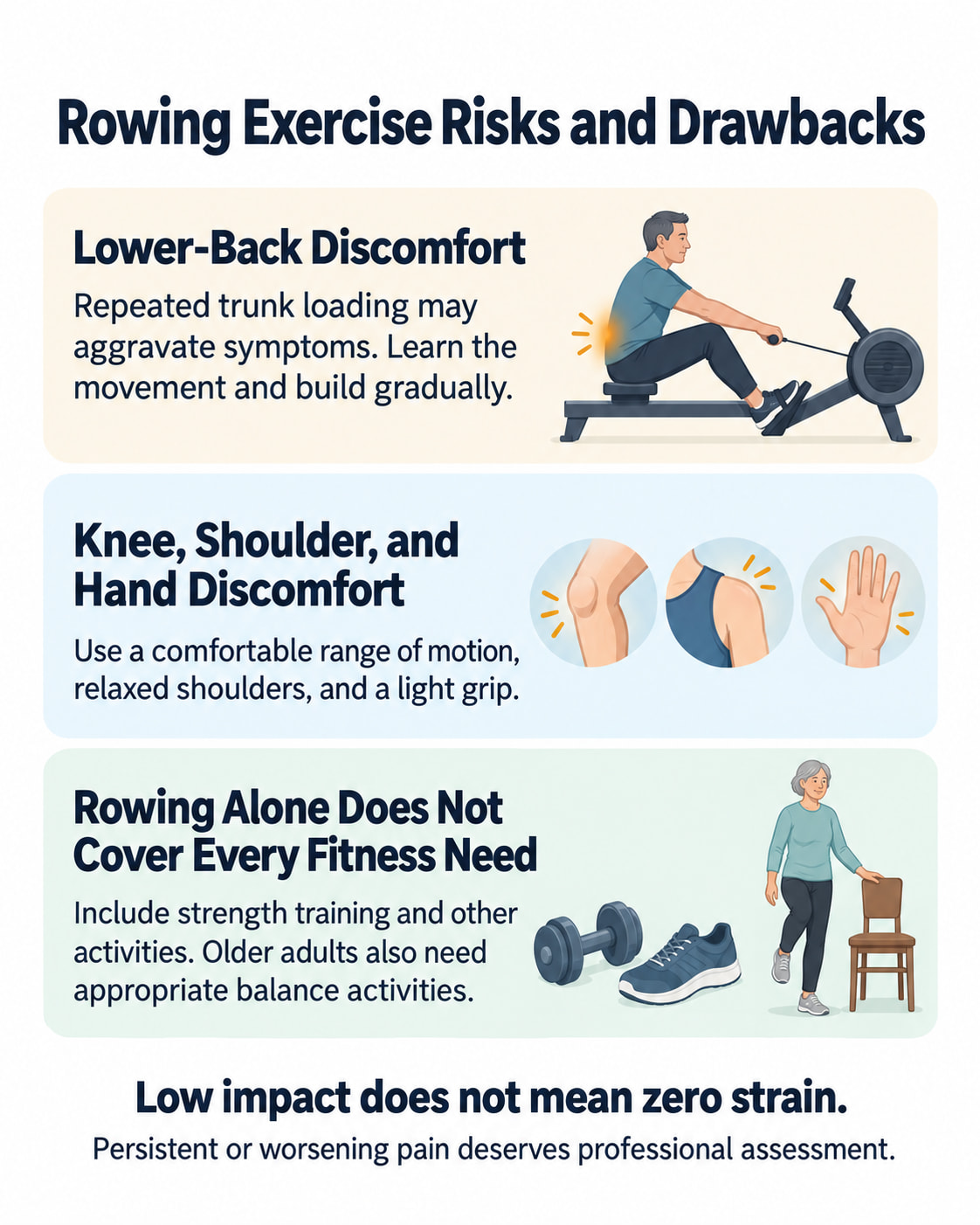
Lower-Back Discomfort
The rowing stroke repeatedly loads the trunk. Fatigue, an unsuitable workload, and difficulty controlling the movement can make sessions uncomfortable.
A 2025 systematic review found that previous low-back pain was associated with higher odds of back pain among rowing athletes. The review included 10 studies involving 2,082 athletes; findings for several other proposed risk factors were inconclusive.
These results do not establish an individual beginner’s injury risk. The practical approach is to learn the movement, build gradually, and respond early if rowing aggravates pain. No single posture cue guarantees prevention.
Knee, Shoulder, and Hand Discomfort
Deep knee bending may bother some people. Excessive reaching, shrugging, or pulling the handle too high can make the shoulders uncomfortable. Gripping tightly can contribute to hand irritation and forearm fatigue.
Use a comfortable range of motion and a relaxed grip. If discomfort keeps returning, have a qualified instructor check your setup and technique. Persistent or worsening pain deserves assessment by a healthcare professional.
Rowing Alone Does Not Cover Every Fitness Need
Indoor rowing mainly involves movement forward and backward. It does not provide the same practice as standing balance exercises, and it does not replace a complete strength program.
Combine it with resistance training and other activities you enjoy. Older adults should also include appropriate balance activities in their routine.
How to Start Rowing as a Beginner
1. Set Up the Machine for Your Body
Adjust the foot supports and secure the straps comfortably according to the machine’s instructions. You should be able to reach the handle without forcing an exaggerated stretch.
Choose a manageable setting. On a Concept2 RowErg, the manufacturer recommends starting around damper setting 3–5. Other machines use different systems, so the same numbers may not apply.
The damper changes airflow and the feel of the stroke. It is not a direct intensity dial: how forcefully you row also determines the effort. The highest setting is unnecessary for a useful workout.
2. Learn the Four Parts of the Stroke
The Concept2 technique guide explains the catch, drive, finish, and recovery. Practice slowly before adding power.
| Stroke phase | What to do |
|---|---|
| Catch | Begin with straight arms, relaxed shoulders, and a slight forward hinge from the hips. Bring your shins toward vertical only as comfortably as you can; avoid compressing beyond that point. |
| Drive | Push through your legs first. Then open your hips and bring your torso slightly back before finishing with the arm pull. |
| Finish | End with extended legs, a small backward lean, and the handle near your lower ribs. Keep wrists flat and shoulders relaxed. |
| Recovery | Straighten your arms, hinge forward from the hips, then bend your knees after the handle clears them. Slide forward under control. |
Remember: legs, hips, arms on the drive; arms, hips, legs on the recovery. Blend these actions into a smooth stroke rather than separate, jerky movements.
Common mistakes include pulling with the arms too early, rushing forward, rounding excessively to reach farther, and leaning far backward at the finish. An instructor’s feedback can help you identify what to adjust.
3. Try a Short First Session
Concept2’s introductory guidance starts with rowing bouts of 3–5 minutes followed by a break. You do not need to complete a continuous 20- or 30-minute workout on your first day.
Here is one beginner example built around that approach:
| Part | Time | What to do |
|---|---|---|
| Warm-up | 5 minutes | Walk gently and get comfortable with the setup |
| First rowing bout | 3 minutes | Row easily while practicing the sequence |
| Break | 2 minutes | Rest or walk; assess how you feel |
| Second rowing bout | 3 minutes | Repeat only if you feel comfortable |
| Cooldown | 5 minutes | Walk slowly and let your breathing settle |
Total: 18 minutes, including 6 minutes of rowing. This is an illustrative starting session, not a required prescription. Shorten it or finish after the first bout if that is enough.
You should be able to speak comfortably during these practice bouts. Technique comes before pace or distance.
4. Build Consistency Before Intensity
Two or three sessions on nonconsecutive days can be a practical starting schedule. Adjust this around your recovery and other exercise.
Once the current session feels manageable, extend a rowing bout or add another short one. Avoid increasing duration, frequency, and effort together.
Track time, comfort, and how consistently you maintain technique. Later, you can monitor average power or pace per 500 meters. Increasing stroke rate alone does not necessarily make a workout more effective.
How Much Rowing Should You Do?
The CDC recommends at least 150 minutes of moderate-intensity aerobic activity or 75 minutes of vigorous activity per week, or an equivalent combination. Adults also need muscle-strengthening activities involving all major muscle groups on at least two days weekly.
Rowing can supply some or much of the aerobic activity. You can also combine it with walking, cycling, or other exercise.
At moderate intensity, you can generally talk but cannot comfortably sing. At vigorous intensity, speaking more than a few words becomes difficult without pausing for breath.
For example, five 20-minute moderate rowing sessions provide 100 minutes. Another 50 minutes of moderate activity would bring the weekly total to 150 minutes.
Breaks and very light technique practice do not automatically count as moderate activity. Nevertheless, short sessions are useful starting points, and you can build toward the weekly goal gradually.
When to Modify Rowing or Seek Help
Ask a healthcare professional for individualized guidance if you have an existing condition that affects exercise safety, recent surgery, or persistent back or joint symptoms.
Stop a session if you develop sharp or increasing pain, dizziness, or unusual breathlessness. Seek assessment for recurring pain, numbness, or weakness rather than pushing through it.
Chest pain or pressure, fainting, or severe unexplained shortness of breath can require emergency help. Stop exercising and contact emergency services for these symptoms.
Frequently Asked Questions
Is Rowing a Good Exercise for Beginners?
Yes, provided you can perform the movement comfortably. Start with easy, short bouts and learn the sequence before adding intensity. Instruction can make the learning process easier.
Is 20 Minutes of Rowing Enough?
Twenty minutes can be a useful workout. Whether it meets your needs depends on effort, weekly frequency, other activity, and goals. You do not need to reach 20 minutes immediately.
Can You Use a Rowing Machine Every Day?
Some experienced exercisers row daily while varying effort. Beginners generally benefit from recovery between sessions. Daily hard rowing is unnecessary, especially if soreness or fatigue affects technique.
Does Rowing Build Muscle?
Rowing challenges muscular endurance and may improve strength, particularly in beginners. For substantial muscle growth and balanced strength, include progressive resistance exercises alongside rowing.
Is Rowing Better Than Walking or Running?
There is no universal winner. Rowing offers seated exercise with upper-body pulling, walking requires little equipment, and running involves greater landing impact. Choose according to comfort, goals, access, and enjoyment.
Is Rowing Good for Belly Fat?
Rowing can contribute to overall fat loss as part of an appropriate eating and activity pattern. It cannot determine where your body loses fat, even though your core works during each stroke.
Conclusion
Rowing can be a useful part of a balanced fitness routine, especially if you enjoy adjustable, low-impact cardio. Begin with a few comfortable minutes, practice a smooth stroke, and build a routine you can repeat. Pair rowing with strength training and other activities that support your goals.
References
- Cleveland Clinic. Benefits of rowing machines.
- Araujo and colleagues. The Time Course of Cardiorespiratory Adaptations to Rowing Indoor Training in Post-Menopausal Women.
- 2024 Adult Compendium of Physical Activities. Conditioning exercise activity values.
- Ze and colleagues. Risk factors associated with low back pain in rowers: a systematic review and meta-analysis.
- World Rowing. Guide for managing low back pain in rowers.
- CDC. Physical activity guidance for older adults.
- National Heart, Lung, and Blood Institute. Heart attack warning signs and emergency action.