
Isometric neck exercises strengthen your neck by creating gentle muscle tension without moving your head or neck. This makes them a practical option when you want controlled strengthening with minimal motion, especially for posture support, desk-related stiffness, and early-stage return to training.

Understanding how to do isometric neck work correctly matters because neck tissues can be sensitive to overload. The right approach focuses on light-to-moderate effort, steady breathing, and short holds you can repeat consistently. For pain-guided progression, the NHS inform neck exercise guidance offers a simple “rate your pain out of 10” framework.
What Are Isometric Neck Exercises?
Isometrics are strength exercises where you contract a muscle without visible joint movement. In neck training, that usually means you “push into your hand” (or into a towel or wall) while keeping your head still.
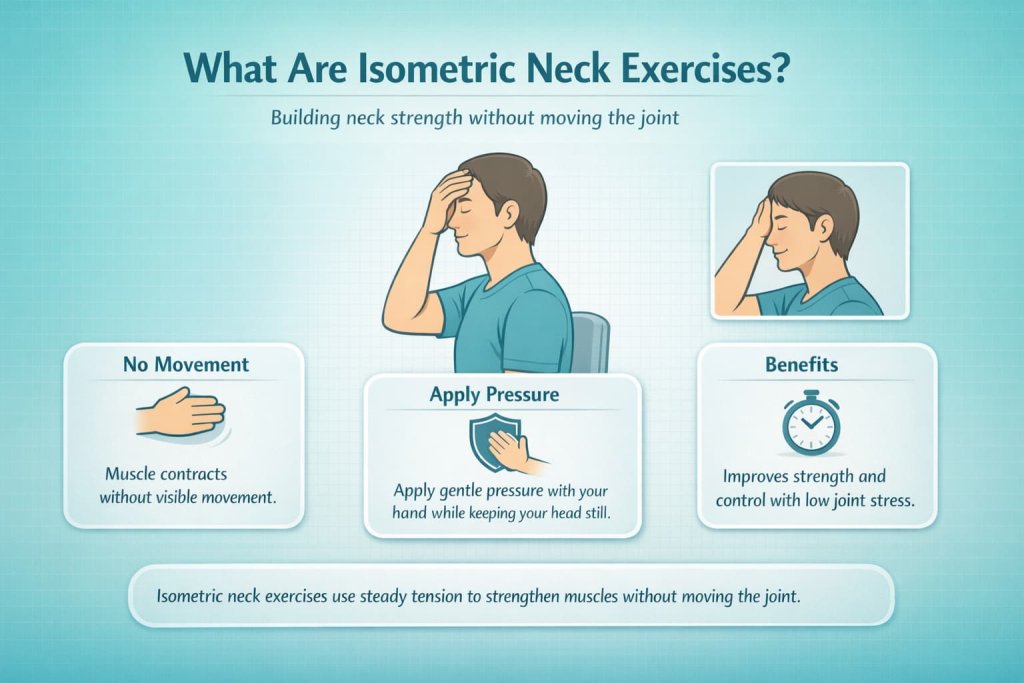
Because the movement stays still, isometrics can be easier to control than repeated neck bending or turning in some situations. They’re also simple: no equipment required, quick to perform, and easy to scale by adjusting effort and hold time. The Cleveland Clinic explains that isometric exercise involves muscle engagement without joint movement.
Benefits of Isometric Neck Exercises
Isometric neck training may help improve strength and endurance of the muscles that support your head position.
A 2022 meta-analysis published on PubMed Central reported that isometric training was associated with improvements in neck pain scores and neck-related function outcomes in people with neck pain, although study size and protocols varied.
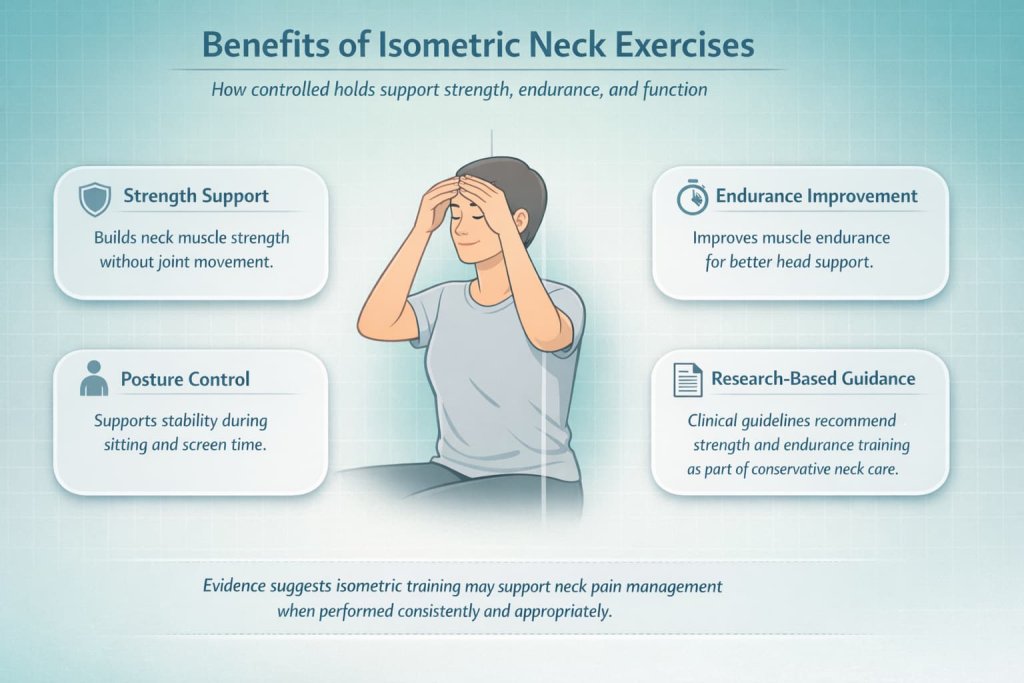
Clinical practice guidelines for neck pain published in the Journal of Orthopaedic & Sports Physical Therapy (JOSPT) emphasize exercise programs that include endurance and strength training as part of conservative care.
Important note: results depend on the cause of symptoms, your starting level, and consistency. Isometrics are not a quick fix, but they can be a useful building block in a broader plan.
6 Best Isometric Neck Exercises
These 6 best isometric neck exercises help build neck strength and stability without moving your head. Each hold targets a different direction to improve posture, control, and balanced muscle support.
1) Isometric Neck Flexion (Front of Neck Hold)
How to do it:
- Sit tall with ribs stacked over hips
- Place your palm on your forehead
- Gently press your forehead into your hand
- Keep your chin level (don’t let it poke forward)
- Hold 5–10 seconds, relax fully
Why it works:
This exercise strengthens and improves control of the muscles that help prevent forward head posture, especially during long periods of sitting, screen time, or desk work.
Muscles worked:
Deep neck flexors and front neck stabilizers.
Trainer Tip:
Use light pressure rather than maximal force. Your hand should easily prevent movement while your neck muscles create steady tension.
2) Isometric Neck Extension (Back of Neck Hold)
How to do it:
- Place one or both hands behind your head
- Press the back of your head gently into your hands
- Keep your chin slightly tucked
- Hold 5–10 seconds, then relax
Why it works:
This hold strengthens the muscles at the back of the neck that help maintain upright posture and support the head against gravity.
Muscles worked:
Cervical extensors (back-of-neck stabilizers).
Trainer Tip:
Avoid lifting your chin upward during the hold. Keep your head in a neutral position.
3) Isometric Right Side Bend (Right Lateral Hold)
How to do it:
- Place your right hand above your right ear
- Gently press your head into your hand without moving
- Keep shoulders relaxed
- Hold 5–10 seconds, relax
Why it works:
This movement improves side-to-side stability, which supports posture control and helps manage asymmetries from daily habits like carrying bags or leaning to one side.
Muscles worked:
Right lateral neck flexors and stabilizers.
Trainer Tip:
Keep your right shoulder down and relaxed. Do not shrug during the hold.
4) Isometric Left Side Bend (Left Lateral Hold)
How to do it:
- Place your left hand above your left ear
- Press gently into your hand without allowing movement
- Hold 5–10 seconds, relax
Why it works:
This exercise balances lateral neck strength and supports even muscle development between both sides of the neck.
Muscles worked:
Left lateral neck flexors and stabilizers.
Trainer Tip:
Keep your jaw relaxed and your eyes level to avoid unnecessary tension.
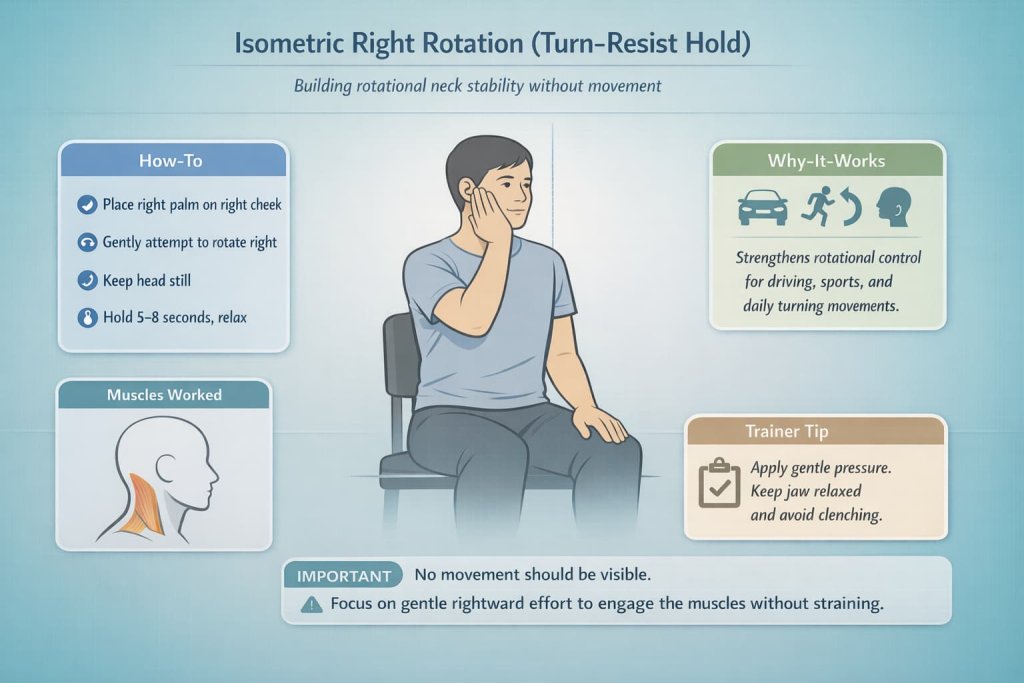
5) Isometric Right Rotation (Turn-Resist Hold)
How to do it:
- Place your right palm on your right cheek
- Try to rotate your head right while your hand resists
- Keep your head still
- Hold 5–8 seconds, relax
Why it works:
This hold strengthens rotational control, which is important for activities like driving, sports, and everyday turning movements.
Muscles worked:
Neck rotators and deep stabilizers.
Trainer Tip:
Apply gentle, controlled pressure. Avoid clenching your jaw.
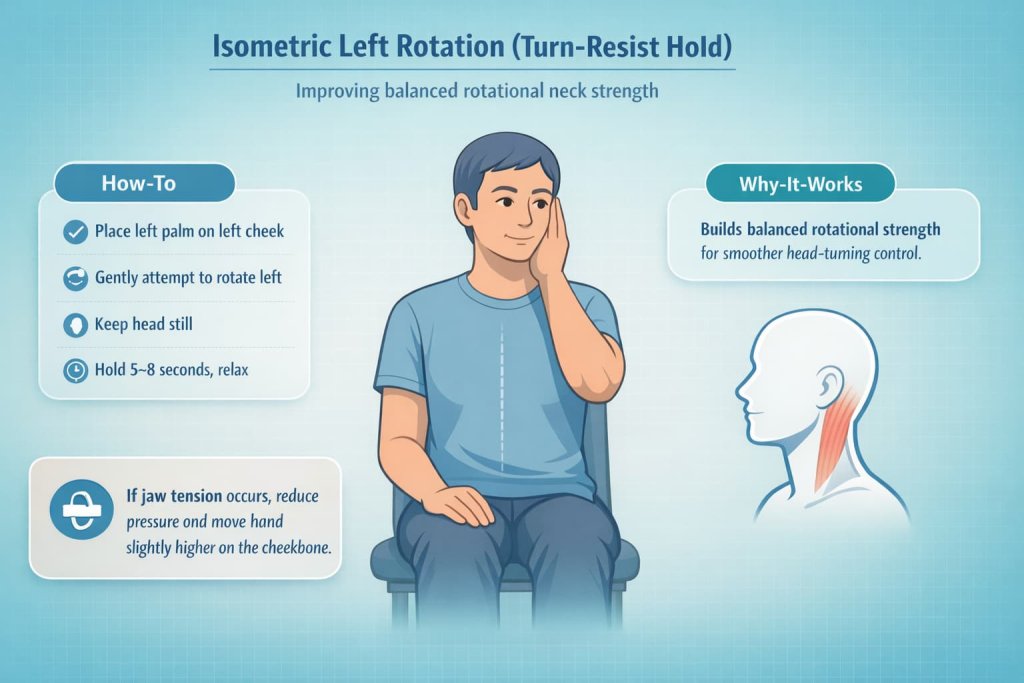
6) Isometric Left Rotation (Turn-Resist Hold)
How to do it:
- Place your left palm on your left cheek
- Gently attempt to rotate left while resisting with your hand
- Hold 5–8 seconds, relax
Why it works:
This movement improves balanced rotational strength and supports smooth head-turning mechanics.
Muscles worked:
Neck rotators and stabilizers.
Trainer Tip:
If you feel tension in your jaw, lighten the pressure and move your hand slightly higher on the cheekbone area.
How to Program Isometric Neck Exercises
Beginner template:
- Hold 5 seconds
- 6 reps per direction
- 1 set
- 3–5 days per week
Progression template:
- Hold 8–10 seconds
- 8–10 reps per direction
- 2 sets
- 3–4 days per week
Increase duration gradually rather than increasing force.
Quick Safety Checklist Before You Start
Use these safety rules to keep isometric neck exercises controlled:
- Keep effort light to moderate (about 3–6 out of 10, not maximal pushing)
- Keep your head perfectly still — no straining or shaking
- Breathe normally and avoid holding your breath, as noted by the Mayo Clinic
- Stop if you feel dizziness, tingling, numbness, vision changes, or sharp worsening pain
- Use a pain-scale approach similar to guidance from NHS inform to stay within an acceptable discomfort range
If you’ve had a recent injury, surgery, or unexplained symptoms, seek medical guidance before starting neck strengthening.
Common Mistakes to Avoid
- Pressing at maximum effort
- Holding your breath
- Allowing visible head movement
- Shrugging shoulders during side holds
- Rushing reps without full relaxation between holds
When to Seek Professional Guidance
Seek urgent medical care if neck symptoms include new weakness, spreading numbness, severe headache unlike usual, significant dizziness, or symptoms following major trauma.
For persistent neck pain, working with a licensed healthcare professional can help tailor intensity and progression appropriately. Exercise-based care is strongly supported in neck pain guidelines published in the Journal of Orthopaedic & Sports Physical Therapy.
FAQs About Isometric Neck Exercises
1) Are isometric neck exercises safe for beginners?
They can be when performed with light effort and proper form.
2) How hard should I press?
Aim for moderate effort — about 3–6 out of 10.
3) How long should I hold each rep?
Typically 5–10 seconds for most beginners.
4) How often should I do them?
3–5 times per week is common.
5) Can they help posture?
They may support better posture by improving muscular endurance in neck stabilizers.
6) What if pain increases?
Reduce effort, shorten hold time, or consult a healthcare provider.
7) Do I need equipment?
No equipment is required — your hands provide sufficient resistance.
Conclusion
Isometric neck exercises are a simple, no-equipment way to build neck strength and stability without moving your head. Focus on gentle pressure, steady breathing, and gradual progression. Consistency matters more than intensity.
This content is for informational purposes only and not medical advice.
References
- Blanpied PR, Gross AR, Elliott JM, et al. (2017). Neck Pain Clinical Practice Guidelines: Revision 2017 (Full PDF). Academy of Orthopaedic Physical Therapy (OrthoOPT). OrthoOPT
- Chiu TTW, Lam TH, Hedley AJ. (2005). A randomized controlled trial on the efficacy of exercise for patients with chronic neck pain. Spine. Europe PMC
- Cochrane Review. (2015). Exercise for neck pain. Cochrane Database of Systematic Reviews. Cochrane