
The Kas glute bridge is a glute-focused exercise that uses the upper portion of a bench-supported hip thrust, with a short, controlled lowering and lifting motion. To perform it, keep your feet planted, support your upper back, and extend your hips without forcing your lower back into an exaggerated arch.
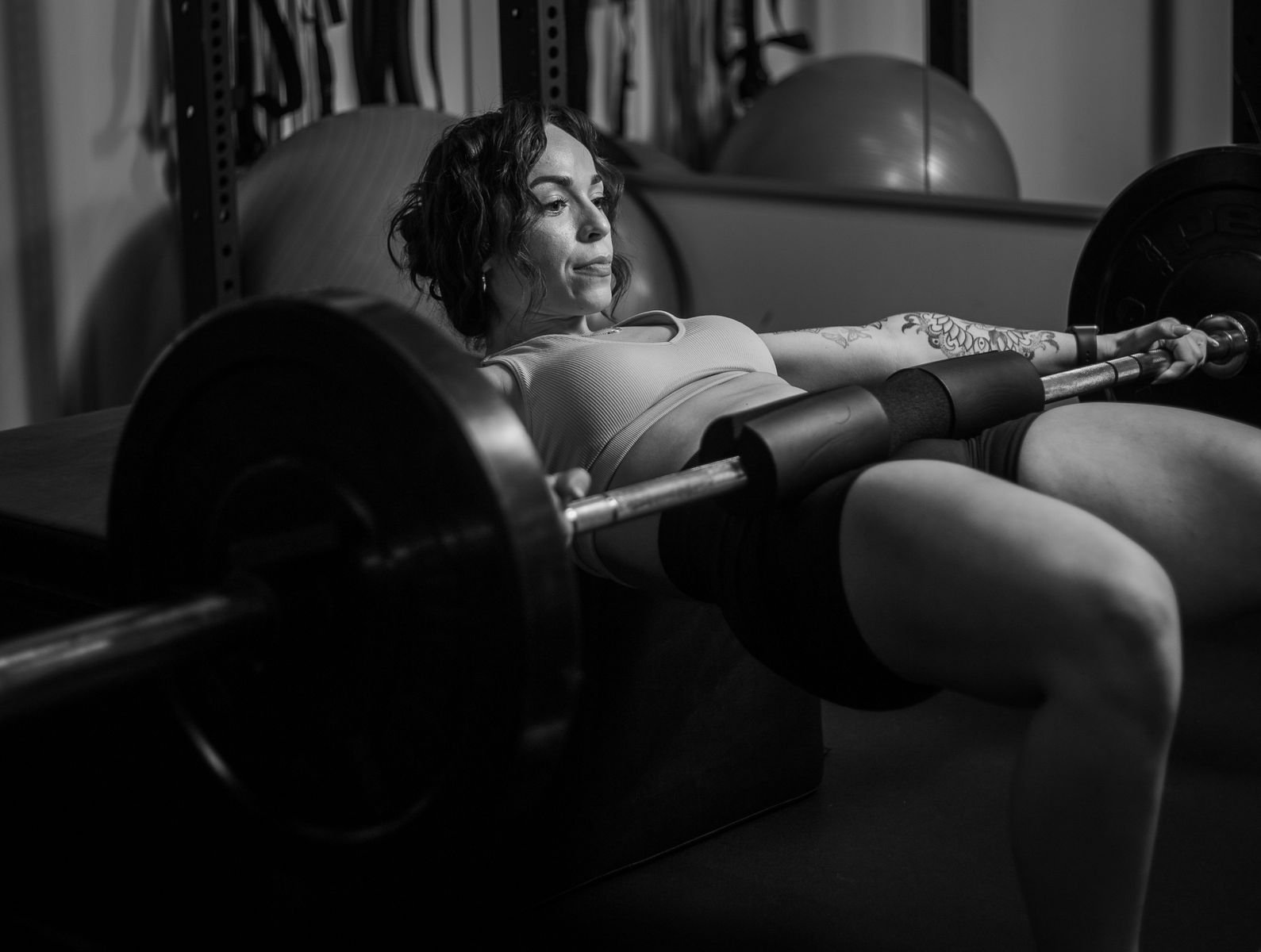
Understanding the setup helps you maintain the intended movement as the weight becomes challenging. Start light, establish a repeatable range, and build from there.
What Is a Kas Glute Bridge?
The Kas glute bridge is named after coach Kassem Hanson, who popularized this variation. You begin the working repetitions near hip extension, lower a short distance, and return to the top.
The exercise uses a bench and a shortened hip-thrust range. A practical stopping cue is to end the descent before your knees begin drifting noticeably backward.
There is no universal distance you must lower. Your proportions and setup influence how that range looks.
What Muscles Does the Kas Glute Bridge Work?
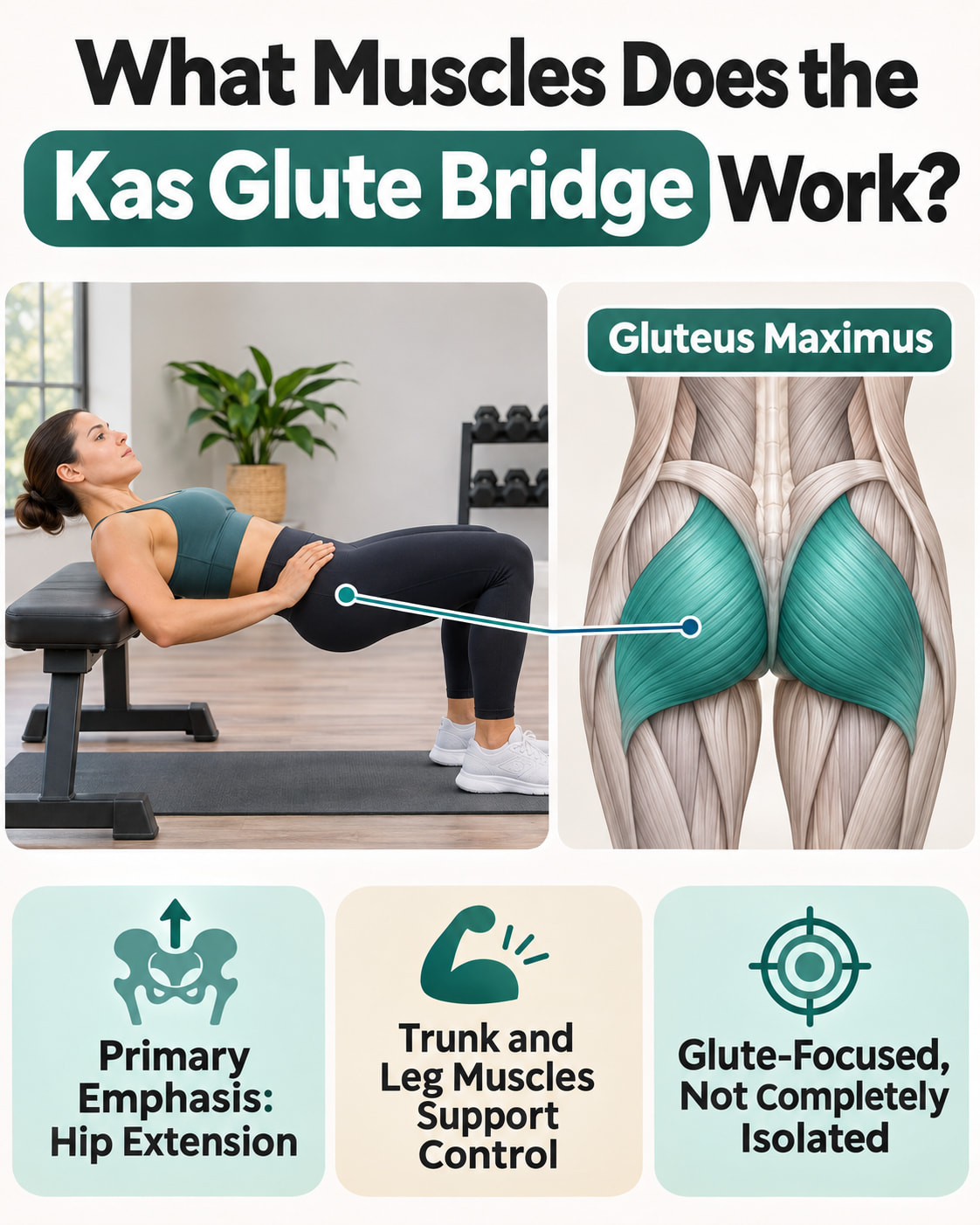
The main emphasis is the gluteus maximus, the large buttock muscle involved in hip extension. Your trunk and other hip and leg muscles also contribute to controlling your position.
Think of the exercise as glute-focused. It does not completely switch off every other muscle, and feeling some effort elsewhere does not automatically mean your technique is wrong.
How to Do a Kas Glute Bridge With Proper Form
Set Up Your Bench and Resistance
Use a sturdy bench that will remain in place throughout the set. Practice without added weight before loading the movement.
Position the bench edge near the bottom of your shoulder blades. Keep your feet flat and begin with your shins approximately vertical when your hips are at the top.
These are starting cues, not exact measurements for every body. A similar bench setup and roughly right-angle knee position are also used in conventional hip thrusts.
If you use resistance:
- Place a padded barbell across the hip crease.
- Alternatively, hold a manageable dumbbell securely across the hips.
- Keep the weight stable with your hands.
- Choose a load you can also position and remove safely.
Establish the Top Position
Press through your planted feet and raise your hips into extension. Your torso and thighs should form an approximately straight line.
Keep your abdomen braced and your neck comfortable. Avoid throwing your head backward or pulling your chin tightly into your chest.
Stop lifting when the hips are extended. Extra height created by arching the lower back is unnecessary.
Lower Through a Short, Controlled Range
From the top, bend at the hips and lower slowly enough to control the weight.
Keep the knees relatively steady. End the descent before they move noticeably backward and the repetition becomes a deeper hip thrust.
The movement should remain visible and deliberate. Avoid replacing it with tiny, uncontrolled bounces.
Return to the Top and Repeat
Lift back to hip extension while maintaining the same foot position and torso control. A brief pause can help you check your finish, but an exaggerated squeeze or long hold is not required.
Breathe throughout the set. When you finish, lower farther under control so you can sit down and remove the weight. The restricted range applies to the working repetitions.
Kas Glute Bridge Benefits
Provides a Focused Hip-Extension Exercise
The limited movement gives you a specific technique to practice: maintaining a stable setup while extending the hips near the top of a bridge.
This can be useful as an accessory exercise when you want another way to organize your glute training.
Offers Options for Progressive Loading
You can learn the movement without added weight, then introduce resistance that you can control.
Progress does not need to mean adding weight every workout. Completing more consistent repetitions with the same load is also a useful training goal.
Can Fit Into a Broader Glute Routine
Kas bridges can sit alongside other lower-body exercises according to your goals and preferences. They do not need to replace every squat, hinge, or conventional hip thrust.
However, direct research on this specific variation is limited. There is no established evidence that Kas bridges build more muscle than conventional hip thrusts.
For context, a 2023 hip-thrust and squat study followed 34 previously untrained adults for nine weeks. It reported similar gluteus maximus growth between the groups. Higher initial muscle-activation readings during hip thrusts did not consistently predict greater growth.
That study examined conventional hip thrusts, not Kas bridges. It supports realistic expectations about glute training without proving that one shortened-range variation is superior.
Kas Glute Bridge vs. Hip Thrust vs. Glute Bridge
| Feature | Kas glute bridge | Conventional hip thrust | Traditional glute bridge |
|---|---|---|---|
| Upper-body support | Upper back on a bench | Upper back on a bench | Back begins on the floor |
| Movement range | Short range near the top | Larger descent and ascent | Range limited by the floor |
| Main execution focus | Repeatable upper-range hip extension | Controlled hip movement through a larger range | Raising the hips from the floor |
| Equipment | Bench; optional resistance | Bench; optional resistance | Floor or mat; optional resistance |
A full hip thrust is a valid exercise. If you lower farther during a Kas bridge, you are changing the variation rather than automatically performing a harmful movement.
Choose the version that fits your training purpose and that you can perform comfortably and consistently.
5 Kas Glute Bridge Mistakes to Avoid
1. Turning Every Rep Into a Full Hip Thrust
As fatigue builds, you may begin lowering farther than intended. Your knees move backward, and the repetitions gradually become full hip thrusts.
How to fix it: Choose your stopping point during the first few light repetitions. Keep that same range throughout the set. Stop the set when you can no longer maintain it.
If you want to train conventional hip thrusts, use their larger range deliberately.
2. Arching Your Lower Back at the Top
Trying to push your hips as high as possible can cause your ribs to lift and your lower back to arch.
How to fix it: Keep your torso controlled and finish with the hips extended. Think about bringing the hips into line with the body instead of reaching for extra height.
Lower the weight if you cannot maintain that position.
3. Setting Your Feet Too Close or Too Far Away
An awkward foot position can make it difficult to maintain balance or repeat the movement comfortably.
How to fix it: Start with flat feet and approximately vertical shins at the top. Adjust the distance slightly during unloaded practice until the position feels stable.
Avoid forcing one exact stance. Muscle sensation alone cannot tell you precisely where your feet should go.
4. Bouncing or Rushing Through the Reps
A short range can become a series of quick pulses if you stop controlling the direction changes.
How to fix it: Make the descent and ascent deliberate. You should be able to pause without losing your position.
There is no mandatory number of seconds for each phase. Choose a pace that lets you repeat the intended movement.
5. Using More Weight Than You Can Control
A load is too demanding for the set if it causes you to change your range, lose your footing, or force the finish through your lower back.
How to fix it: Reduce the resistance and rebuild consistent repetitions. Increase weight only when you can preserve the same technique.
Keep your Kas bridge performance separate from your full hip-thrust records. Different ranges and pauses make the numbers difficult to compare directly.
Kas Glute Bridge Sets, Reps, and Progression
The 2026 ACSM resistance-training guidance, announced March, recommends training all major muscle groups at least twice weekly and adapting the program to individual goals.
That does not mean you must perform this particular exercise twice every week.
The following is an illustrative starting option, not a Kas-specific protocol established by research:
| Variable | Starting option |
|---|---|
| Sets | 2 working sets |
| Repetitions | 10–15 controlled repetitions per set |
| Frequency | One or two lower-body sessions per week |
| Resistance | A load that allows consistent positioning and range |
| Recovery | Allow recovery between challenging glute sessions |
| Progression | Add repetitions or a small amount of resistance as the current work becomes easier |
Rest between sets until you can repeat the movement with control. Account for your other glute exercises before adding more work.
For example, you might progress from two sets of 10 repetitions to two sets of 15 with the same weight. Once those repetitions remain consistent, try a small weight increase and work within the range again.
Avoid increasing load, repetitions, and sets all at once. Changing one variable makes your progress easier to assess.
Kas Glute Bridge Alternatives and Modifications
Choose a simpler setup if equipment or positioning makes the exercise difficult.
- Unloaded Kas bridge: Practice the bench-supported movement without added resistance.
- Dumbbell Kas bridge: Use a manageable dumbbell when a barbell is inconvenient, keeping it secure across your hips.
- Floor glute bridge: Use this separate exercise when you do not have a suitable bench.
- Conventional hip thrust: Choose a larger movement range when that better matches your training plan.
A modification should help you maintain control. Adding resistance or choosing a more demanding variation is optional.
When to Stop or Get Help
Warm up with easy movement, then practice the exercise with little or no resistance.
Mayo Clinic’s weight-training guidance, updated January, 2026, recommends controlled lifting, manageable loads, and stopping an exercise that causes pain.
Check that the bench and your feet remain stable. End the set if you cannot maintain your position.
If pain persists, or an existing injury makes the movement difficult, seek individualized guidance from a qualified healthcare or fitness professional before continuing to load it.
Frequently Asked Questions
Are Kas Glute Bridges Better Than Hip Thrusts?
Research has not established that Kas bridges produce greater muscle growth. The main difference is the shorter movement range. Either variation may fit a training program, depending on your goals, preferences, and ability to perform it comfortably.
What Muscles Do Kas Glute Bridges Work?
They emphasize the gluteus maximus through hip extension. Other muscles help control your trunk, pelvis, and legs. The exercise does not completely isolate the glutes from the rest of the body.
Can You Do a Kas Glute Bridge With a Dumbbell?
Yes. Hold a manageable dumbbell securely across the hip crease while using the same bench-supported setup and short range. Practice without weight first, and use a load you can position and remove safely.
How Far Should You Lower During a Kas Glute Bridge?
Lower a short distance from the top, stopping before the knees drift noticeably backward. Your proportions and bench setup affect the distance. Use a consistent movement cue rather than aiming for a fixed number of inches.
How Many Sets and Reps Should You Do?
Two sets of 10–15 controlled repetitions can serve as a starting example. Adjust the workload to your experience, other exercises, and recovery. There is no universally established Kas-specific sets-and-reps prescription.
Why Do I Feel Kas Glute Bridges in My Hamstrings or Lower Back?
Supporting muscles can contribute, and sensation alone cannot identify the cause. Review your foot position, resistance, and torso control. Reduce the load while checking technique. Stop if the exercise causes pain rather than repeatedly pushing through it.
Can You Do Kas Glute Bridges Without a Bench?
The standard Kas setup uses elevated upper-back support. Without a suitable bench, a floor glute bridge is a practical alternative, but it is a different exercise. Avoid improvising with furniture that moves or cannot support the setup securely.
Conclusion
The Kas glute bridge offers a focused way to practice and load hip extension near the top of a bench-supported bridge. Its value comes from using it consistently within an appropriate routine, without assuming it is superior to other glute exercises.
Start with a light practice set, establish your range, and choose resistance you can control from the first repetition to the last.
References
- Onnit Academy: Bridge variations and the Kas technique.
- Coach Mark Carroll: Glute-training guide.
- American Council on Exercise: Glute Bridge Exercise.
- American Council on Exercise: Understanding the Barbell Hip Thrust.
- Plotkin and colleagues: Hip-thrust and squat training study.
- American College of Sports Medicine: Updated resistance-training guidance.
- Mayo Clinic: Weight-training technique.