
The Nordic hamstring curl is a bodyweight exercise shown in research to significantly reduce hamstring injury risk while building strong, resilient hamstrings.
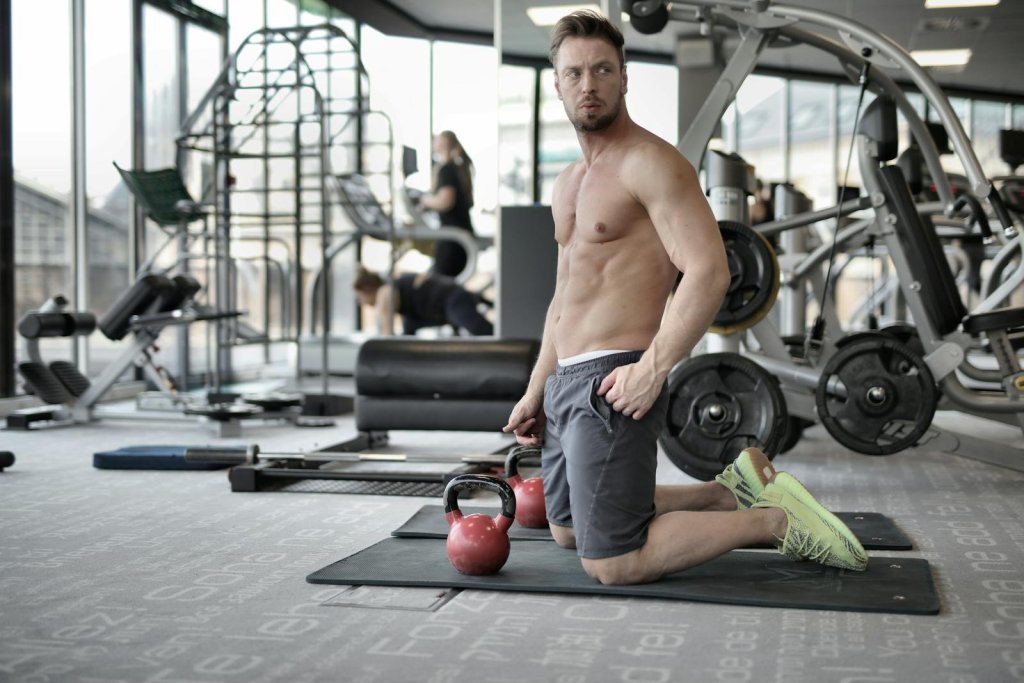
Understanding how and when to use this exercise matters because hamstring strains are among the most common lower-body injuries in sports and active populations, and poor eccentric strength is a key risk factor.
Used widely in injury-prevention programs and elite sports settings, the Nordic hamstring curl focuses on controlled eccentric loading—one of the most effective ways to improve hamstring strength at longer muscle lengths.
What Is the Nordic Hamstring Curl?
The nordic hamstring curl (also called the Nordic hamstring exercise) is a kneeling bodyweight movement where the ankles are fixed while the athlete slowly lowers the torso forward, resisting gravity with the hamstrings.
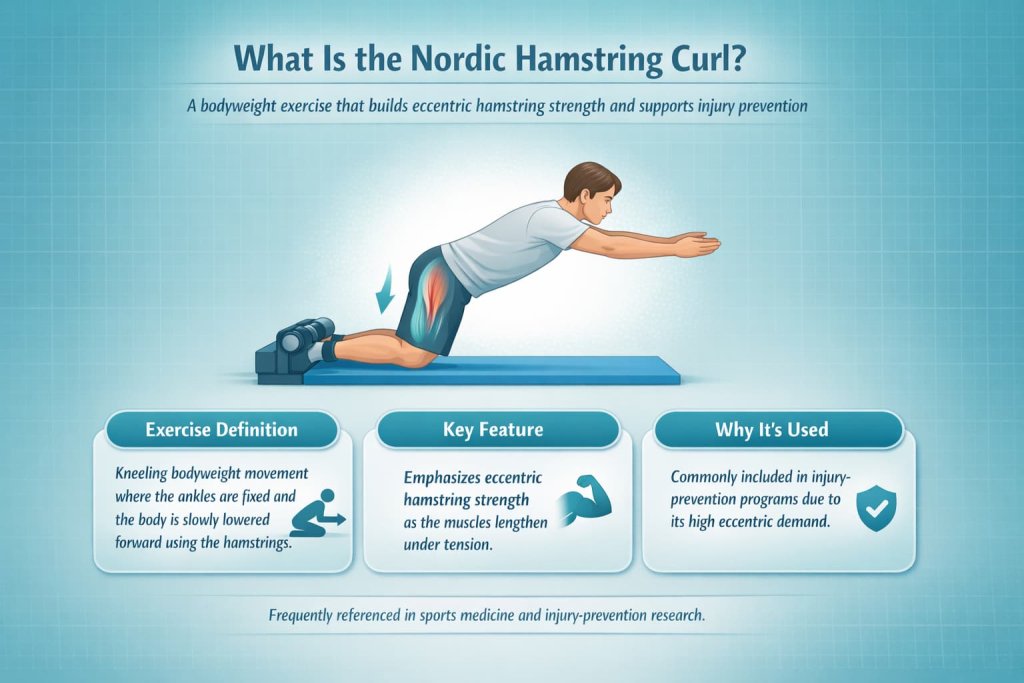
Unlike traditional curls done with machines, this exercise emphasizes eccentric strength—the phase where the hamstrings lengthen under tension. This is particularly relevant because most hamstring strains occur during high-speed running when the muscles are lengthening.
Clinical and sports medicine literature frequently references the Nordic hamstring curl as a cornerstone exercise in hamstring injury-prevention programs.
How to Do the Nordic Hamstring Curl Correctly
How to do it
- Kneel on a padded surface with your torso upright
- Secure your ankles under a sturdy object or have a partner hold them firmly
- Keep your hips extended and your body in a straight line from knees to head
- Slowly lean forward, resisting the fall with your hamstrings as long as possible
- Use your hands to catch yourself when control is lost
- Push lightly with your hands to return to the starting position if needed
Controlled lowering is the priority. The goal is not to “catch yourself late,” but to resist gravity smoothly.
Muscles Worked During the Nordic Hamstring Curl
The nordic hamstring curl primarily targets the posterior chain, with a strong emphasis on the hamstrings.
Primary muscles
- Hamstrings (biceps femoris, semitendinosus, semimembranosus)
Secondary muscles
- Gluteus maximus (isometric hip extension support)
- Gastrocnemius (ankle stabilization)
- Core muscles (trunk control during lowering)
Because the hips remain extended, the hamstrings are loaded across both the hip and knee joints, increasing overall demand.
Why the Nordic Hamstring Curl Works
Research consistently shows that eccentric hamstring training improves strength, muscle architecture, and load tolerance.
According to a large systematic review and meta-analysis published in the British Journal of Sports Medicine, programs that included Nordic hamstring curls reduced hamstring injuries by up to 51% compared with training programs that did not include them.
The exercise works because it:
- Builds high levels of eccentric hamstring strength
- Trains the hamstrings at longer muscle lengths
- Improves the hamstrings’ ability to absorb force during sprinting and deceleration
- Addresses a known mechanism of non-contact hamstring strains
More recent reviews continue to support the Nordic hamstring curl as one of the most evidence-backed exercises for hamstring injury risk reduction.
Common Mistakes to Avoid
Even though the movement looks simple, technique errors can reduce effectiveness or increase strain.
Common mistakes include:
- Sitting back at the hips instead of keeping them extended
- Dropping forward too quickly with no control
- Overusing the arms instead of the hamstrings
- Starting with too much volume too soon
Programming the Nordic Hamstring Curl
How Often Should You Do Nordic Hamstring Curls?
Most research-supported protocols use 1–2 sessions per week, especially in the early phases.
Studies summarized in BMJ Open Sport & Exercise Medicine suggest that:
- Twice-weekly training improves eccentric strength more than once-weekly in trained athletes
- Lower volumes may improve adherence and reduce excessive soreness
Example Beginner Progression
- 1–2 sets of 3–5 slow reps
- 1–2 times per week
- Focus on control, not depth
Progress gradually before increasing volume or frequency.
Who Should Be Cautious With Nordic Hamstring Curls?
While effective, the nordic hamstring curl is demanding and not appropriate for everyone at full intensity.
Use caution if you:
- Have an active hamstring strain
- Are returning from a recent posterior thigh injury
- Experience sharp pain during eccentric loading
- Have significant knee discomfort in kneeling positions
Organizations such as the Mayo Clinic generally recommend graded loading and professional guidance when pain or recent injury is present.
Nordic Hamstring Curl vs Hamstring Machine Exercises
Compared with seated or lying hamstring curls:
- Nordic curls place higher eccentric demands
- Machines allow easier load adjustment and isolation
- Nordic curls require minimal equipment but higher control
Many training programs use both, with Nordic hamstring curls reserved for injury-prevention phases or strength development once a base level of conditioning is established.
When to Seek Professional Guidance
Because the nordic hamstring curl places high eccentric load on the hamstrings, professional guidance may be helpful in certain situations.
Seek advice from a qualified professional if you:
- Have a current or recent hamstring injury
- Feel sharp pain or worsening symptoms during the exercise
- Are returning to sport after a lower-body injury
- Have ongoing knee, hip, or lower-back discomfort
Healthcare organizations such as the Mayo Clinic recommend professional assessment when pain persists or exercise tolerance is unclear.
Frequently Asked Questions
Is the Nordic hamstring curl safe?
When introduced gradually and performed with proper technique, it is considered safe for healthy individuals. Soreness is common initially.
Can beginners do Nordic hamstring curls?
Yes, with modifications such as limited range of motion, arm assistance, or reduced frequency.
Do Nordic hamstring curls build muscle?
They primarily build eccentric strength, but they may also contribute to hypertrophy when programmed appropriately.
How long before benefits appear?
Strength improvements can appear within weeks, while injury-risk reduction is associated with consistent long-term use.
Are Nordic hamstring curls better than stretching?
They serve a different purpose. Nordic curls improve strength and load tolerance, while stretching focuses on flexibility.
Can I do Nordic hamstring curls at home?
Yes, as long as the ankles are securely fixed using a partner or a stable object.
Conclusion
The nordic hamstring curl stands out as one of the most research-supported bodyweight exercises for building strong, resilient hamstrings and reducing injury risk. When introduced progressively and programmed intelligently, it can play a valuable role in both athletic training and long-term lower-body health.
If you are training for performance or aiming to lower your risk of hamstring strain, consider adding Nordic hamstring curls gradually and consistently.
References
- Including the Nordic Hamstring Exercise in Injury Prevention Programmes Halves the Rate of Hamstring Injuries: A Systematic Review and Meta-Analysis of 8,459 Athletes (British Journal of Sports Medicine, 2019)
- Implementing Hamstring Injury Prevention Programmes Remotely: A Randomised Proof-of-Concept Trial (BMJ Open Sport & Exercise Medicine, 2024)
- Effect of Weekly Training Frequency With the Nordic Hamstring Exercise on Muscle-Strain Risk Factors in Football Players: A Randomized Trial (PubMed, 2020)
- A 10-Week Randomized Trial Comparing Nordic Hamstring Training vs Traditional Hamstring Curls in Well-Trained Soccer Players (PubMed, 2004)
- The 11+ Injury Prevention Programme Decreases Rate of Injury: Nordic Hamstring Dosage by Level (British Journal of Sports Medicine, 2024)
- The Effect of Nordic Hamstring Exercise Training Volume on Eccentric Strength and Biceps Femoris Fascicle Length (PubMed, 2018)
- Heterogeneous Effects of Eccentric Training and Nordic Hamstring Exercise on Biceps Femoris Fascicle Length: Systematic Review and Meta-Analysis (PLOS ONE, 2021)
- The Effects of Nordic Hamstring Exercise on Performance, Muscle Architecture, and Injury Prevention: Systematic Review (PubMed Central, 2024)