
Medicine ball workouts for beginners are an effective way to build full-body strength, improve core stability, and learn fundamental movement patterns—without complicated equipment or heavy weights. When done with the right ball size, controlled tempo, and good form, medicine ball training fits perfectly into beginner fitness plans and aligns with public-health strength-training guidelines.

Understanding how to start safely matters. The right exercises, light loads, and simple progressions help you gain strength and coordination while reducing injury risk. Below you’ll find beginner-friendly movements, programming tips, safety guidance, and FAQs—everything you need to get started with confidence.
What Are Medicine Ball Workouts for Beginners?
Medicine ball workouts for beginners use a weighted ball to perform controlled strength and movement exercises such as squats, presses, rotations, and carries. The ball adds resistance while encouraging coordination between the upper body, lower body, and core.
Compared with machines or heavy free weights, medicine balls are:
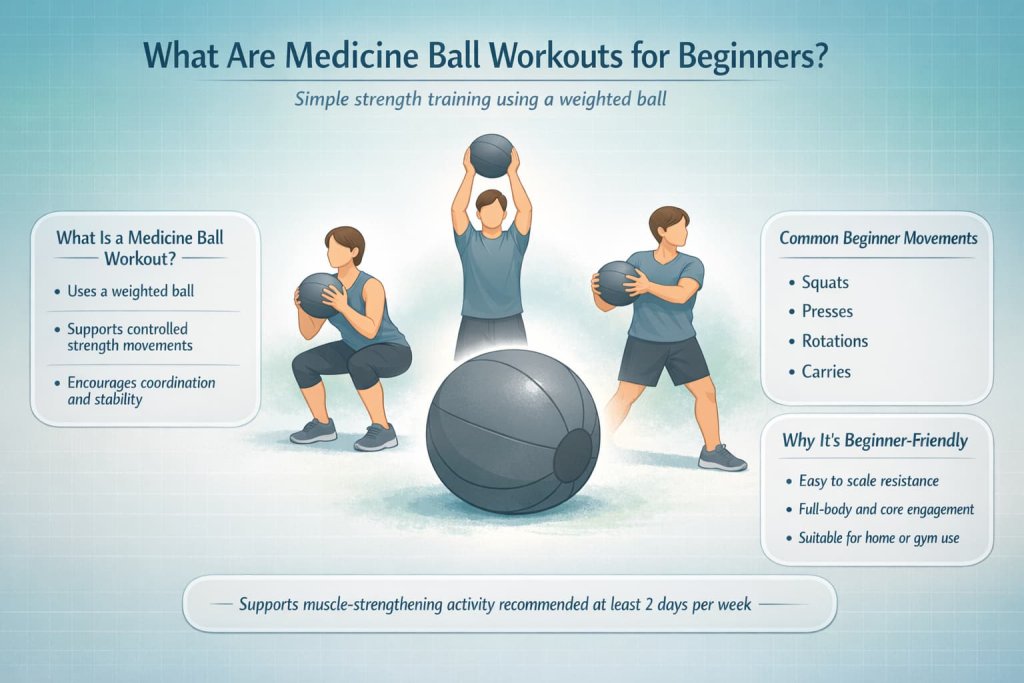
- Easier to scale for beginners
- Useful for full-body and core engagement
- Suitable for home or gym workouts
Public-health guidance from organizations like the Centers for Disease Control and Prevention and the World Health Organization recommends muscle-strengthening activity at least two days per week, which medicine ball workouts can support.
10 Best Medicine Ball Workouts for Beginners
These beginner medicine ball workouts focus on safe, controlled movements that train major muscle groups.
1. Medicine Ball Goblet Squat
How to do it:
- Stand with feet shoulder-width apart
- Hold the medicine ball close to your chest with both hands
- Sit your hips back and bend your knees to lower into a squat
- Keep your chest tall and heels on the floor
- Press through your heels to stand back up
Why it works:
Holding the medicine ball in front of your body helps counterbalance your weight, making it easier for beginners to maintain upright posture and proper squat depth. This reinforces safe squat mechanics while building foundational lower-body strength.
Muscles worked:
Quadriceps, glutes, hamstrings, core, and upper back (postural support)
Trainer Tip:
If your heels lift or chest collapses forward, reduce depth slightly and slow the tempo.
2. Seated Medicine Ball Russian Twist (Controlled)
How to do it:
- Sit on the floor with knees bent and feet flat
- Hold the medicine ball at chest level
- Lean back slightly while keeping your spine tall
- Rotate your torso gently to one side, then the other
- Move slowly and stay controlled
Why it works:
The seated position limits lower-body involvement and reduces spinal load, allowing beginners to train rotational core control safely without excessive stress.
Muscles worked:
Obliques, rectus abdominis, deep core stabilizers
Trainer Tip:
If balance is difficult, sit more upright and shorten the rotation range.
3. Medicine Ball Chest Press (Floor or Bench)
How to do it:
- Lie on your back on the floor or a bench
- Hold the medicine ball at chest level
- Press the ball upward until arms are extended
- Lower slowly with elbows under control
- Keep wrists neutral and shoulders relaxed
Why it works:
Pressing a medicine ball encourages even arm engagement and controlled pressing strength. Floor pressing naturally limits shoulder range, making it beginner-safe.
Muscles worked:
Chest, shoulders, triceps, core (stabilization)
Trainer Tip:
Focus on slow lowering—this improves control and joint awareness.
4. Medicine Ball Deadlift
How to do it:
- Stand with feet hip-width apart and ball on the floor
- Hinge at the hips while keeping your back neutral
- Grip the ball with both hands
- Drive through your heels to stand tall
- Squeeze glutes at the top
Why it works:
This movement teaches proper hip hinging, which is essential for safe lifting patterns and daily activities like bending or picking objects up.
Muscles worked:
Glutes, hamstrings, lower back, core, upper back
Trainer Tip:
Think “hips back, chest proud” to avoid rounding your spine.
5. Overhead Medicine Ball Hold
How to do it:
- Stand tall with feet hip-width apart
- Hold the medicine ball overhead with arms extended
- Keep ribs down and core braced
- Breathe steadily while holding the position
- Maintain upright posture throughout
Why it works:
The static overhead position challenges core and shoulder stabilizers without movement, making it ideal for beginners learning posture control.
Muscles worked:
Shoulders, upper back, core, deep stabilizers
Trainer Tip:
If your lower back arches, lower the ball slightly or shorten the hold time.
6. Medicine Ball Forward Lunge
How to do it:
- Hold the medicine ball at chest height
- Step forward into a lunge position
- Lower until both knees bend comfortably
- Push through the front heel to return
- Alternate legs slowly
Why it works:
The front-held ball improves balance and encourages an upright torso, making lunges more accessible for beginners.
Muscles worked:
Glutes, quadriceps, hamstrings, core
Trainer Tip:
Take shorter steps if balance feels challenging.
7. Medicine Ball Wood Chop (Low to High)
How to do it:
- Stand with feet shoulder-width apart
- Hold the ball near one hip
- Rotate slowly upward across your body
- Finish with the ball near opposite shoulder
- Reverse sides after reps
Why it works:
This controlled rotation trains the core to transfer force safely, building coordination before progressing to faster movements.
Muscles worked:
Obliques, core stabilizers, shoulders, hips
Trainer Tip:
Move slowly—this is about control, not power.
8. Medicine Ball Wall Squat Hold
How to do it:
- Stand with your back against a wall
- Place the medicine ball between chest and wall
- Slide down into a squat position
- Press lightly into the ball
- Hold while breathing steadily
Why it works:
Isometric holds build leg endurance and reinforce posture without complex movement, making them beginner-friendly.
Muscles worked:
Quadriceps, glutes, core, upper back
Trainer Tip:
Adjust squat depth to stay comfortable and pain-free.
9. Standing Medicine Ball Halo (Slow)
How to do it:
- Stand tall holding the ball in front of your chest
- Slowly circle the ball around your head
- Keep elbows close and core engaged
- Reverse direction after reps
- Move smoothly and under control
Why it works:
Halos promote shoulder mobility and upper-back engagement while reinforcing core stability during arm movement.
Muscles worked:
Shoulders, upper back, core, arms
Trainer Tip:
Keep ribs down to prevent lower-back compensation.
10. Medicine Ball Carry (Front Hold)
How to do it:
- Hold the medicine ball at chest height
- Stand tall with shoulders relaxed
- Walk slowly in a straight line
- Maintain steady breathing
- Stop if posture breaks down
Why it works:
Carrying the ball challenges posture, grip, and core endurance, closely mimicking real-life lifting and carrying tasks.
Muscles worked:
Core, arms, shoulders, upper back, grip
Trainer Tip:
Quality posture matters more than distance—stop early if form slips.
How Heavy Should a Medicine Ball Be for Beginners?
For most beginners:
- 4–6 lb is ideal for learning technique
- 6–8 lb may work once movements feel controlled
- Avoid heavy or fast throws early on
A good rule: if you can’t keep the movement slow and stable, the ball is too heavy.
Are Medicine Ball Workouts Safe for Beginners?
Yes—medicine ball workouts are generally safe for beginners when the weight is light, movements are controlled, and form is prioritized. Because medicine balls allow you to hold resistance close to your body, they often feel more stable than dumbbells or barbells.
To stay within safe limits:
- Start with a 4–6 lb ball and progress gradually
- Perform slow, controlled reps before attempting any speed or power
- Stop any movement that causes joint pain (not normal muscle effort)
Public-health guidance from the Centers for Disease Control and Prevention and coaching standards from the American Council on Exercise both emphasize progressive loading, good technique, and matching exercise difficulty to current ability—especially for beginners.
How to Program Medicine Ball Workouts for Beginners
Beginners benefit most from short, consistent sessions that focus on technique rather than volume or intensity.
A beginner-friendly structure:
- Frequency: 2–3 days per week
- Exercises: 5–8 total movements
- Sets: 1–3 per exercise
- Reps: 8–12 controlled reps
- Rest: 45–90 seconds between sets
Medicine ball workouts work well as:
- A standalone full-body session, or
- A strength circuit paired with walking, cycling, or other light cardio
Progress by adding reps or an extra set first—not by jumping to a heavier ball too soon.
Common Beginner Mistakes to Avoid
Avoiding these mistakes will help you progress safely and see better results:
- Using a ball that’s too heavy: This often leads to poor posture and rushed reps
- Moving too fast: Speed should come later; control comes first
- Ignoring posture: Slouching or arching the lower back increases strain
- Skipping the warm-up: Cold joints raise injury risk
- Chasing fatigue instead of form: Beginners build results through consistency, not exhaustion
If form breaks down, shorten the set, reduce the range of motion, or switch to a simpler variation.
Safety Tips for Medicine Ball Workouts for Beginners
Beginner safety is about control, not intensity.
- Warm up with light movement (marching, arm circles, bodyweight squats)
- Choose a ball that allows perfect form
- Avoid explosive throws early on
- Stop if pain (not muscle effort) appears
Guidance from the American Council on Exercise emphasizes mastering slow, controlled reps before adding speed or load.
Who Should Be Careful Before Starting Medicine Ball Training?
Extra caution is advised for:
- Recent shoulder, back, hip, or knee injuries
- Balance or coordination challenges
- Anyone returning to exercise after long inactivity
When in doubt, start with seated or floor-based exercises and progress gradually.
Benefits of Medicine Ball Workouts for Beginners
When practiced consistently, medicine ball workouts may help:
- Improve full-body coordination
- Build foundational strength
- Support core stability and posture
- Increase confidence with resistance training
Results come from consistency and technique, not heavy weights.
Frequently Asked Questions
Are medicine ball workouts good for beginners?
Yes. Medicine balls allow scalable resistance and simple movement patterns that suit beginners well.
Can I do medicine ball workouts at home?
Yes. Most exercises need only one ball and a small open space.
Do medicine ball workouts help with weight loss?
They can support calorie burn and muscle development as part of an overall active lifestyle.
How long should a beginner medicine ball workout be?
About 20–30 minutes is enough for beginners.
Can seniors use medicine balls?
Yes, with lighter weights and controlled movements. Always prioritize balance and safety.
Should beginners do explosive throws?
No. Controlled movements should come first. Power exercises are advanced.
Conclusion
Medicine ball workouts for beginners offer a practical, flexible way to build strength, improve coordination, and learn foundational movement skills. With light weights, simple exercises, and steady progress, beginners can train safely and effectively—at home or in the gym.
If you’re new to resistance training, start with these beginner-friendly medicine ball workouts, focus on control, and build consistency before increasing intensity.