
Squats with resistance bands are squat variations that use elastic band tension to train your legs, glutes, hips, and core with little equipment. They are useful because they can make a basic squat more challenging, improve control, and help you train at home or in the gym.
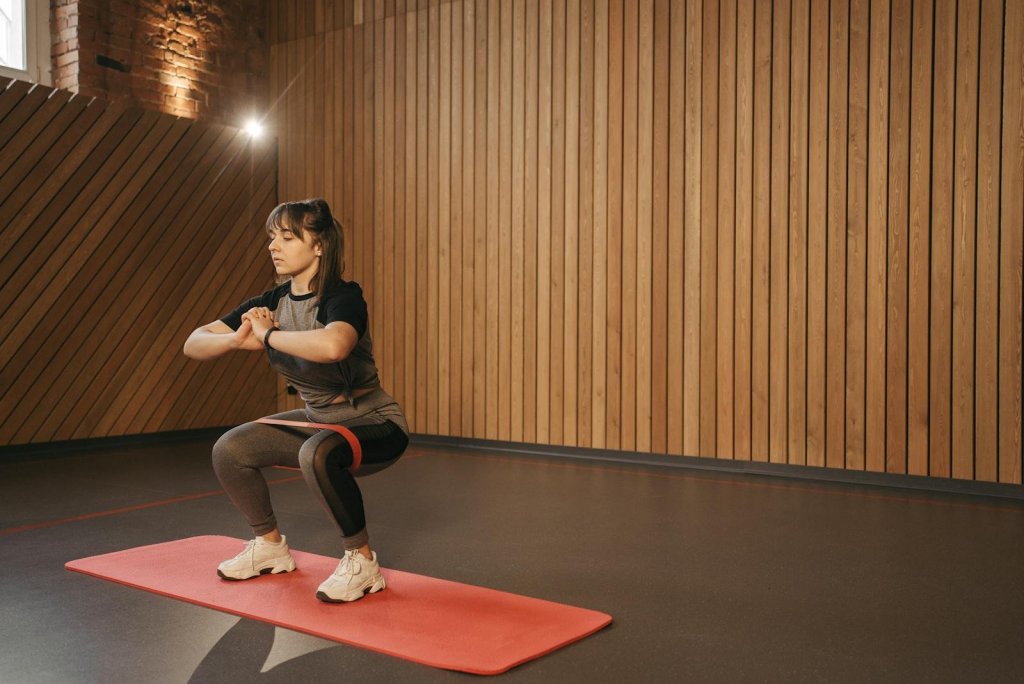
The key is to choose the right band, keep your knees tracking with your toes, brace your core, and use controlled reps. The Mayo Clinic explains that squats with resistance tubing target the quadriceps, hamstrings, and gluteal muscles, while also emphasizing neutral back position, controlled movement, and knee alignment.
What Are Squats With Resistance Bands?
Squats with resistance bands are squats performed with a loop band, long resistance band, or tubing band added to the movement.
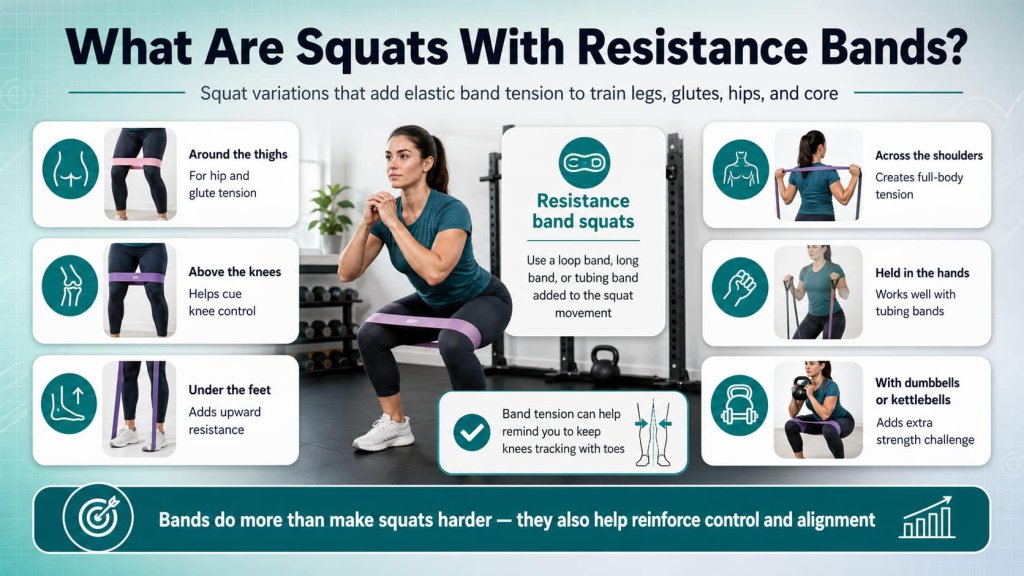
The band can be placed:
- Around the thighs
- Above the knees
- Under the feet
- Across the shoulders
- Held in the hands
- Combined with a dumbbell or kettlebell
The goal is not just to make the squat harder. A band can also give feedback. For example, a mini band above the knees reminds you to keep your knees from collapsing inward.
Benefits of Squats With Resistance Bands
Squats with resistance bands are popular because they are simple, affordable, and easy to scale.
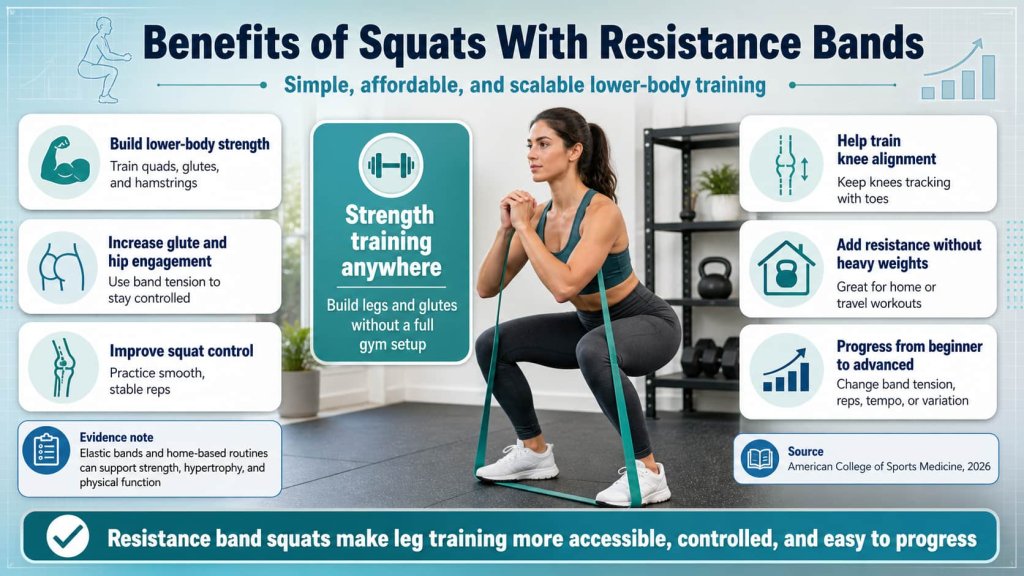
Key benefits include:
- Build lower-body strength
- Increase glute and hip engagement
- Improve squat control
- Help train knee alignment
- Add resistance without heavy weights
- Work well for home workouts
- Offer beginner to advanced variations
- Support strength training without needing a full gym setup
The 2026 American College of Sports Medicine resistance-training update notes that elastic bands, bodyweight exercises, and home-based routines can provide meaningful benefits for strength, hypertrophy, and physical function.
10 Best Squats With Resistance Bands
These resistance band squat variations can help you train your glutes, quads, hamstrings, hips, and core with minimal equipment. Start with controlled reps, choose a band you can manage, and progress only when your form stays strong.
1. Basic Resistance Band Squat
The basic resistance band squat is the best starting point. It teaches you how to squat with band tension while keeping your form controlled.
Why it works:
This variation adds light resistance to a standard squat and helps you practice knee tracking, hip control, and steady lower-body movement.
Muscles worked:
Quads, glutes, hamstrings, calves, core, and hip stabilizers.
How to do it:
- Place a mini band above your knees.
- Stand with your feet shoulder-width apart.
- Brace your core and keep your chest lifted.
- Push your hips back and lower into a squat.
- Keep your knees gently pressing outward against the band.
- Pause briefly at the bottom.
- Push through your feet to stand tall.
- Repeat for controlled reps.
Trainer Tip:
Do not force your knees far outward. The goal is to keep them aligned with your toes, not to overcorrect.
2. Mini Band Squat
The mini band squat is one of the simplest ways to make your glutes and hip stabilizers work harder.
Why it works:
The band creates sideways tension, which challenges the gluteus medius and helps reduce knee collapse during the squat.
Muscles worked:
Glutes, quads, hamstrings, outer hips, calves, and core.
How to do it:
- Place a mini band above your knees.
- Stand with feet hip-width to shoulder-width apart.
- Keep your toes slightly turned out.
- Brace your abs.
- Lower into a squat while keeping tension on the band.
- Keep both feet flat.
- Stand back up with control.
- Repeat without letting the knees cave inward.
Trainer Tip:
If your knees keep collapsing inward, use a lighter band or reduce your squat depth.
3. Banded Goblet Squat
A banded goblet squat combines a mini band with a dumbbell or kettlebell held at chest level.
Why it works:
The goblet position encourages an upright torso, while the band helps reinforce hip and knee control.
Muscles worked:
Quads, glutes, hamstrings, adductors, upper back, core, and hip stabilizers.
How to do it:
- Place a mini band above your knees.
- Hold a dumbbell or kettlebell close to your chest.
- Stand with feet slightly wider than hip-width.
- Brace your core.
- Squat down while keeping your chest tall.
- Keep your knees in line with your toes.
- Press through your feet to stand.
- Keep the weight close to your body the entire time.
Trainer Tip:
Use a light weight at first. If the weight pulls you forward, it is too heavy for clean reps.
4. Resistance Band Sumo Squat
The resistance band sumo squat uses a wider stance and slightly turned-out toes.
Why it works:
The wider stance increases inner-thigh and glute involvement while still training the quads and hips.
Muscles worked:
Glutes, quads, hamstrings, adductors, calves, and core.
How to do it:
- Place a mini band above your knees.
- Stand wider than shoulder-width.
- Turn your toes slightly outward.
- Keep your chest tall.
- Lower your hips straight down.
- Keep your knees tracking over your toes.
- Push through your heels and midfoot to stand.
- Squeeze your glutes gently at the top.
Trainer Tip:
Do not make the stance so wide that your knees or hips feel uncomfortable. Choose a stance you can control.
5. Banded Squat to Side Step
The banded squat to side step combines a squat with lateral movement.
Why it works:
This variation trains the glutes, thighs, and hip stabilizers while adding a balance and coordination challenge.
Muscles worked:
Glutes, quads, hamstrings, outer hips, calves, and core.
How to do it:
- Place a mini band above your knees or around your ankles.
- Stand with feet hip-width apart.
- Lower into a shallow squat.
- Step to the side with one foot.
- Bring the other foot in without losing band tension.
- Perform 2–4 side steps.
- Squat once.
- Repeat in the opposite direction.
Trainer Tip:
Keep your toes facing forward or slightly outward. Avoid letting your feet turn out too much during the side steps.
6. Banded Squat Pulse
A banded squat pulse keeps tension on the muscles by using small controlled movements near the bottom of the squat.
Why it works:
The short range of motion increases time under tension, which can make the glutes and quads work harder without heavy weight.
Muscles worked:
Quads, glutes, hamstrings, adductors, calves, and core.
How to do it:
- Place a mini band above your knees.
- Stand with feet shoulder-width apart.
- Lower into a squat.
- Stay in the lower half of the movement.
- Pulse up and down a few inches.
- Keep your knees aligned with your toes.
- Keep your chest lifted.
- Stand up after completing the target reps.
Trainer Tip:
Do not bounce quickly. Small, controlled pulses are more useful than rushed reps.
7. Banded Box Squat
A banded box squat uses a chair, bench, or box to guide depth.
Why it works:
The box gives beginners a clear target and can help improve confidence, control, and squat consistency.
Muscles worked:
Quads, glutes, hamstrings, calves, core, and hip stabilizers.
How to do it:
- Place a mini band above your knees.
- Stand in front of a box, bench, or chair.
- Keep feet about shoulder-width apart.
- Push your hips back.
- Lower until your glutes lightly touch the box.
- Do not relax or collapse onto the box.
- Press through your feet to stand.
- Repeat with smooth control.
Trainer Tip:
Choose a box height that allows good form. A higher box is better if deep squats bother your knees, hips, or back.
8. Resistance Band Front Squat
The resistance band front squat uses a long loop band or tubing band to create upward resistance.
Why it works:
This variation challenges the quads, glutes, and core while teaching you to stay upright under tension.
Muscles worked:
Quads, glutes, hamstrings, calves, core, upper back, and hip stabilizers.
How to do it:
- Stand on the center of a long resistance band.
- Hold the band ends or handles near your shoulders.
- Keep your elbows slightly forward.
- Brace your core.
- Squat down with control.
- Keep your chest tall.
- Press through your feet to stand.
- Control the band as you return to the top.
Trainer Tip:
Make sure the band is secure under both feet before starting. If it shifts or feels unstable, reset your stance.
9. Banded Squat Jump
The banded squat jump is a power-focused variation. It should only be used after you can do regular banded squats with good control.
Why it works:
This exercise trains explosive lower-body power while still encouraging hip and knee control.
Muscles worked:
Glutes, quads, hamstrings, calves, core, and hip stabilizers.
How to do it:
- Place a light mini band above your knees.
- Stand with feet shoulder-width apart.
- Lower into a quarter or half squat.
- Jump upward with control.
- Land softly with knees tracking over toes.
- Absorb the landing by bending your hips and knees.
- Reset your position.
- Repeat for low reps.
Trainer Tip:
Use fewer reps and focus on landing quality. Stop if your knees cave inward or your landings become loud and heavy.
10. Banded Split Squat
The banded split squat is a single-leg squat pattern that builds strength, balance, and side-to-side control.
Why it works:
This variation trains one leg at a time, which can help expose and improve strength differences between sides.
Muscles worked:
Quads, glutes, hamstrings, calves, hip stabilizers, and core.
How to do it:
- Stand in a split stance.
- Place a mini band above your knees, or use a long band under the front foot.
- Keep your front foot flat.
- Lower straight down with control.
- Keep your front knee aligned with your toes.
- Lightly tap or hover the back knee near the floor.
- Push through the front foot to stand.
- Complete all reps, then switch sides.
Trainer Tip:
Think “down and up,” not “forward and back.” This keeps the movement more stable.
Common Mistakes to Avoid
Resistance bands can improve your squat, but only if your form stays clean.
| Mistake | Why It Matters | Quick Fix |
|---|---|---|
| Knees cave inward | Reduces control and may irritate the knees | Use a lighter band and track knees with toes |
| Band is too heavy | Pulls you out of position | Choose a band you can control |
| Heels lift | Makes the squat less stable | Keep pressure through heel and midfoot |
| Back rounds | Reduces trunk control | Brace your core and reduce depth |
| Reps are too fast | Makes form harder to control | Use slow, smooth reps |
| Band rolls or snaps | Can distract or cause poor setup | Use a secure band and inspect it first |
The Mayo Clinic recommends keeping movements smooth and controlled and stopping when fatigue causes form to suffer.
How Many Sets and Reps Should You Do?
For most beginners, start simple.
| Goal | Sets | Reps | Band Choice |
|---|---|---|---|
| Learn form | 1–2 | 8–10 | Light |
| Build strength | 2–4 | 8–12 | Medium |
| Build muscular endurance | 2–3 | 12–20 | Light to medium |
| Power practice | 2–4 | 3–6 | Light |
A practical starting point is 2–3 sets of 8–12 reps, 2–3 days per week.
The CDC recommends adults do muscle-strengthening activity at least 2 days per week, working all major muscle groups. Resistance band squats can be one part of that weekly routine.
Sample Resistance Band Squat Workout
Use this short workout 2–3 times per week with at least one rest day between hard lower-body sessions.
| Exercise | Sets | Reps |
|---|---|---|
| Basic Resistance Band Squat | 2 | 10–12 |
| Mini Band Squat | 2 | 10–15 |
| Banded Squat to Side Step | 2 | 8–10 each side |
| Banded Box Squat | 2 | 8–12 |
| Banded Squat Pulse | 1–2 | 15–20 |
Rest 45–90 seconds between sets. Focus on control before adding more reps or a stronger band.
How to Make Resistance Band Squats Easier
Use these adjustments if the movement feels too hard or unstable:
- Use a lighter band.
- Squat to a box or chair.
- Reduce your squat depth.
- Hold onto a wall or stable surface.
- Slow the movement down.
- Do fewer reps per set.
- Start with bodyweight squats first.
How to Make Resistance Band Squats Harder
Progress only one variable at a time.
Try these options:
- Use a stronger band.
- Add a dumbbell or kettlebell.
- Add a pause at the bottom.
- Use slower lowering reps.
- Add more sets.
- Add lateral steps.
- Try single-leg variations like split squats.
Do not increase band tension, weight, reps, and tempo all at once. That makes it harder to know what is helping and what is hurting your form.
Who Should Be Careful With Squats With Resistance Bands?
Squats with resistance bands are generally beginner-friendly, but they are not perfect for everyone.
Be careful or get guidance first if you have:
- Current knee, hip, ankle, or back pain
- Recent surgery
- Balance problems
- A history of falls
- Pain that gets worse during squats
- Sharp, pinching, or lingering discomfort
A good rule: muscle effort is normal, but joint pain is not something to push through. Modify the movement or speak with a qualified fitness or healthcare professional if you are unsure.
FAQs About Squats With Resistance Bands
Are squats with resistance bands effective?
Yes, squats with resistance bands can be effective when done with enough tension, good form, and consistent training. They may help build lower-body strength, improve squat control, and train the glutes, quads, and hips.
Do resistance band squats build glutes?
Resistance band squats can support glute training, especially when you use proper depth, knee alignment, and steady tension. For best results, combine them with other glute-focused moves such as hip thrusts, glute bridges, Romanian deadlifts, and lateral band walks.
Where should I place the band for squats?
For beginners, placing a mini band above the knees is usually easiest. You can also place a long band under your feet and hold the ends near your shoulders for a front-squat style variation.
Why do my knees cave in during banded squats?
Your knees may cave in because the band is too heavy, your hips are tired, or you are squatting too deep for your current control. Use a lighter band, slow down, and focus on keeping your knees aligned with your toes.
Can I do resistance band squats every day?
You can do light technique practice often, but hard resistance band squat workouts are usually better 2–3 days per week. Your muscles need time to recover, especially if you are using strong bands, high reps, or added weight.
Are resistance band squats good for beginners?
Yes. Resistance band squats are beginner-friendly when you start with a light band, use controlled reps, and choose a comfortable range of motion. A box squat is a great first option if balance or depth is difficult.
What is the best resistance band squat for glutes?
The mini band squat, banded sumo squat, banded squat pulse, and banded squat to side step are all strong options for glute-focused training. The best choice is the one you can do with steady tension and clean form.
Conclusion
Squats with resistance bands are a simple way to build stronger legs and glutes without needing a full gym setup. Start with the basic resistance band squat, master your knee and hip control, then progress to variations like banded goblet squats, sumo squats, box squats, and split squats.
For the best results, choose a band you can control, move slowly, and train consistently. Stronger bands are not always better; better form is what makes the exercise work.
References
- Mayo Clinic: Squat With Resistance Tubing
- American Council on Exercise: Bodyweight Squat
- CDC: Adult Physical Activity Guidelines
- American College of Sports Medicine: 2026 Resistance Training Guidelines Update
- Mayo Clinic: How to Choose Resistance Tubing
- World Health Organization: Physical Activity
- Mayo Clinic: Squat Exercise
- PubMed Central: Effects of Training With Elastic Resistance Versus Conventional Resistance