
Plank hip dips are a forearm plank variation where you rotate your hips side to side toward the floor to target your obliques while training full-core stability. If you want a simple move that challenges your “side abs” without equipment, plank hip dips are one of the most effective options—when you keep your spine neutral and move with control.
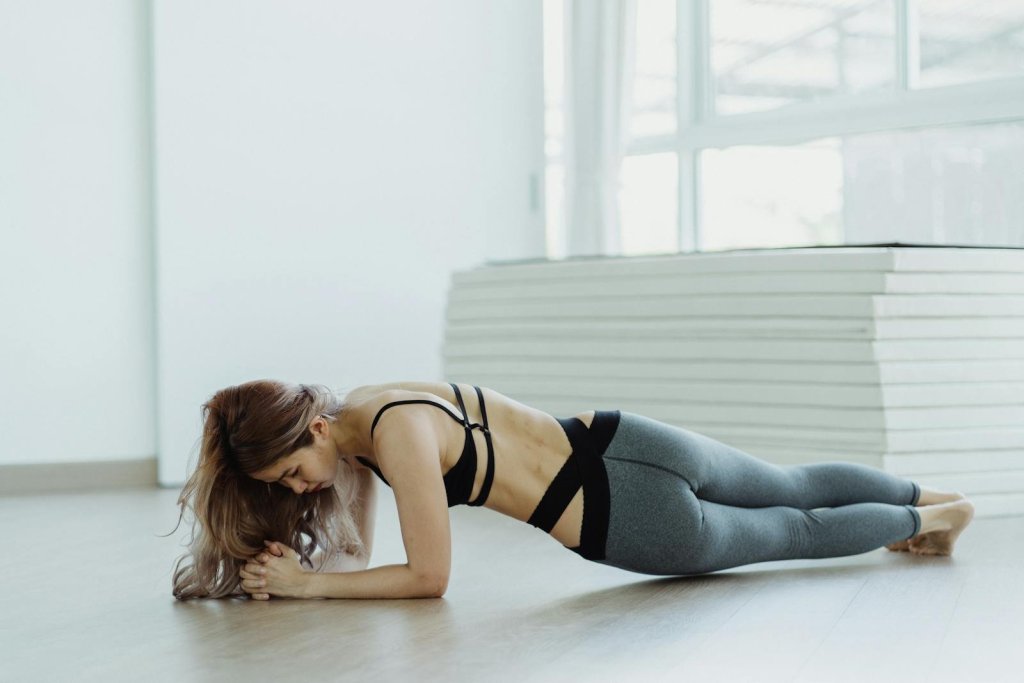
The American Council on Exercise includes this move as “alternating hip touches” (also called rainbow planks) and explains that it’s commonly used to emphasize the obliques.
What are plank hip dips
Plank hip dips start in a forearm plank. From there, you rotate your hips slightly and lower one hip toward the floor, then rotate to the other side. Unlike a standard plank (which is mostly a hold), hip dips add controlled trunk rotation, which increases the demand on your obliques and deep core stabilizers.
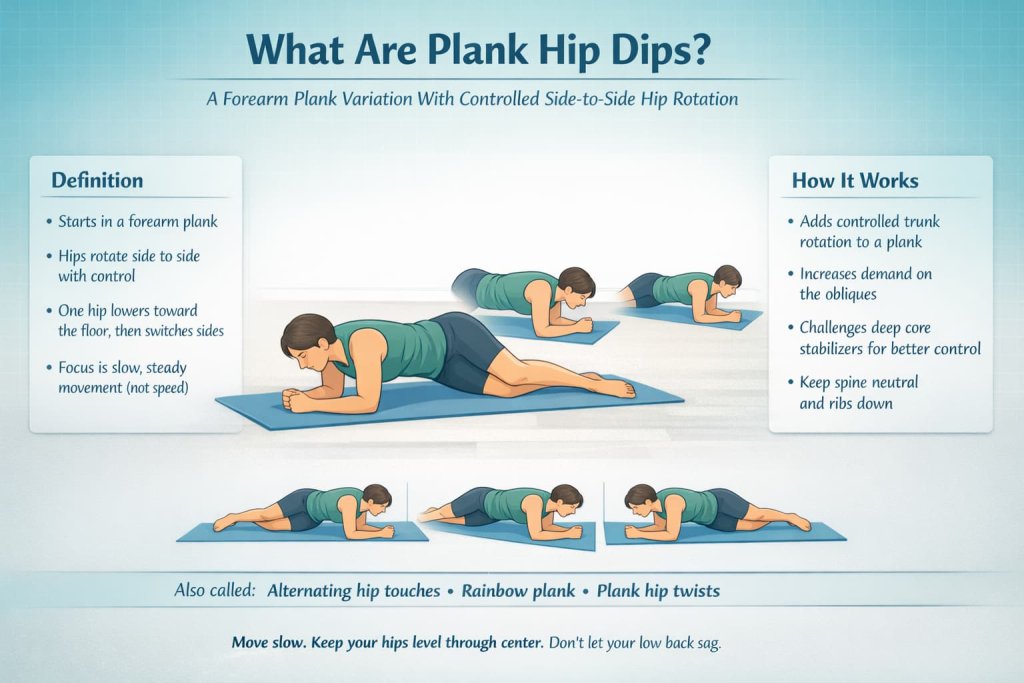
Common names you may see:
- Alternating hip touches
- Rainbow plank
- Plank hip twists
How to do plank hip dips correctly
Follow these form steps to keep the work in your core (not your lower back).
Setup
- Start in a forearm plank: elbows under shoulders, forearms parallel, hands relaxed.
- Step your feet back so your body forms a straight line from head to heels.
- Brace your abs as if you’re preparing for a gentle punch.
- Squeeze your glutes and keep your ribs “down” (no flaring).
Hip dip movement
- Rotate your hips slightly and lower your right hip toward the floor.
- Tap lightly or hover just above the floor (don’t collapse your weight).
- Rotate through center and lower your left hip toward the floor.
- Move slowly and smoothly—think “control,” not speed.
Breathing cue
- Exhale as you rotate and dip.
- Inhale as you return through center.
For beginner-friendly plank alignment cues (like maintaining a steady line through the torso), the Harvard Health plank breakdown is a helpful reference point.
Benefits of plank hip dips for stronger obliques
Plank hip dips can help you build:
- Oblique strength for side-to-side control
- Core stability that carries over to daily movement and sports
- Better body awareness of ribcage and pelvis positioning
- More challenge than a basic plank without adding equipment
A strong core supports balance and steadiness in everyday activity, which aligns with general core-training guidance from the Mayo Clinic.
Muscles worked in plank hip dips
Plank hip dips primarily train:
- External obliques
- Internal obliques
They also heavily involve:
- Transverse abdominis (deep core bracing)
- Rectus abdominis (front abs)
- Glutes (pelvic control)
- Serratus anterior and shoulders (upper-body stability)
Common plank hip dip mistakes that reduce oblique activation
Rushing the reps
Fast swinging usually shifts the work into momentum and your lower back. Slow it down and shorten your range until you feel the obliques doing the job.
Letting the hips sag or the low back arch
If your hips drop, your spine often takes the stress. Reset your brace, squeeze glutes, and shorten your set.
Turning it into a shoulder exercise
If your shoulders feel overloaded, bring elbows directly under shoulders, push the floor away through your forearms, and reduce the range of motion.
Rotating too far
You don’t need a dramatic twist. A small, controlled dip is often more effective and safer.
Beginner modifications
If full plank hip dips feel too hard, use one of these regressions.
Knees-down plank hip dips
- Keep your knees on the floor
- Maintain a straight line from head to knees
- Use a smaller dip range
Elevated forearm plank hip dips
- Place forearms on a bench or sturdy table
- Keep your core braced and movement controlled
- Increase difficulty later by lowering the height
Smaller range “micro dips”
- Only rotate a few inches each side
- Focus on staying stable through your ribs and pelvis
Progressions and variations
Once you can control your hips and keep your back neutral, progress gradually.
Harder plank hip dip variations
- Longer lever: feet closer together (more instability)
- Slow tempo: 3 seconds down, 3 seconds up
- Pause dips: hold 1–2 seconds near the bottom
- Plank walk-out to hip dips (advanced control)
Alternatives that train similar muscles
- Side plank (static oblique strength)
- Side plank reach-through (oblique + rotation control)
- Dead bug (deep core control without loading shoulders)
For a broader framework (stability first, then progressing toward dynamic control), the National Strength and Conditioning Association discusses how core training concepts fit into strength programming.
Sets, reps, and weekly schedule for plank hip dips
The best plan is the one you can do with clean form. Use this as a practical starting point.
Beginner plan
- 2–3 sets
- 6–10 dips per side (or 20–30 seconds total)
- Rest 30–60 seconds between sets
- 2–3 days per week
Intermediate plan
- 3–4 sets
- 10–15 dips per side (or 30–45 seconds total)
- Rest 30–60 seconds
- 3 days per week
Simple weekly schedule example
- Day 1: Plank hip dips + dead bug
- Day 2: Side plank + bird dog
- Day 3: Plank hip dips + glute bridge
Safety checklist for plank hip dips
Use this quick checklist to keep the exercise core-focused and joint-friendly:
- You can hold a steady forearm plank for 20–30 seconds before adding dips
- Your low back stays neutral (no sagging or sharp discomfort)
- Your hips rotate smoothly without jerking
- Your shoulders feel stable, not pinchy or strained
- You can breathe without holding your breath the entire set
Stop and scale the exercise if you feel sharp pain, numbness, or symptoms that don’t improve with a simpler version.
Who should be careful with plank hip dips
Plank hip dips may need modification if you:
- Have current shoulder pain that worsens in planks
- Have low-back pain that increases with rotation
- Can’t maintain a neutral spine in a standard plank yet
- Are early postpartum or returning to core work and need professional guidance
In those cases, start with a knees-down plank, an elevated plank, or a non-plank core drill (like dead bug) until you can brace well.
People also ask about plank hip dips
Are plank hip dips good for obliques?
Yes. Because you rotate side to side under tension, plank hip dips directly challenge the internal and external obliques—especially when you move slowly and keep your trunk stable.
Do plank hip dips slim your waist?
They strengthen muscles and improve core control, but spot reduction isn’t reliable. Waist size changes mainly come from overall body composition, nutrition, and consistent training.
Should my hips touch the floor?
Not necessarily. A light tap is fine, but a hover works too. Prioritize control and a neutral spine over a deep dip.
Why do my shoulders burn more than my abs?
You may be letting your shoulders take over or holding too long. Shorten your set, push the floor away through your forearms, and reduce range of motion until your core does the work.
Are plank hip dips safe for beginners?
They can be, as long as you can first hold a clean forearm plank. If not, start with a knees-down or elevated version.
FAQs
How many plank hip dips should I do?
Start with 6–10 controlled dips per side for 2–3 sets. If your form stays solid, add reps or time gradually.
How fast should I move?
Slow. Aim for smooth, controlled reps—think 2–3 seconds per side, not quick swinging.
Can I do plank hip dips every day?
Most people do best with 2–4 sessions per week. Daily is possible if intensity is low and form stays perfect, but recovery still matters.
What’s better: plank hip dips or side planks?
Both are useful. Side planks build static oblique strength; hip dips add controlled rotation. Many routines use both.
Do plank hip dips help posture?
They can support trunk stability, which may help you maintain better alignment during daily activity—especially when paired with balanced strength training.
What if I feel it in my lower back?
Stop and regress. Try knees-down plank hip dips, reduce range, and focus on bracing and glute squeeze. If discomfort persists, get guidance from a qualified professional.
What equipment do I need?
None. A mat helps for comfort, but plank hip dips are bodyweight-only.
Conclusion
Plank hip dips are a simple, equipment-free way to train your obliques and build stronger core control—if you keep the movement slow, your spine neutral, and your brace solid. Start with a beginner variation, own your form, then progress range, tempo, or time.
References
- PubMed Central (PMC). Electromyographic Analysis of Core Exercises: A Systematic Review.
- Cleveland Clinic. Plank Exercise Benefits: What You Gain From Doing Planks.
- Mayo Clinic Staff. Core Strength: What It Is and Why It Matters.
- PubMed. Study on Plank-Based Variations and Trunk/Hip Muscle Activation.