
The concentration curl is one of the best preacher curl alternatives because it supports the upper arm, limits momentum, and isolates elbow flexion without requiring a preacher bench. Spider curls, incline dumbbell curls, cable curls, wall-supported curls, EZ-bar curls, hammer curls, and chin-ups are also effective options.
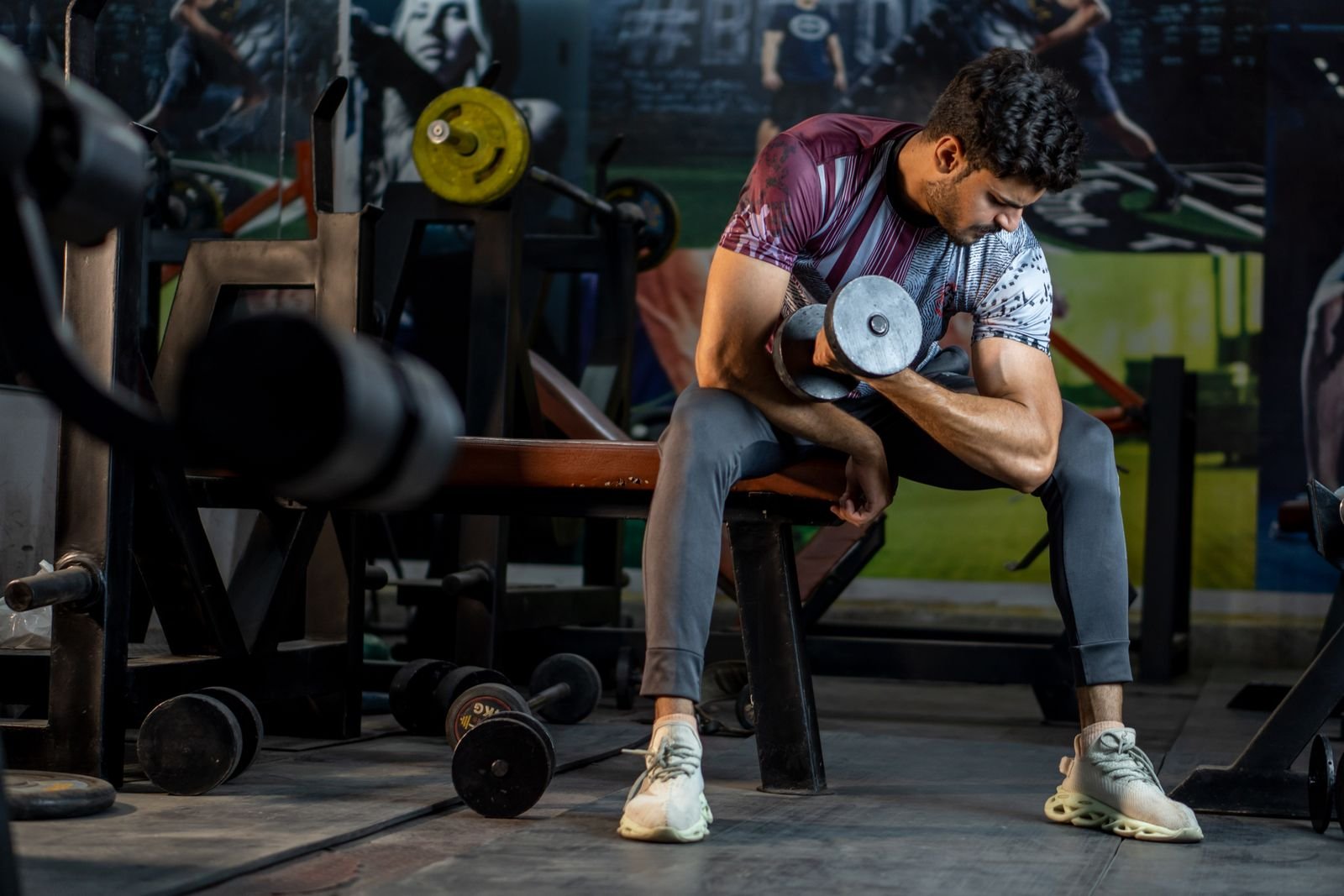
The right preacher curl alternative depends on your equipment, training experience, joint comfort, and whether your main goal is biceps isolation, heavier loading, or overall pulling strength.
You do not need to copy the exact preacher curl position to build stronger biceps. Current research suggests that several curl positions can support muscle growth when you train consistently, control the movement, and gradually increase the challenge.
What Makes a Good Preacher Curl Alternative?
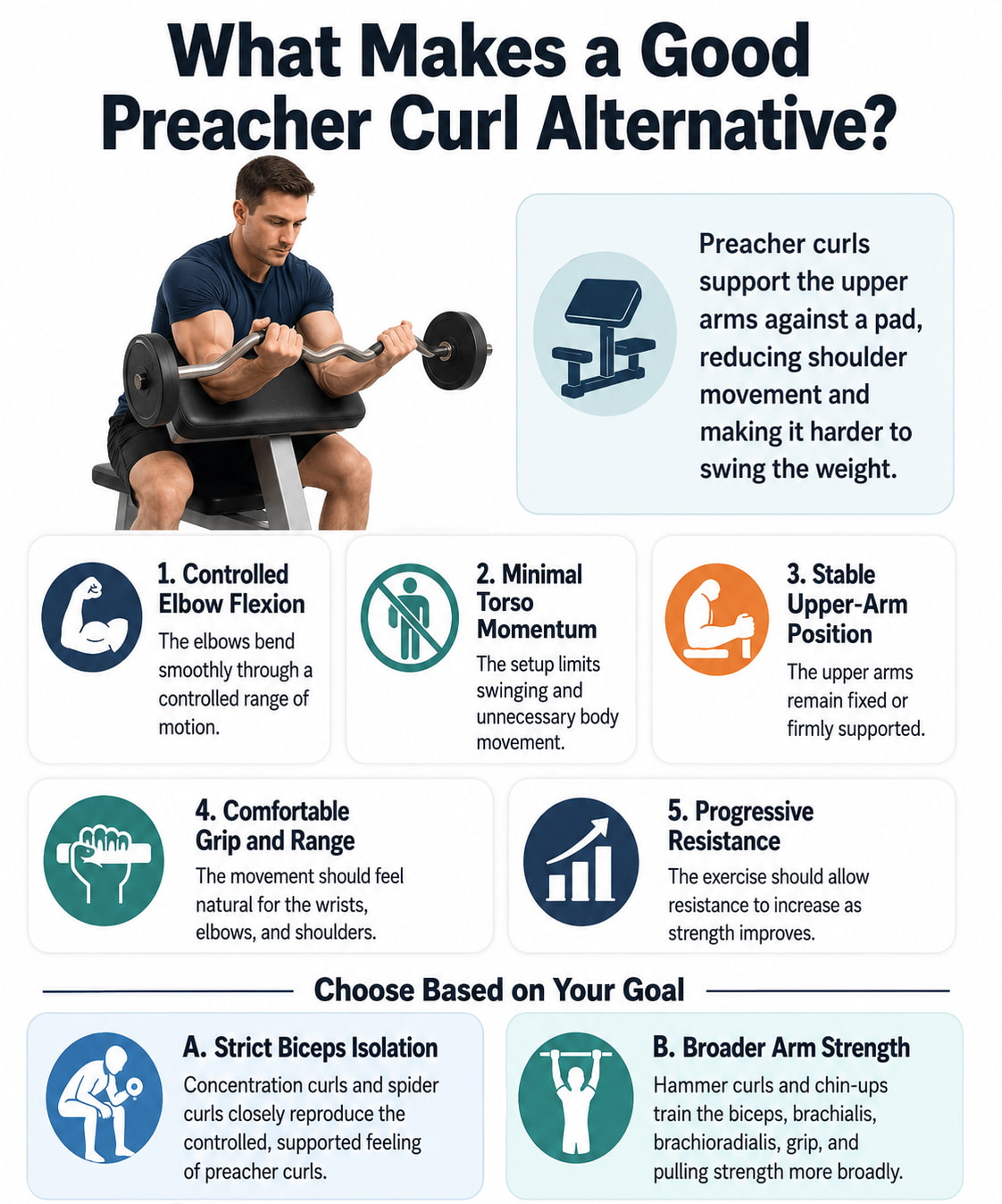
Preacher curls place your upper arms against a pad. This support reduces shoulder movement and makes it harder to swing the weight.
A useful alternative should provide at least some of the same benefits:
- Controlled elbow flexion
- Minimal torso momentum
- A stable upper-arm position
- A comfortable grip and range of motion
- Enough resistance for progressive overload
Some alternatives, such as concentration and spider curls, closely reproduce the strict isolation of preacher curls. Others, including hammer curls and chin-ups, train the elbow flexors differently and may be better for broader arm strength.
The biceps brachii helps flex the elbow and rotate the forearm into a palms-up position. The brachialis and brachioradialis also assist during curling and pulling movements.
8 Best Preacher Curl Alternatives
These 8 preacher curl alternatives help build biceps size and strength using dumbbells, cables, bars, and bodyweight. Choose the option that best matches your equipment, comfort, and training goals.
1. Concentration Curl
Why it works: The concentration curl is probably the closest preacher curl alternative for most home and gym workouts. Bracing your upper arm against your inner thigh prevents excessive shoulder movement and reduces your ability to swing the dumbbell.
An ACE-sponsored exercise comparison found high acute biceps activity during concentration curls. However, muscle activation during one workout does not automatically prove that an exercise will produce the greatest long-term growth. It simply supports the concentration curl as a strong isolation option. (American Council on Exercise)
Muscles worked: The concentration curl primarily trains the biceps brachii. The brachialis, brachioradialis, and forearm muscles also assist with elbow flexion and grip control.
How to do it:
- Sit near the edge of a bench with your feet wider than hip-width.
- Hold a dumbbell in one hand with your palm facing forward.
- Press the back of your upper arm against your inner thigh.
- Begin with your arm almost straight without forcefully locking the elbow.
- Curl the dumbbell toward your shoulder.
- Keep your upper arm pressed against your thigh.
- Pause briefly near the top.
- Lower the dumbbell slowly until your arm is extended again.
- Complete all repetitions before switching arms.
Trainer Tip: Avoid twisting your torso toward the working arm. Use a load that lets you keep the shoulder and upper arm still throughout the set.
2. Spider Curl
Why it works: Spider curls support your torso against an incline bench, reducing body movement and making it difficult to use hip or lower-back momentum. Your arms hang in front of your body, creating a strict curling position.
This variation is useful for lifters who like the controlled feeling of preacher curls but want to use a regular adjustable bench.
Muscles worked: Spider curls mainly train the biceps brachii, with assistance from the brachialis, brachioradialis, forearms, and grip muscles.
How to do it:
- Set an adjustable bench to approximately 45 degrees.
- Lie face down with your chest supported by the bench.
- Hold two dumbbells or an EZ bar with your palms facing forward.
- Let your arms hang naturally beneath your shoulders.
- Brace your abdomen and keep your chest against the pad.
- Curl the weight toward your shoulders.
- Keep your upper arms mostly vertical.
- Squeeze your biceps without lifting your chest.
- Lower the weight slowly to the starting position.
Trainer Tip: Do not allow your elbows to drift backward as the weight rises. A lighter load usually produces better spider-curl form.
3. Incline Dumbbell Curl
Why it works: Incline dumbbell curls place your upper arms slightly behind your torso. This differs from the forward arm position used during preacher curls and gives you another way to train elbow flexion through a long range of motion.
A 2025 trial comparing preacher and incline curls found that both exercises increased elbow-flexor muscle thickness. The exercises produced different regional adaptations, while strength improvements were greatest in the movement participants practiced. This suggests that incline curls are a valuable alternative, not that they are universally better than preacher curls. (PubMed)
Muscles worked: Incline dumbbell curls primarily work the biceps brachii. The brachialis, brachioradialis, forearms, and shoulder stabilizers provide support.
How to do it:
- Set an adjustable bench between approximately 45 and 60 degrees.
- Sit with your back and head supported.
- Hold a dumbbell in each hand with your arms hanging at your sides.
- Turn your palms forward.
- Keep your shoulders down and your upper arms behind or beside your torso.
- Curl the dumbbells toward your shoulders.
- Avoid moving your elbows forward to finish the repetition.
- Pause briefly at the top.
- Lower the dumbbells under control until your arms are nearly straight.
Trainer Tip: Start lighter than you would for standing curls. Do not force your arms farther behind your body than your shoulders comfortably allow.
4. Bayesian Cable Curl
Why it works: The Bayesian cable curl uses a low cable positioned behind your body. The cable maintains resistance throughout the repetition, while the one-arm setup makes it easier to focus on even technique.
A 2025 study compared preacher-style cable curls with Bayesian cable curls while matching their resistance profiles. Both variations increased elbow-flexor muscle thickness and strength, with no statistically significant difference between the conditions. (PMC)
Muscles worked: The exercise mainly trains the biceps brachii. The brachialis, brachioradialis, forearms, grip muscles, and shoulder stabilizers also contribute.
How to do it:
- Attach a single handle to the lowest setting of a cable machine.
- Stand facing away from the cable stack.
- Hold the handle with one hand and take a small step forward.
- Let your working arm extend slightly behind your torso.
- Keep your chest tall and your shoulder controlled.
- Curl the handle toward the front of your shoulder.
- Keep your upper arm mostly still.
- Pause briefly without letting the elbow move forward.
- Lower the handle slowly.
- Complete the set and switch sides.
Trainer Tip: Do not step so far forward that the cable pulls your shoulder into an uncomfortable position. Use a stable stance and a manageable range of motion.
5. Wall-Supported Dumbbell Curl
Why it works: A wall-supported curl is a simple preacher curl alternative without a bench. Keeping your upper back against a wall limits leaning and reduces the momentum commonly used during standing curls.
It is especially useful for home training because it requires only a pair of dumbbells and a clear wall.
Muscles worked: Wall-supported curls train the biceps brachii, brachialis, brachioradialis, forearms, and grip muscles. Your core also works lightly to maintain posture.
How to do it:
- Stand with your upper back and hips against a wall.
- Position your feet slightly in front of your body.
- Hold a dumbbell in each hand with your palms facing forward.
- Keep your shoulders down and your ribs controlled.
- Curl the dumbbells toward your shoulders.
- Keep your back against the wall.
- Avoid pushing your elbows forward.
- Pause briefly at the top.
- Lower the dumbbells slowly until your arms are nearly straight.
Trainer Tip: The goal is not to press your entire arm into the wall. Keep your torso supported while allowing your elbows to rest naturally near your sides.
6. Standing EZ-Bar Curl
Why it works: The standing EZ-bar curl allows you to train both arms together and generally use more weight than you could during a single-arm concentration curl. It is a practical choice when your goal includes progressive strength.
The angled grip may feel more natural than a straight bar for some lifters. However, comfort varies, so choose the grip width that lets your wrists remain stable.
Muscles worked: EZ-bar curls primarily train the biceps brachii and brachialis. The brachioradialis, forearms, grip muscles, core, and upper-back stabilizers also contribute.
How to do it:
- Stand with your feet approximately hip-width apart.
- Hold an EZ bar using a comfortable underhand grip.
- Keep your wrists straight and your elbows near your sides.
- Brace your abdomen and stand tall.
- Curl the bar toward your upper chest.
- Keep your torso still.
- Stop before your elbows move noticeably forward.
- Lower the bar slowly to the starting position.
Trainer Tip: If you need to lean backward to lift the bar, reduce the weight. Controlled repetitions are more useful than moving a heavier load with excessive momentum.
7. Hammer Curl
Why it works: Hammer curls use a neutral grip with the palms facing each other. They are not an exact preacher curl replacement, but they provide more balanced elbow-flexor training by emphasizing the brachialis and brachioradialis along with the biceps.
Developing these muscles may support greater arm thickness, grip strength, and performance during rows, pulldowns, and other pulling exercises.
Muscles worked: Hammer curls work the brachialis, brachioradialis, and biceps brachii. The wrist and grip muscles also help stabilize the dumbbells.
How to do it:
- Stand or sit while holding a dumbbell in each hand.
- Keep your palms facing your thighs.
- Brace your core and keep your shoulders relaxed.
- Curl the dumbbells while maintaining the neutral grip.
- Keep your elbows close to your sides.
- Pause when your forearms approach your upper arms.
- Lower the dumbbells slowly.
- Avoid rotating your palms upward during the repetition.
Trainer Tip: Use alternating hammer curls when lifting both dumbbells together causes you to sway or lose control.
8. Chin-Up or Assisted Chin-Up
Why it works: Chin-ups are a compound alternative for people who want to improve both biceps and upper-body pulling strength. The palms-facing-you grip places the biceps in a strong position while the back muscles produce much of the pulling force.
Chin-ups are less isolated than preacher curls, so they should not be viewed as a perfect one-for-one substitute. They are best used when your goal includes broader strength and muscle development.
Muscles worked: Chin-ups train the latissimus dorsi, biceps brachii, brachialis, brachioradialis, middle and lower trapezius, rhomboids, forearms, grip muscles, and core.
How to do it:
- Hold a pull-up bar with an underhand, approximately shoulder-width grip.
- Begin from a controlled hanging position.
- Keep your ribs controlled and your shoulders active.
- Pull your elbows down toward your sides.
- Raise your chest toward the bar.
- Avoid kicking or swinging.
- Pause briefly near the top.
- Lower yourself under control.
- Use an assistance machine or resistance band when needed.
Trainer Tip: Stop the set before your repetitions become jerky. Assisted chin-ups are usually more productive than repeatedly attempting uncontrolled full-body repetitions.
How to Choose the Right Preacher Curl Alternative
Choose the exercise that best matches your equipment and goal rather than trying to find one movement that is perfect for everyone.
Choose Concentration Curls If You Want Strict Isolation
The braced upper arm limits momentum and requires only one dumbbell. This makes concentration curls suitable for beginners, home training, and high-control accessory work.
Choose Spider Curls If You Have an Adjustable Bench
Spider curls provide torso support and work well with dumbbells or an EZ bar. They are a good option when standing curls cause you to swing.
Choose Incline or Bayesian Curls for a Different Arm Position
Both exercises place the upper arm behind the torso. Current evidence does not show that one shoulder position is automatically superior for everyone, especially when resistance profile and training effort are controlled.
Choose EZ-Bar Curls for Heavier Loading
EZ-bar curls make it easier to train both arms together and track strength progression. They usually fit well near the beginning of a biceps workout.
Choose Hammer Curls for More Complete Elbow-Flexor Training
Hammer curls add greater emphasis to the brachialis and brachioradialis. They complement palms-up curl variations rather than perfectly duplicating them.
Choose Chin-Ups for Compound Strength
Chin-ups are appropriate when you want to train your biceps alongside your back, forearms, grip, and core.
How Many Sets and Reps Should You Do?
A practical starting point is:
- Muscle growth: 2–4 sets of 8–15 repetitions
- Strength-focused curls: 3–4 sets of 6–10 repetitions
- Chin-ups: 3–4 sets of 4–10 controlled repetitions
- Beginners: 2 sets of 10–15 repetitions
- Rest: 60–90 seconds for lighter isolation work and 90–150 seconds for heavier curls or chin-ups
Choose one or two biceps exercises per workout. You do not need to perform all eight alternatives in the same session.
The American College of Sports Medicine’s March 2026 resistance-training guidance emphasizes consistency, individualization, and sufficient weekly training volume. It identifies approximately 10 weekly sets per muscle group as a useful hypertrophy target, but that total should include direct curls and indirect biceps work from rows, pulldowns, and chin-ups.
Beginners may grow with fewer direct sets. More experienced lifters can gradually add volume if they are recovering well and still progressing.
Two Simple Biceps Workout Examples
Size-Focused Biceps Workout
- Standing EZ-bar curl: 3 sets of 6–10 reps
- Incline dumbbell curl: 3 sets of 8–12 reps
- Hammer curl: 2 sets of 10–15 reps
Rest approximately 90 seconds between sets. Stop most sets when you feel you could still complete one or two controlled repetitions.
Minimal-Equipment Biceps Workout
- Chin-up or assisted chin-up: 3 sets of 5–10 reps
- Wall-supported dumbbell curl: 3 sets of 8–12 reps
- Concentration curl: 2 sets of 10–15 reps per arm
Train the workout once or twice weekly, depending on the rest of your pulling volume.
How to Progress Without Sacrificing Form
Use a repetition range rather than increasing the weight every workout.
For example, perform concentration curls for three sets of 8–12 repetitions. Keep the same dumbbell until you can complete 12 controlled repetitions on every set. Then increase the weight slightly and begin again near the lower end of the range.
You can also progress by:
- Adding one repetition
- Improving your range of motion
- Slowing the lowering phase
- Reducing unnecessary body movement
- Adding a set when recovery is good
- Using slightly more resistance
Only change one variable at a time. This makes progress easier to track.
Common Mistakes to Avoid
Swinging the Weight
Hip drive and torso movement transfer work away from the elbow flexors. Reduce the load and keep your body stable.
Moving the Elbows Too Much
Some natural movement may occur, but repeatedly driving the elbows forward turns the curl into more of a shoulder movement.
Bending the Wrists
Keep your wrists aligned with your forearms. Letting them fold backward can make the exercise uncomfortable and weaken your grip.
Dropping the Weight Quickly
Control the lowering phase. Do not allow the resistance to pull your arm down suddenly.
Forcing a Painful Range of Motion
Your arm does not need to become perfectly straight if that position causes discomfort. Use the largest pain-free range you can control.
Doing Too Many Similar Curls
Three nearly identical palms-up curls may add fatigue without providing much additional value. Combine a stable supinated curl with a neutral-grip or compound movement instead.
Preacher Curl Alternative FAQs
What is the closest alternative to a preacher curl?
The concentration curl is one of the closest alternatives because the upper arm is braced and body momentum is limited. Spider curls are another strong option when you have an adjustable bench.
Can concentration curls replace preacher curls?
Yes. Concentration curls can replace preacher curls when your goal is controlled biceps isolation. However, the resistance and arm position are not identical, so performance may feel different.
What is the best preacher curl alternative without a bench?
Wall-supported dumbbell curls are a simple option without a bench. Standing cable curls, EZ-bar curls, hammer curls, and chin-ups can also work depending on your equipment.
Are incline curls better than preacher curls?
Neither exercise is universally better. A 2025 study found that both produced muscle and strength gains, with some differences in where growth occurred and clear exercise-specific strength improvements. The best choice depends on comfort, equipment, and training goals.
Can hammer curls replace preacher curls?
Hammer curls can replace preacher curls when you want general arm strength and more brachialis or brachioradialis involvement. They are less specific when your main goal is training with a palms-up grip.
Are Bayesian curls better than preacher curls?
Current research does not establish Bayesian curls as universally superior. A 2025 comparison found similar muscle and strength improvements when preacher and Bayesian cable curls were matched for resistance profile.
Do you need preacher curls to build bigger biceps?
No. You can build your biceps with dumbbells, cables, barbells, resistance bands, machines, and bodyweight pulling exercises. Consistent training, sufficient effort, gradual progression, and recovery matter more than including one specific curl variation.
Conclusion
The best preacher curl alternative is the one you can perform consistently with stable form and progressive resistance. Concentration curls are the closest all-around substitute, while spider and wall-supported curls are useful for limiting momentum.
Incline and Bayesian curls provide different setups, EZ-bar curls support heavier loading, hammer curls train more of the elbow flexors, and chin-ups build compound pulling strength.
Choose one main curl and one complementary movement. Track your repetitions, improve your control, and add resistance gradually instead of changing exercises every workout.