
Psoas muscle exercises are targeted movements that strengthen and mobilize the deep hip flexor connecting your spine to your legs, supporting better posture, smoother walking, and core stability. Understanding how to train the psoas properly matters because prolonged sitting, poor posture, and imbalanced training can limit hip mobility and place extra strain on the lower back.
This guide explains what psoas muscle exercises are, why they matter, and how to perform the best options safely—using current guidance from trusted health and fitness authorities.
What Are Psoas Muscle Exercises?
Psoas muscle exercises focus on activating, strengthening, and gently stretching the psoas major, a deep muscle that runs from the lumbar spine to the femur. Along with the iliacus, it forms the iliopsoas, the primary hip flexor.
According to the Cleveland Clinic, the psoas plays a key role in:
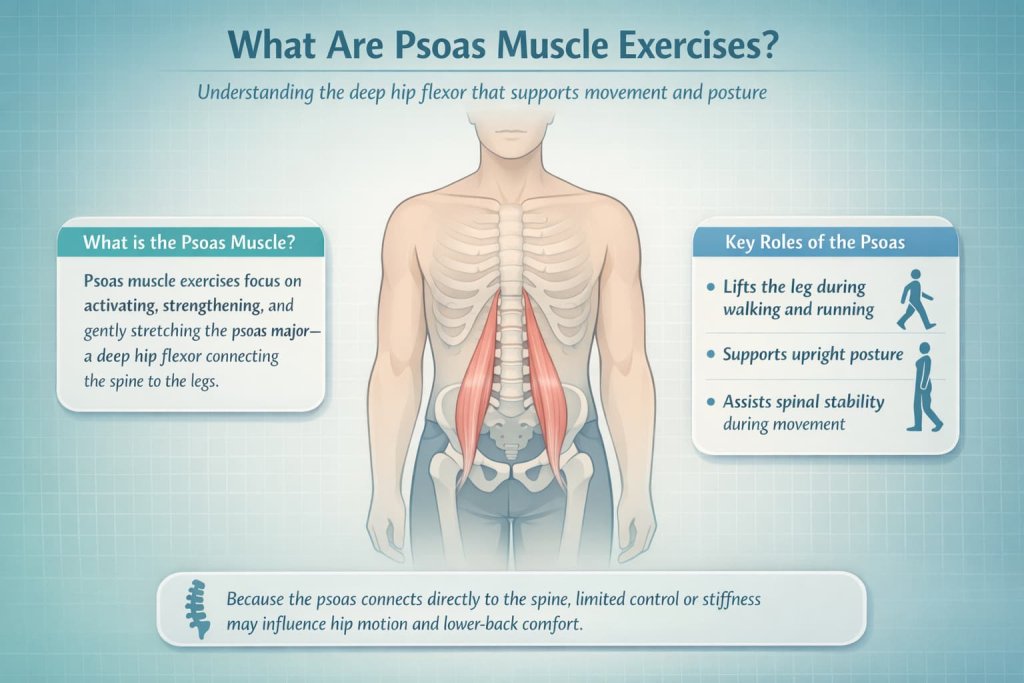
- Lifting the leg during walking and running
- Maintaining upright posture
- Assisting spinal stability during movement
Because the psoas connects directly to the spine, poor control or stiffness can affect both hip motion and lower-back comfort.
Why Psoas Muscle Exercises Matter
Well-designed psoas muscle exercises may help:
- Support healthy hip mobility and walking mechanics
- Improve deep core coordination
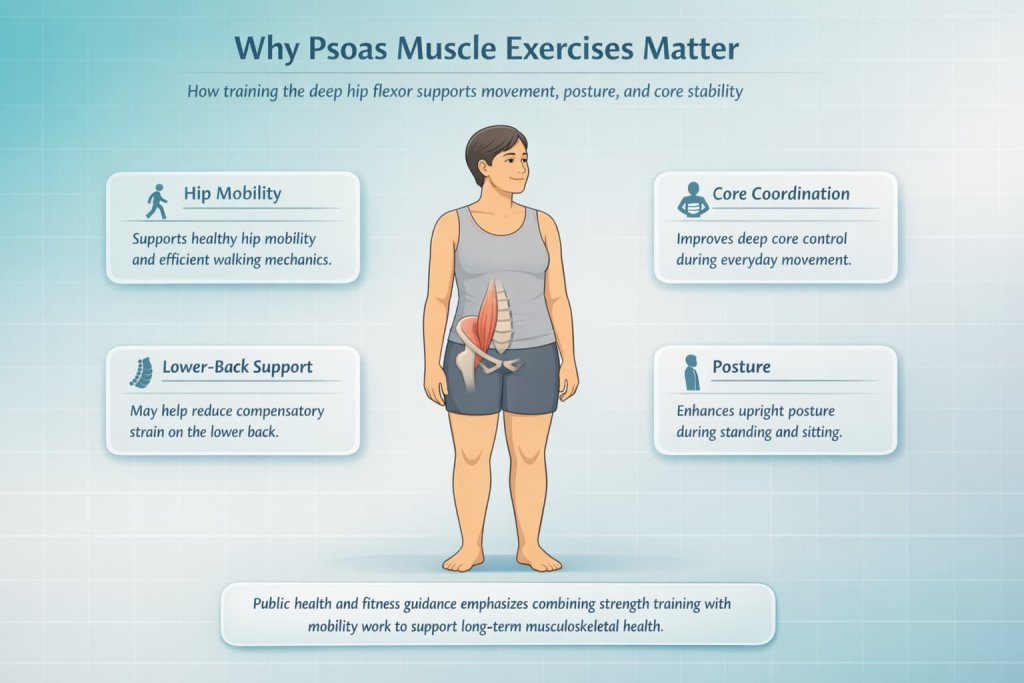
- Reduce compensatory strain on the lower back
- Enhance posture during standing and sitting
Public health and fitness guidance from organizations like the Mayo Clinic and the American College of Sports Medicine emphasizes balanced strength training and mobility work as part of long-term musculoskeletal health.
10 Best Psoas Muscle Exercises
These 10 psoas muscle exercises are designed to improve hip mobility and core strength through controlled, functional movements. They combine gentle activation, strength, and mobility to support better posture and everyday movement.
1. Supine March
A foundational drill for psoas activation without stressing the spine.
How to do it
- Lie on your back with knees bent and feet flat on the floor
- Gently brace your core as if preparing for a cough
- Lift one knee toward your chest until the hip reaches about 90 degrees
- Keep the pelvis level and the lower back neutral
- Lower the foot slowly and alternate sides
Why it works
This exercise isolates hip flexion while minimizing spinal movement, allowing the psoas to activate without compensation from the lower back.
Trainer Tip
If your pelvis rocks or your lower back arches, reduce the knee height and slow the movement.
2. Dead Bug
A widely recommended core exercise that integrates psoas control.
How to do it
- Lie on your back with arms reaching toward the ceiling
- Bend hips and knees to 90 degrees
- Brace your core and keep your lower back gently pressed into the floor
- Extend the opposite arm and leg away from the body
- Return to the starting position and switch sides
Why it works
The dead bug trains the psoas to work in coordination with the abdominal muscles, reinforcing controlled limb movement while stabilizing the spine.
Trainer Tip
Move slowly and stop the extension before your lower back lifts off the floor.
3. Standing March Hold
A functional psoas exercise that mimics walking mechanics.
How to do it
- Stand upright with feet hip-width apart
- Shift weight onto one leg
- Lift the opposite knee to hip height
- Hold briefly while maintaining balance
- Lower with control and repeat on the other side
Why it works
This drill strengthens the psoas in a weight-bearing position, closely matching real-life walking and running demands.
Trainer Tip
Imagine a string pulling the top of your head upward to avoid leaning back.
4. Step-Up with Knee Drive
Combines lower-body strength with psoas engagement.
How to do it
- Stand in front of a low step or box
- Place one foot fully on the platform
- Press through the heel to stand up
- Drive the opposite knee upward in a controlled motion
- Step back down slowly and repeat
Why it works
The knee drive emphasizes active psoas engagement while the step-up strengthens the hips and legs in a functional pattern.
Trainer Tip
Choose a step height that allows full control without pushing off the trailing foot.
5. Hanging Knee Raise (Beginner Range)
A progressive option for building psoas strength.
How to do it
- Hang from a pull-up bar with shoulders engaged
- Keep legs relaxed and slightly bent
- Lift knees a short distance toward the chest
- Pause briefly, then lower under control
Why it works
Gravity increases demand on the psoas, encouraging strength development while the core stabilizes the pelvis.
Trainer Tip
Avoid swinging—controlled motion matters more than range.
6. Seated Resistance Band March
Adds external resistance to hip flexion.
How to do it
- Sit upright on a chair with feet flat
- Loop a resistance band around one foot
- Anchor the band under the opposite foot or chair
- Lift the banded knee upward slowly
- Lower with control before switching sides
Why it works
This exercise isolates hip flexion strength while keeping the spine supported and upright.
Trainer Tip
Keep your torso tall and avoid leaning backward to cheat the movement.
7. Reverse Lunge to Knee Drive
A dynamic exercise blending mobility and strength.
How to do it
- Stand tall with feet hip-width apart
- Step one leg back into a reverse lunge
- Push through the front foot to stand
- Drive the rear knee upward toward hip height
- Alternate sides with control
Why it works
This movement links hip extension and hip flexion, training the psoas within a full lower-body movement pattern.
Trainer Tip
Keep your chest upright and avoid collapsing forward during the lunge.
8. Kneeling Hip Flexor Stretch (Posterior Pelvic Tilt)
A commonly recommended mobility exercise.
How to do it
- Kneel with one knee down and the opposite foot forward
- Gently tuck the pelvis by engaging the glutes
- Shift your hips forward slightly
- Hold the stretch while maintaining a neutral spine
Why it works
The posterior pelvic tilt emphasizes psoas lengthening while reducing stress on the lumbar spine.
Trainer Tip
You should feel the stretch in the front of the hip—not the lower back.
9. Bridge March
Adds hip flexion to a glute bridge position.
How to do it
- Lie on your back with knees bent and feet flat
- Lift hips into a glute bridge
- Hold the bridge and lift one knee toward the chest
- Lower and alternate sides while keeping hips level
Why it works
This exercise trains the psoas while the glutes and core stabilize the pelvis.
Trainer Tip
If your hips drop or twist, reset the bridge before continuing.
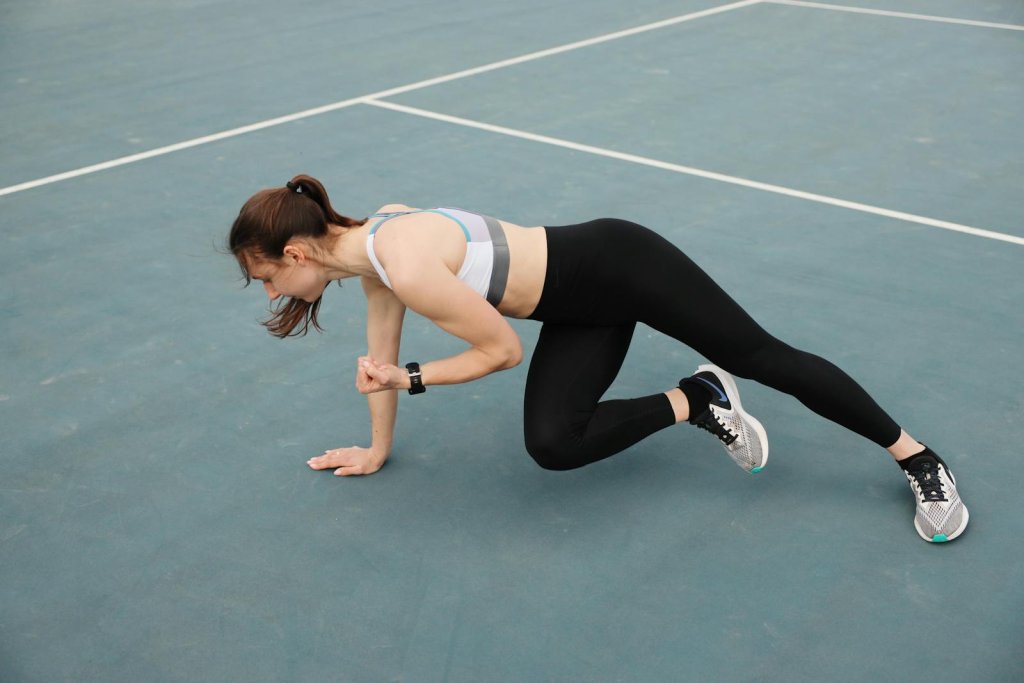
10. Slow Mountain Climber (Controlled)
A low-impact, core-driven variation.
How to do it
- Start in a high plank position
- Brace your core and keep shoulders stacked over wrists
- Slowly bring one knee toward your chest
- Return to plank and switch sides
Why it works
Slow tempo increases time under tension, forcing the psoas to work alongside the core to maintain stability.
Trainer Tip
Move deliberately—this is about control, not speed.
How Often Should You Do Psoas Muscle Exercises?
General strength-training guidance from the American College of Sports Medicine recommends training major muscle groups at least two days per week. For psoas-focused work:
- Strength exercises: 2–3 sessions per week
- Mobility stretches: most days, especially after prolonged sitting
How the Psoas Muscle Works (Brief Anatomy Overview)
The psoas muscle is a deep hip flexor that connects the lower spine to the upper thigh bone. It originates along the lumbar vertebrae and attaches to the femur, allowing it to influence both hip movement and spinal positioning.
Because of this unique attachment, the psoas helps:
- Lift the leg during walking, running, and stair climbing
- Assist in maintaining upright posture
- Support coordination between the hips and core during movement
Medical anatomy overviews from the Cleveland Clinic explain that the psoas works closely with the abdominal and pelvic muscles. This means effective psoas training focuses on controlled movement and stability rather than aggressive stretching or heavy loading.
Who Can Benefit from Psoas Muscle Exercises?
Psoas muscle exercises can be helpful for a wide range of individuals when performed with proper technique and progression.
Common groups who may benefit include:
- People who sit for long periods and want to improve hip mobility
- Adults aiming to support core stability and posture
- Runners and athletes who rely on efficient hip flexion
- Older adults focused on maintaining walking mechanics and balance
- Beginners rebuilding foundational hip and core control
Fitness and movement guidance from the American College of Sports Medicine emphasizes that balanced strength and mobility training supports functional movement across all age groups.
Safety Guidelines and When to Be Careful
Psoas muscle exercises should always be performed with control and within a comfortable range of motion.
General safety guidelines include:
- Avoid forcing hip extension or deep stretches that cause lower-back arching
- Move slowly and prioritize form over repetitions
- Stop any exercise that causes sharp hip, groin, or lower-back pain
- Use beginner variations before progressing to advanced movements
According to general exercise safety guidance from the Mayo Clinic, exercises should never worsen pain or create new symptoms. Mild muscle effort is expected, but discomfort in the joints or spine is not.
When to Seek Professional Guidance
Professional guidance may be appropriate if symptoms persist or worsen despite conservative exercise.
Consider consulting a qualified healthcare professional or physical therapist if you experience:
- Ongoing hip or groin pain lasting more than a few weeks
- Pain that interferes with walking, standing, or daily activities
- A recent hip, lower-back, or abdominal injury
- Symptoms such as numbness, weakness, or limited range of motion
Trusted health resources such as MedlinePlus note that persistent or unexplained musculoskeletal symptoms should be evaluated to ensure safe and appropriate care.
Common Mistakes to Avoid
- Overstretching with excessive lower-back arching
- Rushing through hip flexion movements
- Neglecting core engagement
- Training through sharp or worsening pain
Who Should Be Careful?
People with recent hip injuries, persistent groin pain, or diagnosed hip flexor strains should progress cautiously. According to MedlinePlus, lingering symptoms should be evaluated by a qualified healthcare professional.
Frequently Asked Questions
Are psoas muscle exercises good for posture?
Yes. The psoas influences pelvic and spinal alignment, which plays a role in upright posture.
Can tight psoas muscles affect the lower back?
They can contribute to altered movement patterns, which may increase strain on the lower back.
Should I stretch or strengthen the psoas first?
Most experts recommend a combination—gentle mobility work plus controlled strengthening.
Are psoas exercises safe for beginners?
Many beginner-friendly options exist when performed slowly with proper form.
How long should I hold psoas stretches?
The Mayo Clinic commonly suggests holding stretches for about 30 seconds after warming up.
Can I do psoas exercises at home?
Yes. Many effective psoas exercises require little to no equipment.
Conclusion
Psoas muscle exercises are an important—but often overlooked—part of hip and core training. When performed with control and balance, they may help support mobility, posture, and everyday movement efficiency. Start with beginner-friendly options, progress gradually, and prioritize quality over intensity.