
Rack pulls are a partial-range deadlift variation that may help you build a stronger back, train heavier loads, and improve top-end pulling strength when used with solid form. They matter because they let you target the upper half of the deadlift with less range of motion than pulling from the floor, which can make them useful for strength, hypertrophy, and some mobility-limited lifters.
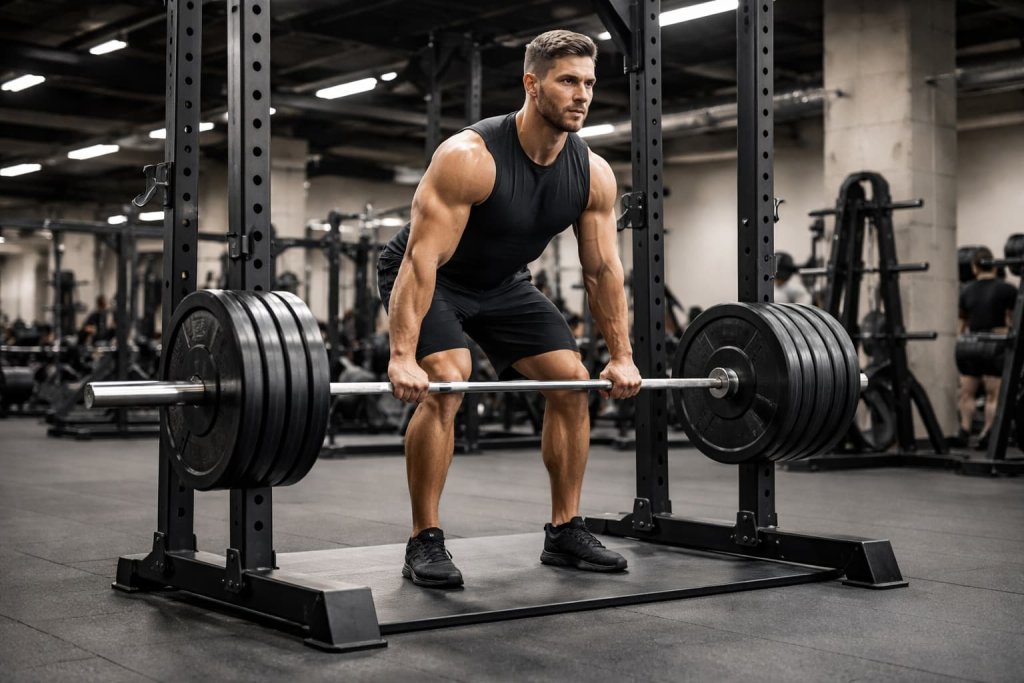
Guidance from the NSCA, ACE, and current deadlift research supports deadlift-based training as an effective way to load the posterior chain when technique and programming are appropriate.
What Are Rack Pulls?
Rack pulls are a deadlift variation done with the barbell resting on safety pins, blocks, or a rack setting above floor level. Most lifters set the bar somewhere from just below the knee to just above the knee, depending on their goal and build. Because the bar starts higher, the lift uses a shorter range of motion than a conventional deadlift from the floor.
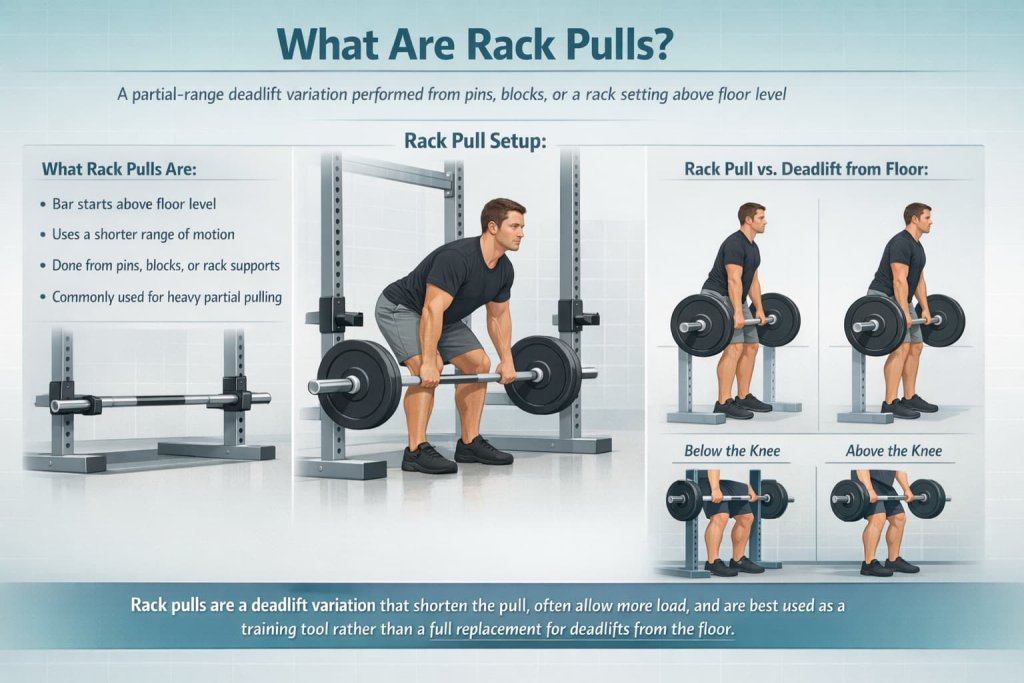
In practice, that usually means you can use more load than you would in a full-range deadlift, but you also train less of the bottom-position demand. That is why rack pulls are best seen as a tool, not a replacement for every other deadlift style. Research in PubMed on partial- versus full-range deadlifts supports that range of motion changes the loading profile and performance characteristics of the lift.
How to Do Rack Pulls With Proper Form
Set the bar on pins or blocks around knee level to start. A just-below-knee position usually gives a better mix of strength work and full-body tension than a very high setup.
How to do it
- Set the bar in a power rack on safety pins or on stable pulling blocks.
- Stand with feet about hip-width apart and the bar close to your legs.
- Hinge at the hips and grab the bar with a double-overhand or mixed grip.
- Brace your core and keep your chest up with a neutral spine.
- Pull the bar by driving the feet down and extending the hips.
- Keep the bar close to the body as you stand tall.
- Finish by squeezing the glutes without leaning far back.
- Lower the bar under control to the pins and reset before the next rep.
A good cue is to think “push the floor away, keep the bar close, and stand tall.” Hospital for Special Surgery notes that deadlift mechanics depend heavily on maintaining spinal position and controlling the hinge pattern rather than yanking the bar with the arms.
Rack Pulls Muscles Worked
Rack pulls mainly train the posterior chain. The biggest contributors are the erector spinae, glutes, hamstrings, and upper back, with the traps and forearms also working hard to stabilize the bar and maintain grip. A systematic review available through PubMed Central shows strong involvement of the spinal erectors and hip extensor muscles across deadlift variations, although exact activation shifts based on setup, bar height, and technique.
Because the movement starts higher than a full deadlift, rack pulls often place extra emphasis on the top half of the pull, where spinal stiffness, hip extension, and upper-back position matter most. That makes them especially popular for lifters who want more back thickness, stronger lockouts, and more exposure to heavy loads.
Benefits of Rack Pulls
Heavier loading potential
Since the bar does not travel from the floor, many lifters can use more weight on rack pulls than on conventional deadlifts. That can be useful for experienced lifters who want to overload the top portion of the lift and build confidence with heavier barbell loads.
Strong posterior-chain training
Rack pulls still demand force from the glutes, hamstrings, spinal erectors, and upper back. ACE notes that deadlift training emphasizes the posterior muscles involved in hip, knee, and back extension, which fits well with why rack pulls remain a staple in many strength programs.
Useful for lockout strength
If your deadlift tends to stall near the top, rack pulls may help by letting you train that position directly. A study indexed in PubMed found that force and muscle demands vary across lift-off, mid-pull, and lockout positions, which supports using height-specific pulling variations for targeted strength work.
Less range of motion
For some lifters, the shorter range can make rack pulls more manageable than pulling from the floor, especially when hip mobility, limb length, or setup consistency makes conventional deadlifts harder to perform well. That does not make rack pulls safer by default, but it can make them easier to learn and control in the right setup. Practical guidance from Hospital for Special Surgery supports the idea that setup quality and movement control matter a lot in loaded hinge patterns.
Common Rack Pull Mistakes
Setting the bar too high
A very high rack pull can turn into a short ego lift with limited training value. If the bar starts too far above the knee, you lose much of the hip hinge and posterior-chain demand that makes the movement useful in the first place.
Overloading too soon
Rack pulls often let you use more weight, but that does not mean every rep should be maximal. Heavy loads can quickly expose poor bracing, loose lats, and sloppy lockouts.
Leaning back at the top
The finish should be tall and stacked, not a dramatic backward lean. Excessive leaning turns a strong lockout into unnecessary spinal extension.
Letting the bar drift forward
When the bar moves away from the body, the lift becomes less efficient and harder to control. ACE advises keeping the load close and maintaining proper deadlift mechanics throughout the movement.
Rack Pulls vs Deadlifts
Rack pulls and conventional deadlifts are related, but they are not interchangeable.
Rack pulls may be better when you want:
- More overload at the top of the pull
- Extra upper-back and trap work
- A shorter range of motion
- A targeted lockout-strength variation
Conventional deadlifts may be better when you want:
- Full-range pulling strength
- More practice from the floor
- Greater demand on the start position
- Better carryover to a full deadlift test or competition pull
The smartest comparison is not “which is best?” but “which fits the goal?” Full-range deadlifts usually win for complete pulling practice, while rack pulls can be a useful accessory or main lift phase when lockout strength, heavy loading, or reduced range is the priority.
Are Rack Pulls Good for Building Muscle?
Yes, rack pulls can support muscle growth, especially in the upper back, traps, spinal erectors, glutes, and hamstrings. The key reason is simple: they let you apply meaningful tension to large muscle groups while often handling substantial loads. That said, muscle growth still depends on total training volume, exercise selection, effort, recovery, and progressive overload.
For hypertrophy, rack pulls often work best when they are not treated as a one-rep-max test every session. Controlled sets of moderate reps usually provide a better balance of tension, technique, and recovery.
Best Rack Pull Height
For most people, just below the knee is the most useful starting point. It is usually low enough to preserve a meaningful hip hinge and high enough to reduce some of the difficulty of pulling from the floor. Above-knee rack pulls can still have a place, but they often become more specific to overload and lockout work than general strength or muscle building. This fits with position-based deadlift research showing that joint angles and muscle demands change meaningfully across lift heights.
Who Should Do Rack Pulls?
Rack pulls may fit well for:
- Intermediate and advanced lifters who want heavy posterior-chain work
- Lifters trying to improve the lockout portion of the deadlift
- People who tolerate deadlift patterns well but prefer a shorter pull
- Programs aimed at back thickness, traps, and top-end strength
They may be less suitable for beginners who have not yet learned to brace, hinge, and control a barbell well. Beginners often benefit more from mastering simpler hip-hinge patterns and lighter deadlift variations first.
Who Should Be Careful With Rack Pulls?
Use extra caution or get qualified guidance first if you have current back pain, recent injury, recent surgery, or symptoms that worsen during loaded hinging. A shorter range of motion does not automatically make rack pulls appropriate for every painful back or hip condition. Hospital for Special Surgery notes that deadlifts can be helpful when done well, but persistent or sharp pain during lifting deserves proper assessment rather than guesswork.
How to Program Rack Pulls
A simple, evidence-aligned starting point is to treat rack pulls like any other demanding strength lift: use them with a clear goal and enough recovery.
For strength
- 3 to 5 sets
- 3 to 6 reps
- Long rest periods
- Focus on bar path, bracing, and strong lockouts
For hypertrophy
- 2 to 4 sets
- 6 to 10 reps
- Controlled eccentrics
- Moderate to hard effort with clean form
For general health, the U.S. Department of Health and Human Services recommends muscle-strengthening work involving all major muscle groups at least 2 days per week. Rack pulls can fit into that plan, but they should sit alongside balanced training for the legs, core, pushing muscles, and upper back rather than replacing everything else.
Quick Safety Checklist for Rack Pulls
- Use a stable rack or solid pulling blocks
- Set the pins evenly on both sides
- Keep the bar close to the body
- Brace before every rep
- Do not chase load at the expense of position
- Stop if you feel sharp, radiating, or unusual pain
Frequently Asked Questions
Are rack pulls better than deadlifts?
Not overall. Rack pulls are better for some goals, especially lockout work, upper-back loading, and partial-range strength. Conventional deadlifts are usually better for full-range pulling strength and practice from the floor.
Do rack pulls build a stronger back?
They can. Rack pulls load the spinal erectors, upper back, traps, glutes, and hamstrings, which can help build back strength and thickness when programmed well.
What muscles do rack pulls work the most?
The main muscles are the erector spinae, glutes, hamstrings, traps, and forearms, with support from other upper-back and lower-body muscles.
Should the bar start above or below the knee?
For most lifters, just below the knee is the best starting point. It usually gives better tension and better carryover than very high pin settings.
Are rack pulls good for beginners?
Usually not as a first big barbell pull. Beginners often do better learning bracing and hinging with simpler deadlift patterns before adding heavy rack pulls.
How often should you do rack pulls?
For most programs, once per week is enough, especially if you also deadlift, squat, or row hard. The right frequency depends on your recovery, total workload, and goal. General muscle-strengthening guidance still points to training major muscle groups at least twice weekly across your program as a whole.
Conclusion
Rack pulls are a simple but powerful tool for building a stronger back and bigger pull. They are not magic, and they are not a full replacement for every deadlift variation, but they can be very effective for overload, lockout strength, and posterior-chain training when your setup and programming make sense. Use a smart pin height, keep your form honest, and progress the lift with control.
If you are adding rack pulls to your program, start with a moderate height and clean reps before chasing heavier numbers.
References
- Coratella G, et al. An Electromyographic Analysis of Romanian, Step-Romanian, and Stiff-Leg Deadlift Variations. International Journal of Environmental Research and Public Health. 2022.
- Cholewa JM, et al. Anthropometrical Determinants of Deadlift Variant Performance. Journal of Sports Science and Medicine. 2019.
- Escamilla RF, Francisco AC, Kayes AV, Speer KP, Moorman CT. An Electromyographic Analysis of Sumo and Conventional Style Deadlifts. Medicine and Science in Sports and Exercise.
- Camara KD, Coburn JW, Dunnick DD, Brown LE, Galpin AJ, Costa PB. An Examination of Muscle Activation and Power Characteristics While Performing the Deadlift Exercise With Straight and Hexagonal Barbells. Journal of Strength and Conditioning Research.
- Swinton PA, Stewart A, Agouris I, Keogh JWL, Lloyd R. A Biomechanical Analysis of Straight and Hexagonal Barbell Deadlifts Using Submaximal Loads. Journal of Strength and Conditioning Research.