
Rebounder exercises are low-impact cardio movements performed on a mini-trampoline that help you burn calories while reducing stress on your joints. Because the elastic surface absorbs much of the landing force, rebounder workouts are often easier on the knees, hips, and ankles than traditional jumping or running.
Understanding rebounder exercises matters if you want an effective cardio option that supports long-term joint comfort. These workouts can raise your heart rate into a moderate-to-vigorous zone, improve balance and coordination, and fit easily into a home routine.
Below is a clear, evidence-based guide to the best rebounder exercises you can use to support fat loss without unnecessary joint strain.
What Are Rebounder Exercises?
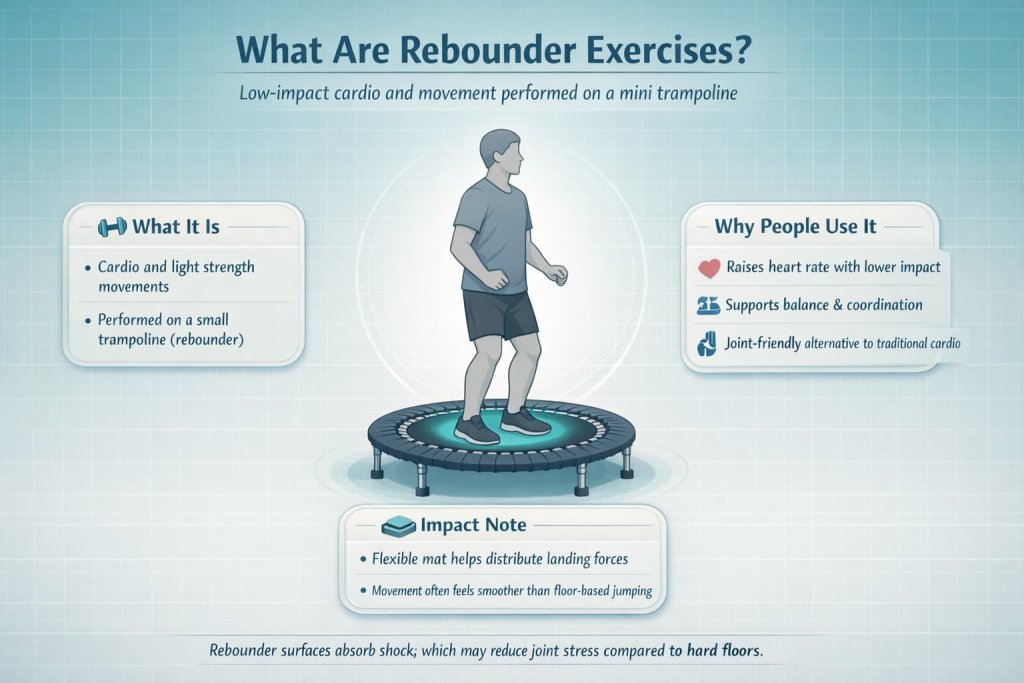
Rebounder exercises are cardio and light strength movements performed on a small trampoline, often called a rebounder. Instead of hard landings on the floor, the flexible mat and springs or bungees help distribute force more evenly through the body.
These exercises are commonly used to:
- Increase heart rate with lower perceived impact
- Support balance and coordination
- Provide a joint-friendly alternative to traditional cardio
According to guidance summarized by the Arthritis Foundation, the rebounder surface absorbs shock, which may make movement feel smoother compared to high-impact floor exercises.
12 Best Rebounder Exercises
These rebounder exercises provide a fun, low-impact way to improve cardio fitness while being gentler on the joints.
They’re suitable for beginners to advanced users and can be used for fat-burning, balance, and full-body conditioning at home.
1. Basic Bounce
How to do it:
- Stand tall in the center of the rebounder with feet hip-width apart
- Keep knees softly bent and heels lightly touching the mat
- Bounce gently by pushing through the balls of your feet
- Maintain an upright torso and relaxed shoulders
Why it works:
The basic bounce introduces rhythmic movement without impact spikes. It raises heart rate gradually while allowing joints to move through small, controlled ranges, making it ideal for warm-ups or steady-state cardio.
Muscles worked:
Calves, quadriceps, glutes, core stabilizers.
Trainer Tip:
Think “soft and quiet” landings—if the mat noise increases, reduce bounce height.
2. Health Bounce
How to do it:
- Stand upright with feet hip-width apart
- Keep heels in contact with the mat throughout
- Create a very small bounce using ankle movement only
- Maintain steady breathing and relaxed posture
Why it works:
This minimal-motion bounce promotes circulation and gentle muscle activation without elevating joint load. It’s commonly used for beginners, recovery days, or cooldown phases.
Muscles worked:
Calves, foot stabilizers, lower-leg muscles.
Trainer Tip:
The movement should feel almost subtle—if your heels lift, the bounce is too big.
3. Marching Bounce
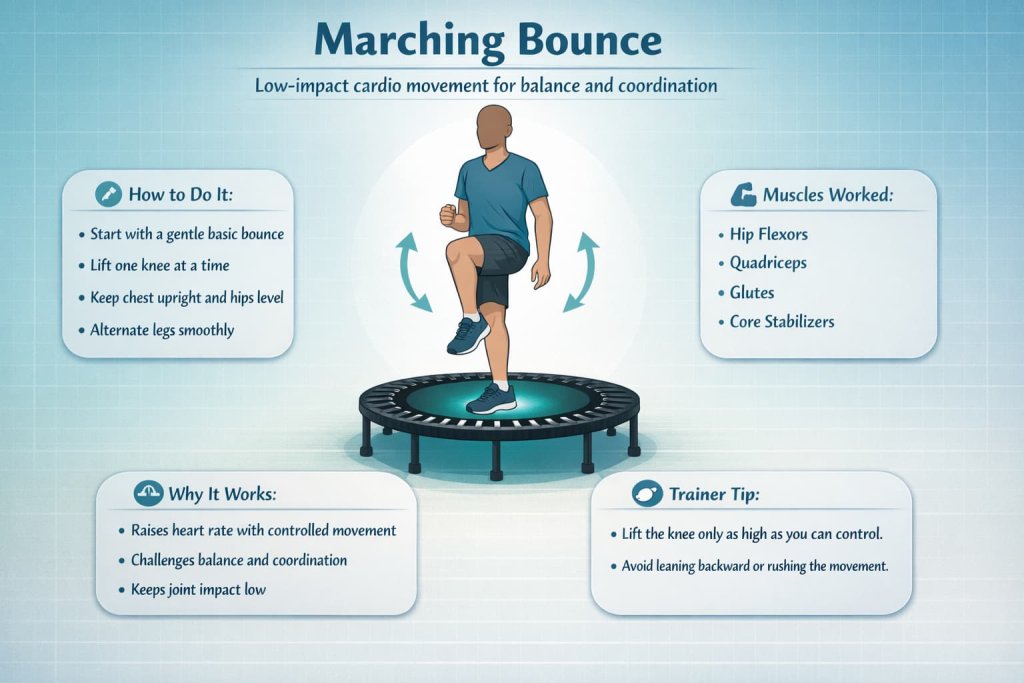
How to do it:
- Begin with a gentle basic bounce
- Lift one knee at a time while maintaining rhythm
- Keep hips level and chest upright
- Alternate legs smoothly
Why it works:
Marching bounces combine cardio with unilateral loading, which challenges balance and coordination while keeping impact low.
Muscles worked:
Hip flexors, quadriceps, glutes, core.
Trainer Tip:
Lift the knee only as high as you can control without leaning back.
4. Jogging in Place
How to do it:
- Start with light bouncing
- Alternate feet in a jogging pattern
- Land softly on the midfoot
- Keep steps quick and controlled
Why it works:
Jogging increases cardiovascular demand while the rebounder surface reduces landing forces compared to floor running.
Muscles worked:
Calves, hamstrings, quadriceps, glutes, core.
Trainer Tip:
Short, quick steps are easier on joints than high, exaggerated lifts.
5. Jumping Jacks
How to do it:
- Begin standing with feet together
- Bounce and move feet out to the sides
- Bring arms overhead as legs separate
- Return to the starting position smoothly
Why it works:
This full-body movement elevates heart rate quickly while the elastic surface reduces joint impact during repeated jumps.
Muscles worked:
Shoulders, calves, quadriceps, glutes, hip abductors.
Trainer Tip:
Control arm movement—speed comes after coordination.
6. High Knees
How to do it:
- Maintain a light bounce rhythm
- Drive one knee upward at a time
- Keep torso upright and core engaged
- Alternate legs rapidly but under control
Why it works:
High knees increase intensity and core demand without requiring high vertical jumps, making them effective for fat-burning intervals.
Muscles worked:
Hip flexors, quadriceps, calves, core.
Trainer Tip:
Stop if posture breaks—quality matters more than speed.
7. Twist Bounce
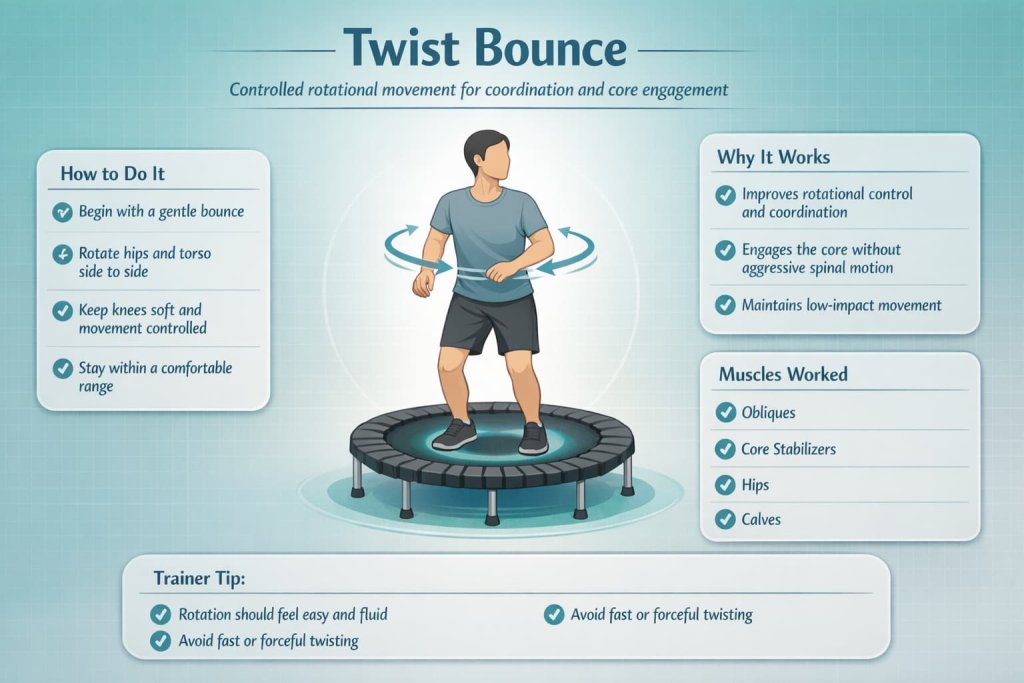
How to do it:
- Begin with a gentle bounce
- Rotate hips and torso slightly side to side
- Keep knees soft and feet light
- Move within a comfortable range
Why it works:
Twist bounces add rotational control and coordination while keeping spinal movement smooth and controlled.
Muscles worked:
Obliques, core stabilizers, hips, calves.
Trainer Tip:
Avoid aggressive twisting—rotation should feel easy and fluid.
8. Skier Jumps
How to do it:
- Start with feet together
- Jump side to side in small, controlled hops
- Land softly with knees bent
- Keep arms relaxed or lightly swinging
Why it works:
Lateral movement challenges stability and coordination while improving lower-body control often missed in straight-line cardio.
Muscles worked:
Glutes, quadriceps, calves, hip stabilizers.
Trainer Tip:
Stay low and controlled rather than jumping wide.
9. Single-Leg Balance Bounce
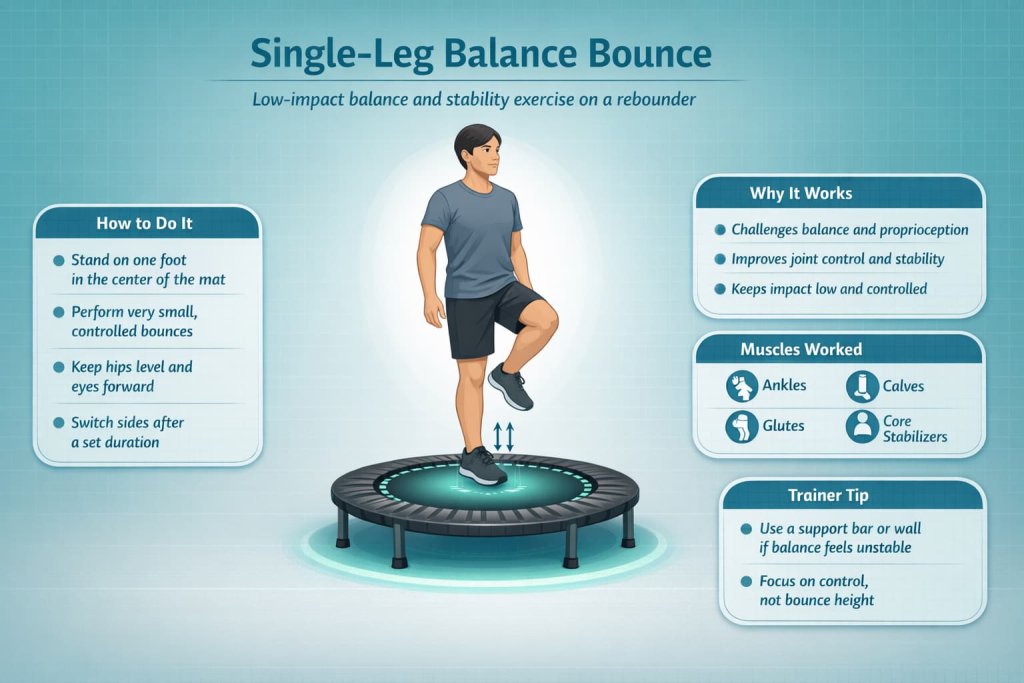
How to do it:
- Stand on one foot in the center of the mat
- Perform very small controlled bounces
- Keep hips level and eyes forward
- Switch sides after a set duration
Why it works:
Single-leg bouncing challenges balance, proprioception, and joint control, which supports long-term stability.
Muscles worked:
Ankles, calves, glutes, core stabilizers.
Trainer Tip:
Use a support bar or wall if balance feels unstable.
10. Jump Squats (Low Range)
How to do it:
- Stand with feet shoulder-width apart
- Perform a shallow squat
- Bounce lightly upward and land softly
- Maintain knee alignment
Why it works:
This exercise adds strength demand to cardio while keeping squat depth shallow to reduce joint strain.
Muscles worked:
Quadriceps, glutes, calves, core.
Trainer Tip:
Depth is optional—control is mandatory.
11. Alternating Kick Bounce
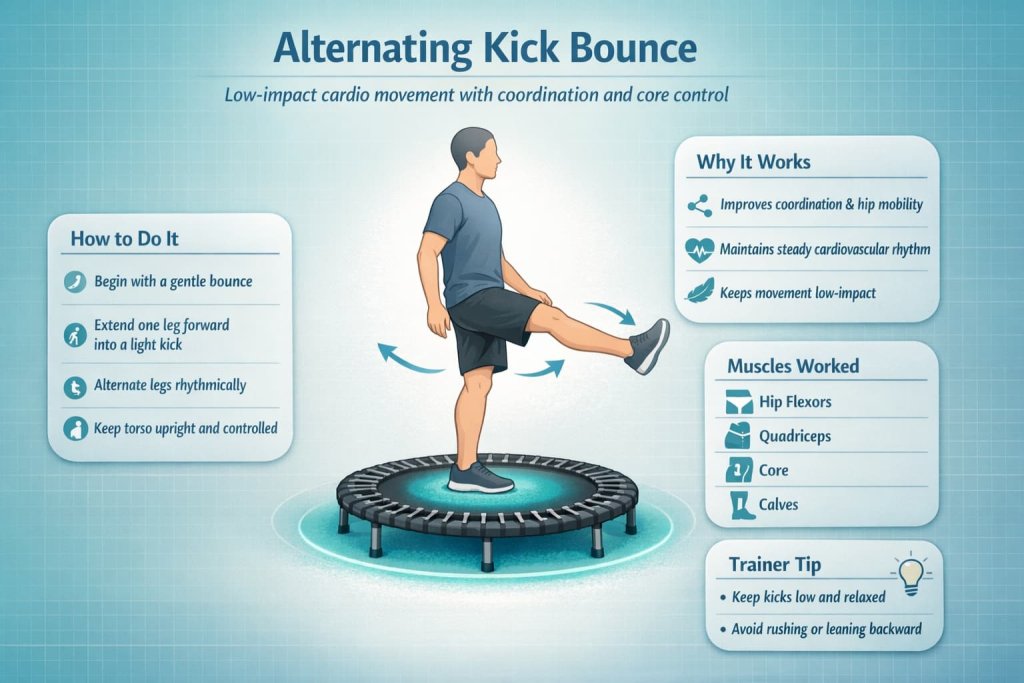
How to do it:
- Begin with a gentle bounce
- Extend one leg forward into a light kick
- Alternate legs rhythmically
- Keep torso upright
Why it works:
Alternating kicks add coordination and hip mobility demands while maintaining a steady cardiovascular rhythm.
Muscles worked:
Hip flexors, quadriceps, core, calves.
Trainer Tip:
Keep kicks low and relaxed to avoid losing balance.
12. Cool-Down Bounce
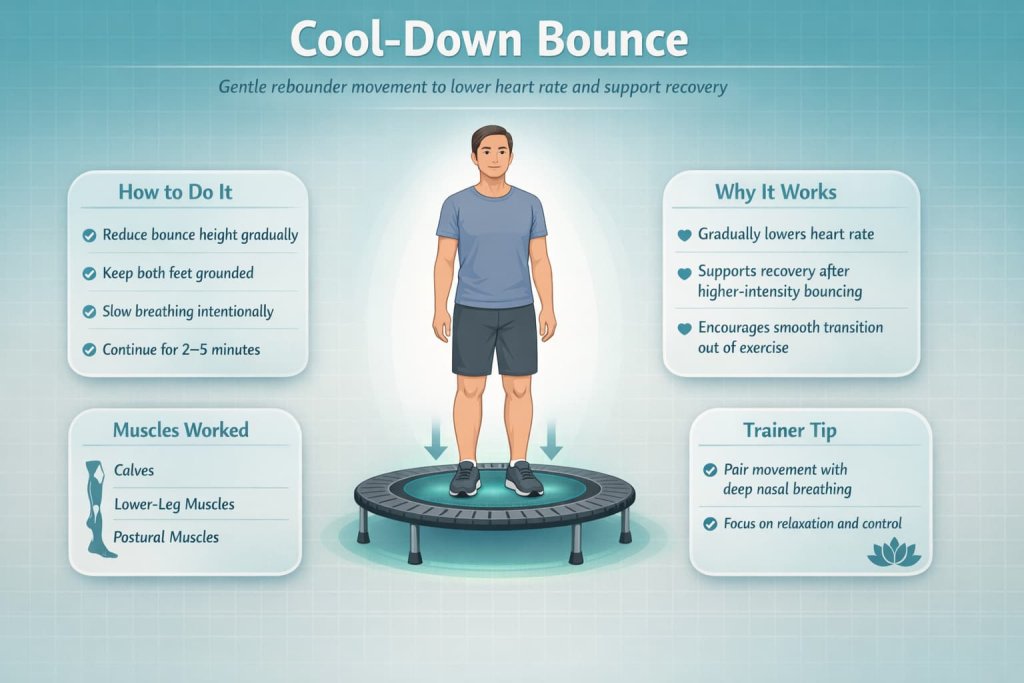
How to do it:
- Reduce bounce height gradually
- Keep both feet grounded
- Slow breathing intentionally
- Continue for 2–5 minutes
Why it works:
Cooling down allows heart rate to decrease gradually and supports recovery after higher-intensity bouncing.
Muscles worked:
Calves, lower legs, postural muscles.
Trainer Tip:
Pair this with deep nasal breathing to enhance recovery.
How to Use Rebounder Exercises for Fat Loss
For most adults, rebounder workouts work best when programmed consistently and progressively.
General guidance includes:
- 20–30 minutes per session
- 3–5 sessions per week
- Moderate intensity where you can talk but not sing
Pairing rebounder cardio with strength training on other days aligns with CDC physical activity recommendations and supports sustainable fat loss.
Can Rebounder Exercises Burn Fat Without Joint Stress?
Rebounder exercises can help support fat loss by allowing you to reach moderate-to-vigorous cardio intensity with less joint impact than floor-based jumping. Fat loss depends on overall calorie balance, so rebounder workouts work best when done consistently and paired with proper nutrition.
Key points:
- Helps increase calorie burn through steady cardio
- Lower peak joint stress due to the elastic mat
- Supports longer or more frequent workouts
Low impact does not mean stress-free—proper technique and controlled bounce height are essential.
Why Rebounder Exercises Are Considered Low-Impact
Rebounders are considered low-impact because the mat absorbs and redistributes landing forces, reducing abrupt stress on joints compared to hard surfaces.
Key reasons:
- Softer landings for knees, hips, and ankles
- Reduced ground-reaction forces
- Smoother movement patterns
Joint comfort still depends on posture, balance, and movement control.
Common Mistakes to Avoid on a Rebounder
Avoiding common errors helps keep rebounder workouts safe and effective.
Common mistakes:
- Bouncing too high or out of control
- Locking the knees during landing
- Leaning forward or rounding the back
- Progressing intensity too quickly
- Ignoring balance limitations
Small, controlled movements with good posture support a joint-friendly rebounder routine.
Safety Guidelines Before Doing Rebounder Exercises
Although rebounder workouts are often described as low impact, they are not risk-free.
Key safety tips:
- Use a stable rebounder on a non-slip surface
- Maintain upright posture with eyes forward
- Keep bounces controlled rather than excessively high
- Hold a support bar or nearby wall if balance is limited
Cleveland Clinic notes that balance challenges can be beneficial but advises extra caution for beginners and older adults.
Who Should Be Cautious
Rebounder exercises may not be appropriate for everyone. Extra care or professional guidance is recommended for people with:
- Significant balance disorders
- Recent fractures or spinal conditions
- Severe joint pain that worsens with bouncing
If pain increases or feels sharp, stop the exercise and seek medical advice.
Frequently Asked Questions
Are rebounder exercises really low impact?
They are generally lower impact than floor jumping because the mat absorbs force, but they still place stress on joints and require proper control.
Can rebounder exercises help with weight loss?
They can support weight loss by increasing calorie burn when combined with consistent activity and appropriate nutrition.
How long should a rebounder workout be?
Most sessions last 20–30 minutes, depending on fitness level and intensity.
Are rebounder exercises good for beginners?
Yes, especially when starting with basic and health bounces and focusing on balance.
Can older adults use a rebounder?
Some studies suggest balance and mobility benefits, but older adults should start slowly and use support as needed.
Is rebounding better than walking?
Neither is universally better. Rebounding may feel easier on joints for some people, while walking may feel safer for others.
Conclusion
Rebounder exercises offer a practical, joint-friendly way to add cardio to your routine. When done with proper technique and consistency, they can help you burn calories, improve balance, and stay active without excessive joint stress. Start gradually, focus on control, and use rebounder workouts as part of a balanced weekly fitness plan.
References
- CDC Physical Activity Guidelines for Adults (150 minutes + strength days)
- Physical Activity Guidelines for Americans, 2nd Edition (Official PDF)
- ACE-Sponsored Research: Putting Mini-Trampolines to the Test
- ACE Press Release: Mini-Trampoline Workouts Effective Yet Perceived as Easier
- Are Trampoline Workouts Safe With Arthritis? (Joint-Friendly Context)
- Cleveland Clinic: Trampoline Workout Benefits and Safety Notes
- Mini-Trampoline Training Improves Balance and Function in Older Women (Full Study)
- Mini-Trampoline Exercise and Vertebral Compression Fracture (Case Series)