
Yes — resistance band arm exercises can effectively build strength, tone, and definition in the arms. Bands create controlled tension that challenges the biceps, triceps, shoulders, and forearms through a full range of motion. This makes them ideal for home workouts, travel, beginners, and anyone needing joint-friendly training.
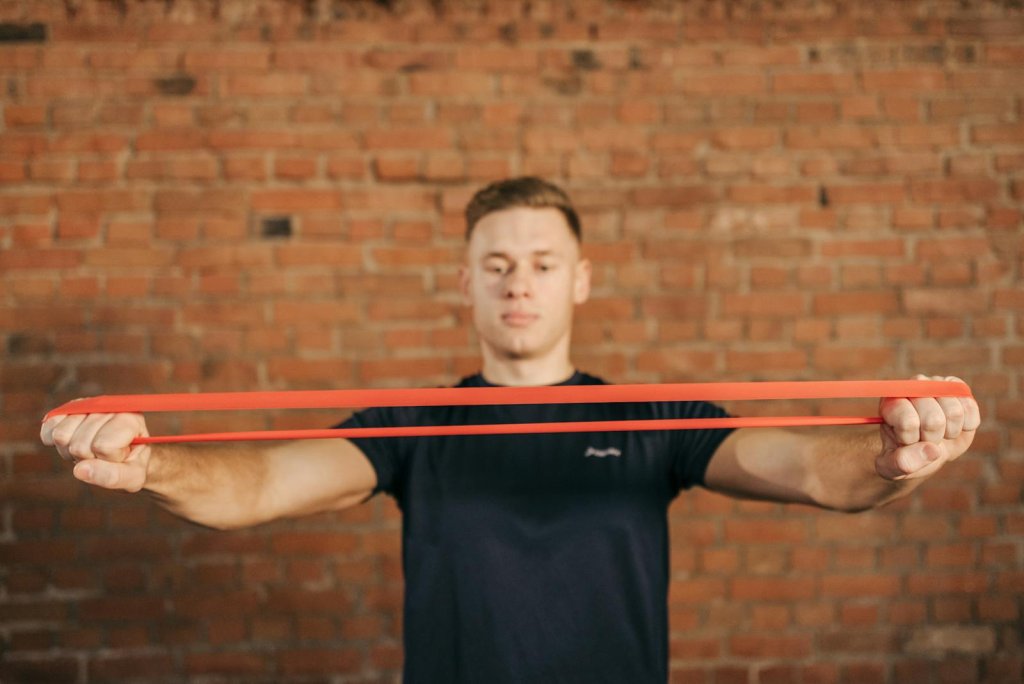
Understanding how resistance band arm exercises work is important because it helps you train safely, choose the right band, and target the correct muscles. Below, you’ll learn how to use bands properly, the benefits of band-based arm training, and the 14 best exercises to build stronger arms anywhere with minimal equipment.
14 Best Resistance Band Arm Exercises
A classic curl that builds overall biceps strength using smooth, controlled tension. Perfect for beginners and ideal for home or travel workouts.
Biceps Exercises
1. Standing Biceps Curl
Why it works:
This curl creates steady resistance through the full range of motion, helping you build stronger and more defined biceps without needing dumbbells. The band increases tension at the top of the movement, improving peak contraction.
Muscles worked:
Biceps brachii, brachialis, forearm flexors.
How to do it:
- Stand with feet shoulder-width apart on the center of the band.
- Hold the handles with palms facing forward.
- Keep elbows glued to your sides.
- Curl the handles toward your shoulders while keeping wrists straight.
- Lower slowly to maintain constant tension.
Trainer Tip:
Avoid swinging your torso—slow, controlled reps give better muscle activation.
2. Hammer Curl
Why it works:
The neutral-grip position shifts more tension to the brachialis and forearms, helping create a fuller, more balanced upper arm.
Muscles worked:
Brachialis, biceps brachii, brachioradialis (forearms).
How to do it:
- Stand on the band and hold the handles with thumbs pointing upward.
- Keep elbows close to your torso.
- Curl the handles upward without twisting your wrists.
- Pause briefly at the top before lowering under control.
Trainer Tip:
Drive your elbows slightly forward at the top to intensify the contraction.
3. Wide-Grip Biceps Curl
Why it works:
A wider hand placement forces the outer portion of the biceps to work harder and increases the stretch at the bottom of the curl.
Muscles worked:
Biceps brachii (especially short head), brachialis.
How to do it:
- Stand with a wider stance on the band.
- Grip the handles wider than shoulder-width.
- Keep elbows tight to your sides.
- Curl upward smoothly, focusing on squeezing the biceps.
- Lower with a slow 2–3 second descent.
Trainer Tip:
Keep your shoulders pulled down and back to avoid shrugging.
4. Reverse Curl
Why it works:
Using an overhand grip shifts emphasis to the forearm extensors and upper arms, improving grip strength and balanced forearm development.
Muscles worked:
Forearm extensors, brachioradialis, biceps brachii.
How to do it:
- Stand on the band and hold the handles with palms facing down.
- Keep elbows tucked and wrists neutral.
- Curl the handles upward until forearms reach about 90 degrees.
- Lower slowly to full extension.
Trainer Tip:
If your wrists bend backward, reduce resistance or start with a lighter band.
Triceps Exercises
5. Overhead Triceps Extension
Why it works:
This movement lengthens the triceps under tension and targets the long head, which contributes most to upper-arm size.
Muscles worked:
Triceps brachii (long head emphasized), shoulders (stabilizers).
How to do it:
- Anchor the band overhead or hold it behind your back.
- Bend your elbows so your hands are behind your head.
- Extend your arms upward until fully straightened.
- Lower slowly while keeping elbows pointed forward.
Trainer Tip:
Keep your ribs down—don’t flare your chest when pressing upward.
6. Triceps Press-Down
Why it works:
Press-downs isolate the triceps by allowing you to move only at the elbow joint, making it an excellent strength-builder.
Muscles worked:
Triceps brachii (all heads).
How to do it:
- Anchor the band at the top of a door or overhead point.
- Hold the handles with elbows locked to your sides.
- Press downward until arms are fully straight.
- Return slowly with elbows fixed in place.
Trainer Tip:
Imagine “pinning” your elbows to your ribcage to prevent shoulder involvement.
7. Triceps Kickback
Why it works:
Kickbacks place the triceps in a fully shortened position at the top, helping improve definition and lockout strength.
Muscles worked:
Triceps brachii (especially lateral head), rear delts (as stabilizers).
How to do it:
- Hinge slightly at the hips while holding the handles.
- Keep elbows raised behind you.
- Extend your arms straight back until fully locked.
- Return slowly without letting elbows drop.
Trainer Tip:
Pause at full extension for 1–2 seconds to maximize activation.
8. Close-Grip Band Press
Why it works:
This pressing motion targets the triceps while also engaging the chest and shoulders for balanced upper-body strength.
Muscles worked:
Triceps brachii, chest, anterior deltoids.
How to do it:
- Anchor the band behind you at chest height.
- Hold the handles close together in front of your chest.
- Press forward while keeping elbows tucked.
- Return with control until hands reach your chest again.
Trainer Tip:
Think of “pushing through the triceps” rather than the chest.
9. Single-Arm Cross-Body Triceps Extension
Why it works:
The diagonal resistance angle helps isolate each tricep individually, improving symmetry between arms.
Muscles worked:
Triceps brachii (all heads), shoulder stabilizers.
How to do it:
- Anchor the band at shoulder height.
- Hold the handle with the opposite hand.
- Pull the band diagonally downward across your body.
- Extend fully at the bottom, then return under control.
Trainer Tip:
Move only at the elbow—keep your upper arm still to maximize isolation.
Shoulder & Upper Arm Exercises
10. Band Pull-Apart
Why it works:
This exercise strengthens the rear shoulders and upper back, essential for posture, shoulder stability, and balanced arm development.
Muscles worked:
Rear deltoids, rhomboids, mid-traps, rotator cuff muscles.
How to do it:
- Hold a loop band at chest height with arms extended.
- Pull the band apart until it reaches your chest.
- Squeeze your shoulder blades at the end range.
- Return slowly to the starting point.
Trainer Tip:
Keep your shoulders down—avoid shrugging as you pull apart.
11. Lateral Raise
Why it works:
Lateral raises target the side delts, helping build width and shape in the upper arms and shoulders.
Muscles worked:
Lateral deltoids, upper traps (stabilizers).
How to do it:
- Stand on the band and hold the handles at your sides.
- Raise your arms outward to shoulder height.
- Lower slowly without letting the band yank your arms down.
Trainer Tip:
Lead with your elbows—not your hands—for better shoulder alignment.
12. Front Raise
Why it works:
This movement isolates the front deltoids, improving shoulder strength and supporting pressing movements.
Muscles worked:
Anterior deltoids, upper chest (minor involvement).
How to do it:
- Stand on the band and grip the handles in front of your thighs.
- Lift your arms straight forward to shoulder height.
- Lower with control.
Trainer Tip:
Keep a slight bend in your elbows to protect your shoulder joints.
13. Upright Row
Why it works:
Upright rows build upper-arm and shoulder strength by working both deltoids and traps, improving pulling mechanics.
Muscles worked:
Deltoids, upper traps, biceps (secondary).
How to do it:
- Stand on the band, hands close together.
- Pull upward, keeping the handles close to your torso.
- Stop when elbows are slightly above shoulder height.
- Lower under control.
Trainer Tip:
Keep elbows higher than your hands to maintain proper form and shoulder safety.
14. External Rotation (Shoulder Health)
Why it works:
Strengthens the rotator cuff, improves shoulder stability, and helps prevent injuries—especially important for anyone doing upper-body training.
Muscles worked:
Rotator cuff (infraspinatus, teres minor), rear deltoid.
How to do it:
- Anchor the band at elbow height.
- Keep elbow tucked to your side at 90 degrees.
- Rotate your forearm outward while keeping elbow pinned.
- Return with control.
Trainer Tip:
Use a light band—this is a stability exercise, not a power move.
Sample Resistance Band Arm Workout
Use this routine 2–3 times per week:
Warm-Up (1–2 minutes)
- Light band curls
- Shoulder circles
- Band pull-aparts
Workout
- Biceps Curl — 12 reps
- Triceps Press-Down — 12 reps
- Lateral Raise — 10–12 reps
- Hammer Curl — 12 reps
- Triceps Kickback — 10–12 reps
- Pull-Apart — 12–15 reps
Sets: 2–3
Rest: 45–60 seconds between exercises
How Often Should You Do Resistance Band Arm Workouts?
Most people see good results training their arms 2–3 times per week, allowing at least one rest day between arm-focused sessions. This schedule gives your muscles enough time to recover and grow stronger while maintaining consistent training frequency.
General guidelines:
- Beginners: 2 sessions per week
- Intermediate: 2–3 sessions per week
- Older adults: 2 sessions per week with light-to-moderate resistance
- Fat loss or toning goals: full-body routines + 1–2 arm-focused add-ons
You can increase resistance, reps, or sets once the exercises feel easier, but always progress gradually and maintain proper form.
Common Mistakes to Avoid
- Using a band that’s too heavy — form breaks quickly
- Leaning backward during curls — keeps tension off the biceps
- Flaring elbows during triceps work
- Snapping the band instead of controlling the eccentric
- Letting shoulders shrug or roll forward
Trainer Tips for Better Arm Gains
- Use slow, controlled reps for maximum tension
- Move through the full range of motion
- Keep your wrists neutral to prevent strain
- Hold the peak contraction for 1 second
- Increase band resistance every 2–3 weeks if reps become easy
Are Resistance Bands Effective for Building Arm Strength?
Yes—resistance bands can effectively build arm strength when used consistently and with proper technique. Bands generate variable resistance, meaning they become harder as they stretch, which increases muscle activation and supports solid strength gains. For most people, bands provide more than enough tension to build stronger, more defined arms without the need for dumbbells or machines.
Why they’re effective:
- Create increasing tension as the band stretches, maximizing muscle engagement
- Enhance control, stability, and technique through slower, smoother movement
- Allow progressive overload by switching to thicker bands or increasing reps
- Strengthen supporting muscles and stabilizers often underworked by free weights
- Provide safer resistance for shoulders, elbows, and wrists
- Effective for beginners, intermediates, and older adults when properly programmed
How to Do Resistance Band Arm Exercises Safely
Using proper form is essential for injury prevention, especially in the shoulders, elbows, and wrists.
Follow these safety guidelines:
- Start with a light or medium band until your form is consistent.
- Move slowly—control both the lifting and lowering phases.
- Keep wrists neutral; avoid bending or twisting them during curls or presses.
- Maintain good posture: shoulders down, chest tall, core engaged.
- Never let the band snap back; guide it through every rep.
- Check the band before each workout for signs of damage.
- Anchor the band securely to prevent slipping or recoil.
If you feel sharp pain, numbness, or sudden discomfort, stop the exercise and reassess your technique.
Who Should Avoid or Modify These Exercises?
Resistance band arm exercises are safe for most people, but some individuals may need modifications or medical clearance.
Consider modifying or avoiding certain exercises if you:
- Have recent shoulder, elbow, or wrist injuries
- Experience pain during overhead movements
- Have uncontrolled high blood pressure or heart conditions
- Are recovering from surgery and haven’t been cleared to lift
- Have limited shoulder mobility or stability issues
- Are new to exercise and need extra support or slower progressions
If you have underlying medical concerns, consult a qualified healthcare provider before beginning or intensifying your routine.
Frequently Asked Questions (FAQ)
1. Can resistance bands build muscle in the arms?
Yes. When used consistently with proper tension, resistance bands can build strength and muscle comparable to traditional weights.
2. How often should I do resistance band arm exercises?
Most people see results with 2–3 arm workouts per week with rest days between sessions.
3. Are resistance band arm exercises good for beginners?
Yes. Bands provide smooth, joint-friendly resistance and are easier to learn than free weights.
4. Can I tone my arms using only resistance bands?
Absolutely. With consistent tension and structured programming, resistance bands can tone and strengthen the entire upper arm.
5. Are resistance bands safe for seniors?
Yes, when used with proper form and light resistance. Seniors should start slowly and increase tension gradually.
6. How long does it take to see results?
Most people notice improved muscle tone and strength within 3–6 weeks of consistent training.
Conclusion
Resistance band arm exercises are one of the simplest and most effective ways to build strong, toned arms at home or on the go. With the 14 exercises listed above, you can create a balanced, joint-friendly workout targeting every major upper-arm muscle. Start with lighter resistance, focus on slow and controlled movement, and progress steadily.