
Sciatic nerve exercises may help ease tension, support mobility, and improve tolerance to movement, but the right routine depends on what is irritating the nerve and how your body responds. That is why it is smart to focus on gentle, controlled exercises first instead of forcing deep stretches or pushing through pain.

Current guidance from the NHS, Mayo Clinic, and Harvard Health consistently supports staying active as tolerated rather than staying inactive for long periods.
Sciatica is a symptom pattern, not one single diagnosis. The NHS separates exercise advice for sciatica linked to piriformis syndrome, herniated disc, spinal stenosis, and degenerative disc disease, which is a helpful reminder that one exercise plan does not fit everyone.
What Are Sciatic Nerve Exercises?
Sciatic nerve exercises are gentle movements that may help reduce tension, support mobility, and make everyday movement feel easier when the sciatic nerve is irritated. They are not one single fixed routine. The NHS notes that exercise advice can vary depending on the cause of symptoms.
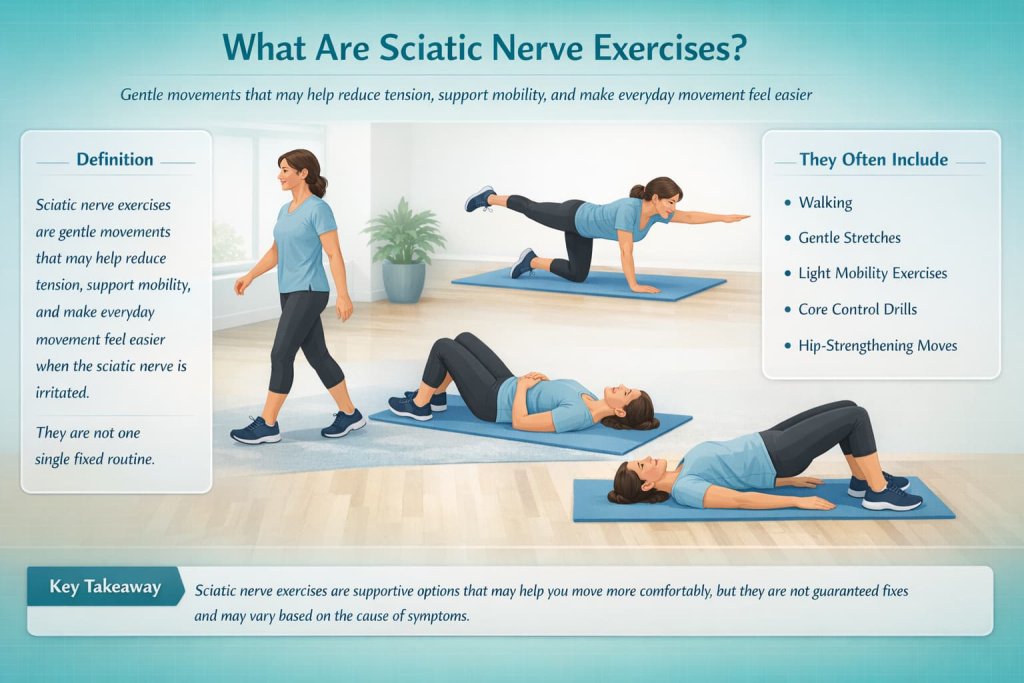
They often include:
- Walking
- Gentle stretches
- Light mobility exercises
- Core control drills
- Hip-strengthening moves
These exercises are best seen as supportive options, not guaranteed fixes.
Why sciatic nerve exercises may help
Gentle movement is commonly recommended because inactivity can make symptoms worse, while controlled stretching and strengthening may improve flexibility, reduce muscle tension, and help support the lower back and hips. Mayo Clinic notes that staying inactive tends to worsen symptoms, and Harvard Health highlights that movement and gentle stretches may improve range of motion and support the tissues around the irritated nerve.
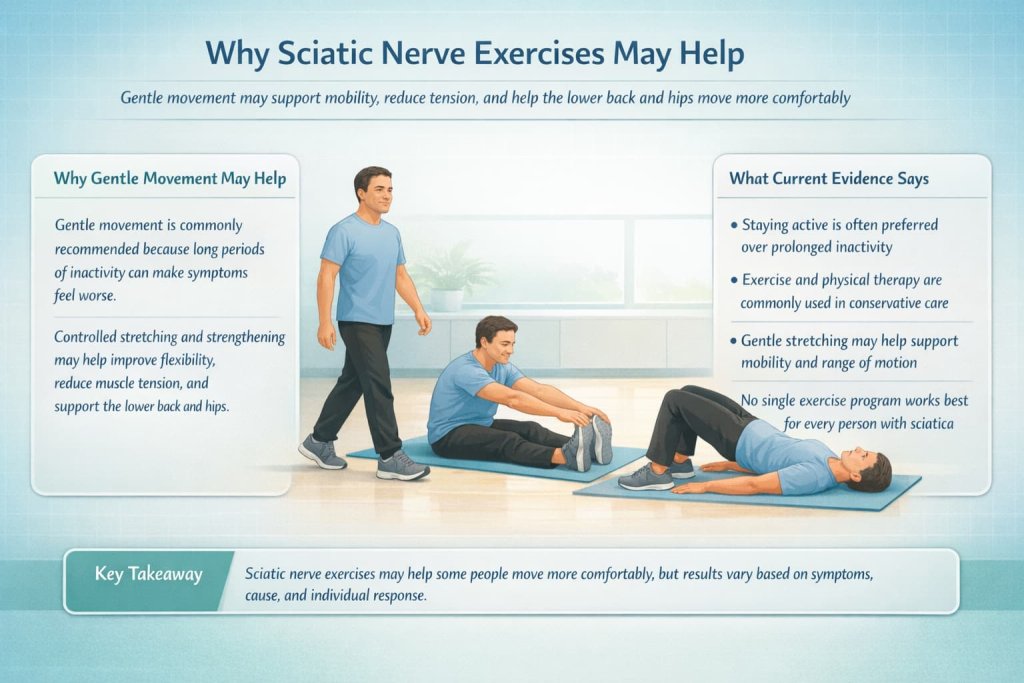
Recent evidence also shows why it is better to be careful about big promises. A 2025 network meta-analysis published in JOSPT reviewed nonsurgical treatments for acute and subacute sciatica, and a 2025 clinical guideline in Neurospine supports exercise and physical therapy as part of conservative care. At the same time, no single exercise program has been proven to be the universal best option for every person with sciatica.
Before you start sciatic nerve exercises
Use these quick rules first:
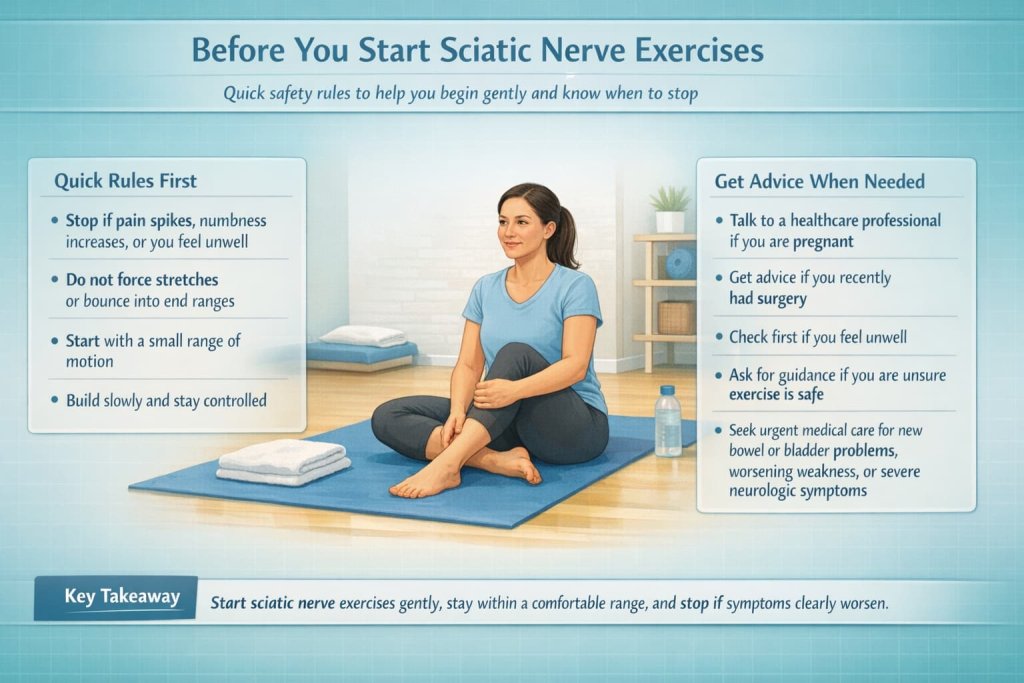
- Stop right away if an exercise causes pain to spike, increases numbness, or makes you feel unwell.
- Avoid forcing stretches or bouncing into end ranges.
- Start with a small range of motion and build slowly.
- Get medical advice before starting if you are pregnant, recently had surgery, feel unwell, or are unsure whether exercise is safe for you.
- Seek urgent medical care for new bowel or bladder problems, rapidly worsening weakness, or severe progressive neurologic symptoms.
10 best sciatic nerve exercises
These exercises are commonly used in gentle home programs and rehab-based progression. They are best viewed as supportive options, not guaranteed fixes.
1. Walking
How to do it
- Start with a short, easy walk on level ground.
- Keep your steps small and relaxed.
- Stop before symptoms build sharply.
- Add a little time only if symptoms stay manageable.
Why it works: Walking is a low-impact way to keep you moving without long periods of sitting or bed rest. Conservative rehab guidance from Mass General Brigham includes frequent short walks when tolerated, and Mayo Clinic advises against prolonged inactivity.
Muscles worked: Glutes, calves, hip stabilizers, core, and leg muscles in a light endurance pattern.
Trainer Tip: Think “easy and steady,” not “push through it.”
2. Pelvic tilt
How to do it
- Lie on your back with knees bent and feet flat.
- Gently tighten your stomach muscles.
- Flatten your low back slightly toward the floor.
- Hold briefly, then relax.
- Repeat with smooth breathing.
Why it works: This is a beginner-friendly way to practice trunk control and reduce excess movement in the lower back. Rehab guidelines for lumbar disc problems often include early low-load core control and neutral-spine work.
Muscles worked: Deep core, abdominals, and pelvic stabilizers.
Trainer Tip: Keep the motion small. This is a control exercise, not a max-effort ab move.
3. Knee-to-chest stretch
How to do it
- Lie on your back with both knees bent.
- Bring one knee gently toward your chest.
- Hold the position without pulling aggressively.
- Lower it slowly and switch sides.
Why it works: This may help some people feel less stiffness through the low back and hip area. Gentle stretching is commonly recommended for sciatica, but the best direction of movement depends on the person and the cause.
Muscles worked: Hip flexors lightly, with a stretch emphasis on the glutes and low-back area.
Trainer Tip: If pulling the knee in makes leg symptoms worse, skip it and use a different option.
4. Sciatic nerve glide
How to do it
- Sit tall near the edge of a chair.
- Straighten one knee slowly as you lift your chest.
- Add a gentle ankle flex only if comfortable.
- Return to the start position.
- Use smooth, light motion rather than a hard stretch.
Why it works: A nerve glide is meant to encourage gentle nerve movement, not aggressive nerve stretching. This is often used in rehab settings, but it should feel mild and controlled. Evidence for nerve mobilization is still developing, so it is best used conservatively.
Muscles worked: Minimal strengthening demand; mainly a mobility and symptom-modulation drill.
Trainer Tip: The goal is “glide,” not “strain.” Back off immediately if tingling or pain ramps up.
5. Piriformis stretch
How to do it
- Lie on your back with knees bent.
- Cross one ankle over the opposite knee.
- Gently draw the uncrossed leg toward you.
- Hold where you feel a mild stretch in the buttock.
- Switch sides.
Why it works: The piriformis region is commonly addressed in sciatica programs, especially when buttock tightness seems to contribute to symptoms. The NHS has a separate exercise video section for piriformis-related sciatica, and Mass General Brigham includes piriformis stretching in conservative rehab progression.
Muscles worked: Piriformis and deep hip rotators, with some glute stretch.
Trainer Tip: Keep the stretch mild. A strong nerve-like pull down the leg is a sign to ease off.
6. Hamstring stretch
How to do it
- Lie on your back and raise one leg gently.
- Hold behind the thigh or use a strap.
- Keep a soft bend in the knee if needed.
- Stop at a light stretch, then lower with control.
- Repeat on the other side.
Why it works: Tight hamstrings can add tension around the pelvis and posterior chain. Harvard Health includes stretches for the hips, lower back, and legs as part of gentle sciatica mobility work.
Muscles worked: Hamstrings, with a stretch emphasis rather than a strength effect.
Trainer Tip: Do not yank the leg upward. Gentle is better here.
7. Cat-cow
How to do it
- Start on hands and knees.
- Round your back gently.
- Then slowly lift your chest and tailbone into a mild arch.
- Move back and forth in a comfortable range.
- Keep the motion slow and easy.
Why it works: This can improve general spinal movement tolerance and reduce the “stiff and guarded” feeling some people get during a flare. Gentle mobility work is a common part of conservative programs.
Muscles worked: Spinal stabilizers, shoulders, and core in a low-load mobility pattern.
Trainer Tip: Stay in a pain-free range. Bigger is not better.
8. Bird dog
How to do it
- Start on hands and knees.
- Brace your trunk lightly.
- Reach one arm forward and the opposite leg back.
- Pause briefly without twisting.
- Return and switch sides.
Why it works: Bird dog builds trunk control and hip stability without heavy loading. Mass General Brigham includes modified bird-dog style progressions in conservative lumbar disc rehab.
Muscles worked: Core, glutes, lower back stabilizers, shoulders, and hips.
Trainer Tip: Balance a cup of water on your low back in your mind. Stay steady.
9. Bridge
How to do it
- Lie on your back with knees bent and feet flat.
- Tighten your glutes and lift your hips gently.
- Pause at the top without over-arching.
- Lower back down slowly.
- Repeat with control.
Why it works: Bridges can help strengthen the hips and posterior chain, which may improve support around the pelvis and low back. Strengthening the surrounding muscles is commonly recommended as part of a gradual return to better movement.
Muscles worked: Glutes, hamstrings, and core.
Trainer Tip: Keep your ribs down and avoid pushing into a painful back extension.
10. Prone press-up
How to do it
- Lie on your stomach with your hands under your shoulders.
- Gently press your chest upward while hips stay down.
- Move only as far as feels comfortable.
- Lower slowly and repeat.
Why it works: Extension-based movement helps some people, especially when sitting and bending forward clearly aggravate symptoms. But it is not right for everyone, which is why cause-specific guidance matters.
Muscles worked: Triceps, shoulders, spinal extensors, and trunk stabilizers lightly.
Trainer Tip: This is one of the most individual exercises on the list. If leg symptoms travel farther down the leg, stop.
Sample beginner routine for sciatic nerve exercises
A simple starting plan could look like this:
- 5 to 10 minutes of easy walking
- 1 to 2 mobility or stretch exercises that feel comfortable
- 1 to 2 light core or hip-strengthening moves
- 1 to 2 sets of 5 to 10 reps, or short holds as tolerated
That kind of gradual approach matches conservative rehab principles that emphasize symptom control, neutral-spine movement, mobility, and low-load strengthening before more demanding activity.
Which sciatic nerve exercises should you avoid?
The main exercises to avoid are the ones that clearly make your symptoms worse. That may include:
- Deep forward bending if it sharply increases leg pain
- Aggressive hamstring stretching
- Twisting under load
- Heavy lifting during a flare
- Any move that increases numbness, weakness, or shooting pain
The NHS says to stop immediately if exercise causes pain or makes you unwell, and conservative rehab guidance also recommends avoiding positions that worsen symptoms.
When to see a healthcare professional
See a clinician if:
- Pain is severe or not improving
- Symptoms keep returning
- You notice increasing weakness
- Numbness is worsening
- Walking becomes harder
- Home exercise keeps aggravating symptoms
This matters because sciatica can come from different problems, including disc-related radiculopathy, piriformis-related irritation, or spinal stenosis, and the best exercise direction may change depending on the cause.
FAQs
What are the best sciatic nerve exercises at home?
Walking, pelvic tilts, gentle knee-to-chest work, piriformis stretching, bird dog, and bridges are common starting options. The best choice depends on which movements feel better or worse for your symptoms.
Should I rest or exercise with sciatica?
Brief rest may help during a flare, but long periods of inactivity usually are not recommended. Mayo Clinic and Harvard Health both note that inactivity can make symptoms worse.
Is walking good for sciatica?
Often, yes. Short, easy walks are commonly used because they keep you moving without heavy loading. Still, if walking sharply increases symptoms, you need a different starting point.
Are nerve glides the same as stretching?
Not exactly. A nerve glide is meant to encourage gentle movement of the nerve, not a hard stretch. It should feel light and controlled.
How often should I do sciatic nerve exercises?
Many people tolerate gentle daily movement better than occasional intense sessions. Start with small amounts and adjust based on your symptoms and a clinician’s advice if needed. This is a progression-based approach, not a one-size-fits-all rule.
Can exercise cure sciatica?
No exercise can honestly be promised as a cure. Exercise may help reduce tension, improve function, and support recovery, but outcomes depend on the cause, severity, and your response to movement.
When should I stop doing sciatic nerve exercises?
Stop if pain spikes, symptoms spread farther down the leg, you feel unwell, or you notice worsening weakness or numbness. The NHS specifically advises stopping immediately if exercise causes pain or makes you unwell.
Conclusion
The best sciatic nerve exercises are usually the ones that help you move a little better without stirring symptoms up. Start gently, stay consistent, and pay attention to how your body responds. If symptoms are strong, persistent, or getting worse, get a proper medical assessment so your exercise plan matches the real cause of the problem.
This content is for informational purposes only and not medical advice.