
TRX chest exercises are bodyweight movements performed using suspension straps to build chest strength, muscle definition, and upper-body control without traditional weights. They use gravity and body angle to adjust resistance, making them suitable for beginners through advanced trainees.
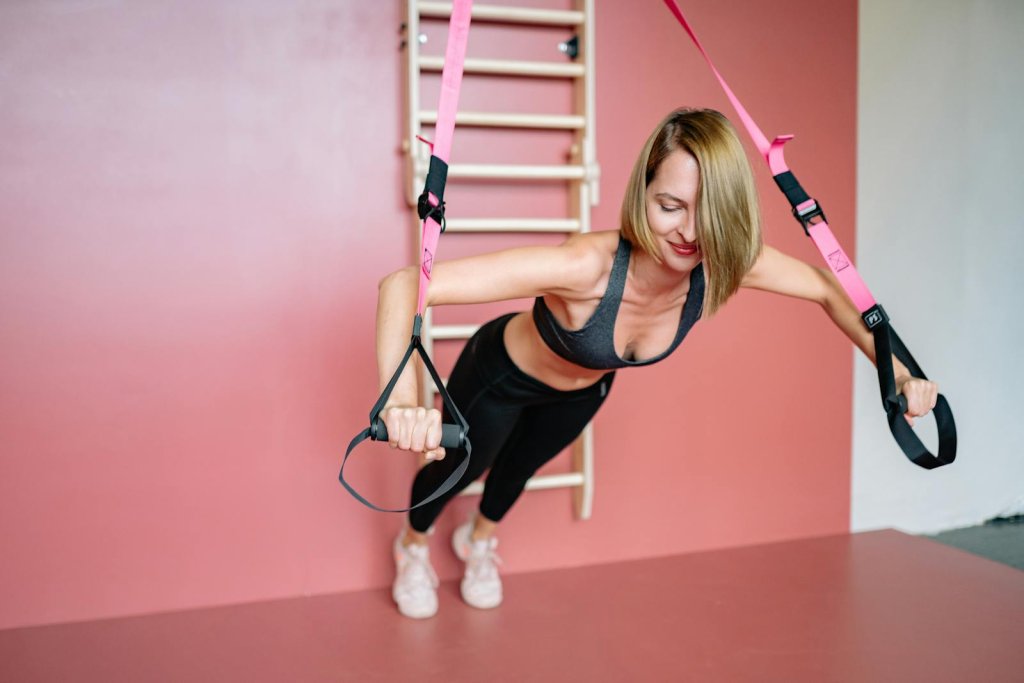
Understanding TRX chest exercises matters because they allow you to train the chest effectively anywhere, improve shoulder and core stability, and progress or regress difficulty instantly by changing body position. These exercises commonly include pressing, fly, and push-up variations that challenge the chest while engaging stabilizing muscles.
8 Best TRX Chest Exercises
These TRX chest exercises use bodyweight and suspension to challenge your chest through pressing and fly movements. They allow easy intensity adjustments while improving upper-body control and stability.
1. TRX Chest Press
How to do it
- Hold the TRX handles with palms facing down and wrists neutral
- Walk your feet back to create a forward-leaning plank position
- Keep your body in a straight line from head to heels
- Bend your elbows and lower your chest between your hands with control
- Press through your palms to return to the starting position
Why it works
The TRX chest press closely mimics a traditional push-up while allowing you to scale resistance by adjusting your body angle. The suspended handles increase stability demands, encouraging controlled chest engagement and coordinated upper-body movement.
Muscles worked
Pectoralis major, anterior deltoids, triceps brachii, core stabilizers
Trainer Tip
The more forward you lean, the harder the exercise becomes—adjust gradually to maintain proper alignment.
2. TRX Chest Fly
How to do it
- Begin in a forward-leaning plank with arms extended and handles together
- Maintain a neutral spine and tight core
- Slowly open your arms out to the sides in a wide arc
- Stop when you feel a controlled stretch across the chest
- Squeeze the chest to bring the handles back together
Why it works
This movement emphasizes horizontal arm adduction, placing a longer lever and greater tension on the chest compared to pressing exercises. It challenges control and strength through a larger range of motion.
Muscles worked
Pectoralis major, anterior deltoids, core stabilizers
Trainer Tip
If shoulder strain appears, shorten the range of motion or reduce the forward lean.
3. TRX Chest Fly to Press
How to do it
- Start in a plank position with arms extended
- Lower into a chest fly by opening the arms wide
- Bring the hands inward toward the chest
- Transition smoothly into a pressing motion to return to start
Why it works
Combining a fly and press increases total time under tension and recruits both stabilizing and pressing strength, making it an efficient chest-focused compound movement.
Muscles worked
Chest, shoulders, triceps, core
Trainer Tip
Pause briefly at the bottom of the fly to maintain control before pressing back.
4. TRX Suspended Push-Up
How to do it
- Place both feet securely into the TRX foot cradles
- Position hands on the floor under your shoulders
- Form a straight line from head to heels
- Lower your chest toward the floor with elbows bending
- Press back up while maintaining balance and control
Why it works
Suspending the feet increases instability, requiring greater chest, shoulder, and core engagement than a traditional floor push-up.
Muscles worked
Chest, shoulders, triceps, core
Trainer Tip
Focus on slow reps—speed often leads to loss of hip and spinal alignment.
5. TRX Atomic Push-Up
How to do it
- Begin in a suspended push-up position
- Perform a controlled push-up
- At the top, draw your knees toward your chest
- Extend legs back to plank and repeat
Why it works
The added knee tuck increases core involvement while maintaining chest loading, creating a combined upper-body and trunk challenge.
Muscles worked
Chest, shoulders, triceps, abdominal muscles
Trainer Tip
Master the suspended push-up first before adding the knee-tuck component.
6. TRX Plyometric Push-Up
How to do it
- Start in a stable suspended push-up position
- Lower your chest under control
- Press explosively so your hands briefly leave the floor
- Land softly and immediately stabilize before the next rep
Why it works
This advanced variation introduces speed and power, training the chest to produce force rapidly while maintaining coordination.
Muscles worked
Chest, shoulders, triceps
Trainer Tip
Keep reps low and quality high—stop when explosiveness decreases.
7. TRX Archer Chest Press
How to do it
- Set up in a chest press position
- Shift more weight to one arm while the other remains straighter
- Lower under control
- Press back up and alternate sides
Why it works
By shifting load to one side, this variation increases unilateral demand and highlights strength imbalances between sides.
Muscles worked
Chest, shoulders, triceps, core
Trainer Tip
Control rotation through the torso to keep the chest doing the work.
8. TRX Single-Arm Chest Press
How to do it
- Hold one TRX handle while placing the free hand behind your back
- Lean forward into a controlled plank position
- Lower into a single-arm press
- Push back to start while resisting torso rotation
Why it works
Single-arm pressing challenges both chest strength and anti-rotation core stability, increasing overall movement control.
Muscles worked
Chest, shoulders, core stabilizers
Trainer Tip
Begin with a shallow body angle and progress only when balance remains steady.
How to Program TRX Chest Exercises
For most adults:
- Frequency: 2–3 sessions per week
- Sets: 2–4 per exercise
- Reps: 8–15 depending on difficulty
- Rest: 60–90 seconds
The American College of Sports Medicine recommends allowing at least 48 hours between intense sessions for the same muscle group.
How to Set Up TRX for Chest Exercises (Safety First)
Proper TRX setup is essential for safe and effective chest training. A stable anchor and correct body positioning help reduce unnecessary strain on the shoulders and lower back.
Follow these setup guidelines:
- Secure the TRX to a solid overhead anchor that can support body weight
- Adjust straps to equal length and remove slack before starting
- Position your body in a straight line from head to heels
- Choose a body angle that allows controlled movement without loss of form
- Keep wrists neutral and shoulders set before lowering into each rep
Always test the straps and anchor point before beginning your workout. If stability feels compromised, adjust your position or reduce the intensity.
Common Mistakes to Avoid During TRX Chest Exercises
Avoiding common technique errors helps ensure the chest muscles are effectively targeted while minimizing unnecessary joint stress.
Watch out for these mistakes:
- Letting the hips sag or pike, which reduces chest activation and strains the lower back
- Allowing straps to go slack, leading to loss of control
- Flaring elbows excessively, increasing shoulder stress
- Rushing through reps instead of using slow, controlled movement
- Leaning too far forward before adequate strength and control are developed
- Neglecting core engagement, resulting in poor body alignment
Focus on controlled tempo, proper alignment, and gradual progression to get the most benefit from TRX chest exercises.
Safety Tips for TRX Chest Training
- Anchor straps securely at an overhead point
- Keep straps under tension at all times
- Maintain neutral spine alignment
- Stop if you feel sharp shoulder or chest discomfort
The official TRX Training education resources emphasize controlled tempo and proper body positioning to reduce strain.
Beginner vs Advanced Progressions
Beginners should:
- Start with chest presses and shallow body angles
- Focus on slow, controlled reps
Advanced trainees can:
- Increase lean angle
- Use single-arm or plyometric variations
- Combine movements into circuits
Progress only when form remains stable.
Frequently Asked Questions
Are TRX chest exercises effective without weights?
Yes. Body angle and instability can provide significant resistance.
Can beginners use TRX for chest training?
Yes. Difficulty is easily adjusted by foot position.
Do TRX chest exercises build muscle size?
They may support muscle growth when performed with sufficient intensity and volume.
How often should I train chest with TRX?
Typically 2–3 times per week, depending on recovery.
Are TRX chest exercises safe for shoulders?
They are generally joint-friendly when performed with proper control and setup.
Can I replace bench press with TRX chest work?
TRX can be an effective alternative, especially for home or travel workouts.
Conclusion
TRX chest exercises offer a versatile, equipment-light way to build strength, size, and definition while improving core and shoulder stability. By progressing gradually and focusing on controlled movement, you can make suspension training a powerful part of your upper-body routine.
If you’re ready to expand your program, consider pairing TRX chest exercises with back and shoulder training for balanced upper-body development.
References
- ACE Exercise Library – TRX Chest Press
- ACE Exercise Library – TRX Suspended Push-Up
- ACSM Position Stand (PubMed) – Progression Models in Resistance Training for Healthy Adults (2009)
- CDC – Adult Physical Activity Guidelines (Muscle-Strengthening 2+ Days/Week) (
- Snarr & Esco (2013) – Electromyographic Comparison of Traditional and Suspension Push-Ups (Full Text)
- Calatayud et al. (2014) – Muscle Activation During Push-Ups With Different Suspension Systems (Full Text)