
Seated core exercises for seniors are a safe, joint-friendly way to strengthen the abdominal and back muscles without getting on the floor. They help improve posture, balance, and everyday strength while reducing strain on the spine and hips.
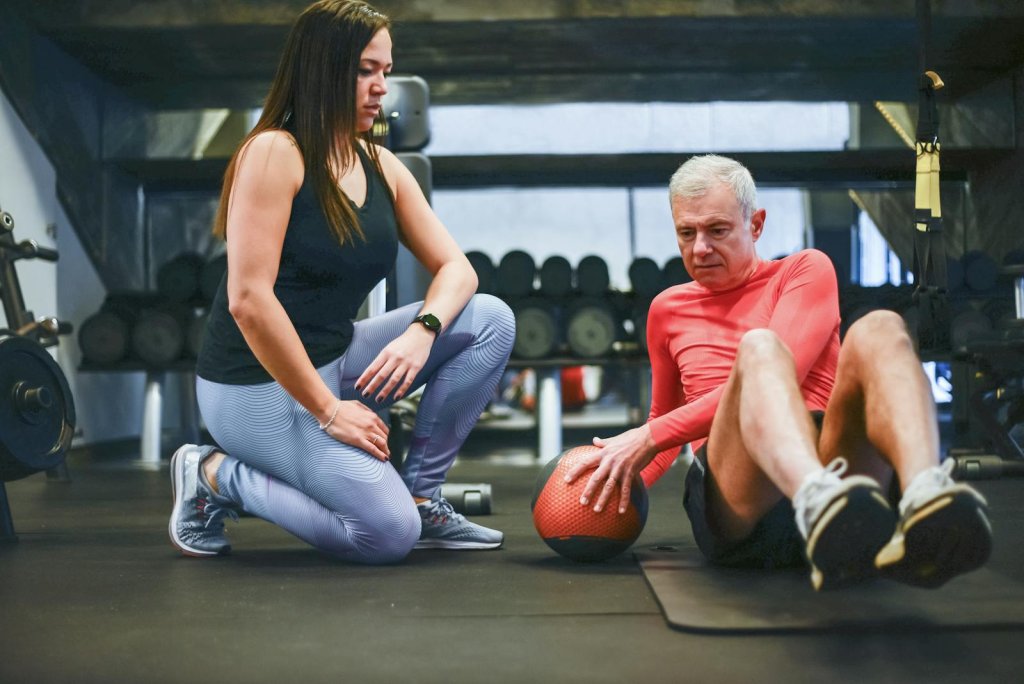
These exercises matter because the core supports nearly every movement you make—standing up, walking, reaching, and maintaining stability. Chair-based workouts are especially helpful for older adults with limited mobility, arthritis, balance concerns, or difficulty kneeling.
In this guide, you’ll learn the 10 best seated core exercises for seniors, how to perform them safely, recommended frequency, warm-up tips, and clear progressions.
Why Seated Core Exercises Matter for Seniors
Strong core muscles support safe, confident movement throughout aging. Seated exercises provide:
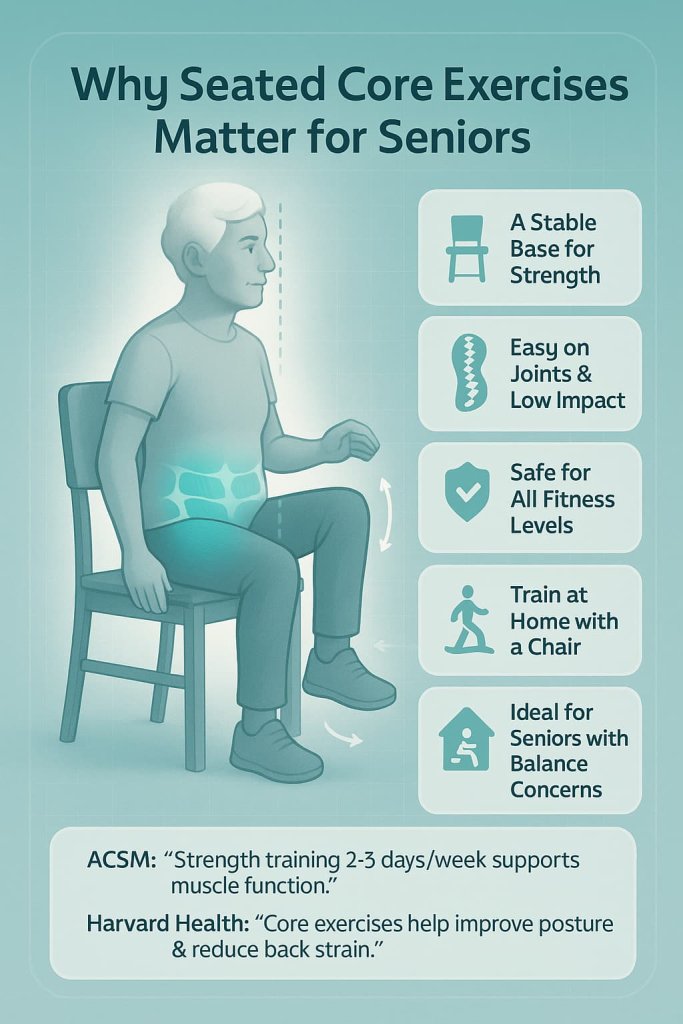
- A stable base for building strength
- Reduced pressure on knees, wrists, and lower back
- Low-impact movements suitable for all fitness levels
- The ability to exercise at home using only a chair
- A safer alternative for seniors with balance limitations
According to the ACSM, older adults should perform strength training 2–3 days per week to maintain muscle function. Harvard Health notes that core-strengthening exercises support better posture and reduce back strain, which can help improve daily mobility.
How Often Should Seniors Do Seated Core Exercises?
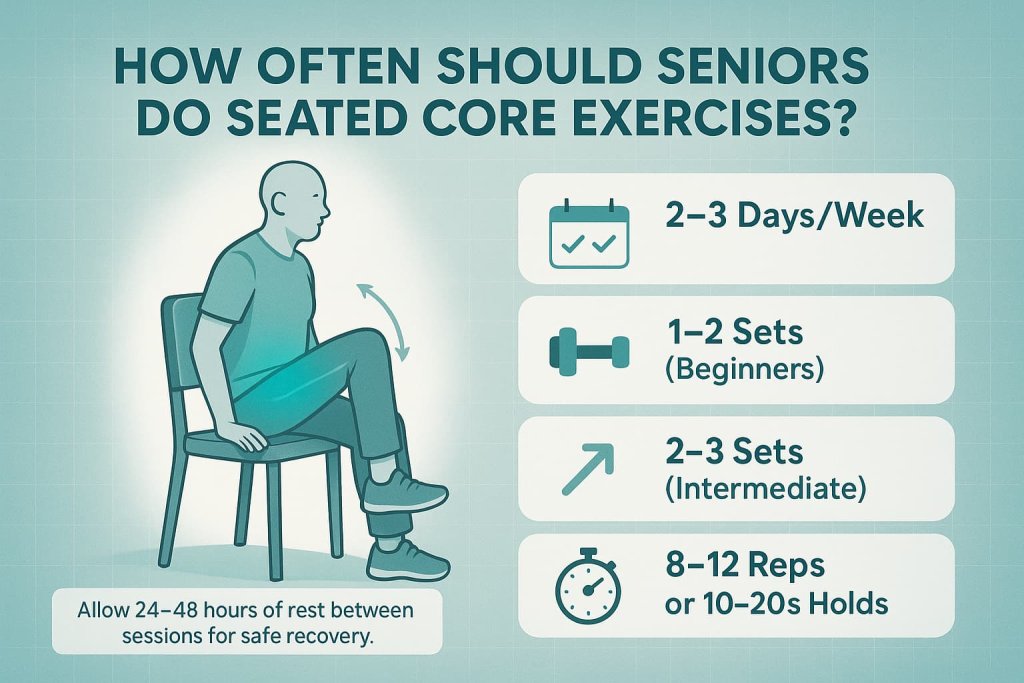
Most seniors benefit from:
- 2–3 core sessions per week
- 1–2 sets per exercise (beginners)
- 2–3 sets per exercise (intermediate)
- 8–12 reps or 10–20-second holds
Always allow 24–48 hours of rest between sessions to support recovery.
How to Warm Up Before Seated Core Workouts
A proper warm-up prepares your hips, spine, and abdominal muscles.
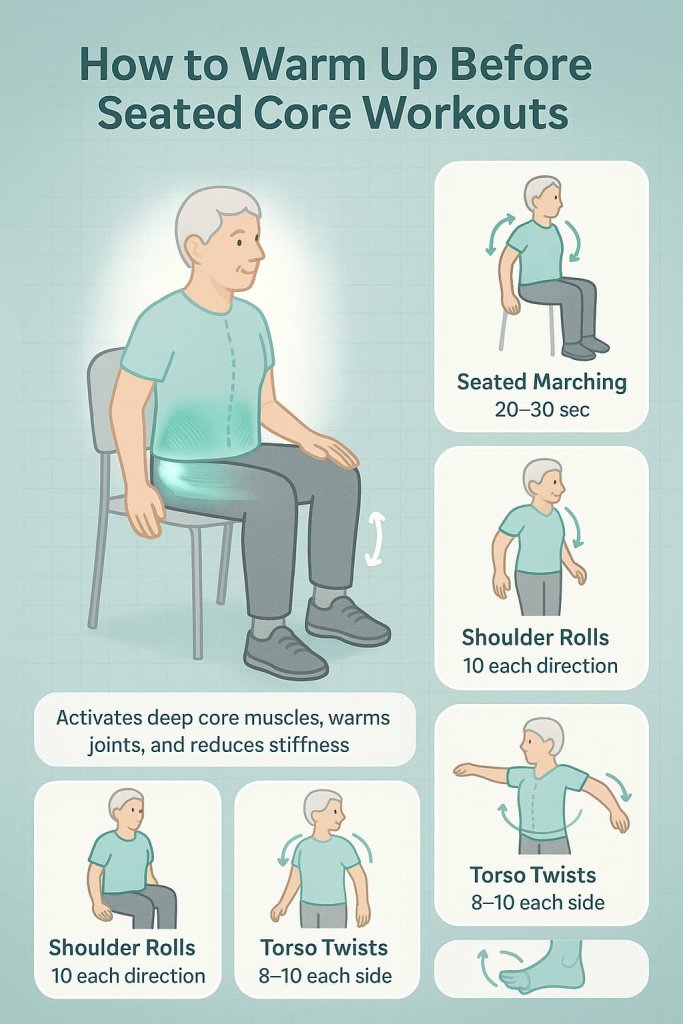
Quick 2–3 Minute Warm-Up:
- Seated marching – 20–30 seconds
- Shoulder rolls – 10 each direction
- Arm circles – 10 each direction
- Torso twists – 8–10 each side
- Ankle circles – 8–10 per side
This boosts circulation, activates the deep core, and reduces stiffness before you begin.
10 Best Seated Core Exercises for Seniors
These seated core exercises help seniors build stability, improve posture, and strengthen essential muscles without getting on the floor. Each move is gentle, joint-friendly, and safe for all fitness levels.
1. Seated Marching
Why it works:
This exercise gently activates the lower abdominals, hip flexors, and deep stabilizing muscles that support walking, balance, and upright posture. It helps seniors improve coordinated leg movement and builds confidence for daily activities like stepping, standing, and climbing stairs.
Muscles worked:
Lower abs, hip flexors, deep core stabilizers
How to do it:
- Sit tall with both feet flat on the floor.
- Lift one knee toward your chest without leaning backward.
- Lower it gently and repeat with the opposite leg.
- Continue alternating legs at a smooth, comfortable pace.
Trainer Tip: Keep your spine tall and avoid leaning back—imagine a string pulling the top of your head upward.
2. Seated Torso Twist
Why it works:
This movement strengthens the muscles responsible for rotation, helping seniors turn, reach, and maintain spinal mobility. It also supports better posture and safer everyday movements.
Muscles worked:
Obliques, spinal rotators, deep abdominal muscles
How to do it:
- Sit upright with your arms crossed over your chest.
- Slowly rotate your torso to the right.
- Return to center.
- Rotate to the left and repeat.
Trainer Tip: Move slowly and stay in control—avoid fast or jerky twisting.
3. Seated Knee-to-Elbow March
Why it works:
A cross-body motion that challenges coordination, core stability, and balance. It helps improve overall functional strength for walking, stepping, and maintaining stability.
Muscles worked:
Abs, obliques, hip flexors
How to do it:
- Sit tall and lift your right knee.
- Bring your left elbow toward the knee.
- Return to the starting position.
- Switch sides and continue alternating.
Trainer Tip: Keep movements small and controlled—focus on quality, not height.
4. Seated Side Bends
Why it works:
This exercise strengthens the lateral core muscles that help with side-to-side balance, reducing fall risk and supporting spine alignment.
Muscles worked:
Obliques, quadratus lumborum (QL), lateral core
How to do it:
- Sit with feet flat and spine tall.
- Slide your right hand toward the floor.
- Return to center.
- Repeat on the left side.
Trainer Tip: Keep both hips grounded to isolate the side body effectively.
5. Seated Lean-Backs
Why it works:
A gentle, low-impact abdominal-strengthening movement that mimics a safe chair-supported crunch. Helps seniors build the strength needed for sitting up, standing up, and maintaining posture.
Muscles worked:
Upper abs, lower abs, deep core
How to do it:
- Sit near the front edge of the chair.
- Cross your arms or place hands on your thighs.
- Lean back slightly while keeping your spine straight.
- Return to upright without rounding your back.
Trainer Tip: Think “hinge from the hips,” not “collapse the chest.”
6. Seated Forward Roll-Up
Why it works:
Improves spinal mobility and core engagement while teaching safe forward flexion. Helps release stiffness and activate the abdominal muscles gently.
Muscles worked:
Rectus abdominis, spinal flexors, deep core
How to do it:
- Sit upright with hands on your knees.
- Slowly roll your spine forward, reaching toward your toes.
- Use your core to return to the starting position.
Trainer Tip: Move gently—especially helpful for seniors with mild back stiffness.
7. Seated “V” Hold (Short Lever)
Why it works:
Builds core stability and endurance by challenging the abdominal muscles to hold tension. A safe alternative to floor-based V-sits.
Muscles worked:
Entire core—upper abs, lower abs, obliques, stabilizers
How to do it:
- Sit near the front of the chair.
- Lean back slightly, keeping your feet on the floor.
- Hold the position for 5–15 seconds.
Trainer Tip: If needed, lightly hold the chair seat for extra support.
8. Seated Pelvic Tilts
Why it works:
Strengthens the deep core and pelvic floor while improving posture and spinal mobility. Excellent for seniors with back discomfort or stiffness.
Muscles worked:
Deep core muscles, pelvic floor, spinal stabilizers
How to do it:
- Sit tall with hands on your hips.
- Gently tuck your pelvis under.
- Tilt your pelvis forward.
- Repeat slowly and rhythmically.
Trainer Tip: Keep the movement small—aim for control, not range.
9. Seated Ball or Pillow Squeeze
Why it works:
Activates the pelvic floor, inner thighs, and lower abdominals. Helps improve stability, bladder control, and core engagement without strain.
Muscles worked:
Inner thighs, pelvic floor, lower abs
How to do it:
- Place a pillow or ball between your knees.
- Sit tall and gently squeeze for 3–5 seconds.
- Release and repeat.
Trainer Tip: Breathe normally—avoid holding your breath when squeezing.
10. Wall-Supported Plank (Chair Version)
Why it works:
Provides a safe, upright alternative to traditional planks, improving whole-core strength without needing to get on the floor.
Muscles worked:
Abs, back muscles, shoulders, deep stabilizers
How to do it:
- Stand facing a wall or place your hands on a sturdy chair.
- Walk your feet back until your body forms a straight line.
- Hold for 10–20 seconds.
Trainer Tip: Gently brace your core as if preparing for a light cough—keep your spine straight, not arched.
Common Mistakes to Avoid
- Slumping or rounding the back
- Holding your breath during exercises
- Twisting too fast
- Leaning too far back without support
- Using a rolling chair (unsafe)
Use a stable, non-slip chair for all movements.
Safety Tips for Seniors
- Stop immediately if you feel dizziness, chest pain, or sharp joint pain.
- Move slowly and controlled—no sudden twisting.
- Keep feet flat and hips level unless the exercise requires lifting.
- If you have osteoporosis, avoid deep forward bending or fast twists.
- Get medical clearance if you have chronic conditions or balance concerns.
FAQ: Seated Core Exercises for Seniors
1. Are seated core exercises safe for seniors?
Yes—when done with proper posture, slow movements, and a sturdy chair. They reduce pressure on joints and minimize fall risk.
2. How long should a seated core workout take?
Most seniors benefit from 10–15 minutes, 2–3 times weekly.
3. Do I need equipment?
No. Optional items like a small ball, pillow, or light band can help with progression.
4. Can these help with balance?
Yes. A strong core supports better balance and stability, which may help reduce fall risk.
5. What if I have back pain?
Choose gentle exercises like pelvic tilts, side bends, and ball squeezes. Avoid rounding your spine. Always consult a healthcare provider first.
6. Are these good for seniors with limited mobility?
Yes—seated exercises are specifically beneficial for older adults who cannot comfortably get on the floor.
7. Can I combine this with walking or standing exercises?
Absolutely. These exercises complement walking, light strength training, and daily movement.
Conclusion
Seated core exercises for seniors offer a safe, effective way to build strength, improve posture, and support daily movement—without getting on the floor. By practicing these simple chair-based exercises 2–3 times per week, older adults can gradually improve stability, confidence, and overall functional strength.
If you’re ready to get stronger at home, start with the exercises above and progress at your own pace.
This content is for informational purposes only and not medical advice.
References
- ACSM Position Stand – Exercise and Physical Activity for Older Adults
https://pubmed.ncbi.nlm.nih.gov/19516148/ - CDC – Physical Activity Guidelines for Older Adults
https://www.cdc.gov/physical-activity-basics/guidelines/older-adults.html - National Institute on Aging – Exercise and Physical Activity
https://www.nia.nih.gov/health/exercise-and-physical-activity - The Effect of Chair-Based Exercise on Physical Function in Older Adults: Systematic Review and Meta-Analysis
https://www.mdpi.com/1660-4601/18/4/1902 - Effects of Chair-Based, Low-Load Elastic Band Resistance Training on Functional Fitness in Older Women
https://pubmed.ncbi.nlm.nih.gov/33707996/ - Strength Training to Prevent Falls in Older Adults: A Systematic Review and Meta-Analysis
https://pmc.ncbi.nlm.nih.gov/articles/PMC8304136/ - NIA – Exercise and Physical Activity: Your Everyday Guide (PDF)
https://pennmemorycenter.org/wp-content/uploads/2021/06/NIA-Exercise-Guide.pdf