
If you’re looking for the best ankle sprain exercises, here’s the short answer: gentle mobility exercises followed by progressive strengthening and balance training are the most effective and clinically recommended way to heal faster and prevent future sprains.

Understanding how to rehab an ankle sprain properly matters because untreated weakness or stiffness can lead to chronic instability, repeated injuries, and slower recovery. These exercises help restore mobility, rebuild ligament support, improve balance, and strengthen the muscles that stabilize your ankle.
In this guide, you’ll get a clear, safe, step-by-step routine based on current rehabilitation guidelines from trusted medical sources.
What Is an Ankle Sprain?
An ankle sprain occurs when the ligaments that support the ankle joint are stretched or torn, usually from twisting, rolling, or turning the foot awkwardly. The most common type is a lateral ankle sprain, which happens when the foot rolls inward and stresses the ligaments on the outside of the ankle.
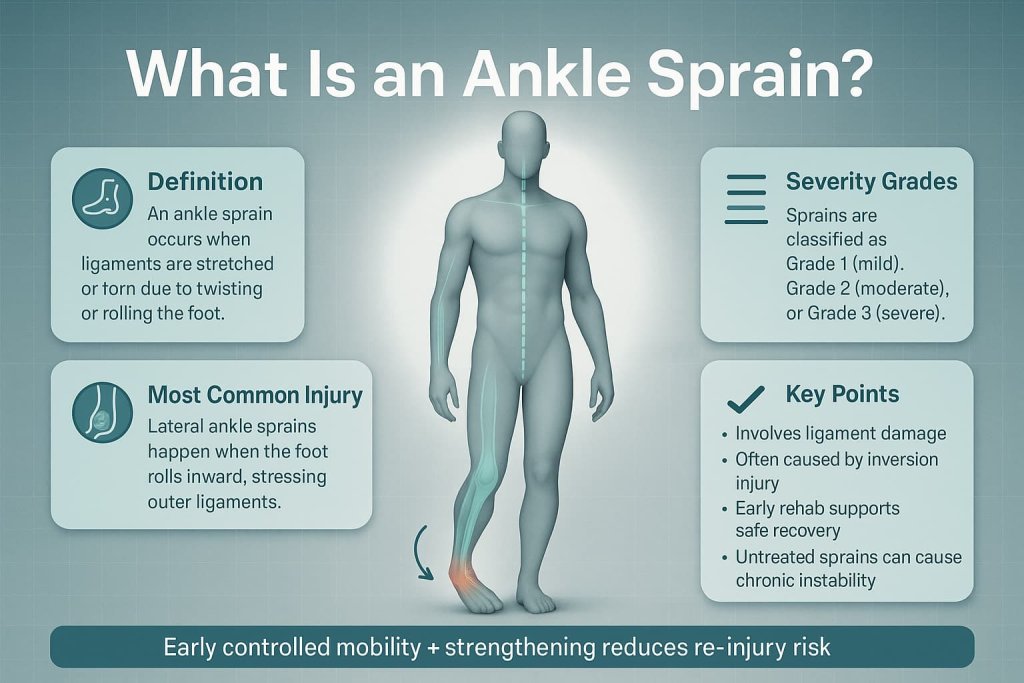
Key points to understand:
- Ankle sprains involve ligament damage, not muscles or bones.
- Most sprains occur when the ankle rolls inward (inversion injury).
- Severity is classified into Grade 1, Grade 2, and Grade 3, based on how many fibers are damaged.
- Mild to moderate sprains often heal well with proper rehabilitation.
- Without correct treatment, sprains may lead to chronic ankle instability, repeated injuries, and long-term weakness.
- Early, guided mobility and strengthening exercises are essential for safe recovery.
Symptoms of an Ankle Sprain
Recognizing the symptoms of an ankle sprain helps you determine whether home exercise is appropriate or if medical evaluation is needed. Symptoms can vary based on severity, but commonly include:
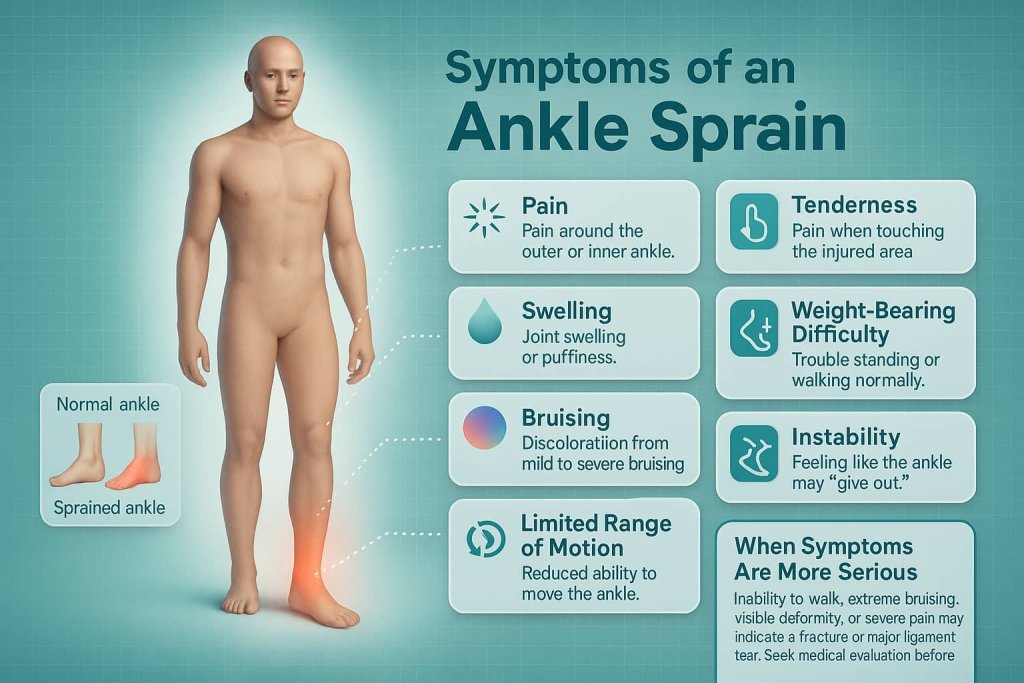
- Pain on the outer or inner side of the ankle
- Swelling or puffiness around the joint
- Bruising or discoloration
- Tenderness when touching the injured area
- Difficulty bearing weight or walking
- Instability or feeling that the ankle might “give out”
- Reduced range of motion
Severe symptoms—such as inability to walk, extreme bruising, or visible deformity—may indicate a more serious injury like a fracture or full ligament tear and should be checked by a healthcare professional before beginning any exercise routine.
What Are Ankle Sprain Exercises?
Ankle sprain exercises are structured rehabilitation movements designed to reduce swelling, restore ankle range of motion, strengthen weakened muscles, and improve balance after the ligaments have been stretched or torn.
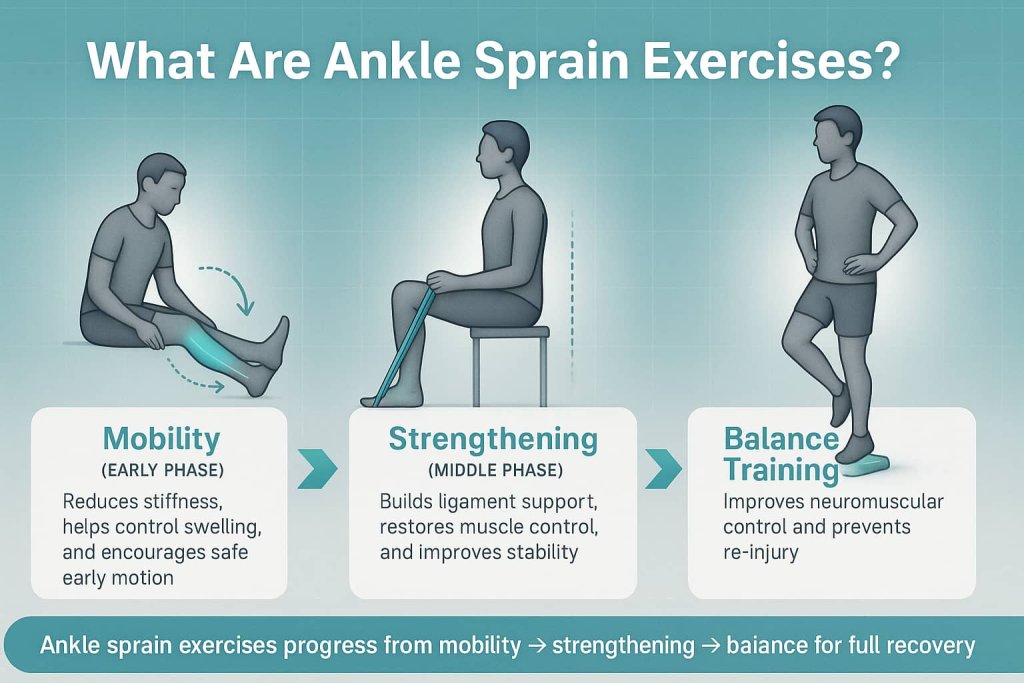
They typically progress through three stages:
- Mobility (early stage) — reduces stiffness and encourages healing.
- Strengthening (middle stage) — supports ligaments and corrects weakness.
- Balance training (late stage) — prevents re-injury by improving neuromuscular control.
10 Best Ankle Sprain Exercises (Step-by-Step Guide)
The exercises below are the most recommended for restoring ankle mobility, rebuilding strength, and improving balance after a sprain. Start with gentle movements, then progress to strengthening and stability work as your pain decreases and walking becomes easier.
1. Ankle Pumps (Mobility)
Why it works:
Increases circulation, helps move swelling out of the joint, and keeps the ankle from stiffening during early recovery.
Muscles worked:
Tibialis anterior, gastrocnemius, soleus.
How to do it:
- Sit or lie down with your injured leg extended.
- Point your toes downward (plantarflexion).
- Pull your toes back toward your shin (dorsiflexion).
- Repeat 15–20 reps, 2–3 times daily.
Trainer Tip:
Keep the motion smooth and gentle—sharp pain means you should stop and try again later.
2. Ankle Circles (Mobility)
Why it works:
Promotes fluid movement around the joint and improves mobility in all ankle directions.
Muscles worked:
Tibialis anterior, peroneals, gastrocnemius, intrinsic foot muscles.
How to do it:
- Sit or stand and lift your foot slightly off the floor.
- Draw slow circles with your foot clockwise.
- Reverse and draw circles counterclockwise.
- Perform 10–15 reps each direction.
Trainer Tip:
Aim for large, smooth circles to encourage full-range mobility—avoid fast, jerky movements.
3. Ankle Alphabet (Mobility)
Why it works:
Moves the ankle through multiple planes of motion without overloading the ligaments, easing stiffness and improving coordination.
Muscles worked:
All major ankle movers: tibialis anterior, peroneals, gastrocnemius, soleus.
How to do it:
- Sit comfortably with your leg supported.
- Lift your foot slightly off the floor.
- “Write” the letters A–Z in the air using just your foot.
Trainer Tip:
Keep movements relaxed—don’t force larger letters if the ankle feels tight.
4. Towel Stretch for Calf (Mobility)
Why it works:
Releases tight calf muscles that often restrict ankle motion after a sprain, improving gait and dorsiflexion.
Muscles worked:
Gastrocnemius, soleus.
How to do it:
- Sit with your leg extended straight in front of you.
- Loop a towel around the ball of your foot.
- Gently pull the towel toward you until you feel a stretch.
- Hold for 20–30 seconds, repeat 2–3 times.
Trainer Tip:
Keep knee straight to stretch the gastrocnemius; bend knee slightly to target the soleus.
5. Resistance Band Dorsiflexion (Strength)
Why it works:
Strengthens the muscles that lift the foot, improving walking mechanics and reducing toe-drag risk.
Muscles worked:
Tibialis anterior.
How to do it:
- Anchor a resistance band to a stable object.
- Loop the band around your forefoot.
- Pull your toes toward your shin against resistance.
- Perform 12–15 reps, 2–3 sets.
Trainer Tip:
Control the return phase—slow lowering builds better strength and stability.
6. Resistance Band Eversion (Strength)
Why it works:
Targets the peroneal muscles, essential for outer ankle stability and preventing future lateral sprains.
Muscles worked:
Peroneus longus and brevis.
How to do it:
- Anchor or hold one end of the band.
- Loop the other end around your forefoot.
- Turn your foot outward against the resistance.
- Perform 12–15 reps, 2–3 sets.
Trainer Tip:
This is the most important strength exercise for avoiding re-injury—perform it consistently.
7. Resistance Band Inversion (Strength)
Why it works:
Strengthens the inner ankle muscles that support ligament recovery and improve joint stability.
Muscles worked:
Tibialis posterior, flexor digitorum longus, intrinsic stabilizers.
How to do it:
- Loop the band around your foot and secure the other end.
- Slowly turn your foot inward against resistance.
- Perform 12–15 reps, 2–3 sets.
Trainer Tip:
Use slow, controlled motion to avoid recreating the sprain mechanism.
8. Double-Leg Calf Raises (Strength)
Why it works:
Strengthens the ankle stabilizers and calf muscles, which are essential for walking, running, and climbing stairs.
Muscles worked:
Gastrocnemius, soleus, intrinsic foot stabilizers.
How to do it:
- Stand while holding a chair or counter for balance.
- Raise both heels off the floor.
- Lower slowly under control.
- Perform 12–15 reps.
Trainer Tip:
Once pain-free and stable, progress to single-leg calf raises for more advanced strength.
9. Single-Leg Balance (Balance Training)
Why it works:
Retrains proprioception, improving your ankle’s ability to sense movement and adjust—crucial for preventing future sprains.
Muscles worked:
Peroneals, tibialis anterior/posterior, foot intrinsic muscles, core stabilizers.
How to do it:
- Stand on your injured leg.
- Hold for 20–30 seconds.
- Progress by closing eyes or standing on a cushion.
Trainer Tip:
Stand near a wall for safety and focus on keeping the foot relaxed and aligned.
10. Heel-to-Toe Walking (Balance & Gait Training)
Why it works:
Improves coordination, gait stability, and activation of small foot muscles that guide proper foot alignment.
Muscles worked:
Tibialis anterior, calf muscles, intrinsic foot stabilizers, hip stabilizers.
How to do it:
- Walk in a straight line, placing heel directly in front of your toes.
- Take 10–15 steps, repeat 2–3 times.
Trainer Tip:
Keep core engaged and walk slowly to maximize stability training.
When to Start Ankle Sprain Exercises
Most people can begin gentle mobility work 24–48 hours after the injury, once swelling starts to ease and weight-bearing becomes more comfortable. Always keep movements pain-free or low-discomfort.
Start strengthening and balance work only after you can walk with minimal pain.
If you suspect a fracture, cannot bear weight at all, or have severe pain—seek medical evaluation first.
Safety Guidelines Before Starting Ankle Sprain Exercises
- Keep all movements pain-free or low discomfort.
- Avoid exercises if ankle is extremely swollen or bruised.
- Do not perform strengthening exercises during the first 48 hours.
- Stop immediately if you feel sharp pain or numbness.
- Always progress gradually—rushing can cause re-injury.
Who Should Avoid or Modify These Exercises
- Anyone who cannot bear weight on the injured leg.
- If you suspect a fracture or severe ligament tear.
- If pain worsens rather than improves after 2–3 days.
- People with neuropathy or circulation issues should consult a clinician first.
When to See a Healthcare Professional
Seek medical evaluation if:
- The ankle gives way repeatedly.
- Swelling persists longer than 2 weeks.
- You hear a “pop” at the time of injury.
- You cannot walk four steps without significant pain.
- You notice numbness, tingling, or severe bruising.
Frequently Asked Questions (FAQ)
1. How long does an ankle sprain take to heal?
Mild sprains may heal in 1–2 weeks; moderate sprains take 3–6 weeks. Severe sprains may require 6–12 weeks.
2. Can I walk on a sprained ankle?
Yes—if you can tolerate it. Light walking encourages healing, but avoid limping or sharp pain.
3. When can I return to sports?
When you regain full strength, balance, and pain-free mobility. This usually takes 4–8 weeks depending on severity.
4. Should I use ice or heat?
Ice is helpful in the first 48 hours to reduce swelling. Heat may help later for stiffness.
5. Are these exercises safe for old ankle sprains?
Yes, strengthening + balance training may help chronic instability and reduce re-injury risk.
6. Can I prevent future ankle sprains?
Yes—strong evertor muscles (peroneals) and good balance control significantly reduce risk.
7. Do I need a brace while exercising?
Some people benefit from wearing an ankle brace during early rehab or sports for added stability.
Conclusion
Recovering from an ankle sprain doesn’t have to be slow or frustrating. By following the right combination of mobility, strengthening, and balance exercises, you can restore ankle function, walk more comfortably, and dramatically reduce the chance of spraining your ankle again. Start gently, stay consistent, and progress step-by-step.
If symptoms don’t improve, consult a healthcare professional to ensure proper diagnosis and treatment.
References
- Ankle Stability and Movement Coordination Impairments: Lateral Ankle Ligament Sprains – Clinical Practice Guideline (Revision 2021) – Journal of Orthopaedic & Sports Physical Therapy (JOSPT)
- Sprained Ankle: Symptoms, Types, Treatment & Recovery – Cleveland Clinic
- Sprained Ankle – Symptoms and Causes – Mayo Clinic
- Sprains and Strains (includes ankle sprain home care) – nhs.uk
- Rehabilitation Protocol for Lateral Ankle Sprain – Massachusetts General Hospital
- Ankle Strengthening Exercises – Patient Advice Sheet – Bridgewater Community Healthcare
- Effects of 6 Weeks of Balance Training on Chronic Ankle Instability in Athletes: A Randomized Controlled Trial – PubMed
- A Systematic Review and Meta-Analysis of Balance Training in Patients with Chronic Ankle Instability – Guo et al., 2024 (PMC Open Access)