
Scapular dyskinesis exercises are targeted movements designed to retrain shoulder blade positioning, timing, and control during arm motion. Improving how the scapula moves and stabilizes against the ribcage is important because altered scapular mechanics may contribute to reduced shoulder efficiency, early fatigue, and recurrent shoulder discomfort.
Understanding and practicing the right scapular dyskinesis exercises can help support smoother arm movement, better posture, and long-term shoulder function—especially when exercises are performed with proper technique and gradual progression. Reputable rehabilitation and sports medicine resources consistently emphasize scapular-focused exercise as part of comprehensive shoulder care programs.
What Is Scapular Dyskinesis?
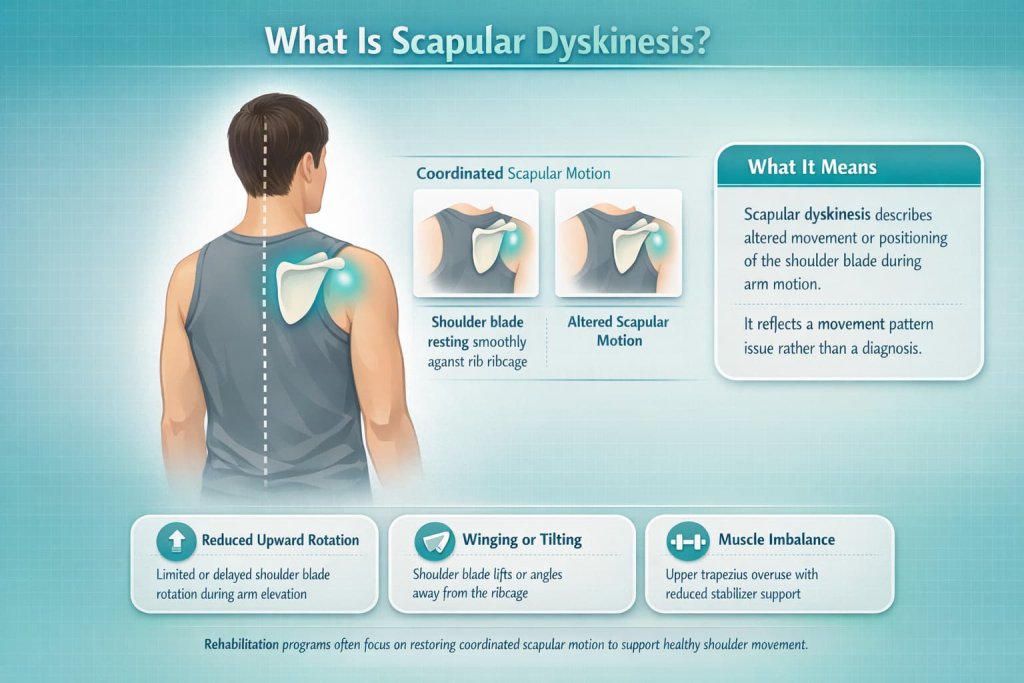
Scapular dyskinesis refers to altered movement or positioning of the shoulder blade during arm motion. Rather than being a diagnosis on its own, it is considered a movement pattern issue often observed alongside other shoulder conditions.
Common characteristics include:
- Delayed or reduced upward rotation during arm elevation
- Excessive winging or tilting of the shoulder blade
- Overuse of the upper trapezius with under-activation of stabilizers
According to research published in the Journal of Orthopaedic & Sports Physical Therapy, restoring coordinated scapular motion is a key goal in shoulder rehabilitation programs.
8 Best Scapular Dyskinesis Exercises
These exercises focus on improving shoulder blade control, coordination, and stability during arm movement. When performed consistently with proper technique, they may help support smoother shoulder mechanics and better posture awareness.
1. Scapular Setting Drill
Why it works:
The scapular setting drill builds foundational awareness of neutral shoulder blade positioning. Many people with scapular dyskinesis overuse the upper trapezius while underusing deeper stabilizers. This drill retrains the nervous system to find and hold a controlled scapular position, which is essential before progressing to loaded or dynamic exercises.
Muscles worked:
- Lower trapezius
- Middle trapezius
- Serratus anterior (low-level activation)
- Deep postural stabilizers
How to do it:
- Stand or sit tall with your arms relaxed at your sides
- Gently draw your shoulder blades slightly back and down
- Keep your chest relaxed—do not flare the ribs
- Avoid shrugging the shoulders or arching the lower back
- Hold the position for 3–5 seconds, then fully relax
Trainer Tip:
Think of “setting” the shoulder blades, not squeezing them hard. The movement should feel subtle and controlled, not forced.
2. Wall Slides
Why it works:
Wall slides encourage coordinated upward rotation and posterior tilt of the scapula during arm elevation. The wall provides feedback that helps limit compensation from the lower back or neck, making this an effective drill for improving overhead mechanics.
Muscles worked:
- Serratus anterior
- Lower trapezius
- Upper trapezius (controlled contribution)
- Rotator cuff (stabilizing role)
How to do it:
- Stand facing a wall with forearms resting against it
- Lightly press your forearms into the wall
- Slide your arms upward while keeping ribs down
- Maintain a neutral neck and relaxed shoulders
- Slowly return to the starting position
Trainer Tip:
If your ribs flare or neck tightens, reduce the range of motion and focus on smooth, controlled movement.
3. Push-Up Plus
Why it works:
The push-up plus emphasizes active scapular protraction, a key function of the serratus anterior. This movement improves how the scapula stays anchored to the ribcage during pushing tasks and arm loading.
Muscles worked:
- Serratus anterior (primary)
- Pectoralis minor (assisting)
- Core stabilizers
- Shoulder stabilizers
How to do it:
- Start in a modified or full push-up position
- Lower into a push-up as usual
- At the top, push the floor away to spread the shoulder blades
- Keep elbows straight during the “plus” phase
- Maintain a stable trunk throughout
Trainer Tip:
Focus on the final protraction at the top. If your elbows bend or shoulders shrug, reset and slow the movement down.
4. Low Row (Closed-Chain)
Why it works:
The low row is commonly used early in scapular rehabilitation because it promotes co-activation of stabilizing muscles without excessive shoulder strain. The closed-chain nature of the movement helps reinforce proper scapular positioning under light resistance.
Muscles worked:
- Lower trapezius
- Middle trapezius
- Serratus anterior
- Rhomboids (supporting role)
How to do it:
- Hold a resistance band or cable at waist height
- Begin with arms extended and shoulders relaxed
- Pull elbows back while gently setting the shoulder blades
- Keep chest tall and neck relaxed
- Return slowly with control
Trainer Tip:
Avoid pulling the elbows too far back. The goal is scapular control, not maximal range or load.
5. Prone Y Raise
Why it works:
This exercise selectively targets the lower trapezius, a muscle often underactive in scapular dyskinesis. Strengthening this muscle supports upward rotation while minimizing upper trapezius dominance.
Muscles worked:
- Lower trapezius (primary)
- Middle trapezius
- Posterior shoulder stabilizers
How to do it:
- Lie face down on a bench or floor
- Position arms overhead in a Y shape
- Lift arms slightly off the surface with thumbs pointing up
- Keep shoulders relaxed and neck neutral
- Lower slowly and under control
Trainer Tip:
Use very light resistance or bodyweight. If you feel neck tension, reduce the lift height.
6. Serratus Punch
Why it works:
The serratus punch isolates scapular protraction without elbow movement, making it ideal for refining serratus activation and improving forward scapular control.
Muscles worked:
- Serratus anterior
- Pectoralis minor
- Shoulder stabilizers
How to do it:
- Hold light weights or a resistance band
- Extend arms straight in front of you
- Punch forward by moving only the shoulder blades
- Pause briefly at the end range
- Return slowly to the starting position
Trainer Tip:
Imagine reaching forward rather than “punching hard.” Control matters more than speed.
7. Resistance Band External Rotation With Scapular Control
Why it works:
This exercise reinforces proper scapular positioning while training the rotator cuff. It teaches the shoulder to rotate without losing scapular stability, which is essential for healthy shoulder mechanics.
Muscles worked:
- Infraspinatus
- Teres minor
- Serratus anterior (stabilizing)
- Lower trapezius
How to do it:
- Stand with elbow bent at 90 degrees and tucked to your side
- Set the shoulder blade gently before moving
- Rotate the forearm outward against band resistance
- Keep shoulders level and neck relaxed
- Return slowly to start
Trainer Tip:
If the shoulder creeps upward, reduce resistance and reset scapular position before continuing.
8. Dynamic Hug
Why it works:
The dynamic hug trains scapular protraction and upward rotation through a functional movement pattern. It closely mimics real-life pushing and reaching actions.
Muscles worked:
- Serratus anterior (primary)
- Pectoralis major
- Anterior deltoid
- Scapular stabilizers
How to do it:
- Anchor a resistance band behind you
- Hold the handles with arms slightly open
- Move arms forward as if hugging a large barrel
- Keep ribs down and shoulders relaxed
- Control the return to the starting position
Trainer Tip:
Maintain smooth tension throughout the movement. Avoid snapping the arms forward or locking the elbows.
How Often Should You Do Scapular Dyskinesis Exercises?
General exercise guidelines suggest:
- 2–4 sessions per week
- 2–3 sets of 8–15 controlled repetitions
- Light to moderate resistance
The Centers for Disease Control and Prevention and ACSM both recommend muscle-strengthening activities at least two days per week as part of a balanced fitness routine.
Common Mistakes to Avoid
- Rushing through repetitions
- Over-shrugging the shoulders
- Using excessive resistance too early
- Ignoring posture and breathing
Quality of movement is more important than load.
Why Scapular Dyskinesis Exercises Matter
Well-designed scapular dyskinesis exercises may help support:
- Improved shoulder blade control during lifting and reaching
- More efficient shoulder mechanics during daily and athletic tasks
- Reduced strain on the neck and upper shoulder muscles
- Better posture awareness and endurance
Public health and fitness organizations such as the American College of Sports Medicine and the National Institutes of Health highlight coordinated muscle activation around joints as a key factor in functional movement quality.
Key Muscles Targeted in Scapular Dyskinesis Exercises
Scapular dyskinesis exercises primarily focus on improving coordination between:
- Serratus anterior
- Lower trapezius
- Middle trapezius
- Rhomboids (supporting role)
- Rotator cuff muscles (secondary stabilizers)
Balanced activation of these muscles helps guide the scapula smoothly during arm elevation and lowering.
How to Perform Scapular Dyskinesis Exercises Safely
Scapular dyskinesis exercises should emphasize control, posture, and gradual progression rather than heavy resistance.
- Move slowly with controlled tempo
- Start with light resistance or bodyweight
- Keep ribs down, neck relaxed, and spine neutral
- Avoid shoulder shrugging or excessive tension
- Stay within a comfortable, pain-free range
- Progress only after consistent control is established
Who Should Be Cautious or Seek Professional Guidance?
These exercises are generally low-impact, but extra caution is advised if you have:
- A recent shoulder, neck, or upper-back injury
- A history of shoulder surgery or instability
- Persistent or worsening shoulder discomfort
- Numbness, tingling, or weakness in the arm
In these cases, consulting a qualified healthcare or rehabilitation professional can help ensure safe and appropriate exercise selection.
This content is for informational purposes only and not medical advice.
Frequently Asked Questions
Are scapular dyskinesis exercises only for athletes?
No. These exercises may benefit desk workers, older adults, and anyone looking to improve shoulder movement quality.
Can these exercises help with posture?
They may help support postural awareness by improving shoulder blade control.
How long does it take to notice improvement?
Many people notice better control within a few weeks when exercises are performed consistently.
Should these exercises cause pain?
They should feel controlled and comfortable. Stop if sharp discomfort occurs.
Can I combine these with other shoulder exercises?
Yes, they are often included alongside general shoulder strength and mobility work.
Do I need equipment?
Many exercises can be done with bodyweight or light resistance bands.
Conclusion
Scapular dyskinesis exercises focus on restoring how your shoulder blades move and stabilize during everyday and athletic activities. When practiced consistently with proper technique, they may help support smoother shoulder motion, improved posture, and long-term shoulder function.
If you want to build a complete shoulder routine, consider pairing these exercises with mobility, strength, and posture-focused training for balanced results.
References
- Kibler WB, McMullen J. Scapular dyskinesis and its relation to shoulder pain (2003).
- Sciascia A, et al. Current views of scapular dyskinesis and its possible clinical relevance (2022).
- Cools AMJ, et al. Rehabilitation of scapular dyskinesis: from the office worker to the elite overhead athlete (2014).
- Ludewig PM, Reynolds JF. Scapular kinematics and glenohumeral joint pathologies (2009).
- Hardwick DH, et al. A comparison of serratus anterior muscle activation during a wall slide exercise and other traditional exercises (2006).
- Ekstrom RA, et al. Electromyographic analysis of exercises for the trapezius and serratus anterior (2003/2004).
- Kang FJ, et al. Serratus anterior and upper trapezius EMG findings across push-up plus exercise variants (2019).
- U.S. Department of Health and Human Services. Physical Activity Guidelines for Americans, 2nd edition (2018).