
TRX exercises for seniors are a safe, low-impact way to build strength, balance, and confidence using bodyweight and adjustable support. Because resistance is controlled by body angle and hand support, TRX suspension training lets older adults train effectively without heavy weights or high joint stress.
Understanding how to choose and scale TRX movements is important, especially for maintaining independence, reducing fall risk, and supporting everyday activities like standing, walking, and reaching.
Below is a clear, evidence-based guide to 9 of the best TRX exercises for seniors, with safety tips and progressions built in.
What Are TRX Exercises for Seniors?
TRX exercises for seniors are suspension-based movements performed using adjustable straps anchored overhead. Instead of lifting external weights, resistance comes from your body position and the support provided by the handles.
Key characteristics include:
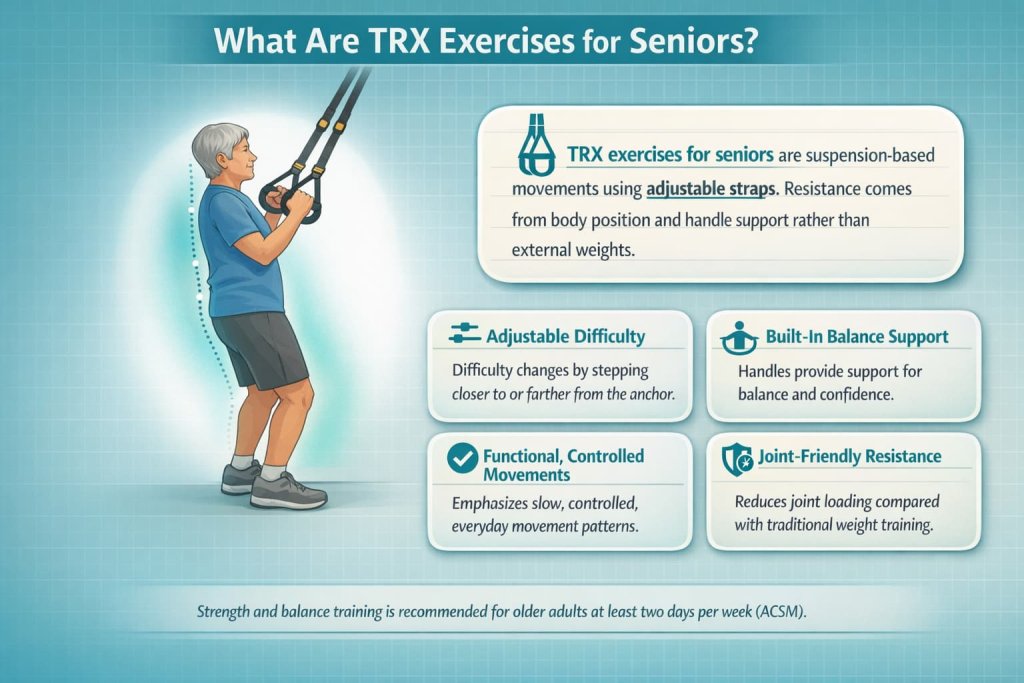
- Adjustable difficulty by stepping closer to or farther from the anchor
- Built-in balance support through the handles
- Emphasis on controlled, functional movement patterns
- Reduced joint loading compared with traditional weight training
According to guidance from American College of Sports Medicine, older adults benefit from regular strength and balance training performed at least two days per week as part of a well-rounded fitness routine.
9 Best TRX Exercises for Seniors
These exercises focus on safe, low-impact strength and balance using adjustable TRX support. Each movement is simple to scale, making it suitable for older adults at different fitness levels.
1. TRX Assisted Squat
How to do it:
- Hold the TRX handles with arms extended and shoulders relaxed
- Stand with feet about shoulder-width apart
- Sit your hips back as if lowering into a chair
- Keep your chest tall and knees tracking over toes
- Use the straps as needed for balance and assistance
- Press through your heels to return to standing
Why it works:
This exercise reinforces safe sit-to-stand mechanics, a key daily movement for seniors. The TRX support allows controlled depth while reducing joint stress.
Muscles worked:
Quadriceps, glutes, hamstrings, core
Trainer Tip:
Start with a partial squat and increase depth only if balance and knee comfort remain solid.
2. TRX Supported Reverse Lunge
How to do it:
- Hold the TRX handles firmly for balance
- Step one foot straight back
- Lower into a controlled lunge with the front knee bent
- Keep your torso upright and weight centered
- Push through the front heel to return to standing
Why it works:
Stepping backward reduces forward knee stress while improving lower-body strength and balance control.
Muscles worked:
Glutes, quadriceps, hamstrings, calves
Trainer Tip:
Keep steps short and controlled to avoid overloading the back knee.
3. TRX Row
How to do it:
- Face the anchor and hold the handles with palms facing each other
- Walk feet forward slightly and lean back
- Keep your body in a straight line from head to heels
- Pull your chest toward the handles by squeezing your shoulder blades
- Slowly extend arms to return to start
Why it works:
Rows strengthen the upper back muscles that support posture and shoulder health.
Muscles worked:
Upper back, latissimus dorsi, biceps, core
Trainer Tip:
Stand more upright to reduce intensity; increase lean only when control improves.
4. TRX Chest Press
How to do it:
- Face away from the anchor while holding the handles
- Step feet back slightly and maintain a straight body line
- Bend elbows to lower your chest toward your hands
- Press through your arms to return to the start position
Why it works:
This exercise builds pushing strength using bodyweight while minimizing shoulder and joint strain.
Muscles worked:
Chest, shoulders, triceps, core
Trainer Tip:
Keep elbows slightly tucked rather than flared to support shoulder comfort.
5. TRX Hip Hinge
How to do it:
- Hold the straps lightly and stand tall
- Push hips back while keeping your spine neutral
- Allow a slight knee bend
- Feel the stretch in the back of your legs
- Drive hips forward to return to standing
Why it works:
The hip hinge teaches safe bending mechanics and supports lifting tasks in daily life.
Muscles worked:
Glutes, hamstrings, lower back
Trainer Tip:
Think “hips back, chest tall” throughout the movement.
6. TRX Standing Calf Raise
How to do it:
- Hold the handles lightly for balance
- Stand tall with feet hip-width apart
- Rise slowly onto the balls of your feet
- Pause briefly at the top
- Lower heels with control
Why it works:
Strong calves support walking, balance reactions, and stair climbing.
Muscles worked:
Calves, ankle stabilizers
Trainer Tip:
Move slowly to improve balance awareness and control.
7. TRX Assisted Step-Back
How to do it:
- Hold the TRX handles securely
- Step one foot backward and lightly tap the floor
- Keep weight on the front leg
- Return to standing with control
- Alternate sides
Why it works:
This exercise improves coordination and prepares the body for directional changes.
Muscles worked:
Glutes, quadriceps, stabilizing muscles
Trainer Tip:
Use full strap support until balance feels steady.
8. TRX Shoulder Y-Raise
How to do it:
- Face the anchor with arms extended
- Hold the handles with palms facing inward
- Raise arms upward into a “Y” shape
- Keep shoulders relaxed and neck neutral
- Lower arms slowly
Why it works:
This movement supports shoulder mobility and upper-back activation important for posture.
Muscles worked:
Shoulders, upper back
Trainer Tip:
Use a very upright stance to keep resistance light.
9. TRX Assisted Balance Reach
How to do it:
- Hold one or both handles for support
- Stand on one leg
- Reach the opposite foot forward or to the side
- Return to the starting position with control
Why it works:
This exercise challenges balance while allowing adjustable hand support.
Muscles worked:
Hips, ankles, core
Trainer Tip:
Use both handles initially and reduce support gradually as balance improves.
How to Program TRX Exercises for Seniors
A simple, safe structure:
- Frequency: 2–3 days per week
- Sets: 1–3 per exercise
- Reps: 8–12 controlled repetitions
- Rest: 45–60 seconds between sets
The World Health Organization recommends multicomponent physical activity that includes strength and balance training for older adults to support long-term function.
Why TRX Exercises for Seniors Matter
Well-designed TRX training may help support:
- Lower-body and upper-body strength for daily tasks
- Better balance and coordination
- Core engagement for posture and stability
- Confidence during movement and transitions
The Centers for Disease Control and Prevention highlights that balance and strength training are key components of fall-prevention strategies for older adults. TRX exercises naturally combine both elements in a controlled way.
Who Should Use TRX Exercises — and Who Should Be Cautious
TRX exercises can work well for many seniors because support and difficulty are easy to adjust.
TRX exercises may be suitable for seniors who:
- Can stand and move independently
- Want low-impact strength and balance training
- Prefer bodyweight exercises over heavy weights
Extra caution is advised for seniors who:
- Have had recent falls or balance issues
- Are recovering from surgery or injury
- Experience ongoing joint pain, dizziness, or instability
Medical clearance is recommended if there are existing health concerns.
How to Adjust TRX Difficulty for Senior Fitness Levels
TRX difficulty can be modified instantly to match comfort and ability.
Simple ways to adjust intensity:
- Stand more upright to reduce resistance
- Use a wider stance for better balance
- Hold both handles instead of one
- Limit range of motion if joints feel sensitive
- Move slowly and with control
Progress gradually and prioritize stability over intensity.
Common Mistakes Seniors Should Avoid
Avoiding common errors helps improve safety and effectiveness.
Common mistakes include:
- Leaning too far too quickly
- Rushing through movements
- Holding the breath
- Allowing poor posture
- Ignoring pain or balance discomfort
Focus on control, breathing, and proper alignment.
Safety Guidelines Before Starting TRX Exercises for Seniors
Before beginning:
- Use a secure anchor point designed to hold bodyweight
- Keep movements slow and controlled
- Stay upright at first; increase lean only if balance feels steady
- Stop if you feel sharp pain, dizziness, or unusual discomfort
- Consult a healthcare professional if you have recent injuries, surgery, or balance concerns
Start with supervision if you are new to suspension training.
When to Stop or Seek Professional Guidance
Stop exercising and seek guidance if you experience:
- Sharp or worsening joint pain
- Dizziness or shortness of breath
- Loss of balance that feels unsafe
- Pain that lasts after exercise
- New or unusual symptoms
Professional guidance can help ensure exercises remain safe and appropriate.
Common Questions About TRX Exercises for Seniors
Are TRX exercises safe for seniors?
Yes, when performed with proper setup, upright angles, and controlled movement.
Do seniors need prior fitness experience?
No. TRX exercises are easily modified for beginners.
Can TRX help with balance?
Yes. Many TRX exercises naturally challenge balance while offering hand support.
How hard should the exercises feel?
Moderate effort is ideal. You should be able to talk but feel challenged.
Can TRX replace weights for seniors?
TRX can effectively support strength training without heavy external loads.
Is TRX suitable for home workouts?
Yes, provided the anchor point is secure and designed for suspension training.
Conclusion
TRX exercises for seniors offer a safe, scalable, and effective way to build strength, balance, and confidence at any fitness level. By focusing on controlled movement and proper support, older adults can stay active, independent, and strong without unnecessary joint stress.
If you’re starting out, begin with upright positions, progress slowly, and prioritize consistency over intensity.
References
- Gaedtke A, et al. TRX-OldAge: Suspension Training Program for Healthy Older Adults (PMC)
- Campa F, et al. 12-Week Suspension vs Traditional Resistance Training in Older Men (Nutrients, 2021)
- ACSM: Physical Activity Guidelines (Strength Training Recommendations)
- CDC: Facts About Falls (May 9, 2024)
- Sherrington C, et al. Exercise for Preventing Falls in Older People (Cochrane Review, 2019)
- National Institute on Aging (NIH): Exercise and Physical Activity