
Leg stretching exercises for seniors are gentle, controlled stretches that help maintain flexibility and support steadier, more comfortable movement. In most cases, the safest approach is to warm up first, stretch to a mild pull (not pain), hold each stretch about 10–30 seconds, and repeat a few times per side, as recommended by the American Heart Association.
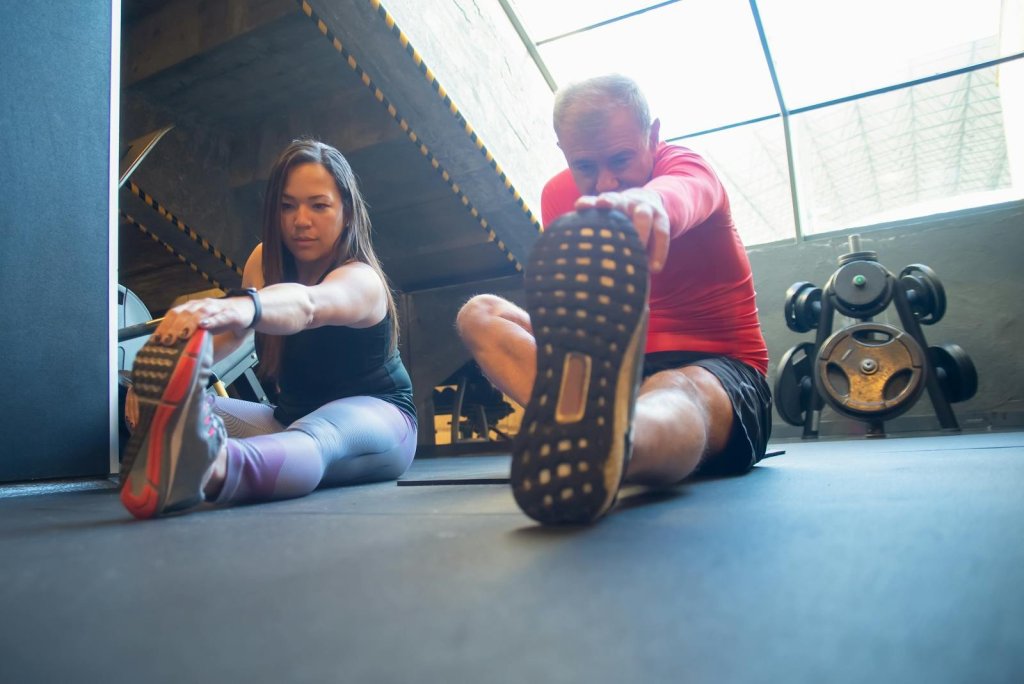
Understanding the right stretches (and how to do them safely) matters because flexible hips, thighs, and calves can make everyday tasks like walking, stairs, and getting up from a chair feel easier and more confident. For detailed safety cues and technique principles, see guidance from the Mayo Clinic.
What Are Leg Stretching Exercises for Seniors?
Leg stretching exercises for seniors are gentle, controlled movements designed to maintain or improve flexibility in the hips, thighs, calves, and ankles while prioritizing balance and joint comfort. Unlike aggressive athletic stretching, senior-focused stretching emphasizes stability, slow transitions, and pain-free range of motion.
These stretches are typically:
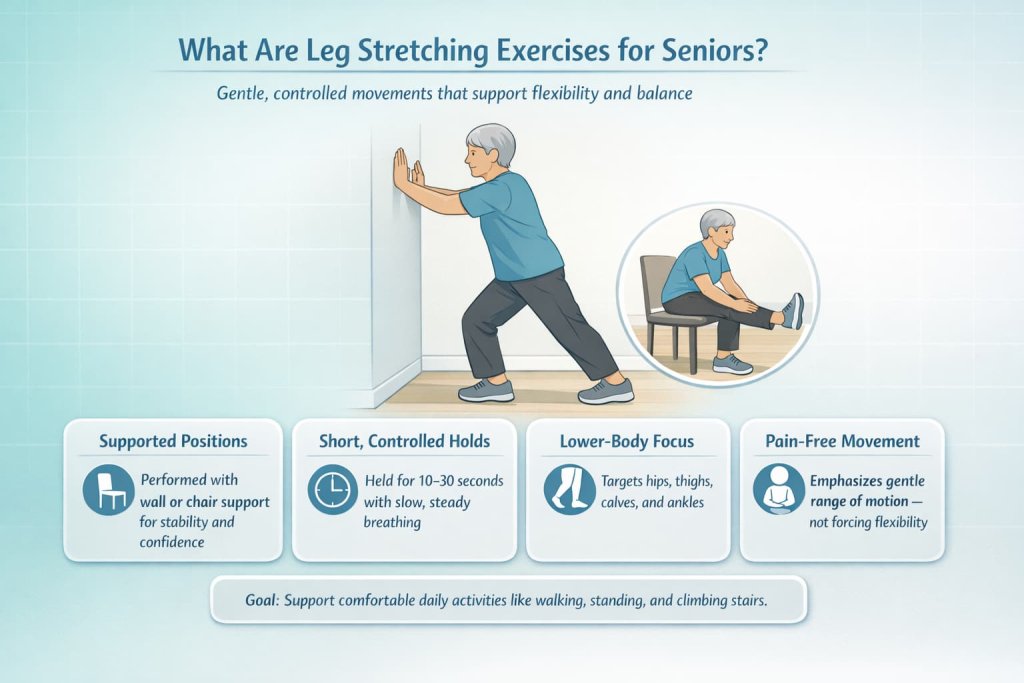
- Performed with wall or chair support
- Held for short, controlled durations (around 10–30 seconds)
- Focused on major lower-body muscle groups
- Combined with steady breathing and upright posture
The goal is not to force flexibility but to support comfortable daily movement such as walking, standing up from a chair, and climbing stairs.
10 best leg stretching exercises for seniors
For each stretch, aim for a mild pulling sensation and use support as needed.
1) Standing Calf Stretch (Wall)
Why it works:
Calf flexibility supports ankle mobility, which plays a key role in walking, balance recovery, and stair climbing. Tight calves can limit ankle motion and shorten stride length, so improving flexibility may help make steps feel smoother and more stable.
Muscles worked:
Gastrocnemius and soleus (primary calf muscles), with light involvement of ankle stabilizers.
How to do it:
- Stand facing a wall and place both hands on it for support
- Step one foot back and keep the back heel flat on the floor
- Keep the back knee straight and toes pointing forward
- Gently lean your body forward until you feel a mild stretch in the calf
- Hold for 20–30 seconds, then switch sides
Trainer Tip:
If the stretch feels too intense, shorten your stance slightly. Focus on keeping the back heel grounded rather than leaning aggressively forward.
2) Bent-Knee Calf Stretch (Soleus Focus)
Why it works:
This variation targets the deeper soleus muscle, which is heavily involved in walking and standing endurance. Stretching it can support ankle comfort during longer walks.
Muscles worked:
Soleus primarily, along with ankle stabilizing muscles.
How to do it:
- Stand facing a wall in the same position as the standard calf stretch
- Step one foot back and keep the heel down
- Slightly bend the back knee while keeping the heel pressed into the floor
- Lean forward until you feel the stretch lower in the calf
- Hold for 20–30 seconds, then switch sides
Trainer Tip:
Keep your hips square and facing forward. Avoid rotating the back foot outward to “cheat” the stretch.
3) Seated Hamstring Stretch (Chair)
Why it works:
Hamstring flexibility supports easier standing from a chair and smoother walking mechanics. Tight hamstrings may contribute to stiffness in the back of the legs.
Muscles worked:
Hamstrings (back of the thigh).
How to do it:
- Sit near the front edge of a sturdy chair
- Extend one leg straight with the heel on the floor and toes pointing up
- Sit tall and gently hinge forward at the hips
- Stop when you feel a mild stretch behind the thigh
- Hold for 20–30 seconds, then switch sides
Trainer Tip:
Avoid rounding your back. Think about keeping your chest lifted as you lean forward.
4) Supine Hamstring Stretch (Strap or Towel)
Why it works:
This supported version reduces balance demands and allows better control of intensity. It is ideal for seniors who prefer floor-based stretching.
Muscles worked:
Hamstrings, with light calf involvement.
How to do it:
- Lie on your back with one knee bent and foot flat on the floor
- Loop a strap or towel around the other foot
- Slowly lift and straighten the leg until you feel a mild pull
- Keep your hips level and shoulders relaxed
- Hold for 20–30 seconds, then switch sides
Trainer Tip:
Keep a slight bend in the knee if you feel discomfort behind the joint. The stretch should feel muscular, not sharp.
5) Standing Quad Stretch (Chair Support)
Why it works:
Flexible quadriceps help support knee comfort and upright posture. Tight quads may increase strain around the knee during walking.
Muscles worked:
Quadriceps (front of the thigh).
How to do it:
- Stand beside a chair or counter for balance
- Bend one knee and bring your heel toward your glutes
- Hold your ankle or use a strap if needed
- Keep your knees close together and stand tall
- Hold for 20–30 seconds, then switch sides
Trainer Tip:
Avoid arching your lower back. Keep your hips gently tucked under to feel the stretch in the thigh, not the spine.
6) Side-Lying Quad Stretch (Floor or Bed)
Why it works:
This variation removes balance demands and may feel more stable and comfortable for many seniors.
Muscles worked:
Quadriceps and hip flexors.
How to do it:
- Lie on your side with your head supported
- Bend the top knee and hold the ankle (or use a strap)
- Gently draw the heel toward the glutes
- Keep your hips stacked and avoid rolling forward
- Hold for 20–30 seconds, then switch sides
Trainer Tip:
Perform this stretch on a bed if getting to the floor feels difficult.
7) Hip Flexor Stretch (Supported Split Stance)
Why it works:
Tight hip flexors can shorten stride length and affect posture. Gentle stretching may support more upright walking mechanics.
Muscles worked:
Iliopsoas and rectus femoris.
How to do it:
- Stand holding a counter or chair for balance
- Step one foot back into a comfortable split stance
- Slightly bend both knees
- Gently tuck your pelvis and shift forward
- Feel the stretch in the front of the back hip
- Hold for 20–30 seconds, then switch sides
Trainer Tip:
Keep your ribs stacked over your pelvis. Avoid leaning forward from the upper body.
8) Figure-4 Glute Stretch (Seated)
Why it works:
This stretch targets the glutes and deep hip rotators, supporting hip mobility for walking and sitting comfort.
Muscles worked:
Gluteus maximus, gluteus medius, deep hip rotators.
How to do it:
- Sit tall in a chair
- Cross one ankle over the opposite knee
- Keep the crossed foot flexed
- Gently lean forward at the hips
- Stop at a mild stretch in the outer hip
- Hold for 20–30 seconds, then switch sides
Trainer Tip:
If crossing over the knee feels uncomfortable, place the ankle lower on the shin instead.
9) Inner Thigh Stretch (Seated Butterfly)
Why it works:
Inner thigh flexibility supports side-stepping, balance reactions, and getting in and out of a car.
Muscles worked:
Adductors (inner thigh muscles).
How to do it:
- Sit tall near the edge of a chair
- Place your feet wider apart
- Slowly slide your feet inward so knees fall gently outward
- Keep your back tall and lean forward slightly
- Hold for 20–30 seconds
Trainer Tip:
Do not push your knees down with your hands. Let gravity create a gentle stretch.
10) Seated Ankle Mobility and Shin Stretch
Why it works:
Ankle and shin mobility support smoother steps and help maintain proper foot clearance during walking.
Muscles worked:
Tibialis anterior and other ankle movers.
How to do it:
- Sit in a chair with feet flat on the floor
- Extend one leg forward with the heel resting on the floor
- Slowly point the toes away, then pull them toward you
- Add gentle ankle circles in both directions
- Perform for 20–30 seconds, then switch sides
Trainer Tip:
Move slowly and stay within a comfortable range. This exercise should feel controlled, not forced.
Why Leg Stretching Exercises Matter for Flexibility and Balance
Flexibility and balance work together. As we age, muscles and connective tissues may gradually lose elasticity, which can reduce joint range of motion and affect walking patterns. Gentle leg stretching exercises for seniors help maintain mobility in key areas like the hips, hamstrings, quadriceps, and calves.
Improved flexibility may help:
- Support smoother walking mechanics
- Maintain stride length
- Improve posture alignment
- Reduce stiffness after sitting
- Complement balance and strength training
When stretching is paired with regular strength and balance activities, it supports overall movement confidence and independence. Stretching alone does not prevent falls, but it can contribute to better lower-body mobility when combined with broader activity habits.
How long should seniors hold a leg stretch?
Most general health guidance recommends:
- Hold each stretch 10–30 seconds (work toward 30 seconds comfortably), according to the American Heart Association.
- Repeat 2–4 times per side.
- Stretch major muscle groups at least 2–3 days per week, based on Mayo Clinic flexibility recommendations.
If a muscle group feels especially tight, longer holds (up to about 60 seconds) may be appropriate if they remain comfortable and pain-free, as noted in Mayo Clinic flexibility guidance.
Quick safety checklist before you stretch
- Warm up with 5–10 minutes of easy movement (marching in place, short walk, gentle cycling), as advised by the Mayo Clinic.
- Stretch to a slight pull, never sharp pain.
- Move slowly, avoid bouncing, and breathe normally.
- Use a wall or sturdy chair for balance whenever needed.
Stop and get medical guidance before stretching if you have new swelling, warmth/redness, sudden weakness/numbness, severe pain, or a recent injury.
Who Should Modify or Avoid These Stretches?
Most seniors can perform gentle leg stretches safely, but certain situations require modification or professional guidance.
You should consult a healthcare provider before stretching if you have:
- A recent hip, knee, or ankle surgery
- Severe osteoporosis
- Acute swelling, warmth, or redness in a joint
- Sharp or worsening joint pain
- Numbness, tingling, or sudden leg weakness
- A recent fall with unresolved pain
Modifications may include:
- Performing stretches seated instead of standing
- Reducing hold time
- Using additional support (wall, counter, chair)
- Limiting range of motion
Stretching should feel like mild muscle tension — not joint strain or sharp discomfort.
Simple 10-Minute Leg Stretch Routine for Seniors
This short routine can be done 2–4 days per week after a brief warm-up (such as 5 minutes of easy walking).
1. Standing calf stretch – 20–30 seconds each side
2. Seated hamstring stretch – 20–30 seconds each side
3. Standing hip flexor stretch – 20 seconds each side
4. Seated figure-4 stretch – 20–30 seconds each side
5. Seated inner thigh stretch – 20–30 seconds
6. Seated ankle mobility – 30 seconds each side
Move slowly, breathe steadily, and avoid bouncing. The entire routine should feel controlled and comfortable.
If you are new to stretching, start with shorter holds and gradually increase duration as your body adapts.
Common mistakes to avoid
- Stretching cold muscles instead of warming up first
- Bouncing to go deeper
- Holding your breath
- Pushing into joint pain
For additional orthopedic safety tips on warming up and flexibility, refer to the American Academy of Orthopaedic Surgeons via OrthoInfo.
FAQs
1) How long should I hold each leg stretch as a senior?
Around 10–30 seconds per stretch is commonly recommended by the American Heart Association.
2) How many days a week should seniors stretch?
At least 2–3 days per week for major muscle groups, based on Mayo Clinic flexibility guidance.
3) Should stretching feel uncomfortable?
You should feel a mild muscle pull, not sharp or joint pain.
4) Can leg stretching help balance?
Stretching supports mobility, but balance improves most when combined with strength and balance exercises, as emphasized by the CDC and NIA.
5) What’s the best warm-up before stretching?
5–10 minutes of easy movement such as walking or marching in place is commonly recommended by Mayo Clinic.
Conclusion
Leg stretching exercises for seniors work best when they are gentle, consistent, and combined with regular walking, strength, and balance activities. Choose a few stretches that feel comfortable, practice them several times per week, and focus on steady progress rather than forcing range. Small, consistent efforts can support better mobility and confidence over time.
References
- Centers for Disease Control and Prevention: Older Adult Activity Guidelines Overview
- National Institute on Aging: Three Types of Exercise (Endurance, Strength, Balance)
- U.S. Department of Health and Human Services: Physical Activity Guidelines for Americans (2nd Edition PDF)
- PubMed: The Physical Activity Guidelines for Americans (Piercy et al., 2018)
- PubMed Central: Meta-analysis on Chronic Stretching and Range of Motion Outcomes