
The best foot drop exercises are movements that strengthen the dorsiflexors, improve ankle mobility, and support safer walking by helping the foot lift more effectively. Foot drop makes it hard to raise the front of the foot, which can lead to tripping, toe dragging, and balance issues.
Understanding which exercises improve dorsiflexion, ankle control, and gait stability is essential because foot drop often comes from nerve injury, stroke, neuropathy, or muscle weakness. While exercises alone cannot fix the underlying cause, they may help improve strength, mobility, and walking safety when done consistently.
This guide explains the 15 best physical therapy–based exercises, when to use them, how to perform each safely, and what to avoid.
What Is Foot Drop?
Foot drop is a condition where the front of the foot cannot lift properly during walking due to weakness, nerve dysfunction, or muscle impairment. This leads to toe dragging, difficulty clearing the foot, and a higher risk of tripping or falls.
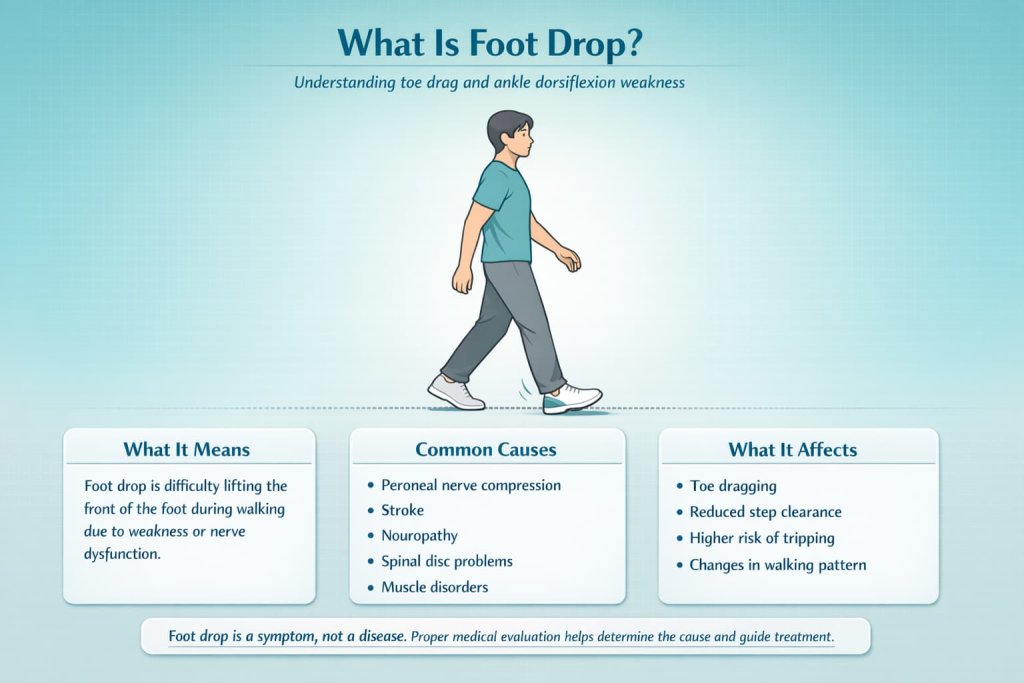
Foot drop is usually caused by issues such as peroneal nerve compression, stroke, neuropathy, spinal disc problems, or muscle disorders. Treatment varies based on the cause, but exercises may help improve ankle mobility, strength, and gait control when used alongside medical care.
Why Foot Drop Exercises Matter
Foot drop exercises help strengthen the muscles that lift the foot, improve ankle motion, support gait symmetry, and reduce compensations like hip hiking or high-stepping. These exercises also encourage better neuromuscular control, which may help the body relearn more efficient movement patterns.
Consistent training supports:
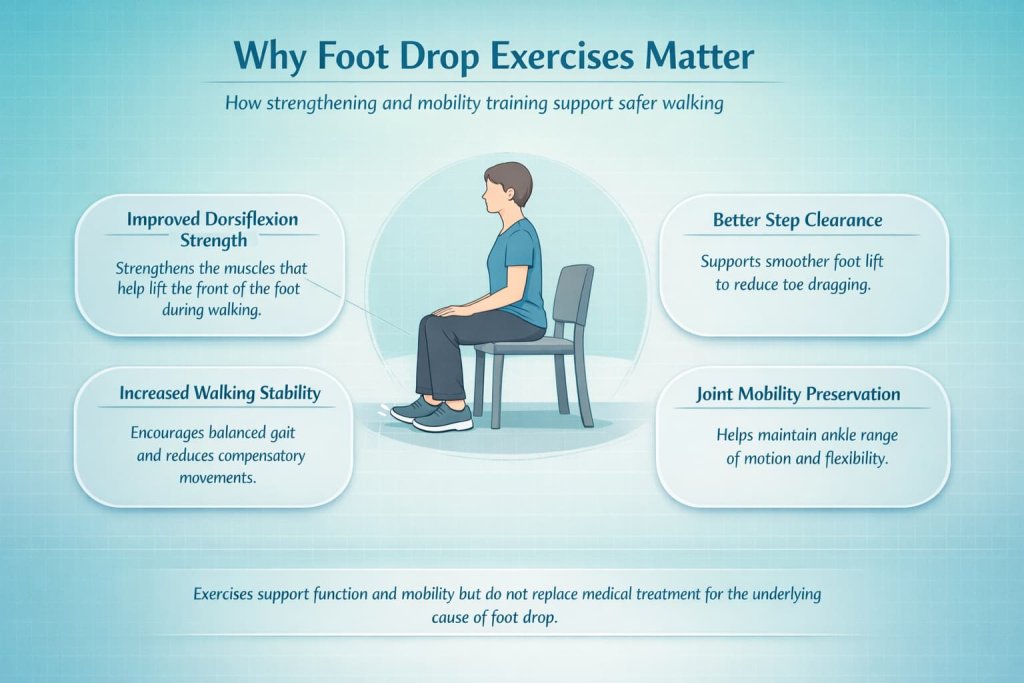
- Improved dorsiflexion strength
- Better step clearance
- Reduced risk of tripping
- Increased walking stability
- Preservation of joint mobility
While exercises cannot treat the underlying medical cause, they may support functional improvement and help maintain independence.
15 Best Foot Drop Exercises
These exercises are designed to strengthen the muscles that lift your foot, improve ankle mobility, and support safer, more efficient walking. Perform them consistently and progress gradually to help reduce toe dragging and increase stability.
1. Assisted Ankle Dorsiflexion
Why it works:
Assisted dorsiflexion helps activate the tibialis anterior even when nerve signals are weak. The added support improves ankle mobility and encourages the foot to lift more effectively during walking.
Muscles worked:
- Tibialis anterior
- Extensor digitorum longus
- Extensor hallucis longus
How to do it:
- Sit with your leg extended in front of you.
- Loop a towel or resistance band around the ball of your foot.
- Gently pull the towel to guide your foot upward toward your shin.
- Hold 2–3 seconds at the top.
- Perform 12–15 repetitions.
Trainer Tip:
Move slowly and avoid pulling too hard—this exercise should feel supportive, not forceful.
2. Active Ankle Dorsiflexion
Why it works:
This exercise strengthens the muscles responsible for lifting the foot without external assistance, improving step clearance and reducing toe dragging.
Muscles worked:
- Tibialis anterior
- Toe extensor muscles
How to do it:
- Sit or stand with your foot flat on the floor.
- Lift your toes upward while keeping the heel planted.
- Lower down slowly with control.
- Complete 12–15 reps.
Trainer Tip:
If your foot barely moves, keep practicing—even small movements help retrain the nerve-muscle connection.
3. Toe Raises (Heel Down)
Why it works:
Targets dorsiflexor strength in a functional, weight-bearing position, improving control during walking.
Muscles worked:
- Tibialis anterior
- Ankle stabilizers
How to do it:
- Stand while holding onto a chair or counter.
- Lift your toes upward as high as you can while keeping your heels down.
- Lower slowly.
- Perform 10–12 reps.
Trainer Tip:
Avoid leaning backward—keep your weight centered for proper activation.
4. Seated Toe Taps
Why it works:
Improves fast-twitch activation of the dorsiflexors, which is essential for quick foot lifts during walking.
Muscles worked:
- Tibialis anterior
- Toe extensors
How to do it:
- Sit with both feet resting on the floor.
- Rapidly tap your toes upward and downward.
- Continue for 20–30 seconds.
Trainer Tip:
Keep movements light and rhythmic—do not lift the whole leg.
5. Ankle Alphabet
Why it works:
Increases multi-directional ankle mobility, helping restore full range of motion impacted by weakness or nerve dysfunction.
Muscles worked:
- All ankle mobility muscles
- Intrinsic foot muscles
How to do it:
- Sit comfortably and lift one foot off the ground.
- Use your foot to “draw” the letters of the alphabet in the air.
- Complete one full alphabet per foot.
Trainer Tip:
Make the letters large and controlled to target all movement directions.
6. Ankle Inversion & Eversion
Why it works:
Strengthens supporting muscles that stabilize the ankle and improve side-to-side control, reducing the risk of rolling your ankle.
Muscles worked:
- Peroneals (eversion)
- Tibialis posterior (inversion)
- Lateral stabilizers
How to do it:
- Loop a resistance band around your foot.
- Turn your foot inward for inversion; outward for eversion.
- Perform 10–15 reps in each direction.
Trainer Tip:
Only move your ankle—avoid rotating your entire leg.
7. Heel-to-Toe Rocking
Why it works:
Trains the ankle to shift between dorsiflexion and plantarflexion smoothly, improving balance and gait mechanics.
Muscles worked:
- Tibialis anterior
- Gastrocnemius and soleus
- Ankle stabilizers
How to do it:
- Stand with support.
- Rock forward onto your toes.
- Then rock backward onto your heels.
- Repeat 12–15 times.
Trainer Tip:
Move slowly and focus on full heel and toe contact during transitions.
8. Calf Stretch
Why it works:
Reduces tightness in the gastrocnemius and soleus, which often restrict dorsiflexion and worsen foot drop symptoms.
Muscles worked:
- Gastrocnemius
- Soleus
How to do it:
- Stand facing a wall.
- Step one leg back and keep the heel flat.
- Lean forward gently to feel a stretch in the calf.
- Hold 20–30 seconds.
Trainer Tip:
Keep your back knee straight for an upper-calf stretch, slightly bent for a deeper soleus stretch.
9. Hamstring Stretch
Why it works:
Improves leg mobility and reduces tension that may alter your walking pattern.
Muscles worked:
- Hamstrings
- Lower back stabilizers
How to do it:
- Sit with one leg extended forward.
- Reach toward your toes until you feel a stretch.
- Hold 20–30 seconds.
Trainer Tip:
Avoid rounding your back—hinge from your hips for a safer stretch.
10. Towel Scrunches
Why it works:
Strengthens intrinsic foot muscles, which help stabilize the arch and improve push-off during walking.
Muscles worked:
- Toe flexors
- Intrinsic foot stabilizers
How to do it:
- Place a small towel under your foot.
- Scrunch the towel toward you using your toes.
- Perform 10–12 reps.
Trainer Tip:
Spread your toes wide between reps to improve control.
11. Marble Pick-Ups
Why it works:
Enhances fine motor control of the foot and toes, improving balance and foot precision during gait.
Muscles worked:
- Flexor digitorum longus
- Intrinsic foot muscles
How to do it:
- Scatter marbles on the floor.
- Use your toes to pick them up and place them into a cup.
- Continue for 1–2 minutes.
Trainer Tip:
Work slowly and deliberately—quality over speed.
12. Heel Walking (If Safe)
Why it works:
Strengthens the dorsiflexors in a functional standing pattern, helping improve foot elevation during steps.
Muscles worked:
- Tibialis anterior
- Ankle stabilizers
How to do it:
- Walk for 10–20 steps on your heels.
- Lift your toes upward as you move.
Trainer Tip:
Avoid this exercise if you have poor balance or severe weakness.
13. High-Knee Marching
Why it works:
Improves hip flexion and reinforces lifting the foot to prevent toe drag, helping create a safer, more controlled gait.
Muscles worked:
- Hip flexors
- Tibialis anterior
- Core stabilizers
How to do it:
- March in place, lifting knees high.
- Focus on raising your toes each time your leg lifts.
- Continue 30–45 seconds.
Trainer Tip:
Use a slow, marching rhythm to avoid losing balance.
14. Controlled Step-Ups
Why it works:
Builds functional leg strength, supports proper leg lifting mechanics, and improves step clearance during stairs or uneven surfaces.
Muscles worked:
- Quadriceps
- Glutes
- Hip flexors
- Ankle dorsiflexors
How to do it:
- Stand in front of a low step or platform.
- Step up slowly, keeping your toes lifted as you move.
- Lower with control.
- Perform 10–12 reps per leg.
Trainer Tip:
Choose a low step height at first to avoid compensating by swinging your leg.
15. Balance Training (Single-Leg Stand)
Why it works:
Improves ankle stability, proprioception, and overall balance—key for preventing falls related to foot drop.
Muscles worked:
- Ankle stabilizers
- Core muscles
- Hip abductors
How to do it:
- Stand near a wall or chair for support.
- Lift one foot slightly off the ground.
- Balance for 10–20 seconds.
- Switch legs.
Trainer Tip:
Keep your gaze forward and core engaged to maintain balance.
How Often Should You Do Foot Drop Exercises?
Most people benefit from doing foot drop exercises 1–2 times per day, focusing on gentle activation, mobility, and controlled strengthening. For nerve-related weakness, frequent practice helps reinforce motor pathways and improve coordination.
General frequency guidelines:
- Start with 10–15 minutes per session
- Perform 8–15 reps per exercise, depending on fatigue
- Stretching can be done daily, even multiple times per day
- Strengthening should be progressive, increasing slowly over weeks
If exercises increase numbness, sharp pain, or instability, reduce intensity or stop until a healthcare provider reviews your symptoms.
Safety Guidelines Before Doing Foot Drop Exercises
- Always confirm diagnosis with a doctor or physical therapist.
- Start with low resistance and gentle movement.
- Avoid exercises that cause numbness, sharp pain, or increased foot drop.
- Use support (chair, wall, railing) for all standing exercises.
- Stop immediately if your foot gives out during walking drills.
- Consider an AFO brace if recommended to prevent falls.
Who Should Avoid or Modify Foot Drop Exercises
Stop or modify exercises if you have:
- Severe neuropathy with loss of sensation
- Significant foot deformity
- Recent surgery without clearance
- Uncontrolled balance issues
- Progressive neurological disease without medical supervision
Functional electrical stimulation (FES), bracing, and medical treatment may be required based on cause.
When to Expect Improvement
Foot drop improvement varies widely based on the underlying cause.
You may notice:
- Better ankle mobility in 2–4 weeks
- Increased toe lift in 6–12 weeks
- Improved gait pattern with consistent therapy
Nerve recovery, however, may take months.
When to See a Doctor or Physical Therapist
Seek professional evaluation if you experience:
- Sudden onset of foot drop
- Worsening weakness or inability to lift the foot
- Frequent tripping or near-falls
- Numbness, tingling, or loss of sensation
- Back pain combined with leg weakness
- Foot drop after injury, surgery, or rapid weight loss
A doctor or physical therapist can determine the underlying cause, provide targeted treatment, and recommend devices such as an AFO brace or functional electrical stimulation (FES) if appropriate.
Early medical assessment improves outcomes, especially when nerve involvement is suspected.
Frequently Asked Questions (FAQ)
1. Can exercises fix foot drop?
Exercises may help improve strength and walking mechanics, but they cannot cure nerve damage. Treatment depends on the cause.
2. How often should I do these exercises?
Most people benefit from 1–2 sessions daily, especially early-stage activation drills.
3. What is the best exercise for foot drop?
Active and assisted ankle dorsiflexion is the most widely recommended by physical therapists.
4. Is foot drop permanent?
Not always. Recovery depends on nerve healing, physical therapy, and early treatment.
5. Do I need a brace (AFO)?
Many patients benefit from an AFO to prevent tripping while strengthening the foot.
6. When should I see a doctor?
If you notice sudden foot drop, worsening symptoms, numbness, or falls, seek medical care immediately.
7. Are these exercises safe for neuropathy?
Yes—if monitored, but avoid high-impact movements and always watch for loss of sensation.
Conclusion
Foot drop exercises can support dorsiflexion strength, improve gait, and enhance walking safety, especially when used consistently and under professional guidance. Start with basic movements, progress gradually, and follow medical advice. If symptoms worsen, or if you struggle with balance, an AFO or additional physical therapy may be needed.
Ready to improve ankle strength and walking confidence? Begin with 2–3 exercises today and build up gradually.
References
- Nori SL. Foot Drop. StatPearls. 2024.
Comprehensive medical overview of foot drop, causes, diagnosis, and management. - Mayo Clinic – Foot Drop: Diagnosis and Treatment.
Explains workup and treatment, including braces, physical therapy, and stretching. - Cleveland Clinic – Foot Drop: What It Is, Causes, Symptoms & Treatment.
Patient-friendly explanation of foot drop, risk factors, and management options. - Lezak B. Peroneal Nerve Injury. StatPearls. 2024.
Details peroneal nerve dysfunction, a key cause of foot drop, and conservative care. - Li X, et al. Electromyographic Feedback FES for Foot Drop After Stroke. Frontiers in Neuroscience. 2024.
Shows that functional electrical stimulation plus rehab improves gait in foot drop. - Brehm MA, et al. Effect of Ankle-Foot Orthoses on Walking in Neurologic Conditions. Journal of Rehabilitation Medicine.
Supports your section on AFOs improving walking efficiency and stability.