
A low impact workout for beginners is a beginner-friendly way to build strength and fitness using controlled movements with little-to-no jumping and more joint-friendly positions. If you’re new to exercise (or returning after time off), low-impact training helps you practice good form, improve consistency, and gradually get stronger without feeling beat up.
For a simple starting target, public-health guidelines recommend working up to 150 minutes per week of moderate-intensity activity plus 2 days per week of muscle-strengthening work, as outlined by the CDC.
What counts as a low impact workout for beginners
Low impact does not mean “easy.” It means less pounding (usually no jumping) and more stable, controlled reps. You can still challenge your muscles and heart rate with:
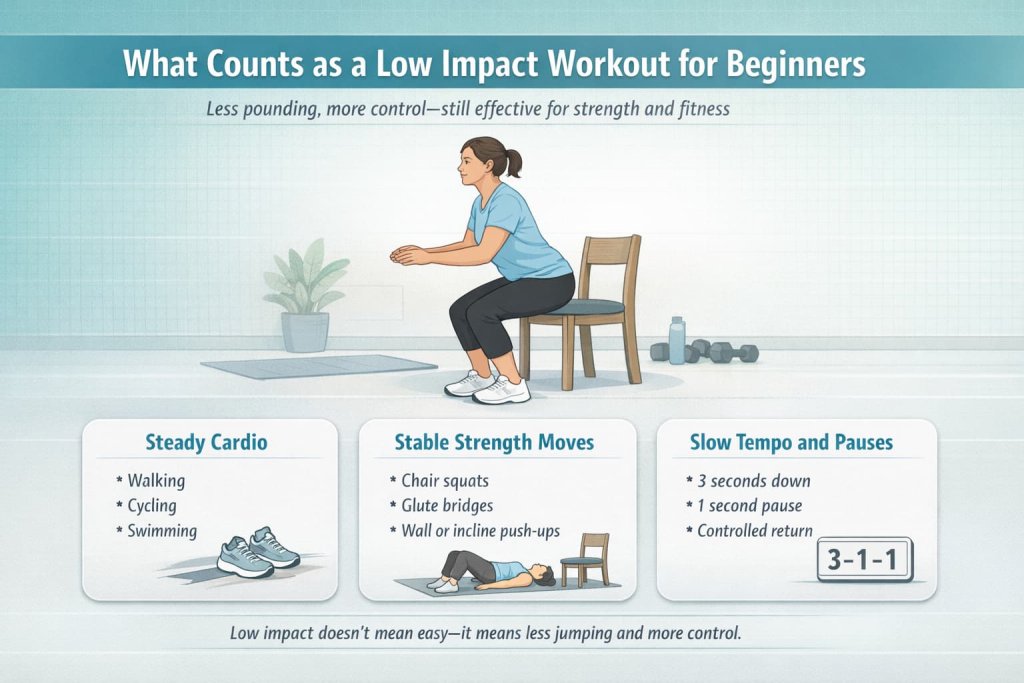
- Steady cardio (walking, cycling, swimming)
- Strength moves with both feet planted (squats to a chair, glute bridges)
- Slow tempo and pauses (3 seconds down, 1 second pause)
How hard should a beginner low impact workout feel
Use these simple safety tools:
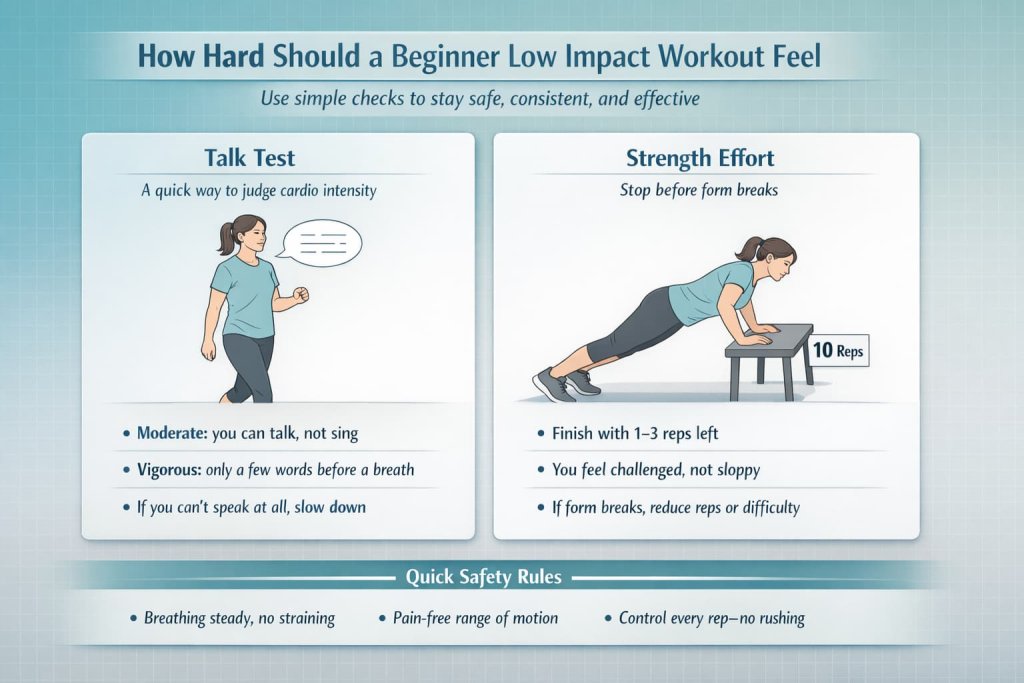
- Talk test: Moderate intensity means you can talk but not sing; vigorous means you can only say a few words before needing a breath, as explained by the CDC.
- Beginner strength effort: Stop a set with 1–3 reps left in the tank (you feel challenged, but form stays clean).
11 best low impact exercises for beginners to build strength safely
Use the format below to build a full-body routine. Start with 1–2 sets per exercise, then build to 2–3 sets.
1. Sit-to-Stand (Chair Squat)
How to do it:
- Sit tall on a sturdy chair with feet hip-width and full feet on the floor.
- Lightly brace your core and lean forward slightly with your chest up.
- Stand by pushing the floor away through your heels/midfoot.
- Sit back down slowly and tap the chair (don’t “plop”).
Why it works: This move builds beginner-friendly leg strength using the chair as a stable target, which helps you learn safe squat mechanics and control.
Muscles worked: Quads, glutes, hamstrings, core.
Trainer Tip: Use a higher chair to make it easier, then lower the chair height over time as your strength and control improve.
2. Glute Bridge
How to do it:
- Lie on your back with knees bent and feet flat.
- Brace your core and squeeze your glutes to lift your hips.
- Pause for 1 second at the top.
- Lower slowly with control.
Why it works: Glute bridges strengthen the hips without impact and teach you to extend through the glutes instead of overusing the lower back.
Muscles worked: Glutes, hamstrings, core.
Trainer Tip: Keep your ribs down and avoid arching your lower back at the top—think “hips up, ribs down.”
3. Wall Push-Up
How to do it:
- Place hands on a wall at chest height and step feet back.
- Keep your body in a straight line with a light core brace.
- Bend elbows and bring your chest toward the wall.
- Press back to the start position.
Why it works: This is a joint-friendly pushing pattern that builds upper-body strength with less load than floor push-ups, making it ideal for beginners.
Muscles worked: Chest, shoulders, triceps, core.
Trainer Tip: Step your feet farther from the wall to make it harder, or move closer to make it easier.
4. Incline Push-Up (Hands on Bench or Counter)
How to do it:
- Place hands on a bench or counter and walk feet back into a straight-body plank.
- Lower your chest toward the edge with elbows angled slightly back.
- Press up while keeping hips level and ribs stacked.
Why it works: Incline push-ups let you train real push-up strength while keeping the movement stable and adjustable based on your current level.
Muscles worked: Chest, shoulders, triceps, core.
Trainer Tip: Choose an incline that lets you keep a strong plank—if your hips sag or your shoulders shrug, raise the surface.
5. Supported Split Squat (Hold a Chair or Wall)
How to do it:
- Take a staggered stance (one foot forward, one back) and lightly hold a chair or wall.
- Lower straight down until both knees bend comfortably.
- Push through the front foot to stand back up.
Why it works: This builds single-leg strength and balance in a controlled way, and the support helps you focus on form instead of wobbling.
Muscles worked: Quads, glutes, hamstrings, calves.
Trainer Tip: Keep most of your weight over the front foot and keep your torso tall for a more stable, beginner-friendly feel.
6. Step-Up (Low Step)
How to do it:
- Step onto a low step with your whole foot (heel down).
- Stand tall at the top without bouncing.
- Step down slowly and repeat, alternating sides.
Why it works: Step-ups strengthen the legs and train real-life stair strength without impact, especially when you control the lowering phase.
Muscles worked: Glutes, quads, hamstrings, calves.
Trainer Tip: Start with the lowest step possible and prioritize a slow, quiet step-down—control matters more than height.
7. Hip Hinge (Dowel/Wall Hinge)
How to do it:
- Stand tall with knees slightly soft.
- Push hips back like you’re closing a car door behind you.
- Keep your spine neutral, then return by squeezing your glutes.
Why it works: The hip hinge teaches safe bending mechanics and helps you build posterior-chain strength without turning the movement into a lower-back strain.
Muscles worked: Glutes, hamstrings, lower back (support), core.
Trainer Tip: If you feel it mostly in your lower back, shorten the range of motion and slow the movement down.
8. Dumbbell or Backpack Deadlift (Light Load)
How to do it:
- Hold a light dumbbell or backpack close to your legs.
- Hinge hips back with a neutral spine and slight knee bend.
- Stand up by driving hips forward and squeezing glutes.
Why it works: This strengthens the full body using a low-impact hinge pattern and teaches you how to lift with hips and legs, not just the back.
Muscles worked: Glutes, hamstrings, upper back, grip, core.
Trainer Tip: Keep the load close to your body the entire time—distance from the body usually makes it feel harder and less stable.
9. Bird Dog
How to do it:
- Start on hands and knees with hands under shoulders and knees under hips.
- Extend the opposite arm and leg slowly.
- Pause for 1 second, then return and switch sides.
Why it works: Bird dogs train core stability and coordination with very low joint stress, helping you build control that carries over to strength training.
Muscles worked: Core, glutes, back stabilizers, shoulders.
Trainer Tip: Keep hips level and move slower if your torso shifts—smooth control beats big range.
10. Side-Lying Clamshell
How to do it:
- Lie on your side with knees bent and feet together.
- Keep hips stacked and open the top knee.
- Lower slowly with control.
Why it works: Clamshells strengthen hip stabilizers that help control knee position and pelvic stability, which supports safer walking, squatting, and stepping patterns.
Muscles worked: Glute medius/minimus (hip abductors).
Trainer Tip: Keep the movement small if needed and avoid rolling your hips backward—quality beats range.
11. Marching in Place (Low Impact Cardio Finisher)
How to do it:
- Stand tall and march with controlled knee lifts.
- Swing your arms naturally.
- Keep steps light, quiet, and steady.
Why it works: Marching boosts heart rate without jumping, making it one of the simplest low-impact ways to add beginner-friendly cardio at the end of a workout.
Muscles worked: Hip flexors, calves, core; cardio system.
Trainer Tip: Use the talk test—aim for a pace where you can talk but not sing to stay in a moderate zone.
Beginner-friendly low impact workout plan
Do this 2–3 days per week (non-consecutive days if possible). A commonly cited framework for novice resistance training progression is described in the ACSM position stand.
Workout A (Full body, 25–35 minutes)
- Sit-to-Stand: 2 sets of 8–12
- Glute Bridge: 2 sets of 10–15
- Incline Push-Up: 2 sets of 6–12
- Step-Up: 2 sets of 6–10 per side
- Bird Dog: 2 sets of 6–10 per side
- Marching in Place: 5–10 minutes
Workout B (Full body, 25–35 minutes)
- Supported Split Squat: 2 sets of 6–10 per side
- Hip Hinge: 2 sets of 8–12
- Wall Push-Up: 2 sets of 8–15
- Clamshell: 2 sets of 10–15 per side
- Marching in Place: 5–10 minutes
How to progress safely (without making it high impact)
Use one change at a time:
- Add 1–2 reps each week until you reach the top of the range
- Then add one set (up to 3 sets)
- Then increase difficulty (lower incline, slightly heavier weight, slightly lower chair)
- Keep cardio low impact by increasing time (from 5 to 12 minutes) instead of jumping
Common beginner mistakes to avoid
- Going hard every day instead of building a routine
- Rushing reps (speed hides weak positions)
- Holding your breath during strength moves (exhale as you stand/press)
- Ignoring recovery (sleep, hydration, easy walking days)
Modifications and Low-Impact Alternatives
Make it easier:
- Higher chair, lower step, smaller range
- Push-ups: wall → counter → bench
- Bird dog: arms only or legs only
- Lighter load, slower tempo, more rest
FAQs
What is the best low impact workout for beginners at home?
A full-body routine using chair squats, glute bridges, incline push-ups, step-ups, and core stability (bird dogs) is a strong starting point because it’s simple, scalable, and joint-friendly.
How many days a week should a beginner do low impact workouts?
A practical start is 2–3 strength days per week plus easy low-impact cardio on other days, building toward guideline targets over time.
Can low impact workouts build strength?
Yes. Strength comes from progressive overload (more reps, sets, resistance, or control), not from impact.
Is walking enough as a low impact workout?
Walking is one of the simplest low-impact cardio options and a strong habit for beginners, especially when you gradually increase time and pace.
What if I have knee pain during squats or step-ups?
Reduce range of motion, use a higher chair/lower step, slow down, and focus on control. If pain persists or is sharp, get guidance from a qualified clinician or trainer.
What’s a safe intensity level for beginners?
Use the talk test for cardio and keep strength sets challenging but controlled, stopping with a couple of reps left before form breaks.
Do I need equipment?
No. You can start with a chair, a wall, and bodyweight. Add a light dumbbell or backpack later for gentle progression.
Conclusion
A low impact workout for beginners works best when it’s consistent, simple, and progressive. Pick 5–6 moves from the list, train 2–3 days per week, add easy cardio like marching or walking, and improve one small thing each week (a rep, a set, or a little more control). If you want, tell me your available equipment and time (10, 20, or 30 minutes), and I’ll format this into a clean “Workout A/B” plan for your exact schedule.