
For most adults, a normal resting heart rate is 60 to 100 beats per minute, and the standard normal range is generally the same for men and women. What changes more clearly is age: babies and young children normally have faster pulse rates, while older children, adults, and most seniors usually fall into the same adult resting range. Understanding that difference can help you read a heart rate chart correctly, avoid unnecessary worry, and know when a number may need medical attention.
If you searched for a “heart rate chart by age and gender,” the most accurate answer is that official resting pulse charts are mainly age-based, not strongly gender-based. Gender can affect average pulse slightly, but major clinical sources do not usually publish separate normal resting heart rate cutoffs for adult men and women.
Heart Rate Chart by Age and Gender
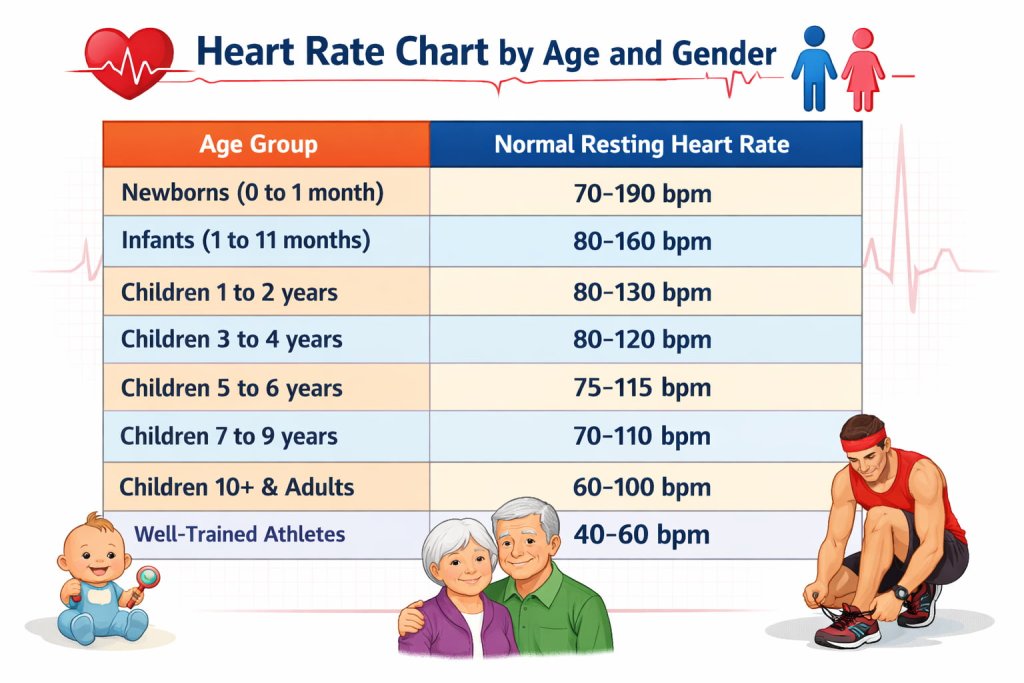
The most practical resting pulse chart is shown below. The age ranges come from MedlinePlus, and the adult interpretation aligns with guidance from the American Heart Association.
| Age group | Normal resting heart rate |
|---|---|
| Newborns (0 to 1 month) | 70 to 190 bpm |
| Infants (1 to 11 months) | 80 to 160 bpm |
| Children 1 to 2 years | 80 to 130 bpm |
| Children 3 to 4 years | 80 to 120 bpm |
| Children 5 to 6 years | 75 to 115 bpm |
| Children 7 to 9 years | 70 to 110 bpm |
| Children 10+ and adults, including seniors | 60 to 100 bpm |
| Well-trained athletes | 40 to 60 bpm |
This chart shows why age matters more than gender for resting pulse. Children normally run faster heart rates than adults, while teens, adults, and seniors usually use the same 60 to 100 bpm resting range.
What “by Gender” Really Means
Here is the key point many articles miss: men and women generally use the same official adult normal resting heart rate range. In other words, there is not a widely used clinical chart that says adult men should have one normal resting range and adult women another.
That said, research does show a modest average difference. A peer-reviewed review available through PubMed Central reports that adult women often have slightly higher average resting heart rates than adult men. That finding helps explain why women may trend a little higher on average, but it does not change the standard normal adult resting range used in everyday clinical guidance.
Simple Gender Takeaway
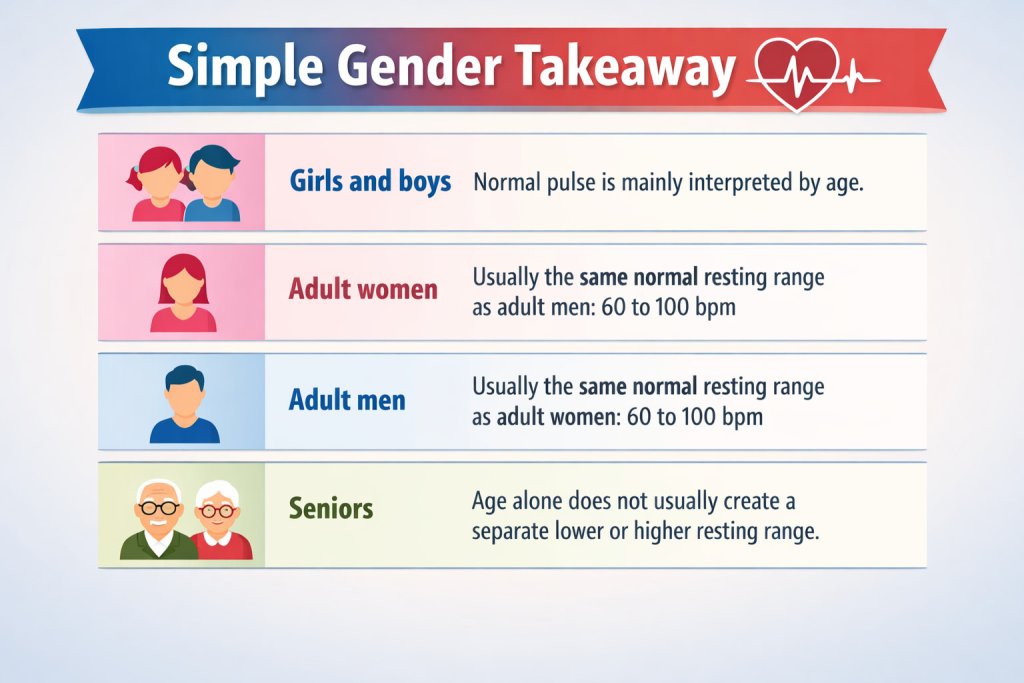
| Group | What to know |
|---|---|
| Girls and boys | Normal pulse is mainly interpreted by age |
| Adult women | Usually the same normal resting range as adult men: 60 to 100 bpm |
| Adult men | Usually the same normal resting range as adult women: 60 to 100 bpm |
| Seniors | Age alone does not usually create a separate lower or higher resting range |
This is the safest and most accurate way to explain a heart rate chart by age and gender without overstating sex-based differences.
What Is a Resting Heart Rate?
Your resting heart rate is your pulse when you are calm, awake, and not exercising. The American Heart Association notes that a normal adult resting heart rate is 60 to 100 bpm when you are sitting or lying down, calm, and feeling well.
This matters because heart rate changes all day long. Stress, standing up, activity, pain, heat, emotions, and some medicines can all move the number up or down. That is why one random reading is less useful than a true resting reading taken under consistent conditions.
How to Measure Your Resting Pulse Correctly
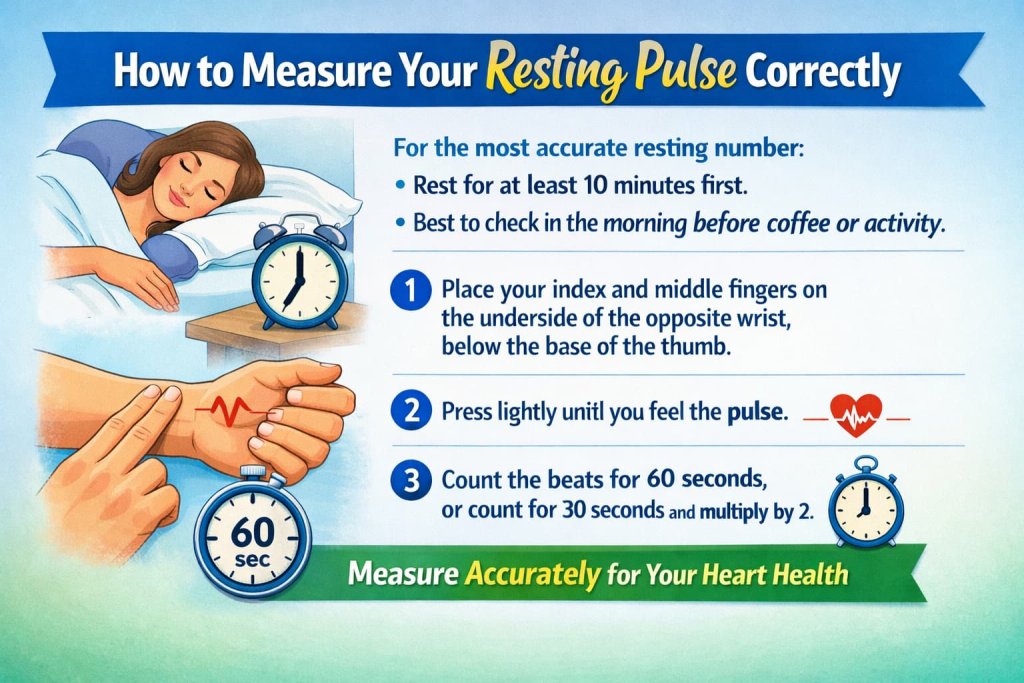
For the most accurate resting number, MedlinePlus says you should be resting for at least 10 minutes first. A good time to check is in the morning before coffee, exercise, or rushing around.
To check your pulse at the wrist:
- Place your index and middle fingers on the underside of the opposite wrist, below the base of the thumb.
- Press lightly until you feel the pulse.
- Count the beats for 60 seconds, or count for 30 seconds and multiply by 2.
You can also check the pulse in the neck, but press gently. MedlinePlus advises against checking both sides of the neck at the same time because that can cause problems in some people.
Many people now use a smartwatch or fitness tracker for pulse checks. That can be helpful for spotting trends, but the U.S. Food and Drug Administration says wearable heart-rate and rhythm notifications are not meant to provide a diagnosis, false alerts can happen, and clinical decisions should be made with a qualified healthcare professional. Treat a wearable as a prompt to recheck or follow up, not as the final word.
Does Resting Heart Rate Change With Age?
Yes and no. Children’s normal resting heart rates are clearly higher than adults’, which is why age-based charts are important in pediatrics. But once you reach older childhood and adulthood, the standard resting range becomes much more stable.
For older adults, the National Institute on Aging says resting heart rate does not change significantly with normal aging. What does change more noticeably is how fast the heart can beat during physical activity or stress.
Why Your Heart Rate May Be Higher or Lower Than Usual
A heart rate number should always be read in context. The American Heart Association notes that resting heart rate can be affected by stress, anxiety, hormones, medication use, body position, temperature, exercise level, and overall fitness.
A lower resting heart rate can be completely normal in some people. Well-trained athletes may have resting heart rates around 40 to 60 bpm, and some medicines such as beta blockers can also slow the pulse.
A higher resting heart rate does not always mean heart disease either. Temporary causes such as dehydration, infection, pain, or emotional stress can raise the number. Still, if your pulse is persistently faster or slower than usual for you, it is worth discussing with a clinician.
When a Heart Rate May Be Too High or Too Low
For adults at rest, a heart rate over 100 bpm is generally considered tachycardia, while a heart rate below 60 bpm may be called bradycardia. But those labels do not automatically mean something is wrong. Symptoms, medical history, medications, and fitness level all matter.
An irregular pulse also deserves attention, even when the number itself falls inside the usual adult range. MedlinePlus notes that an irregular pulse can indicate a problem, so a reading such as 72 bpm is not automatically reassuring if the rhythm feels uneven, skipping, fluttering, or newly erratic.
A person with a resting pulse below 60 may feel completely fine, especially if they are athletic or take a heart-rate-lowering medication. On the other hand, a pulse that is normal on paper may still need attention if it is new, irregular, or comes with symptoms.
Resting Heart Rate vs. Exercise Heart Rate
This is an easy place to get confused. A resting heart rate chart tells you what is usual when you are calm and not active. An exercise or target heart rate chart is different and is used to judge workout intensity.
So if your pulse rises well above 100 during exercise, that may be completely normal. The important question is whether the number is appropriate for what you are doing and whether you feel well while active.
Safety Box: When to Seek Medical Care
A pulse chart is useful, but it does not diagnose a heart rhythm problem by itself. Seek urgent medical care if a fast, slow, or irregular heart rate comes with:
- chest pain or pressure
- shortness of breath
- fainting or near-fainting
- severe dizziness or lightheadedness
- a pounding, fluttering, or irregular heartbeat that feels new or concerning
The American Heart Association specifically advises calling 911 if your heart rate is suddenly very high or very low for you and you also have symptoms such as chest pain, shortness of breath, dizziness, or fainting. If you have chest pain or pressure and think it could be a heart attack, call 911 right away.
When to Make a Routine Medical Appointment
You do not need emergency symptoms to bring a heart rate concern to a clinician. MedlinePlus advises discussing resting heart rates that are continually high, resting heart rates below the normal range that are not typical for you, an irregular pulse, or a pulse that feels unusually hard and pounding for more than a few minutes. That is especially worth doing if the change is new for you or keeps showing up at rest.
Practical Examples
Is 55 bpm normal?
It can be. A resting heart rate of 55 bpm may be normal in a well-trained athlete or in someone taking certain medicines, especially if they feel well. But if 55 is unusual for you or comes with weakness, dizziness, or fainting, it should be checked.
Is 90 bpm normal?
Usually yes. For most adults, 90 bpm is still within the standard resting range of 60 to 100 bpm. The bigger questions are whether you were truly resting and whether the number is persistently high for you or comes with symptoms.
Is a pulse of 105 always dangerous?
Not always. Anxiety, fever, pain, dehydration, or recent activity can temporarily push heart rate above 100. But a resting pulse that stays above 100, especially with symptoms, deserves medical advice.
FAQ
Do women have a higher heart rate than men?
Often slightly, on average, yes. But the usual official adult resting range is still the same for both sexes: 60 to 100 bpm. Average differences do not usually create separate clinical normal charts for adult men and women.
Does resting heart rate go up with age?
In children, normal pulse rates are higher and gradually slow with age. In older adults, however, the National Institute on Aging says resting heart rate does not change significantly with normal aging.
Is 60 bpm good?
For many adults, yes. A resting heart rate of 60 bpm sits right at the lower edge of the standard adult normal range and may be perfectly healthy, especially in active people.
Can anxiety raise heart rate?
Yes. The American Heart Association notes that stress, anxiety, and emotions can raise pulse rate, which is why it is best to measure resting heart rate when you are calm.
Should seniors use a different resting heart rate chart?
Usually no. MedlinePlus places adults and seniors in the same 60 to 100 bpm resting range, and the National Institute on Aging says resting heart rate does not change significantly with normal aging.
The Bottom Line on a Heart Rate Chart by Age and Gender
A useful heart rate chart is mostly an age chart, not a men-versus-women chart. For most adults, including most seniors, a normal resting pulse is 60 to 100 bpm. Women may average slightly higher resting heart rates than men, but the standard clinical range is generally the same.
If you want the most meaningful number, measure your pulse when you are truly at rest, track your usual pattern over time, and pay attention to symptoms, not just the number alone. If your heart rate feels very different from normal for you, or if you have chest pain, fainting, shortness of breath, or a new irregular rhythm, get medical advice promptly.
Sources/References
- MedlinePlus — Pulse
- American Heart Association — All About Heart Rate
- PubMed Central — Role of Biological Sex in Normal Cardiac Function and in Its Disease Outcome
- U.S. Food and Drug Administration — Post-Market Evaluation of Smartwatch Cardiovascular Notifications
- National Institute on Aging — Heart Health and Aging
This content is for informational purposes only and not medical advice.