
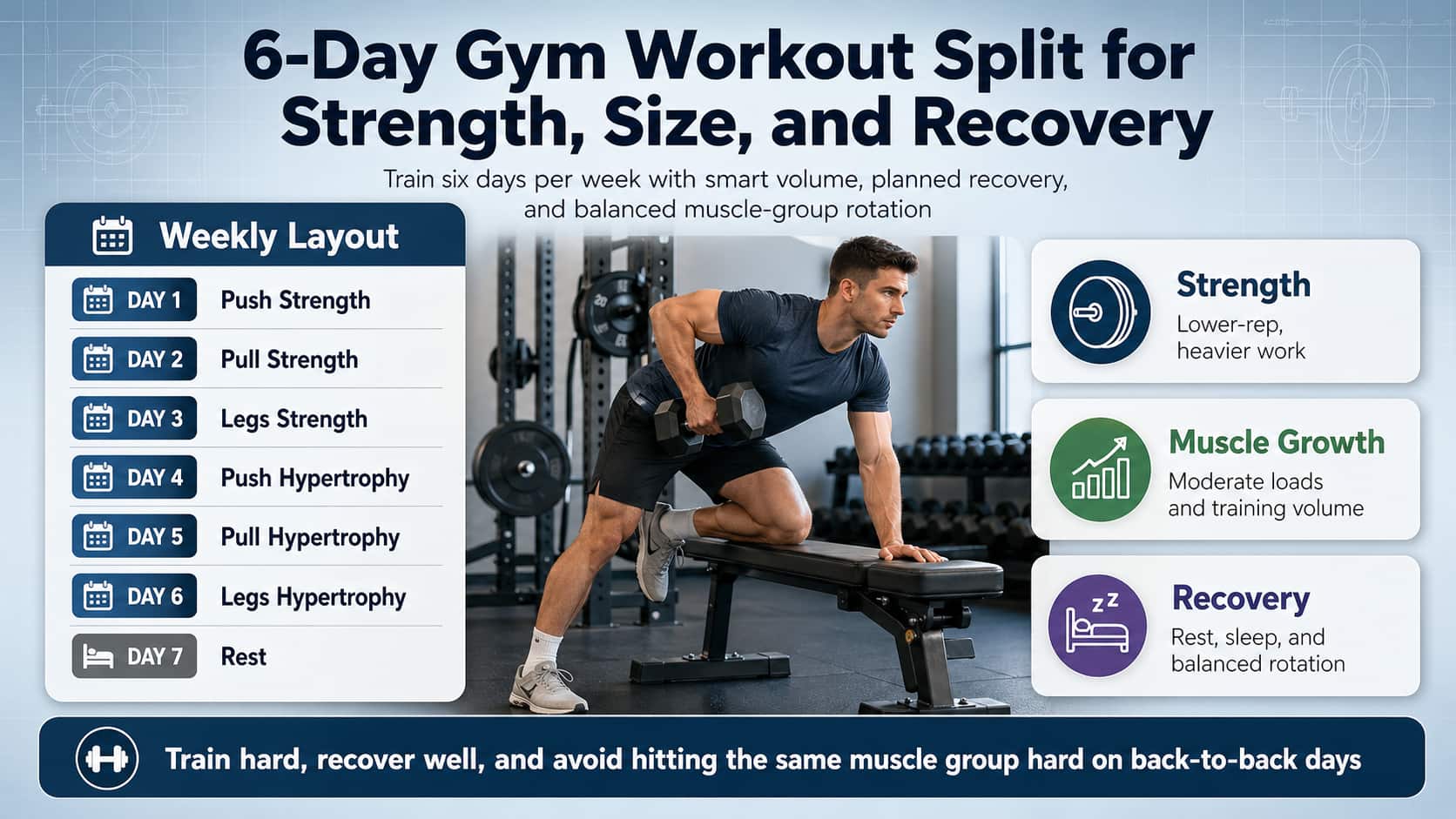
A 6-day workout split is a structured gym plan that trains different muscle groups across six weekly sessions, usually with one full rest day, so you can build strength and muscle while still protecting recovery. The best 6-day workout split is not about doing more for the sake of more. It is about spreading your weekly training volume across the week so each session stays focused, productive, and manageable.
For most lifters, a push/pull/legs split repeated twice per week works especially well. It trains each major muscle group twice weekly, gives muscles time to recover, and lets you use heavier work for strength early in the week and higher-rep work for size later in the week.
What Is a 6-Day Workout Split?
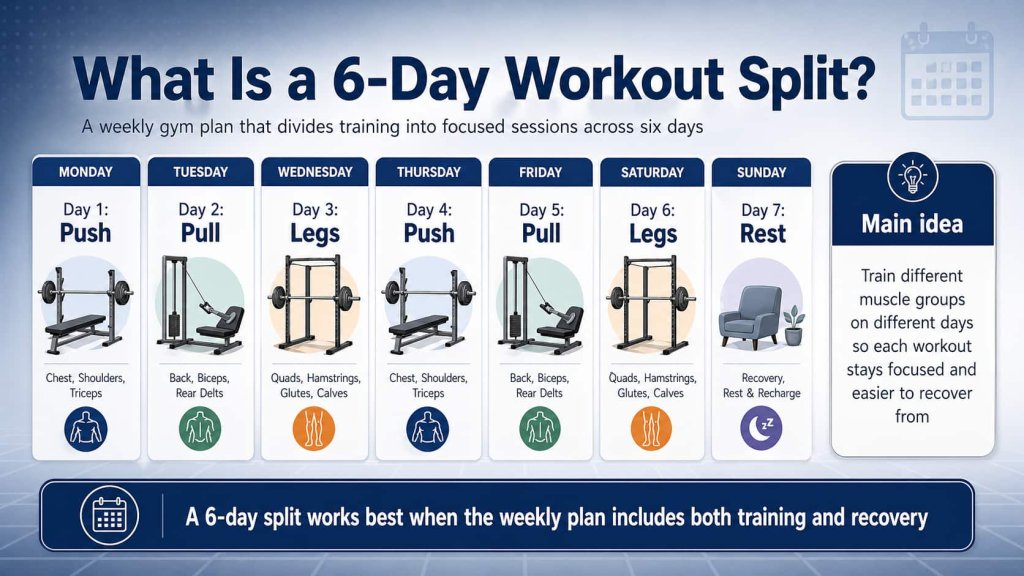
A 6-day workout split is a weekly training schedule where you lift weights six days per week and rest one day. Instead of training your whole body every session, you divide workouts by movement pattern or muscle group.
A common version looks like this:
| Day | Workout | Main Focus |
|---|---|---|
| Day 1 | Push | Chest, shoulders, triceps strength |
| Day 2 | Pull | Back, rear delts, biceps strength |
| Day 3 | Legs | Quads, hamstrings, glutes strength |
| Day 4 | Push | Chest, shoulders, triceps hypertrophy |
| Day 5 | Pull | Back, rear delts, biceps hypertrophy |
| Day 6 | Legs | Quads, hamstrings, glutes hypertrophy |
| Day 7 | Rest | Recovery, mobility, light walking |
This layout works because it avoids training the same major muscle group hard on back-to-back days. Mayo Clinic recommends training all major muscle groups at least two times per week while avoiding working the same muscle group two days in a row.
Is a 6-Day Workout Split Effective?
Yes, a 6-day workout split can be effective for strength and muscle growth when the weekly volume, exercise selection, and recovery plan are realistic. It is especially useful for intermediate and advanced lifters who can already train consistently.
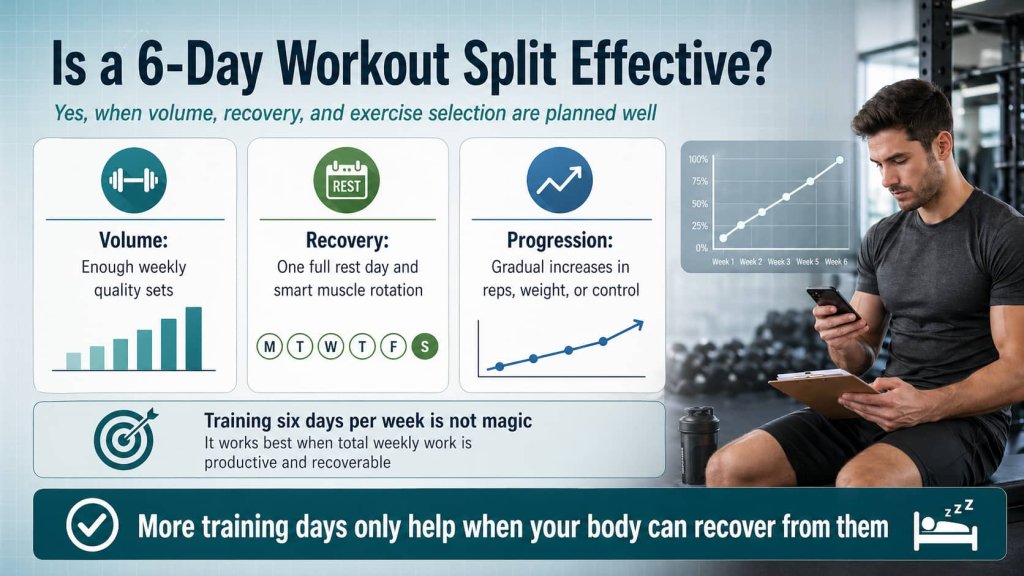
The key point is this: training six days per week is not automatically better than training three or four days per week. A 6-day split mainly helps you distribute your work better. A PubMed-indexed meta-analysis by Schoenfeld and colleagues found a dose-response relationship between weekly resistance training volume and muscle growth, while another review found that training frequency does not appear to strongly affect hypertrophy when total volume is matched. In simple terms, total quality work matters more than the number of days alone.
Who Should Use a 6-Day Workout Split?
A 6-day gym workout split is usually best for lifters who already have a training base.
It may be a good fit if you:
- Have been lifting consistently for at least several months
- Recover well between workouts
- Can train with good form without rushing
- Sleep and eat enough to support frequent lifting
- Want to train each muscle group twice per week
- Prefer shorter, focused workouts instead of long full-body sessions
A 6-day split may not be ideal if you are brand new to lifting, returning after a long break, dealing with pain, sleeping poorly, or feeling constantly run down. In those cases, a 3-day or 4-day split is usually a better starting point.
6-Day Workout Split for Strength, Size, and Recovery
This plan uses a strength-focused first half of the week and a hypertrophy-focused second half. The heavier days build strength. The higher-rep days add training volume for muscle growth.
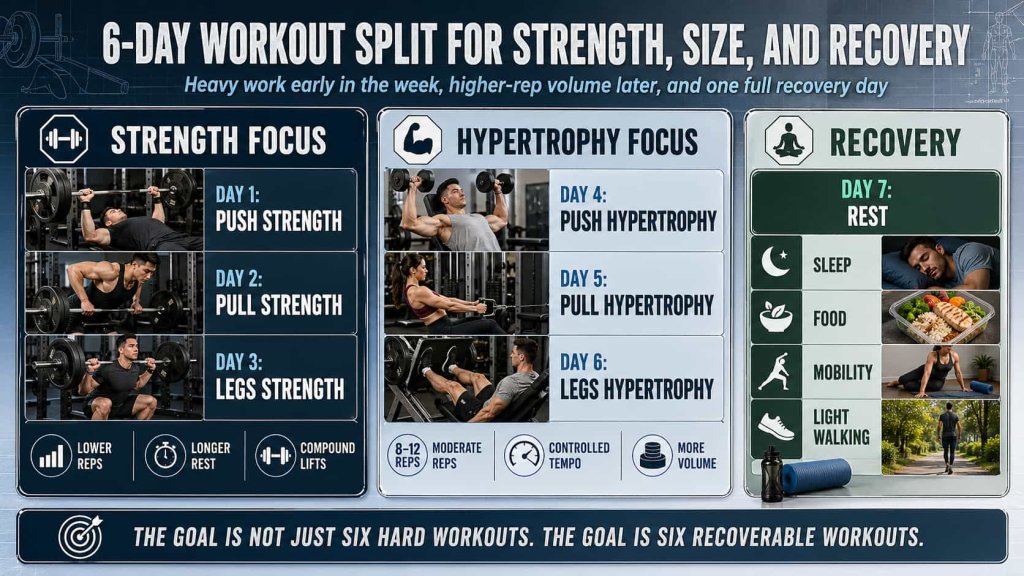
Use a weight that allows clean form. Most sets should finish with about 1–3 reps left in reserve. Avoid turning every set into a max-effort grind.
How Hard Should Each Set Feel?
“Reps left in reserve” means how many more clean reps you could likely do before your form breaks down. If you finish a set and feel like you could do 2 more good reps, that is 2 reps in reserve.
For this plan, use this simple guide:
- Main strength lifts: stop with about 1–3 reps in reserve.
- Hypertrophy sets: stop with about 0–3 reps in reserve.
- Isolation exercises: you can occasionally go closer to failure, but only with controlled form.
- Avoid true max-effort failure on heavy squats, deadlifts, bench presses, and overhead presses unless you are experienced and have proper safety setup.
This keeps the workouts hard enough to drive progress without making recovery harder than it needs to be.
Day 1: Push Strength
Focus on heavier pressing for the chest, shoulders, and triceps.
| Exercise | Sets | Reps |
|---|---|---|
| Barbell bench press | 3 | 3–6 |
| Standing overhead press | 3 | 4–6 |
| Incline dumbbell press | 2–3 | 6–8 |
| Weighted dip or assisted dip | 2 | 6–10 |
| Dumbbell lateral raise | 2–3 | 12–15 |
| Cable triceps pressdown | 2–3 | 8–12 |
Rest 2–3 minutes on heavy presses and about 60–90 seconds on smaller accessory exercises.
Day 2: Pull Strength
This workout targets the back, rear delts, biceps, and grip.
| Exercise | Sets | Reps |
|---|---|---|
| Deadlift or rack pull | 2–3 | 3–5 |
| Pull-up or lat pulldown | 3 | 5–8 |
| Barbell row | 3 | 5–8 |
| Seated cable row | 2–3 | 8–10 |
| Face pull | 2–3 | 12–15 |
| Barbell curl | 2–3 | 8–12 |
If deadlifts are too draining, use Romanian deadlifts, trap-bar deadlifts, or chest-supported rows instead.
Day 3: Legs Strength
This session prioritizes heavier lower-body lifts.
| Exercise | Sets | Reps |
|---|---|---|
| Back squat or front squat | 3 | 3–6 |
| Romanian deadlift | 3 | 5–8 |
| Leg press | 2–3 | 6–10 |
| Lying or seated leg curl | 2–3 | 8–12 |
| Standing calf raise | 3 | 8–12 |
| Plank | 2–3 | 30–60 seconds |
Keep your reps controlled. Do not bounce out of squats or force depth if your form breaks down.
Day 4: Push Hypertrophy
The goal is more controlled volume for muscle growth.
| Exercise | Sets | Reps |
|---|---|---|
| Incline barbell or dumbbell press | 3 | 8–12 |
| Seated dumbbell shoulder press | 2–3 | 8–12 |
| Machine chest press | 2–3 | 10–15 |
| Cable fly | 2–3 | 12–15 |
| Dumbbell lateral raise | 3 | 12–20 |
| Overhead cable triceps extension | 2–3 | 10–15 |
Use smooth reps and a full comfortable range of motion. The weight should challenge you without forcing sloppy reps.
Day 5: Pull Hypertrophy
This workout adds back width, back thickness, rear-delt work, and biceps volume.
| Exercise | Sets | Reps |
|---|---|---|
| Lat pulldown | 3 | 8–12 |
| Chest-supported row | 3 | 8–12 |
| Single-arm dumbbell row | 2–3 | 10–12 each side |
| Rear-delt fly | 2–3 | 12–20 |
| Cable pullover | 2 | 12–15 |
| Incline dumbbell curl | 2–3 | 10–15 |
| Hammer curl | 2 | 10–15 |
Keep your shoulders down and back during rows and pulldowns. Avoid turning every rep into a lower-back swing.
Day 6: Legs Hypertrophy
This session uses moderate loads and higher reps for the quads, hamstrings, glutes, calves, and core.
| Exercise | Sets | Reps |
|---|---|---|
| Hack squat or goblet squat | 3 | 8–12 |
| Hip thrust | 3 | 8–12 |
| Walking lunge | 2–3 | 10–12 each leg |
| Leg extension | 2–3 | 12–15 |
| Seated leg curl | 2–3 | 12–15 |
| Seated calf raise | 3 | 12–20 |
| Hanging knee raise or dead bug | 2–3 | 10–15 |
If your knees, hips, or lower back feel beat up, reduce the load and choose more joint-friendly variations.
Day 7: Rest or Active Recovery
Your rest day is part of the program, not a missed workout. Use it to recover so your next week of training is productive.
Good rest-day options include:
- Easy walking
- Light mobility work
- Gentle stretching
- Meal preparation
- Extra sleep
- No heavy lifting
The CDC says adults need at least 150 minutes of moderate-intensity aerobic activity per week or 75 minutes of vigorous activity, plus muscle-strengthening work on at least 2 days per week. A 6-day lifting split can fit within an active lifestyle, but it should not replace basic recovery.
How Many Sets and Reps Should You Do?
The right sets and reps depend on your goal.
| Goal | Best Rep Range | Practical Use |
|---|---|---|
| Strength | 3–6 reps | Main compound lifts |
| Muscle growth | 6–15 reps | Most working sets |
| Isolation work | 10–20 reps | Side delts, arms, calves, rear delts |
| Technique work | Light to moderate reps | Learning or refining form |
The American College of Sports Medicine updated its resistance training guidance in 2026 and noted that heavier loads around 80% of one-rep max or higher are useful for strength, while roughly 10 weekly sets per muscle group can support hypertrophy for many lifters.
For this 6-day workout split, most major muscle groups land near that range when you count both strength and hypertrophy days.
How to Progress on a 6-Day Workout Split
Progression should be steady, not reckless. You do not need to add weight every workout.
Use this simple method:
- Pick a rep range, such as 8–12 reps.
- Start with a weight you can lift cleanly for the lower end of the range.
- Keep the same weight until you can hit the top end on all sets.
- Add a small amount of weight the next time.
- If form breaks down, reduce the weight or reps.
For example, if your dumbbell press target is 3 sets of 8–12 reps, stay with the same weight until you can do 12, 12, and 12 with good control. Then increase the weight slightly.
How Long Should Each Workout Take?
Most workouts in this plan should take about 45–75 minutes.
If your workouts consistently take longer than 90 minutes, you may be doing too much volume, resting too long between smaller exercises, or adding unnecessary extra sets. A 6-day workout split should make sessions easier to manage, not turn every workout into a marathon.
How Much Rest Should You Take Between Sets?
Rest longer for heavy compound lifts and shorter for isolation work.
| Exercise Type | Suggested Rest |
|---|---|
| Heavy squats, presses, deadlifts | 2–3 minutes |
| Rows, pulldowns, leg press | 90–120 seconds |
| Curls, raises, flys, pressdowns | 45–90 seconds |
| Core work | 30–60 seconds |
Longer rest helps strength performance. Shorter rest can work well for accessories, but do not rush so much that your form suffers.
Recovery Rules for a 6-Day Workout Split
Recovery is what allows training to turn into progress. Without it, a 6-day routine can quickly become too much.
Use these recovery rules:
- Keep at least one full rest day each week.
- Avoid hard training for the same muscle group on back-to-back days.
- Sleep enough to support performance and recovery.
- Eat enough protein and total calories for your goal.
- Reduce volume if soreness, fatigue, or joint irritation keeps building.
- Take a lighter week when performance drops for several workouts.
A consensus statement from the American Academy of Sleep Medicine and Sleep Research Society says adults should sleep 7 or more hours per night on a regular basis for optimal health. For nutrition, the International Society of Sports Nutrition states that many exercising individuals can benefit from about 1.4–2.0 grams of protein per kilogram of body weight per day.
When to Take a Deload Week
A deload is a planned easier week that helps you recover before fatigue starts hurting your progress. You do not need to deload on a fixed schedule, but it becomes useful when your body is clearly asking for less.
Consider a deload week if:
- Your lifts drop for several workouts in a row
- Normal weights feel unusually heavy
- Joint aches keep building
- Sleep, motivation, or energy feels worse than usual
- Soreness lasts longer than it normally does
- You feel mentally burned out from training
During a deload, reduce your training volume by about 30–50% and avoid max-effort sets. You can keep the same exercises, but use fewer sets, lighter weights, or both. After the deload, return to training gradually instead of immediately trying to beat every previous number.
Should You Add Cardio to a 6-Day Workout Split?
Yes, but keep it realistic. Cardio supports heart health, work capacity, and recovery when it is programmed well.
Good options include:
- 20–30 minutes of incline walking after upper-body workouts
- 2–3 low-intensity cardio sessions per week
- Easy cycling or walking on rest day
- Short conditioning work only if it does not hurt leg recovery
Avoid adding intense cardio after every workout if your main goal is strength and size. Too much high-intensity work can make leg days harder to recover from.
What to Eat to Support a 6-Day Workout Split
Training six days per week requires enough food to support performance and recovery. If you under-eat while training this often, your workouts may feel harder, soreness may last longer, and strength progress may stall.
Focus on the basics first:
- Eat enough protein each day to support muscle repair and growth.
- Include carbohydrates around training to fuel harder sessions.
- Get healthy fats from foods like eggs, olive oil, nuts, seeds, avocado, and fatty fish.
- Drink enough fluids so your urine is usually pale yellow.
- Do not rely on supplements to fix poor sleep, low calories, or inconsistent meals.
For muscle gain, most lifters need a small calorie surplus. For fat loss, use a modest calorie deficit while keeping protein high and training volume recoverable. Avoid aggressive dieting while running a demanding 6-day split, especially if strength and muscle growth are your main goals.
Beginner Version of the 6-Day Workout Split
True beginners usually do not need six lifting days right away. A better approach is to build consistency first.
Start with this 3-day version:
| Day | Workout |
|---|---|
| Monday | Full body |
| Wednesday | Full body |
| Friday | Full body |
| Other days | Walking, mobility, rest |
Or use this 4-day version:
| Day | Workout |
|---|---|
| Monday | Upper body |
| Tuesday | Lower body |
| Thursday | Upper body |
| Friday | Lower body |
After several months of consistent training, you can move toward the 6-day split if recovery is good.
Best Exercises for a 6-Day Gym Workout Split
A strong 6-day split should include compound lifts, machine work, and isolation exercises.
Best compound exercises:
- Squat
- Deadlift
- Bench press
- Overhead press
- Pull-up or lat pulldown
- Row
- Leg press
- Romanian deadlift
- Hip thrust
Best accessory exercises:
- Lateral raise
- Rear-delt fly
- Cable fly
- Triceps pressdown
- Biceps curl
- Leg curl
- Leg extension
- Calf raise
- Core stability exercises
You do not need every exercise in one plan. Choose movements you can perform well and recover from.
Common Mistakes to Avoid
The biggest mistake is treating a 6-day split as permission to train hard all the time.
Avoid these common errors:
- Maxing out too often
- Adding extra sets every week without tracking recovery
- Training through sharp or worsening pain
- Skipping warm-ups
- Ignoring sleep and nutrition
- Doing too many heavy deadlift or squat variations
- Copying an advanced lifter’s routine without adjusting volume
- Turning rest day into another intense workout
Mayo Clinic advises warming up for 5–10 minutes before lifting, using controlled movement, and avoiding pain during weight training.
How to Warm Up Before Each Workout
A good warm-up prepares your joints, muscles, and nervous system without tiring you out before the real work starts.
Use this simple warm-up structure:
- Start with 5–10 minutes of easy cardio, such as walking, cycling, or rowing.
- Do 2–3 light mobility drills for the joints you will train that day.
- Perform warm-up sets before your first heavy lift.
- Start light and gradually add weight until you reach your working sets.
For example, before a heavy bench press, you might do the empty bar for 10–15 reps, then a moderate set of 5–8 reps, then a heavier warm-up set of 2–4 reps before starting your working weight.
Do not skip warm-up sets on heavy compound lifts. They help you practice technique, check how your body feels that day, and reduce the chance of starting too heavy too soon.
Safety Box: When to Modify or Stop
A 6-day workout split should make you feel stronger over time, not constantly exhausted.
Modify the plan if you notice:
- Joint pain that gets worse during training
- Soreness that does not improve between sessions
- A sudden drop in performance
- Poor sleep or unusual fatigue
- Loss of motivation for several workouts in a row
- Form breaking down even with lighter weights
Stop the exercise and choose a safer variation if you feel sharp pain, dizziness, chest discomfort, or unusual shortness of breath. If you have an injury history, chronic medical condition, or you are unsure whether frequent lifting is appropriate, speak with a qualified healthcare professional or certified trainer before starting.
Sample Weekly Schedule
Here is a simple weekly layout you can follow:
| Day | Workout | Intensity |
|---|---|---|
| Monday | Push strength | Heavy |
| Tuesday | Pull strength | Heavy |
| Wednesday | Legs strength | Heavy |
| Thursday | Push hypertrophy | Moderate |
| Friday | Pull hypertrophy | Moderate |
| Saturday | Legs hypertrophy | Moderate |
| Sunday | Rest | Easy recovery |
If your schedule is different, keep the same order and place the rest day where you need it most.
How to Adjust the Split for Your Goal
A 6-day workout split can be adjusted for strength, muscle size, or fat loss. The structure can stay similar, but your exercise choices, volume, and recovery needs should match your main goal.
For Strength
Prioritize the first three workouts of the week. Keep the main lifts heavy, rest longer, and avoid adding too many accessory sets.
Best focus:
- Bench press
- Squat
- Deadlift or deadlift variation
- Overhead press
- Row or pull-up
For Muscle Size
Prioritize weekly volume and controlled reps. Keep most sets in the 6–15 rep range and include isolation exercises for muscles that need more attention.
Best focus:
- Enough weekly sets per muscle group
- Full range of motion
- Controlled eccentrics
- Consistent progression
- Good recovery between sessions
For Fat Loss
A 6-day workout split can support fat loss, but fat loss mainly depends on overall energy balance, food choices, sleep, and consistency. Do not add excessive lifting volume just to “burn more calories.” Keep the strength plan sustainable and use walking or moderate cardio as needed.
FAQ About the 6-Day Workout Split
Is a 6-day workout split too much?
It can be too much for beginners or anyone recovering poorly. For intermediate and advanced lifters, it can work well if volume is controlled and at least one full rest day is included.
Is push/pull/legs the best 6-day split?
Push/pull/legs is one of the best 6-day splits because it trains each major muscle group twice per week and naturally separates related movement patterns. It is not the only option, but it is one of the easiest to organize.
Can I build muscle with a 6-day workout split?
Yes. A 6-day split can help build muscle when you use enough weekly volume, train close to failure without overdoing it, eat enough protein, and recover well.
Should I train abs every day on a 6-day split?
No. Your core needs recovery too. Two to four focused core sessions per week is usually enough, especially because squats, deadlifts, rows, and presses already challenge trunk stability.
Can beginners do this 6-day workout split?
Most beginners should start with 3–4 days per week. Once form, consistency, and recovery improve, they can gradually move toward a 6-day split.
How many exercises should I do per workout?
Most sessions should include 5–7 exercises. More is not always better. The goal is enough quality work to progress without making recovery harder.
Conclusion
A 6-day workout split can be a powerful way to build strength and size when it is planned around recovery. The best approach is a balanced push/pull/legs structure that trains each muscle group twice per week, uses heavier work for strength, adds moderate-rep volume for muscle growth, and keeps one full rest day.
Start with the version you can recover from, track your progress, and adjust volume before fatigue turns into a setback. A good 6-day gym workout split should help you train hard, recover well, and keep making progress week after week.
References
- CDC — Adult Activity: An Overview
- American College of Sports Medicine — Resistance Training Guidelines Update 2026
- Mayo Clinic — Strength Training
- Mayo Clinic — Weight Training: Do’s and Don’ts of Proper Technique
- PubMed — Dose-Response Relationship Between Weekly Resistance Training Volume and Muscle Hypertrophy
- PubMed — How Many Times Per Week Should a Muscle Be Trained to Maximize Muscle Hypertrophy?
- PubMed Central — Recommended Amount of Sleep for a Healthy Adult
- PubMed — International Society of Sports Nutrition Position Stand: Protein and Exercise