
Front squat vs back squat comes down to your goal: back squats are usually better for lifting heavier weight and building overall lower-body strength, while front squats are excellent for quad focus, upright posture, core control, and cleaner squat mechanics.
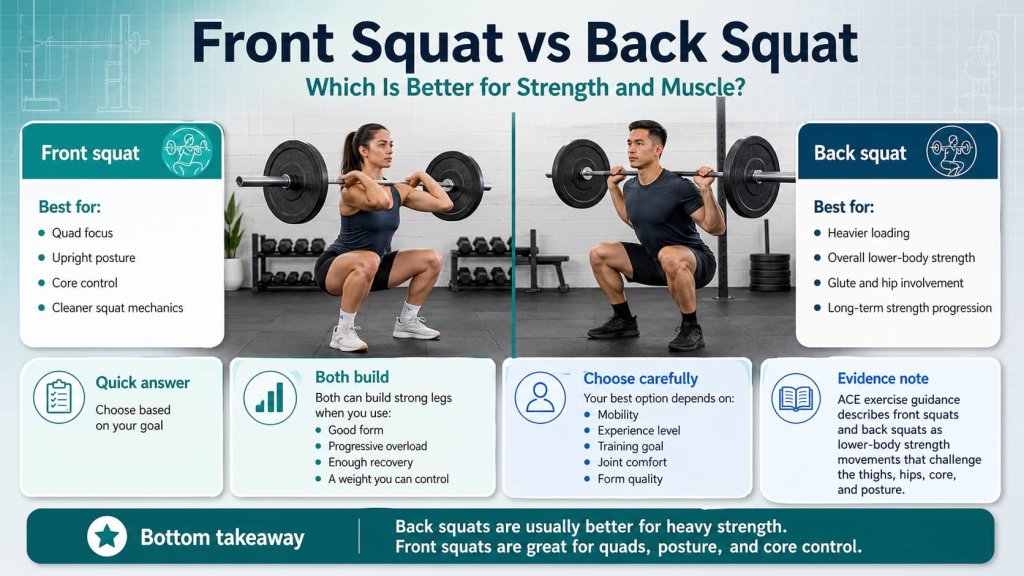
Both exercises can build strong legs and muscle when you use good form, progressive overload, and enough recovery. The best choice depends on your mobility, experience level, training goal, and how each squat feels on your knees, hips, wrists, shoulders, and back.
The American Council on Exercise describes the front squat as a full-body movement that challenges the thighs, hips, core, and upper-back position, while its exercise guidance for the back squat shows why the back squat is a major lower-body strength exercise.
Front Squat vs Back Squat: The Quick Answer
If your main goal is maximum strength, the back squat is usually the better choice because most lifters can use more weight.
If your goal is quad strength, upright posture, core control, or a squat variation that may feel easier to keep vertical, the front squat can be a better fit.
| Goal | Better Choice | Why |
|---|---|---|
| Lift the most weight | Back squat | Bar position usually allows heavier loading |
| Build overall lower-body strength | Back squat | Strong choice for quads, glutes, hips, and trunk |
| Emphasize quads | Front squat | More upright torso and forward knee travel often increase quad demand |
| Train core and upper-back control | Front squat | Bar position forces strong bracing and posture |
| Improve squat technique | Front squat | Easier to notice if you lean too far forward |
| Build glutes | Back squat | Often allows heavier loading and more hip involvement |
| Beginner learning | Depends | Goblet squats may come before either barbell version |
The simple answer: choose back squats for heavier strength work and front squats for quad-focused, posture-demanding squat training.
What Is a Front Squat?
A front squat is a squat variation where the load sits in front of your body, usually across the front of your shoulders.
Because the bar is in front, you must keep your torso more upright. If you lean too far forward, the bar may roll or feel unstable. That makes the front squat a strong teaching tool for bracing, posture, and controlled squat depth.
How to do it
- Set the bar at about upper-chest height in a rack.
- Step under the bar so it rests across the front of your shoulders.
- Use a clean grip, cross-arm grip, or strap-assisted grip.
- Keep your elbows lifted as much as your mobility allows.
- Stand tall and step back carefully.
- Brace your core before each rep.
- Squat down with control while keeping your chest tall.
- Keep your knees tracking in line with your toes.
- Drive through your midfoot to stand back up.
- Reset your brace before the next rep.
Why it works
The front squat challenges your quads, glutes, upper back, and core at the same time. The front-loaded position makes it harder to fold forward, so your trunk and upper back must work hard to keep the bar stable.
Trainer Tip
Think “elbows high, ribs down, brace hard.” If your elbows drop and your upper back rounds, the bar will feel harder to control.
What Is a Back Squat?
A back squat is a squat variation where the bar rests across your upper back instead of the front of your shoulders.
Because the load is behind your centerline, most lifters can usually handle more weight with a back squat than a front squat. That makes it one of the most popular exercises for building lower-body strength.
How to do it
- Set the bar in a rack at about upper-chest height.
- Step under the bar and position it across your upper back.
- Grip the bar firmly with both hands.
- Pull your shoulder blades back and down to create a stable shelf.
- Stand up, step back, and set your feet.
- Brace your core before descending.
- Sit down and slightly back while keeping your feet planted.
- Keep your knees tracking over your toes.
- Squat to a depth you can control.
- Drive through your feet to stand tall.
Why it works
The back squat allows heavy loading through the legs, hips, and trunk. It is effective for strength because you can usually progress the load over time while training several major muscle groups together.
Trainer Tip
Do not chase depth by rounding your back or letting your heels lift. Use the deepest range you can control with stable feet, a braced core, and good alignment.
Front Squat vs Back Squat: Main Differences
The biggest difference between a front squat and back squat is bar position.
That one change affects posture, loading, mobility demands, muscle emphasis, and how the lift feels.
| Feature | Front Squat | Back Squat |
|---|---|---|
| Bar position | Front of shoulders | Upper back |
| Torso angle | More upright | More forward lean is common |
| Loading potential | Usually lighter | Usually heavier |
| Main feel | Quads, core, upper back | Quads, glutes, hips, full lower body |
| Mobility needs | More wrist, shoulder, upper-back, ankle mobility | More shoulder and hip control |
| Technique feedback | Bar position exposes forward lean quickly | Easier to “muscle through” poor reps |
| Best use | Quad focus, posture, clean mechanics | Strength, hypertrophy, heavier loading |
Neither squat is automatically better for everyone. They are different tools.
Muscles Worked in Front Squats and Back Squats
Front squats and back squats train many of the same muscles.
The main difference is how the load is positioned and how your body organizes itself under that load.
Primary muscles used in both squats
- Quadriceps
- Gluteus maximus
- Hamstrings
- Adductors
- Calves
- Core muscles
- Spinal erectors
- Upper-back stabilizers
Front squat muscle emphasis
Front squats often feel stronger in the quads because the torso stays more upright and the knees usually travel forward more. They also demand strong upper-back and core control because the bar is held in front of the body.
Back squat muscle emphasis
Back squats often allow more total load, which can make them highly effective for overall leg and hip strength. They can also involve the glutes and posterior chain strongly, especially with a slightly wider stance, controlled depth, and good hip drive.
A PubMed biomechanical comparison reported that front squats produced similar overall muscle recruitment to back squats, while back squats showed higher compressive forces and knee extensor moments in the tested group.
Which Squat Builds More Strength?
For maximum strength, the back squat usually wins.
Most people can back squat more than they can front squat because the bar position is more stable for heavy loading. This makes the back squat easier to progress for low-rep strength work.
Back squats are especially useful for:
- Powerlifting-style strength
- Heavy lower-body training
- Progressive overload
- Glute and leg strength
- Sports performance programs
- Building confidence under heavier loads
That does not mean the front squat is weak or less useful. Front squats can build serious strength, especially in the quads, core, and upper back. They just usually use lighter loads compared with back squats.
Which Squat Builds More Muscle?
Both front squats and back squats can build muscle.
Muscle growth depends on more than exercise selection. It also depends on training volume, effort, range of motion, consistency, nutrition, sleep, and progressive overload.
Back squats may have an advantage for total lower-body muscle because they often allow heavier loads and more total volume. Front squats may be excellent for building the quads because the upright torso often increases quad demand.
For hypertrophy, both can work well when programmed correctly.
| Muscle-Building Goal | Better Option |
|---|---|
| Overall leg size | Back squat |
| Quad-focused growth | Front squat |
| Glute emphasis | Back squat |
| Core and posture challenge | Front squat |
| Heavy progressive overload | Back squat |
| Cleaner squat mechanics | Front squat |
A smart plan can include both.
Front Squat Benefits
Front squats are useful because they build strength while demanding clean posture and control.
Key benefits include:
- Strong quad stimulus
- More upright torso position
- High core demand
- Strong upper-back involvement
- Useful carryover to Olympic lifting
- Helpful for learning better squat mechanics
- Often easier to limit excessive forward lean
Front squats can also be useful when you want a challenging squat without using as much weight as a back squat.
Back Squat Benefits
Back squats are popular because they allow heavy, progressive lower-body training.
Key benefits include:
- Excellent for total lower-body strength
- Usually allows heavier loading
- Strong glute, quad, and hip involvement
- Easy to progress over time
- Useful for strength athletes
- Efficient compound lift for muscle building
- Works well as a main lower-body exercise
If your goal is to get stronger in a general sense, the back squat is usually the main squat variation to prioritize.
Front Squat vs Back Squat for Quads, Glutes, and Core
The best squat depends on which muscles you want to emphasize.
| Area | Front Squat | Back Squat |
|---|---|---|
| Quads | Very strong emphasis | Strong emphasis |
| Glutes | Moderate to strong | Very strong |
| Hamstrings | Support role | Support role |
| Core | Very high demand | High demand |
| Upper back | Very high demand | Moderate to high |
| Lower back | Must stay braced | Often more loading demand |
| Adductors | Strong involvement | Strong involvement |
- For quads, choose front squats.
- For glutes and overall strength, choose back squats.
- For core and posture, front squats are often the better teacher.
Which Squat Is Better for Beginners?
For true beginners, neither barbell front squats nor barbell back squats always need to come first.
A better starting path may look like this:
- Bodyweight squat
- Goblet squat
- Box squat
- Dumbbell squat
- Front squat or back squat
Goblet squats are often easier to learn because the weight is held close to the chest and the load is lighter. Once the basic squat pattern feels stable, you can move toward front squats or back squats.
Choose the front squat if the beginner can keep the elbows up, brace well, and squat comfortably.
Choose the back squat if the beginner has enough shoulder mobility, can control the bar position, and understands how to brace.
Which Squat Is Better for Knee and Back Comfort?
There is no single squat that is best for every knee or back.
Some people feel better with front squats because the torso stays more upright and the load is usually lighter. Others feel better with back squats because the rack position is more comfortable and does not stress the wrists or shoulders.
The PubMed comparison found that back squats created higher compressive forces and knee extensor moments than front squats in healthy trained individuals, but that does not mean front squats are automatically “safe” for every person or every injury.
Use these rules:
- Sharp pain is not normal.
- Pain that worsens during the set is a warning sign.
- Pain that lingers after training should not be ignored.
- Reduce load, range of motion, or volume if form breaks down.
- Get guidance from a qualified professional if you have an injury history.
For general strength training, the CDC recommends adults include muscle-strengthening activity at least 2 days per week, but exercise selection should match your ability and health status.
Common Front Squat Mistakes
Front squats can feel awkward at first. Most problems come from the rack position, bracing, or mobility limits.
Elbows dropping
When your elbows drop, the bar may roll forward.
Fix it by lifting your elbows before every rep and thinking about keeping your upper arms parallel to the floor as much as possible.
Bar resting on the wrists
The bar should sit across the front of the shoulders, not hang in the hands.
If your wrists hurt, try a cross-arm grip or use lifting straps around the bar.
Rounding the upper back
A rounded upper back makes the bar harder to control.
Fix it by bracing your core, lifting your chest, and using a lighter load until your posture improves.
Heels lifting
If your heels lift, you may need better ankle mobility, a slightly wider stance, or weightlifting shoes.
You can also use a goblet squat while building control.
Common Back Squat Mistakes
Back squats allow heavier weight, so small form mistakes can become bigger problems.
Knees caving inward
Your knees should generally track in the same direction as your toes.
Use lighter weight and focus on pressing the floor apart as you stand.
Losing core tension
If your torso collapses or your lower back overarches, the weight may be too heavy.
Brace before every rep and keep your ribs stacked over your pelvis.
Going too heavy too soon
Heavy squats require skill.
Build gradually instead of adding weight every session at the expense of form.
Poor bar position
A bar that sits too high, too low, or unevenly can make the lift uncomfortable.
Take time to find a stable position across your upper back.
How Many Sets and Reps Should You Do?
Your sets and reps should match your goal.
| Goal | Sets | Reps | Load |
|---|---|---|---|
| Beginner practice | 2–3 | 8–12 | Light to moderate |
| Strength | 3–5 | 3–6 | Heavy but controlled |
| Muscle growth | 3–4 | 6–12 | Moderate to heavy |
| Technique work | 2–4 | 5–8 | Light to moderate |
| Conditioning | 2–3 | 10–15 | Light |
For many general fitness goals, starting with a weight you can control for 8–12 good reps is practical. The Mayo Clinic recommends beginning with a weight you can lift comfortably for 12 to 15 repetitions while keeping technique correct.
How Often Should You Squat?
Most people do well squatting 1–3 times per week, depending on experience, recovery, and total training volume.
A beginner may start with one squat-focused day per week.
An intermediate lifter may use one heavy squat day and one lighter technique or variation day.
An advanced lifter may squat more often, but only with smart load management.
A simple weekly setup could look like this:
| Day | Squat Focus |
|---|---|
| Monday | Back squat for strength |
| Wednesday | No heavy squats or lower-body recovery |
| Friday | Front squat for quads and technique |
You do not need to max out both lifts every week.
Can You Do Both Front Squats and Back Squats?
Yes. Many lifters get the best results by using both.
A balanced plan might use back squats as the main strength lift and front squats as an accessory lift.
Example:
- Back squat: heavier sets of 3–6 reps
- Front squat: lighter sets of 6–10 reps
- Accessories: lunges, Romanian deadlifts, leg curls, calf raises, core work
This gives you the heavy loading benefit of back squats and the posture, quad, and core benefits of front squats.
Sample Front Squat and Back Squat Workout Plan
Here is a simple lower-body workout using both squat variations.
Lower-Body Strength Workout
| Exercise | Sets | Reps |
|---|---|---|
| Back squat | 4 | 4–6 |
| Front squat | 3 | 6–8 |
| Romanian deadlift | 3 | 8–10 |
| Walking lunge | 2 | 10 per leg |
| Plank | 3 | 30–45 seconds |
Use a weight that lets you finish each set with good form. Stop the set if your technique breaks down.
How to Choose the Right Squat for Your Goal
Choose the front squat if you want:
- More quad focus
- Better upright posture
- A strong core challenge
- A lighter but demanding squat variation
- Carryover to cleans or Olympic lifting
- A squat that exposes forward lean quickly
Choose the back squat if you want:
- Heavier loading
- Maximum lower-body strength
- More glute and hip involvement
- A main lift for strength training
- Better progression for powerlifting-style goals
- A squat variation that most gyms are built around
For most lifters, the best answer is not front squat or back squat.
It is front squat and back squat, used at the right time.
Front Squat vs Back Squat: Which Is Better for Strength?
The back squat is usually better for pure strength because it allows heavier weight and easier long-term loading.
Front squats still build strength, but they usually limit the load because of the front rack position, upper-back demand, and core challenge.
If your main goal is a bigger squat number, prioritize back squats.
If your goal is stronger quads, better posture, and better squat control, include front squats.
Front Squat vs Back Squat: Which Is Better for Muscle?
Both can build muscle.
Back squats may be better for total lower-body muscle because they usually allow heavier loads and more volume. Front squats may be better for lifters who want a stronger quad emphasis without needing as much weight.
For the best results, use both over time and progress gradually.
Who Should Be Careful With Front Squats or Back Squats?
Be careful with either squat if you have:
- Current knee, hip, ankle, shoulder, wrist, or back pain
- Recent surgery or injury
- Trouble balancing under load
- Pain that gets sharper during squats
- Numbness, tingling, or unusual symptoms
- No experience with barbell lifting
In these cases, start with easier variations and consider getting help from a qualified coach, physical therapist, or healthcare professional.
FAQs About Front Squat vs Back Squat
Is front squat harder than back squat?
Yes, front squats often feel harder with lighter weight because the bar position demands more core, upper-back, wrist, shoulder, and posture control.
Can front squats replace back squats?
Front squats can replace back squats if they fit your goals and body better. However, if your goal is maximum lower-body strength or powerlifting-style performance, back squats are usually harder to replace.
Are front squats better for quads?
Front squats are often better for quad emphasis because they encourage a more upright torso and more knee bend. Back squats still train the quads well, especially with good depth and control.
Are back squats better for glutes?
Back squats are often better for glutes because they usually allow heavier loading and more hip involvement. Stance, depth, and individual anatomy also matter.
Which squat is safer?
Neither squat is automatically safer. Front squats may use lighter loads and can encourage an upright torso, but they also require more front rack mobility. Back squats allow heavier weight, so technique and load management are important.
Should beginners do front squats or back squats?
Many beginners should start with bodyweight squats, box squats, or goblet squats before barbell squats. After that, the better choice depends on comfort, mobility, coaching, and goals.
Can I build big legs with only front squats?
Yes, front squats can build strong, muscular legs, especially the quads. For more complete lower-body development, add hip hinges, lunges, leg curls, calf work, and possibly back squats.
Conclusion
Front squat vs back squat is not about finding one perfect exercise. It is about choosing the right squat for your goal.
Use back squats if you want heavier loading, total lower-body strength, and long-term strength progression.
Use front squats if you want stronger quads, better posture, more core demand, and a squat that teaches clean movement.
For many people, the best plan is to train both. Start with the version you can perform safely and consistently, then build strength over time with smart progression.
References
- American Council on Exercise — Front Squat
Best for front squat setup, technique cues, posture, target muscles, and exercise instruction. - American Council on Exercise — Back Squat
Best for back squat form, bar position, lower-body strength focus, and safe coaching cues. - PubMed — A Biomechanical Comparison of Back and Front Squats in Healthy Trained Individuals
Best for comparing front squat vs back squat muscle recruitment, knee forces, and joint loading. - PubMed Central — Biomechanical Comparisons of Back and Front Squats With Different Load Placements
Best for explaining how front-loaded and back-loaded squat positions change squat mechanics and body position. - PubMed Central — A Biomechanical Review of the Squat Exercise
Best for supporting general squat mechanics, joint movement, muscle involvement, and technique-based explanations. - Mayo Clinic — Weight Training: Do’s and Don’ts of Proper Technique
Best for beginner-friendly strength-training safety, proper form, controlled reps, and gradual loading. - CDC — Adult Physical Activity Guidelines
Best for supporting general strength-training frequency and the recommendation to train major muscle groups at least 2 days per week. - NSCA — Exercise Technique: Front Squat
Best for expert coaching support on front squat technique, rack position, posture, and bracing.