
Chin up vs pull up comes down to grip, muscle emphasis, and difficulty: chin-ups use an underhand grip and usually feel more biceps-friendly, while pull-ups use an overhand grip and often feel harder and more back-focused. Both are excellent upper-body pulling exercises for building strength in the lats, arms, shoulders, upper back, grip, and core.
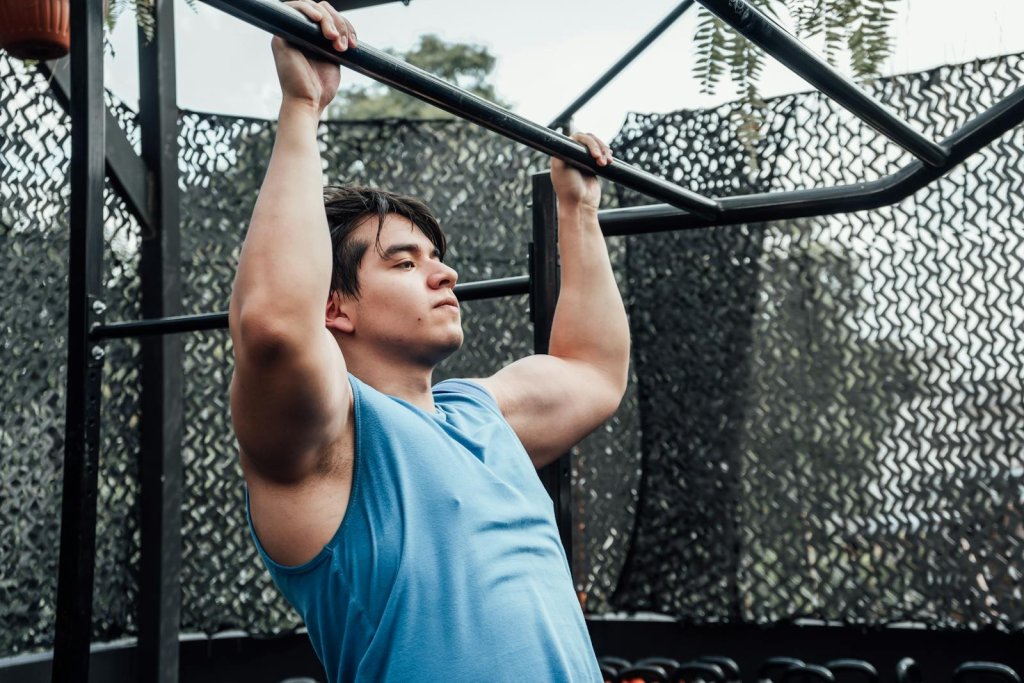
The best choice depends on your goal. If you are a beginner, chin-ups may be the easier starting point. If you want a tougher back-focused challenge, pull-ups may be the better option. According to NASM, both exercises are multi-joint movements that train the lats, biceps, shoulders, and upper back, but the grip changes how the muscles contribute.
Chin Up vs Pull Up: Quick Answer
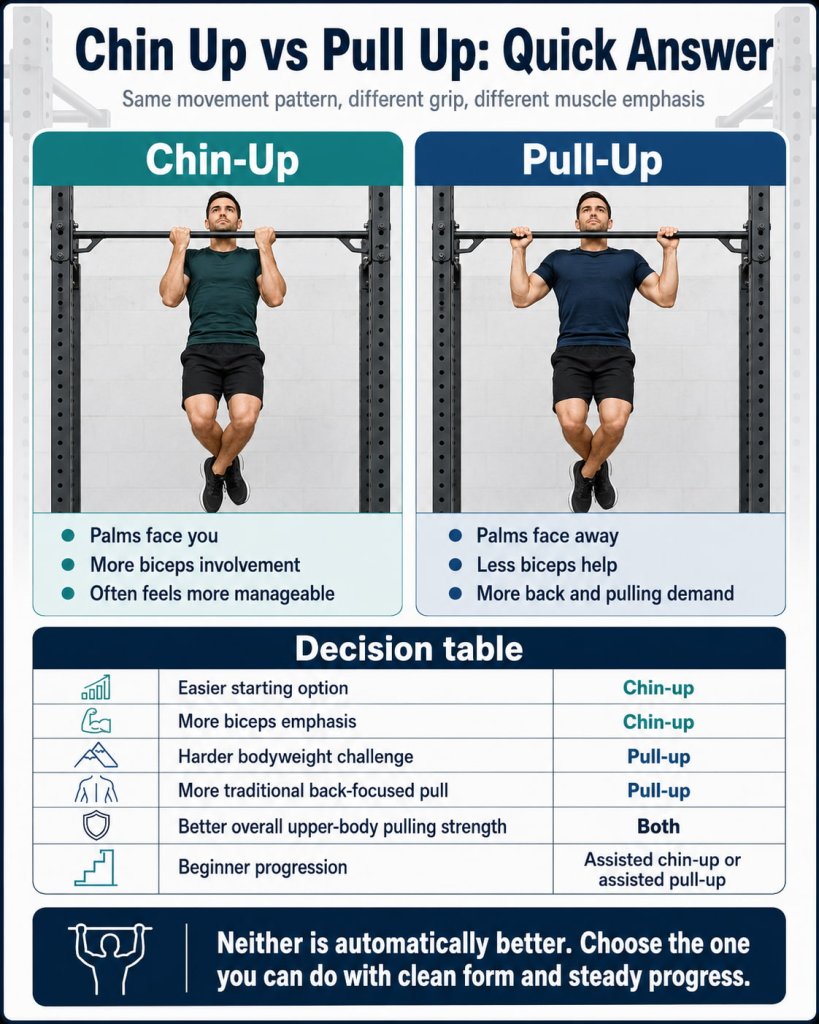
Chin-ups and pull-ups are not the same exercise, even though they look similar.
A chin-up uses a supinated grip, meaning your palms face you. This usually allows more biceps involvement, which can make the movement feel more manageable for many people.
A pull-up uses a pronated grip, meaning your palms face away from you. This grip usually makes the exercise feel harder because the biceps have less mechanical advantage, so your back and upper-body pulling strength must do more work.
Simple answer:
| Goal | Better choice |
|---|---|
| Easier starting option | Chin-up |
| More biceps emphasis | Chin-up |
| Harder bodyweight challenge | Pull-up |
| More traditional back-focused pull | Pull-up |
| Better overall upper-body pulling strength | Both |
| Beginner progression | Assisted chin-up or assisted pull-up |
Neither exercise is automatically “better.” The better choice is the one you can do with clean form, no sharp pain, and steady progress.
What Is a Chin-Up?
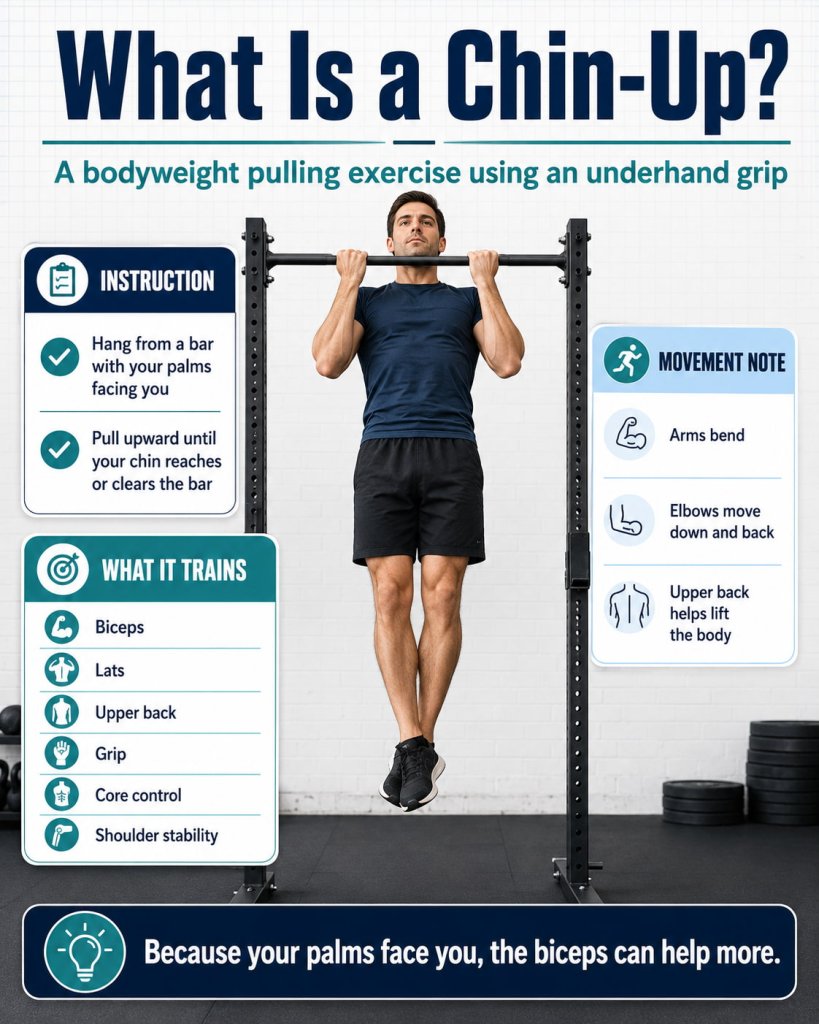
A chin-up is a bodyweight pulling exercise where you hang from a bar with your palms facing you, then pull your body upward until your chin reaches or clears the bar.
The American Council on Exercise describes the chin-up as an overhead pulling movement that uses a supinated grip and involves elbow flexion and shoulder extension.
In simple terms, your arms bend, your elbows move down and back, and your upper back helps lift your body.
Chin-ups are popular because they train:
- Biceps
- Lats
- Upper back
- Grip
- Core control
- Shoulder stability
Because your palms face you, the biceps can help more. That is why many people can do their first chin-up before their first strict pull-up.
What Is a Pull-Up?
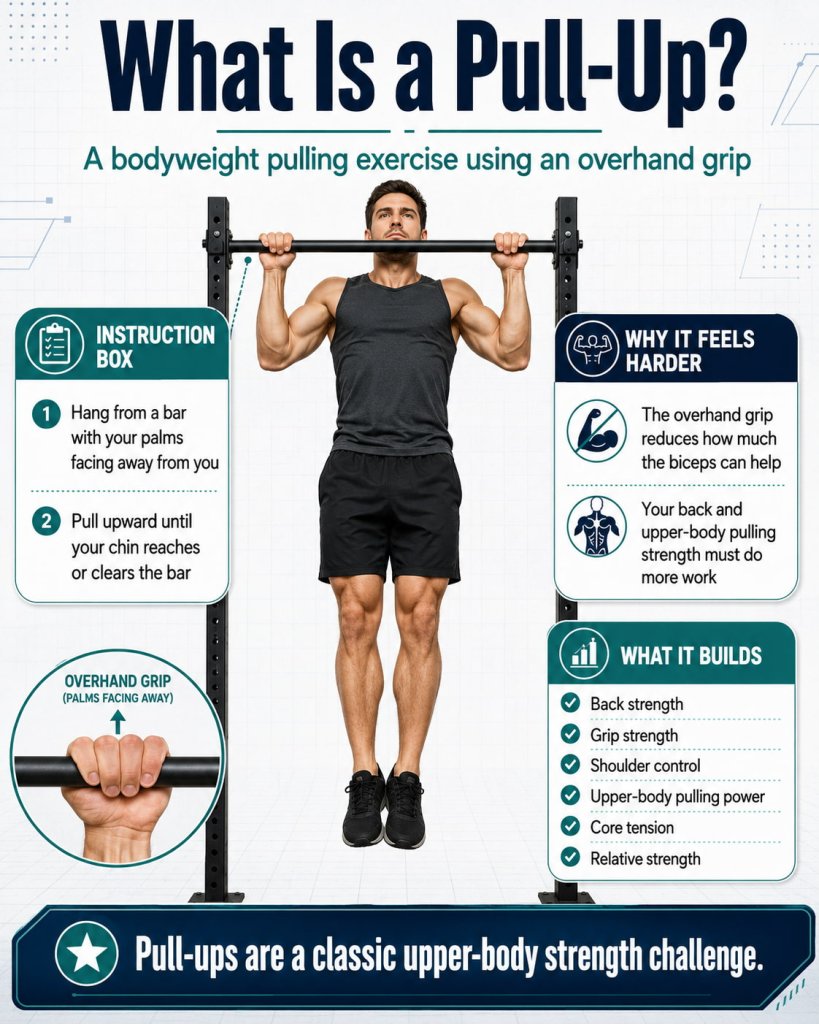
A pull-up is a bodyweight pulling exercise where you hang from a bar with your palms facing away from you, then pull your body upward until your chin reaches or clears the bar.
Pull-ups are often considered harder than chin-ups because the overhand grip reduces how much the biceps can help. NASM notes that pull-ups use the lats, rhomboids, traps, shoulders, posterior deltoids, and arm muscles, with the lats playing a major role.
Pull-ups are commonly used to build:
- Back strength
- Grip strength
- Shoulder control
- Upper-body pulling power
- Core tension
- Relative strength
Relative strength means how strong you are compared with your body weight. That is one reason pull-ups can feel challenging even for people who already lift weights.
Chin Up vs Pull Up: Main Differences
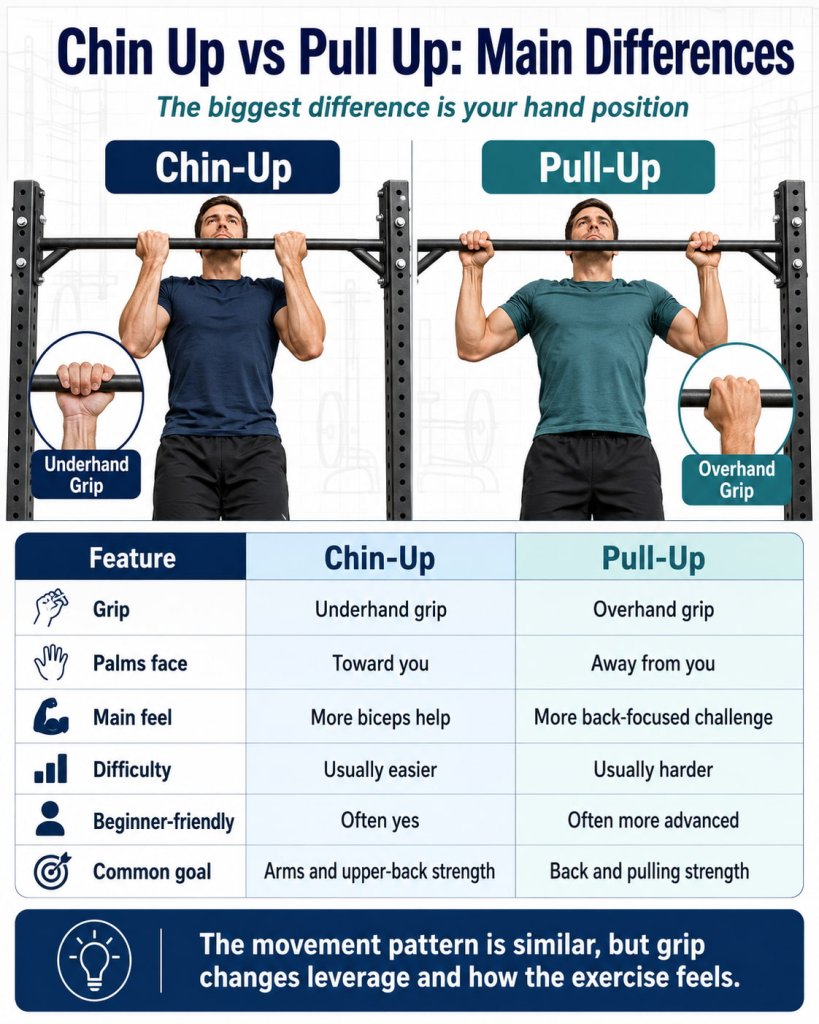
The biggest difference between a chin-up and pull-up is your hand position.
| Feature | Chin-up | Pull-up |
|---|---|---|
| Grip | Underhand grip | Overhand grip |
| Palms face | Toward you | Away from you |
| Main feel | More biceps help | More back-focused challenge |
| Difficulty | Usually easier | Usually harder |
| Beginner-friendly | Often yes | Often more advanced |
| Common goal | Arms and upper-back strength | Back and pulling strength |
The movement pattern is similar, but the grip changes your leverage. That small change can make a big difference in how the exercise feels.
Chin Up vs Pull Up Muscles Worked
Both chin-ups and pull-ups work many of the same muscles. The difference is not that one exercise works the back and the other does not. Both train the back. The difference is how much each muscle contributes.
A PubMed indexed electromyography study compared muscle activation during different pull-up variations and found that grip position can influence activation patterns across the upper-body pulling muscles.
Chin-Up Muscles Worked
Chin-ups mainly train the lats and biceps, with help from the upper back, shoulders, forearms, and core.
Primary muscles:
- Latissimus dorsi
- Biceps brachii
- Brachialis
- Brachioradialis
- Teres major
- Rhomboids
- Middle and lower trapezius
Supporting muscles:
- Rear delts
- Forearms and grip muscles
- Deep core stabilizers
- Shoulder stabilizers
Because your palms face you, the biceps are in a stronger pulling position. This is why chin-ups often feel more natural for beginners and people who already have decent arm strength.
Pull-Up Muscles Worked
Pull-ups mainly train the lats, upper back, arms, shoulders, grip, and trunk.
Primary muscles:
- Latissimus dorsi
- Rhomboids
- Middle and lower trapezius
- Teres major
- Posterior deltoids
- Brachialis
- Brachioradialis
Supporting muscles:
- Biceps
- Forearms
- Rotator cuff muscles
- Core stabilizers
The biceps still work during pull-ups, but they usually do not help as much as they do during chin-ups. That makes pull-ups feel more demanding for many people.
Which Is Harder: Chin-Up or Pull-Up?
Pull-ups are usually harder than chin-ups.
The main reason is grip position. During a chin-up, the underhand grip lets the biceps contribute more strongly. During a pull-up, the overhand grip places the arms in a less helpful position, so the back, grip, and shoulder stabilizers often have to work harder.
That said, difficulty can vary from person to person.
A chin-up may feel harder if:
- Your elbows or wrists dislike the underhand grip
- Your biceps fatigue quickly
- Your shoulder mobility is limited
- Your grip is too narrow
A pull-up may feel harder if:
- Your lats are weak
- Your grip gives out early
- You cannot control your shoulder blades
- You swing or lose core tension
The best test is simple: choose the variation you can do with the cleanest form and the least discomfort.
Chin-Up Benefits
Chin-ups are one of the best bodyweight exercises for building pulling strength with more biceps assistance.
Main benefits:
- Builds upper-body strength
- Trains the lats and biceps together
- Improves grip strength
- Helps beginners learn vertical pulling
- Builds core tension during hanging movements
- Requires minimal equipment
- Can be progressed with assistance, tempo, or added weight
Chin-ups are also useful because they can bridge the gap between easier pulling exercises and harder pull-up variations.
Pull-Up Benefits
Pull-ups are a powerful exercise for back strength and total upper-body control.
Main benefits:
- Builds strong lats and upper back
- Improves grip and forearm strength
- Trains shoulder blade control
- Builds bodyweight strength
- Strengthens the arms without needing curls
- Challenges core stability
- Carries over to climbing, sports, and general pulling tasks
The American Council on Exercise notes that a full pull-up is challenging for many people and recommends progressions such as assisted pull-ups and other strengthening drills to build toward it.
Chin Up vs Pull Up: Which Is Better for Beginners?
Chin-ups are often better for beginners because the underhand grip allows more help from the biceps.
However, beginners do not need to force full chin-ups right away. It is usually smarter to start with assisted variations and build strength gradually.
Good beginner options include:
- Assisted chin-ups
- Assisted pull-ups
- Band-assisted chin-ups
- Eccentric chin-ups
- Lat pulldowns
- Inverted rows
- Dead hangs
- Scapular pull-ups
If you cannot do a full rep yet, that is normal. A full bodyweight chin-up or pull-up is a high-strength movement. Start with progressions and focus on control.
Chin Up vs Pull Up: Which Is Better for Back and Biceps?
For biceps, chin-ups are usually the better choice.
The underhand grip places your biceps in a stronger position, so they can contribute more during the pull. If your goal is to train your arms while also building your back, chin-ups are a strong option.
For back, pull-ups are often the better challenge.
Pull-ups tend to feel more lat- and upper-back-focused because the biceps have less advantage. If your goal is to build stronger vertical pulling strength and challenge your lats, pull-ups are a great choice.
Best practical answer:
- Choose chin-ups for more biceps help and beginner-friendly pulling strength.
- Choose pull-ups for a harder back-focused challenge.
- Use both if your shoulders, elbows, and wrists tolerate them well.
How to Do Chin-Ups With Proper Form
Use a controlled setup before you start pulling. Good form matters more than rushing reps.
How to do it
- Stand under a pull-up bar.
- Grip the bar with your palms facing you.
- Use about shoulder-width grip or slightly narrower.
- Hang with your arms straight but not loose.
- Brace your core and keep your ribs down.
- Pull your shoulder blades down before bending your elbows.
- Drive your elbows down toward your ribs.
- Pull until your chin reaches or clears the bar.
- Pause briefly at the top without craning your neck.
- Lower slowly until your arms are straight again.
- Reset your shoulder position before the next rep.
Why it works
The chin-up works because your lats and upper back pull your arms down while your biceps help bend the elbows. This combination makes it a strong exercise for building upper-body pulling strength.
Trainer Tip
Think “elbows to ribs,” not “chin to bar.” This cue helps you pull with your back instead of reaching your neck forward just to finish the rep.
How to Do Pull-Ups With Proper Form
Pull-ups require control from the first hang to the last inch of the lowering phase. Avoid swinging and focus on clean reps.
How to do it
- Stand under a pull-up bar.
- Grip the bar with your palms facing away from you.
- Start with your hands about shoulder-width or slightly wider.
- Hang with your body long and your core braced.
- Keep your legs still and avoid kicking.
- Pull your shoulder blades down before bending your elbows.
- Drive your elbows down and slightly back.
- Pull until your chin reaches or clears the bar.
- Keep your chest lifted without over-arching your lower back.
- Lower under control until your arms are straight again.
- Reset before starting the next rep.
Why it works
The pull-up works because it challenges your lats, upper back, arms, grip, and core to move your full body weight against gravity. The overhand grip makes it demanding and useful for building strong vertical pulling ability.
Trainer Tip
Start each rep by pulling your shoulders “down away from your ears.” This helps reduce shrugging and improves shoulder control.
Common Mistakes to Avoid
Small mistakes can make chin-ups and pull-ups feel harder than they need to be.
| Mistake | Why it matters | Better cue |
|---|---|---|
| Swinging the legs | Reduces control and changes the exercise | Brace your core and keep legs quiet |
| Shrugging at the start | Can make the shoulders feel crowded | Pull shoulder blades down first |
| Half reps only | Limits strength through full range | Use assistance and train controlled range |
| Reaching chin forward | Strains the neck and hides poor pulling height | Keep neck neutral and chest lifted |
| Dropping too fast | Misses strength-building lowering phase | Lower for 2–3 seconds |
| Grip too wide | Can reduce control for beginners | Start around shoulder-width |
| Training through sharp pain | May worsen irritation | Stop, modify, or get guidance |
Good reps should feel strong, controlled, and repeatable. They should not feel like a painful shoulder, elbow, or wrist battle.
Best Progressions If You Cannot Do One Yet
You do not need to start with full chin-ups or pull-ups. Progressions help you build strength safely.
1. Assisted Chin-Up
An assisted chin-up uses a resistance band or assisted machine to reduce how much body weight you lift.
How to do it
- Use a band or assisted pull-up machine.
- Choose enough assistance to control every rep.
- Grip the bar with palms facing you.
- Pull your chest toward the bar.
- Lower slowly.
- Reduce assistance gradually as you get stronger.
Why it works
It lets you practice the full movement pattern without needing full bodyweight strength yet.
Muscles worked
Lats, biceps, upper back, forearms, grip, and core.
Trainer Tip
Use the least assistance that still allows clean reps.
2. Assisted Pull-Up
An assisted pull-up uses the same idea but with an overhand grip.
How to do it
- Set up on an assisted pull-up machine or band.
- Grip the bar with palms facing away.
- Brace your core.
- Pull shoulder blades down first.
- Pull until your chin reaches or clears the bar.
- Lower slowly.
- Keep reps smooth and controlled.
Why it works
It builds pull-up-specific strength while reducing the load enough to keep your form clean.
Muscles worked
Lats, traps, rhomboids, rear delts, arms, forearms, grip, and core.
Trainer Tip
Do not bounce out of the bottom. Pause briefly, reset, and start each rep with control.
3. Eccentric Chin-Up or Pull-Up
An eccentric rep focuses on the lowering phase.
How to do it
- Use a box or step to reach the top position.
- Start with your chin over the bar.
- Hold your body tight.
- Lower slowly for 3–5 seconds.
- Step back up and repeat.
- Stop the set before your lowering control breaks down.
Why it works
You are usually stronger during the lowering phase than the lifting phase, so eccentrics help build strength for full reps.
Muscles worked
Lats, biceps, upper back, forearms, grip, and core.
Trainer Tip
Do not turn eccentrics into a drop. The lowering phase should be slow and intentional.
4. Inverted Row
An inverted row is a horizontal pulling exercise that can build the strength needed for chin-ups and pull-ups.
How to do it
- Set a bar around waist height.
- Lie underneath it.
- Grip the bar and keep your body straight.
- Pull your chest toward the bar.
- Squeeze your shoulder blades together.
- Lower with control.
- Make it easier by bending your knees.
Why it works
It strengthens the upper back, lats, arms, and grip while keeping your feet on the floor.
Muscles worked
Lats, rhomboids, traps, rear delts, biceps, forearms, and core.
Trainer Tip
Keep your ribs down and avoid turning the row into a hip thrust.
5. Lat Pulldown
The lat pulldown is a machine-based vertical pulling exercise.
How to do it
- Sit at a lat pulldown machine.
- Grip the bar slightly wider than shoulder-width.
- Brace your core.
- Pull the bar toward your upper chest.
- Keep your elbows driving down.
- Slowly return the bar overhead.
- Avoid leaning far back.
Why it works
It trains a similar vertical pulling pattern while allowing you to adjust the weight.
Muscles worked
Lats, upper back, biceps, forearms, and shoulder stabilizers.
Trainer Tip
Use the lat pulldown to build strength, but still practice hanging and assisted reps if your goal is a full chin-up or pull-up.
Chin Up vs Pull Up: How to Program Them
How often you train chin-ups and pull-ups depends on your strength level, recovery, and total workout plan.
A practical starting point:
| Level | Sets and reps | Frequency |
|---|---|---|
| Beginner | 2–3 sets of 3–6 assisted reps | 2 days per week |
| Intermediate | 3–4 sets of 4–8 reps | 2–3 days per week |
| Advanced | 3–5 sets of 5–10 reps | 2–3 days per week |
| Strength focus | 3–5 sets of 2–5 harder reps | 2 days per week |
| Muscle focus | 3–4 sets of 6–12 controlled reps | 2–3 days per week |
For general strength training, the American Council on Exercise commonly recommends 2–4 sets of 8–12 repetitions for strengthening exercises when the load allows safe completion of the target reps.
Simple weekly example:
- Day 1: Chin-ups, rows, push-ups, core work
- Day 2: Lower-body training
- Day 3: Pull-ups, lat pulldowns, dumbbell rows, carries
Avoid maxing out every session. Your elbows, shoulders, and grip usually recover better when you leave 1–2 good reps in reserve.
Should You Do Chin-Ups and Pull-Ups on the Same Day?
Yes, you can do both on the same day, but you do not have to.
If you are a beginner, start with one main variation per workout. Doing too much too soon can irritate your elbows or shoulders.
Better options:
- Workout A: Chin-ups
- Workout B: Pull-ups
- Or: Chin-ups first, then assisted pull-ups
- Or: Pull-ups first, then easier chin-up reps
If strength is your priority, do the harder exercise first while you are fresh.
Which Grip Width Is Best?
Start with a grip that feels strong and joint-friendly.
For chin-ups:
- Shoulder-width or slightly narrower usually works well.
- Avoid forcing an extremely narrow grip if it bothers your wrists or elbows.
For pull-ups:
- Shoulder-width to slightly wider than shoulder-width is a good starting point.
- Very wide pull-ups are not automatically better and may reduce range of motion.
The best grip is one that allows controlled reps without sharp pain, shoulder pinching, or wrist strain.
Who Should Be Careful With Chin-Ups and Pull-Ups?
Chin-ups and pull-ups are useful exercises, but they are demanding. Some people should modify them or get guidance first.
Be careful if you have:
- Current shoulder pain
- Elbow pain or tendon irritation
- Wrist discomfort with gripping
- Recent upper-body injury or surgery
- A history of shoulder instability
- Difficulty hanging from a bar safely
- Pain that gets sharper or worse during the movement
Stop the exercise if you feel sharp pain, numbness, tingling, or unusual weakness. Choose a supported variation such as a lat pulldown, assisted machine, or row, and consider working with a qualified fitness or healthcare professional.
Chin Up vs Pull Up: Which Is Better?
The best choice depends on your goal.
Choose chin-ups if you want:
- A more beginner-friendly vertical pull
- More biceps involvement
- A strong upper-body bodyweight exercise
- A bridge toward pull-ups
- A movement that may feel easier to progress
Choose pull-ups if you want:
- A harder pulling challenge
- More traditional back-focused training
- Better overhand grip strength
- Stronger lats and upper back
- A classic test of bodyweight strength
Choose both if:
- Your shoulders, elbows, and wrists tolerate them well
- You want balanced pulling strength
- You enjoy bodyweight training
- You want variety in your back and arm workouts
The smartest answer is not “chin-ups are better” or “pull-ups are better.” The smartest answer is: use the variation that matches your current strength, feels good on your joints, and helps you train consistently.
FAQs About Chin Up vs Pull Up
Are chin-ups easier than pull-ups?
Yes, chin-ups are usually easier for many people because the underhand grip allows the biceps to help more. Pull-ups often feel harder because the overhand grip places more demand on the back, grip, and shoulder stabilizers.
Do chin-ups work your back or just your biceps?
Chin-ups work your back and biceps. The biceps help strongly, but the lats, upper back, rear delts, grip muscles, and core are also involved.
Are pull-ups better than chin-ups for lats?
Pull-ups are often more lat-focused for many people, but chin-ups still train the lats well. If your main goal is back strength, pull-ups are a strong choice. If you want back and biceps together, chin-ups are excellent.
Can beginners do chin-ups or pull-ups?
Yes, but most beginners should start with assisted versions, eccentric reps, rows, and lat pulldowns. Full bodyweight reps require a lot of strength, so progress gradually.
Should I do chin-ups or pull-ups first?
Do the harder or more important exercise first. If pull-ups are your main goal, do pull-ups first. If chin-ups are your main goal, do chin-ups first.
Can I build muscle with chin-ups and pull-ups?
Yes. Chin-ups and pull-ups can support muscle growth when you train them with enough volume, good form, progressive overload, and proper recovery.
Why do my elbows hurt during chin-ups?
Elbow discomfort can happen from doing too much too soon, using a grip that does not fit your joints, lowering too fast, or overusing the biceps and forearms. Reduce volume, try assistance, adjust grip width, and stop if pain is sharp or worsening.
Conclusion
Chin-ups and pull-ups are both valuable upper-body exercises. Chin-ups usually feel easier and involve more biceps, while pull-ups usually feel harder and place more demand on the back, grip, and shoulder control.
For most people, the best plan is to start with the variation they can control best, build strength with assisted reps if needed, and eventually use both exercises for balanced upper-body pulling strength. Focus on clean reps, steady progress, and joint-friendly technique.
References
- NASM: Chin-Ups vs Pull-Ups: Differences, Benefits, Muscles Worked
- American Council on Exercise: ACE Technique Series: Chin-Ups
- American Council on Exercise: Chin-Ups Exercise Library
- American Council on Exercise: Pull-Ups Exercise Library
- American Council on Exercise: 4 Moves to Help You Master the Pull-Up
- PubMed: Electromyographic Analysis of Muscle Activation During Pull-Up Variations
- PubMed: Surface Electromyographic Activation Patterns and Elbow Joint Motion During a Pull-Up, Chin-Up, or Perfect-Pullup Rotational Exercise
- PubMed: Effects of Grip Width on Muscle Strength and Activation in the Lat Pull-Down