
The best leg curl alternatives are stability ball hamstring curls, slider hamstring curls, Nordic hamstring curls, Romanian deadlifts, glute bridges, hip thrusts, cable pull-throughs, and good mornings. These exercises train the hamstrings without needing a seated or lying leg curl machine.
A good leg curl alternative should match your goal. If you want the closest machine-free replacement, choose exercises that bend the knee, such as slider curls or stability ball curls. If you want stronger hamstrings and glutes together, add hip-hinge moves like Romanian deadlifts and good mornings.
The hamstrings sit at the back of your thighs and help with walking, climbing stairs, squatting, hip extension, and knee movement, according to the Cleveland Clinic.
What Is a Leg Curl Alternative?
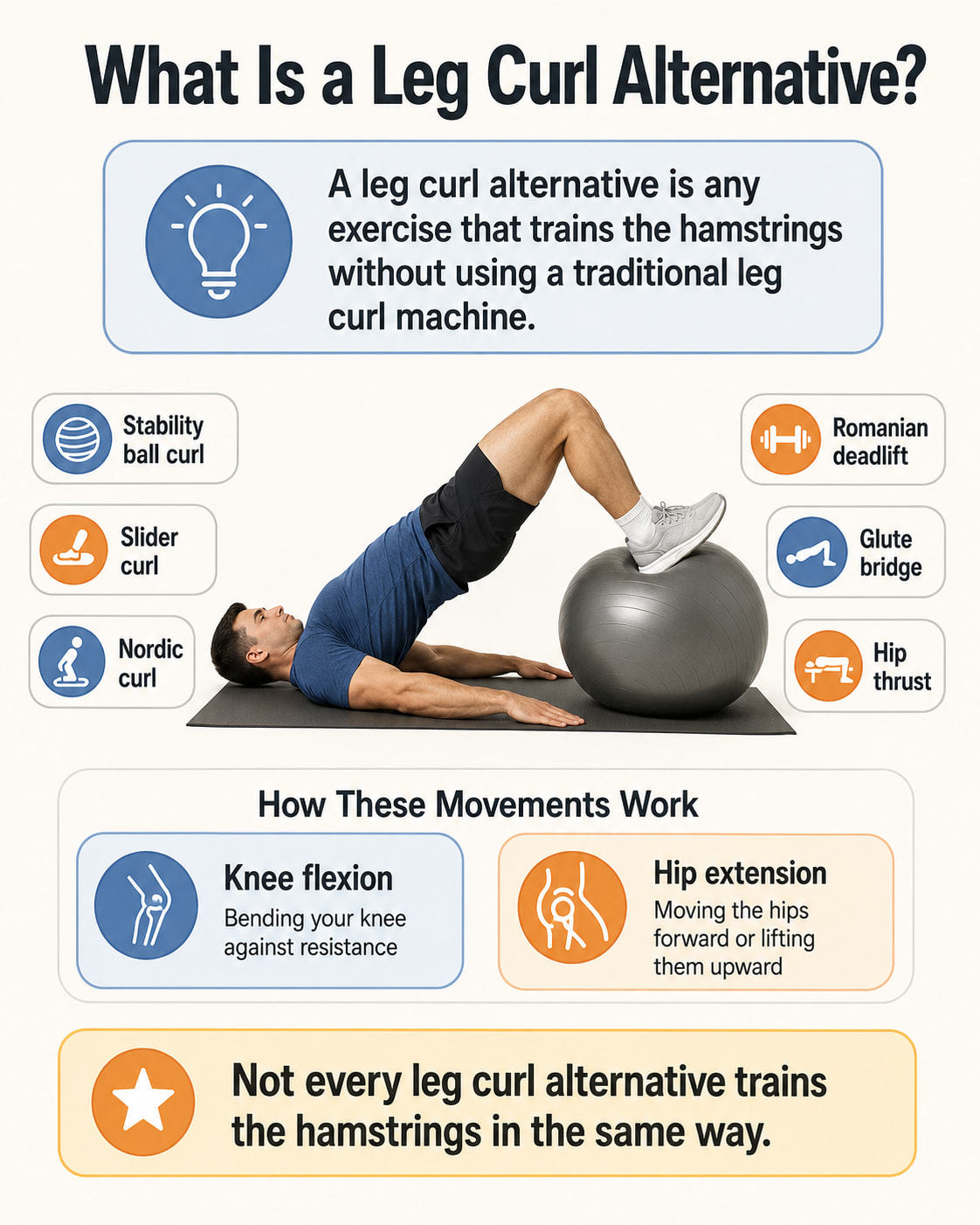
A leg curl alternative is any exercise that trains the hamstrings without using a traditional leg curl machine.
Leg curl machines mainly train knee flexion, which means bending your knee against resistance. This targets the hamstrings directly.
However, your hamstrings also help extend your hips. That is why exercises like Romanian deadlifts, good mornings, glute bridges, and hip thrusts can also be useful alternatives.
The key is understanding that not every alternative feels the same.
| Type of leg curl alternative | Main movement | Best examples |
|---|---|---|
| Knee-flexion alternatives | Bend the knee | Stability ball curl, slider curl, Nordic curl |
| Hip-hinge alternatives | Extend the hip | Romanian deadlift, good morning, cable pull-through |
| Glute and hamstring alternatives | Bridge or thrust the hips | Glute bridge, hip thrust |
10 Best Leg Curl Alternatives
Below are the 10 best leg curl alternatives to target your hamstrings without using a traditional leg curl machine.
Choose the right option based on your equipment, experience level, and whether you want more hamstring isolation or full posterior-chain strength.
1. Stability Ball Hamstring Curl
The stability ball hamstring curl is one of the closest home-friendly alternatives to a leg curl machine. It trains knee flexion while also requiring your glutes and core to keep your hips lifted.
The American Council on Exercise describes this exercise as a supine movement where your lower legs and heels rest on a stability ball while you use your hamstrings to curl the ball toward your body.
Why it works: This exercise closely matches the leg curl pattern because your knees bend against resistance. The ball also adds instability, which makes your hamstrings, glutes, and core work together.
Muscles worked: Hamstrings, glutes, calves, and core stabilizers.
How to do it:
- Lie on your back with your heels on a stability ball.
- Keep your arms on the floor for support.
- Brace your core and lift your hips.
- Keep your body in a straight line from shoulders to knees.
- Bend your knees and roll the ball toward your glutes.
- Pause briefly when your knees are bent.
- Slowly roll the ball back out.
- Keep your hips lifted through the rep.
Trainer Tip: Start with both legs. Progress to single-leg stability ball curls only after you can control the movement without your hips dropping.
2. Slider Hamstring Curl
Slider hamstring curls are another excellent leg curl alternative. You can do them with exercise sliders, towels on a smooth floor, or socks on a slick surface.
Why it works: Like a machine leg curl, this exercise trains knee flexion. Because your body is on the floor, it also trains hip stability and core control.
Muscles worked: Hamstrings, glutes, calves, and core.
How to do it:
- Lie on your back with your heels on sliders.
- Bend your knees and place your feet hip-width apart.
- Lift your hips into a bridge position.
- Slowly slide your heels away from your body.
- Keep your hips lifted as your legs extend.
- Pull your heels back toward your glutes.
- Squeeze your hamstrings at the top.
- Repeat with control.
Trainer Tip: If the full version is too hard, lower your hips to the floor between reps or use a smaller range of motion.
3. Nordic Hamstring Curl
The Nordic hamstring curl is one of the most challenging hamstring exercises. It uses your body weight to train the hamstrings eccentrically, meaning the muscles work hard while lengthening.
A British Journal of Sports Medicine systematic review and meta-analysis found that injury-prevention programs including the Nordic hamstring exercise reduced hamstring injuries by up to 51% across multiple sports settings.
Why it works: Nordic curls overload the hamstrings during the lowering phase. This makes them powerful, but also demanding.
Muscles worked: Hamstrings, glutes, calves, and core.
How to do it:
- Kneel on a soft pad.
- Anchor your ankles under a stable object or have a partner hold them.
- Keep your body straight from knees to shoulders.
- Brace your core and squeeze your glutes lightly.
- Slowly lower your torso forward.
- Use your hamstrings to resist the fall.
- Catch yourself with your hands if needed.
- Push lightly off the floor to return to the start.
Trainer Tip: Do not force full reps right away. Start with a short range of motion, slow eccentrics, or band assistance.
4. Romanian Deadlift
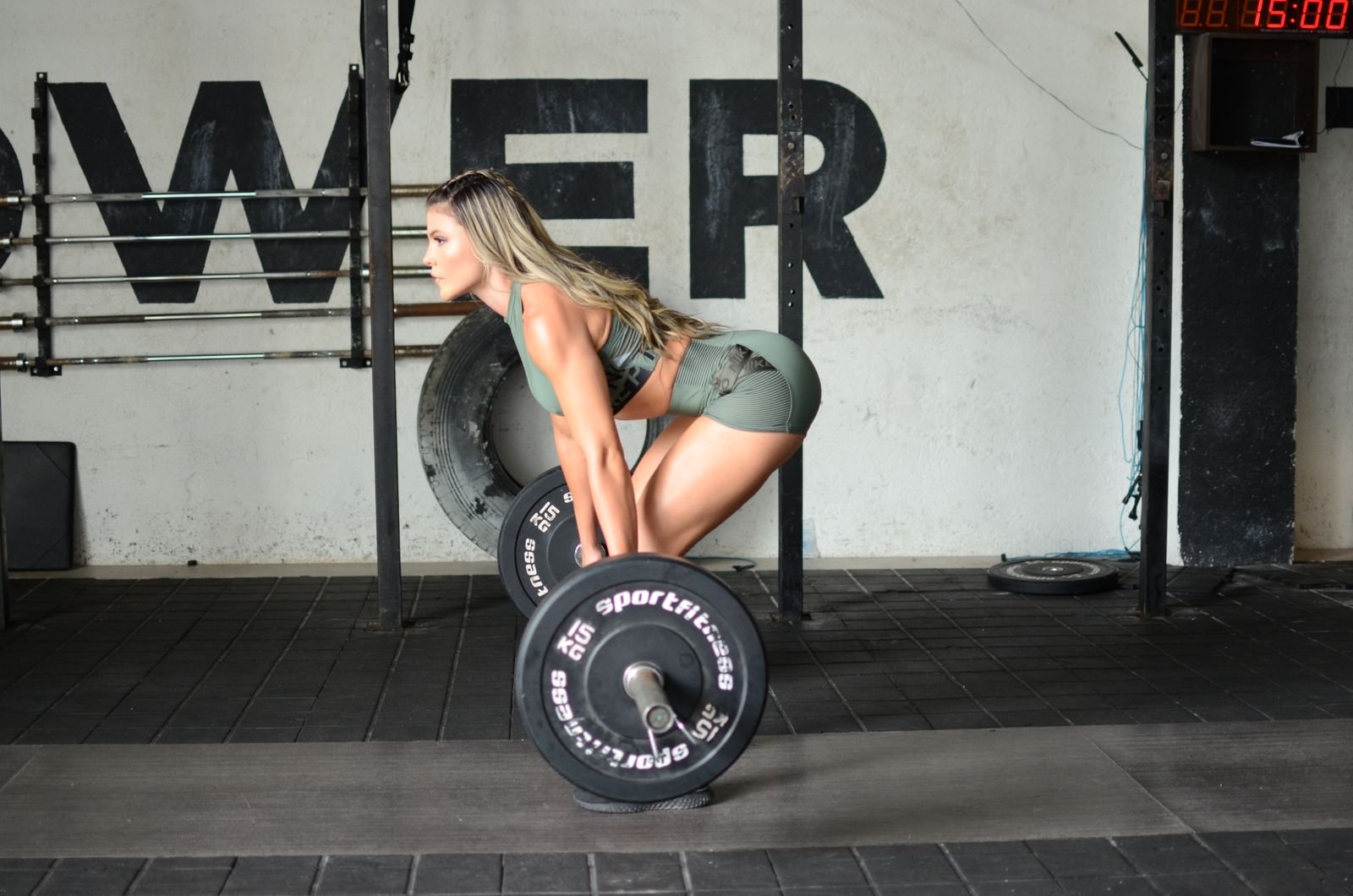
The Romanian deadlift is one of the best leg curl alternatives for building stronger hamstrings and glutes. It does not copy the exact leg curl motion, but it trains the hamstrings hard through hip extension.
NASM describes the Romanian deadlift as a hip-hinge exercise with minimal knee flexion that emphasizes the hamstrings and glutes through the eccentric stretching phase.
Why it works: The Romanian deadlift trains the hamstrings in a lengthened position. It also builds glute strength, back stability, and hip-hinge control.
Muscles worked: Hamstrings, glutes, erector spinae, adductors, and core.
How to do it:
- Stand tall with a barbell, dumbbells, or kettlebells.
- Keep your feet about hip-width apart.
- Soften your knees slightly.
- Brace your core.
- Push your hips back as the weight lowers.
- Keep the weight close to your legs.
- Lower until you feel a strong hamstring stretch.
- Drive your hips forward to stand tall.
Trainer Tip: Think “hips back,” not “bend down.” Your spine should stay neutral, and the movement should come mostly from the hips.
5. Dumbbell Romanian Deadlift
The dumbbell Romanian deadlift is a more accessible version of the barbell RDL. It is great for home workouts, beginners, and anyone who wants more freedom of movement.
Why it works: Dumbbells allow each side to work more naturally. They also make it easier to start light and learn the hip-hinge pattern.
Muscles worked: Hamstrings, glutes, lower back, adductors, and core.
How to do it:
- Hold a dumbbell in each hand.
- Stand with feet hip-width apart.
- Keep the dumbbells in front of your thighs.
- Brace your core.
- Push your hips back.
- Lower the dumbbells along your legs.
- Stop when you feel your hamstrings stretch.
- Stand back up by squeezing your glutes.
Trainer Tip: Keep the dumbbells close. If they drift too far forward, your lower back may work harder than your hamstrings.
6. Single-Leg Romanian Deadlift
The single-leg Romanian deadlift is a strong leg curl alternative for balance, hamstring strength, and glute control. It is harder than it looks, so start light.
Why it works: This exercise trains one leg at a time, which can help improve left-right control. It also challenges the hamstrings and glutes while your hips work to stay level.
Muscles worked: Hamstrings, glutes, calves, core, and hip stabilizers.
How to do it:
- Stand on one leg with a slight knee bend.
- Hold one or two dumbbells if using weight.
- Brace your core.
- Hinge at the hips.
- Let your free leg extend behind you.
- Keep your hips as square as possible.
- Lower until you feel a hamstring stretch.
- Drive through your standing foot to return to standing.
Trainer Tip: Use a wall, rack, or bench for light fingertip support if balance limits your form.
7. Glute Bridge
The glute bridge is one of the best beginner-friendly alternatives. It is not a direct leg curl replacement, but it strengthens the glutes and supports hamstring function.
The American Council on Exercise describes the glute bridge as a floor-based movement where you press your hips upward by contracting the glutes while keeping the core engaged.
Why it works: Glute bridges train hip extension, which involves the glutes and hamstrings. They are easy to learn and require no equipment.
Muscles worked: Glutes, hamstrings, core, and hip stabilizers.
How to do it:
- Lie on your back with your knees bent.
- Place your feet flat on the floor.
- Keep your feet about hip-width apart.
- Brace your core.
- Press through your heels.
- Lift your hips until your body forms a straight line from shoulders to knees.
- Squeeze your glutes at the top.
- Lower with control.
Trainer Tip: Do not overarch your lower back at the top. Stop when your hips are extended and your ribs stay controlled.
8. Hip Thrust
The hip thrust is a stronger, more loadable version of the bridge pattern. It is especially useful if your goal is stronger glutes with hamstring support.
ACE’s elevated glute bridge setup uses a bench, external resistance, and a strong hip-extension pattern, which is similar to how many people perform loaded hip thrust variations.
Why it works: Hip thrusts let you use more load than floor bridges. They mainly target the glutes, but the hamstrings help stabilize and support the movement.
Muscles worked: Glutes, hamstrings, adductors, core, and hip stabilizers.
How to do it:
- Sit on the floor with your upper back against a bench.
- Place your feet flat on the floor.
- Keep your knees bent.
- Add a barbell, dumbbell, or body weight as needed.
- Brace your core.
- Drive through your heels.
- Lift your hips until your torso is roughly parallel to the floor.
- Lower slowly and repeat.
Trainer Tip: Keep your chin slightly tucked and ribs down. This helps prevent excessive lower-back arching.
9. Cable Pull-Through
The cable pull-through is a gym-based hip-hinge exercise. It trains the hamstrings and glutes without loading the spine as heavily as a barbell good morning or deadlift.
Why it works: The cable pulls from behind you, which encourages a strong hip hinge. This makes it a useful teaching exercise for people learning to push the hips back.
Muscles worked: Hamstrings, glutes, lower back, and core.
How to do it:
- Attach a rope handle to a low cable.
- Face away from the machine.
- Hold the rope between your legs.
- Walk forward until there is tension.
- Stand with feet about shoulder-width apart.
- Push your hips back.
- Let the cable move your hands behind you.
- Drive your hips forward to stand tall.
Trainer Tip: Keep your arms relaxed. The movement should come from your hips, not your shoulders.
10. Good Morning
The good morning is an advanced hip-hinge exercise that targets the hamstrings, glutes, and back muscles. It can be effective, but it requires excellent control.
Why it works: Good mornings place the hamstrings under tension while the hips hinge backward. They are useful for lifters who already have solid hinge mechanics.
Muscles worked: Hamstrings, glutes, erector spinae, core, and upper back.
How to do it:
- Place a light barbell across your upper back.
- Stand with feet about hip-width apart.
- Soften your knees slightly.
- Brace your core.
- Push your hips back.
- Lower your torso forward with control.
- Stop when you feel your hamstrings stretch.
- Drive your hips forward to return to standing.
Trainer Tip: Start very light. If you cannot keep a neutral spine, choose Romanian deadlifts or cable pull-throughs first.
Benefits of Leg Curl Alternatives
Leg curl alternatives are useful because they give you more exercise options, especially if you train at home or your gym does not have a leg curl machine.
They can help you:
- Train your hamstrings with little or no equipment
- Strengthen your glutes and posterior chain
- Improve hip-hinge mechanics
- Build single-leg control and balance
- Add variety to lower-body workouts
- Reduce dependence on machines
- Train at home with sliders, a towel, a ball, dumbbells, or bands
The CDC recommends adults do muscle-strengthening activities at least 2 days per week, and hamstring-focused exercises can fit into those lower-body or full-body strength sessions.
How to Choose the Best Leg Curl Alternative
Choose your exercise based on your equipment, experience level, and training goal.
| Your goal | Best choice |
|---|---|
| Closest machine-free leg curl replacement | Slider hamstring curl or stability ball hamstring curl |
| Beginner-friendly hamstring and glute work | Glute bridge |
| Stronger hamstrings and glutes | Romanian deadlift |
| Advanced hamstring strength | Nordic hamstring curl |
| Better balance and control | Single-leg Romanian deadlift |
| Home workout option | Slider curl, glute bridge, dumbbell RDL |
| Gym-based posterior-chain strength | Hip thrust, cable pull-through, good morning |
For most people, the best approach is to combine one knee-flexion exercise and one hip-hinge exercise.
Example:
- Slider hamstring curl plus Romanian deadlift
- Stability ball hamstring curl plus hip thrust
- Nordic hamstring curl plus dumbbell Romanian deadlift
Best Leg Curl Alternatives by Equipment
| Equipment available | Best alternatives |
|---|---|
| No equipment | Glute bridge, Nordic curl progression |
| Sliders or towels | Slider hamstring curl |
| Stability ball | Stability ball hamstring curl |
| Dumbbells | Dumbbell Romanian deadlift, single-leg RDL |
| Barbell | Romanian deadlift, good morning, hip thrust |
| Cable machine | Cable pull-through |
| Bench | Hip thrust, elevated glute bridge |
Best Leg Curl Alternatives for Home Workouts
If you train at home, you do not need a leg curl machine to train your hamstrings well.
Good home options include:
- Slider hamstring curl
- Stability ball hamstring curl
- Glute bridge
- Single-leg glute bridge
- Dumbbell Romanian deadlift
- Single-leg Romanian deadlift
- Assisted Nordic curl
A simple home hamstring workout could look like this:
| Exercise | Sets | Reps |
|---|---|---|
| Dumbbell Romanian deadlift | 3 | 8–12 |
| Slider hamstring curl | 3 | 8–12 |
| Glute bridge | 2–3 | 10–15 |
| Single-leg Romanian deadlift | 2 | 8–10 per side |
Best Leg Curl Alternatives for Beginners
Beginners should start with exercises that are stable, easy to control, and simple to progress.
Best beginner choices:
- Glute bridge
- Dumbbell Romanian deadlift
- Stability ball hamstring curl
- Short-range slider curl
- Cable pull-through
Avoid starting with heavy good mornings or full Nordic curls if you are still learning basic hinge control.
A beginner-friendly workout:
| Exercise | Sets | Reps |
|---|---|---|
| Glute bridge | 2–3 | 10–15 |
| Dumbbell Romanian deadlift | 2–3 | 8–12 |
| Stability ball hamstring curl | 2 | 8–10 |
| Bodyweight split squat | 2 | 8–10 per side |
Best Leg Curl Alternatives for Muscle Growth
For hamstring growth, use enough weekly volume and progressive overload. ACSM notes that hypertrophy is generally supported by higher weekly volume, around 10 sets per muscle group, while strength-focused training often uses heavier loads for fewer sets.
For muscle growth, prioritize:
- Romanian deadlifts
- Dumbbell Romanian deadlifts
- Stability ball hamstring curls
- Slider hamstring curls
- Hip thrusts
- Good mornings if you are experienced
A hamstring growth workout could look like this:
| Exercise | Sets | Reps |
|---|---|---|
| Romanian deadlift | 3–4 | 6–10 |
| Stability ball hamstring curl | 3 | 10–15 |
| Hip thrust | 3 | 8–12 |
| Slider hamstring curl | 2 | 8–12 |
Best Leg Curl Alternatives for Knee-Friendly Training
No exercise is automatically knee-friendly for everyone, but some alternatives may feel smoother because they use more hip extension and less direct knee-flexion loading.
Options to try:
- Glute bridge
- Hip thrust
- Romanian deadlift
- Cable pull-through
- Dumbbell Romanian deadlift
Be more careful with:
- Nordic hamstring curls
- Aggressive slider curls
- Fast hamstring curls
- Deep ranges that cause discomfort
If you have a current knee, hip, back, or hamstring injury, get guidance from a qualified professional before pushing hard. Cleveland Clinic advises not pushing through pain in the hip, knee, or leg when trying to reduce hamstring injury risk.
Leg Curl Alternative Workout Plan
Here is a simple weekly setup you can use 2 days per week.
Day 1 Hamstrings and Glutes
| Exercise | Sets | Reps |
|---|---|---|
| Romanian deadlift | 3 | 6–10 |
| Hip thrust | 3 | 8–12 |
| Stability ball hamstring curl | 2–3 | 10–15 |
| Calf raise | 2–3 | 12–15 |
Day 2 Hamstrings and Stability
| Exercise | Sets | Reps |
|---|---|---|
| Dumbbell Romanian deadlift | 3 | 8–12 |
| Slider hamstring curl | 2–3 | 8–12 |
| Single-leg Romanian deadlift | 2 | 8–10 per side |
| Glute bridge | 2 | 12–15 |
Start with moderate effort. Leave about 1–3 reps in reserve on most sets. Add reps, sets, or load gradually as your form improves.
Common Mistakes With Leg Curl Alternatives
Using Only Hip-Hinge Exercises
Romanian deadlifts and good mornings are great, but they do not fully replace knee-flexion work.
For a more complete plan, include at least one curl-style movement, such as slider curls, stability ball curls, or Nordic curl progressions.
Going Too Heavy Too Soon
Heavy Romanian deadlifts and good mornings can overload your lower back if your hinge form is not ready.
Start light, control the lowering phase, and increase load gradually.
Letting the Hips Drop During Curl Variations
During slider curls or stability ball curls, your hips should stay lifted. If they drop, the movement becomes less effective and harder to control.
Use a shorter range of motion or do fewer reps.
Rushing Nordic Curls
Nordic curls are advanced. They create a strong eccentric load on the hamstrings.
Start with partial reps, band assistance, or slow lowering only.
Ignoring Pain
Muscle effort is normal. Sharp pain, sudden pulling, or pain that gets worse is not something to push through.
Stop the exercise and choose a gentler variation if something feels wrong.
Safety Tips Before You Start
Use these tips to make your hamstring training safer and more effective:
- Warm up with light cardio and easy hip-hinge drills.
- Start with bodyweight or light resistance.
- Keep your spine neutral during hinge exercises.
- Move slowly on the lowering phase.
- Avoid bouncing out of deep stretches.
- Progress one variable at a time.
- Stop if pain is sharp, sudden, or worsening.
- Ask a qualified trainer or healthcare professional for help if you have a current injury.
FAQs About Leg Curl Alternatives
What is the best leg curl alternative?
The best leg curl alternative depends on your goal. For the closest machine-free replacement, choose slider hamstring curls or stability ball hamstring curls. For overall hamstring and glute strength, choose Romanian deadlifts.
Can I train hamstrings without a leg curl machine?
Yes. You can train your hamstrings with slider curls, stability ball curls, Nordic curls, Romanian deadlifts, glute bridges, hip thrusts, good mornings, and cable pull-throughs.
Are Romanian deadlifts a good leg curl alternative?
Yes, but they are not an exact replacement. Romanian deadlifts train the hamstrings through hip extension, while leg curls train the hamstrings through knee flexion. A complete plan can include both hinge and curl-style movements.
What can I use instead of leg curls at home?
Good home alternatives include slider hamstring curls, stability ball hamstring curls, glute bridges, single-leg glute bridges, dumbbell Romanian deadlifts, and assisted Nordic curls.
Are leg curl alternatives good for glutes too?
Many leg curl alternatives train the glutes, especially Romanian deadlifts, hip thrusts, glute bridges, cable pull-throughs, and good mornings. Curl-style exercises usually focus more directly on the hamstrings.
Are Nordic curls better than leg curls?
Nordic curls are not automatically better, but they are more demanding. They heavily train eccentric hamstring strength and have strong research support in hamstring injury-prevention programs. They are best used as an advanced progression, not a beginner starting point.
How many times per week should I train hamstrings?
Most people can train hamstrings 2 times per week as part of a balanced lower-body or full-body strength plan. The CDC recommends muscle-strengthening activity at least 2 days per week for adults.
Conclusion
The best leg curl alternative is the one that matches your equipment, strength level, and goal. If you want the closest replacement, start with stability ball hamstring curls or slider hamstring curls. If you want stronger hamstrings and glutes overall, add Romanian deadlifts, hip thrusts, glute bridges, cable pull-throughs, or good mornings.
For the best results, combine one curl-style exercise with one hip-hinge exercise. Start with clean form, progress slowly, and keep your training consistent.
This content is for informational purposes only and not medical advice.
References
- Cleveland Clinic: Hamstring Muscles
- American Council on Exercise: Stability Ball Hamstring Curl
- American Council on Exercise: Glute Bridge
- American Council on Exercise: Elevated Glute Bridge
- NASM: Romanian Deadlift
- NASM: Dumbbell Romanian Deadlift
- British Journal of Sports Medicine: Nordic Hamstring Exercise Meta-Analysis
- CDC: Physical Activity Guidelines for Adults