
Nordic hamstring curl alternatives are exercises that strengthen the hamstrings—especially through eccentric loading—without requiring the full Nordic curl position. They are important because many people lack the strength, equipment, or joint tolerance to perform Nordic curls safely, yet still want to support hamstring strength and injury prevention.
Understanding your options helps you build strong, resilient hamstrings using movements that match your current ability, training environment, and injury history. Research and clinical guidance consistently emphasize that hamstring strength—particularly controlled lengthening strength—plays a key role in reducing strain risk when programmed correctly.
Why Look for Nordic Hamstring Curl Alternatives?
The Nordic hamstring exercise is well known for its role in injury-prevention programs, but it is also one of the most demanding hamstring exercises. Many people struggle with:
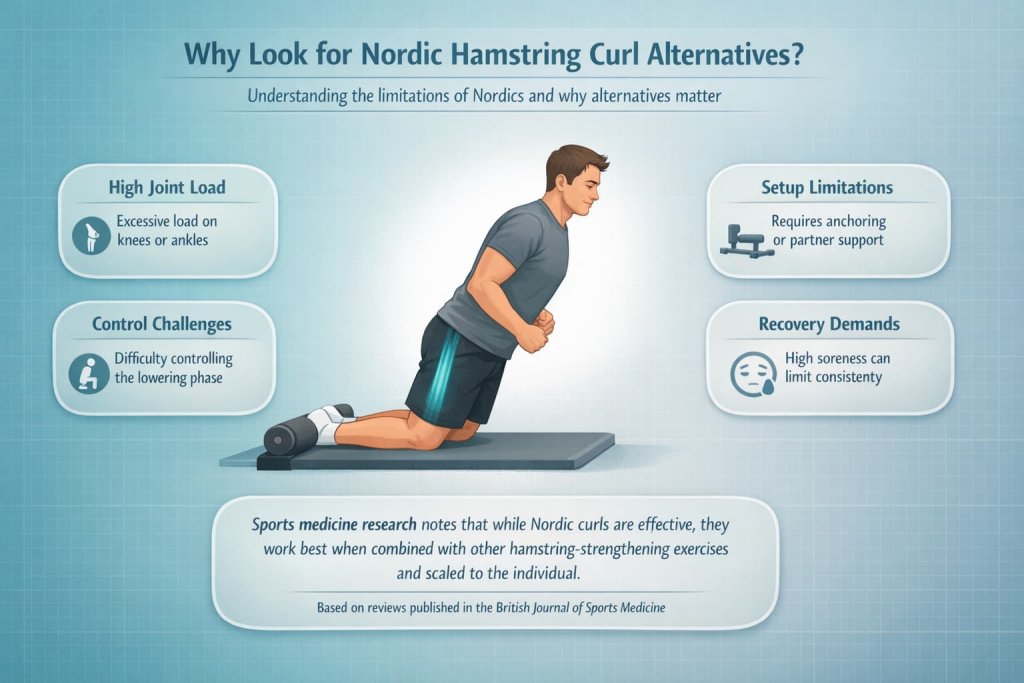
- Excessive load on the knees or ankles
- Inability to control the lowering phase
- Lack of proper anchoring or partner support
- High soreness that limits consistency
Authoritative sports medicine literature, including reviews published in the British Journal of Sports Medicine, highlights that while Nordic curls are effective, they work best when paired with other hamstring-strengthening movements and scaled to the individual.
10 Best Nordic Hamstring Curl Alternatives
These Nordic hamstring curl alternatives help strengthen the hamstrings using safer, more accessible movements. They focus on controlled eccentric loading, balance, and progression to support strength and injury prevention.
1. Sliding Hamstring Curls
How to do it:
- Lie on your back with knees bent and heels placed on sliders, towels, or socks on a smooth floor
- Bend your knees and lift your hips into a bridge position
- Slowly slide your heels away from your body, extending your legs
- Keep hips elevated as long as possible during the movement
- Lower hips only after control is lost, then reset and repeat
Why it works:
Sliding hamstring curls emphasize eccentric control, which is a key component of hamstring strength and injury prevention. Because resistance increases as the legs extend, the exercise naturally challenges the hamstrings through their lengthening phase without external load.
Muscles worked:
Hamstrings (primary), gluteus maximus, core stabilizers.
Trainer Tip:
Slow down the lowering phase to 3–5 seconds to maximize eccentric benefits and reduce momentum.
2. Stability Ball Hamstring Curls
How to do it:
- Lie on your back with heels placed on a stability ball
- Lift hips into a straight-line bridge position
- Pull the ball toward your body by bending your knees
- Keep hips elevated and pelvis stable throughout
- Extend legs slowly to return to the starting position
Why it works:
This exercise combines hamstring knee flexion with pelvic stability demands. Maintaining hip elevation increases posterior-chain engagement while the unstable surface challenges coordination and control.
Muscles worked:
Hamstrings, gluteus maximus, core stabilizers, lower back.
Trainer Tip:
If keeping hips elevated is difficult, reduce range of motion or perform the exercise one leg at a time later as a progression.
3. Romanian Deadlift (RDL)
How to do it:
- Stand holding a barbell, dumbbells, or kettlebell
- Keep knees slightly bent and spine neutral
- Hinge at the hips, pushing them backward
- Lower the weight until you feel a strong hamstring stretch
- Drive hips forward to return to standing
Why it works:
The RDL loads the hamstrings at long muscle lengths, which is essential for strength development and resilience. It complements knee-dominant exercises by training the hamstrings’ hip-extension role.
Muscles worked:
Hamstrings, gluteus maximus, erector spinae, adductors.
Trainer Tip:
Think “hips back, chest long” rather than bending forward to protect the lower back and maximize hamstring loading.
4. Single-Leg Romanian Deadlift
How to do it:
- Stand on one leg holding a dumbbell or kettlebell
- Keep hips square and spine neutral
- Hinge forward while the free leg extends backward
- Lower until balance or hamstring stretch limits motion
- Return to standing under control
Why it works:
Unilateral loading increases hamstring demand while exposing side-to-side strength imbalances. It also improves hip stability and balance, both of which are linked to reduced injury risk.
Muscles worked:
Hamstrings, gluteus maximus, gluteus medius, core stabilizers.
Trainer Tip:
Use a wall or light fingertip support at first to maintain balance without reducing hamstring demand.
5. Machine Leg Curl (Seated or Lying)
How to do it:
- Adjust the machine so the knee joint aligns with the pivot point
- Sit or lie down with pads resting comfortably above the ankles
- Curl the weight by bending the knees
- Pause briefly at the top
- Lower the weight slowly under control
Why it works:
Machine leg curls isolate knee-flexion strength with precise load control. Seated versions place the hamstrings under greater stretch, which may support strength gains at longer muscle lengths.
Muscles worked:
Hamstrings (all heads), gastrocnemius (secondary).
Trainer Tip:
Use lighter weight and slower tempo to prioritize control rather than momentum.
6. Resistance Band Hamstring Curls
How to do it:
- Anchor a resistance band behind you at ankle height
- Loop the band around one or both ankles
- Lie face down or stand depending on setup
- Bend the knee against band resistance
- Slowly return to the starting position
Why it works:
Bands provide accommodating resistance, meaning tension increases as the hamstrings shorten. This makes the movement joint-friendly and adaptable for beginners or home workouts.
Muscles worked:
Hamstrings, calves (secondary).
Trainer Tip:
Focus on smooth movement and full control—band exercises lose effectiveness if rushed.
7. Hip Thrusts
How to do it:
- Sit with upper back supported on a bench
- Place feet flat on the floor, knees bent
- Drive through heels to lift hips upward
- Pause briefly at full hip extension
- Lower hips slowly to the starting position
Why it works:
Hip thrusts strengthen the posterior chain while limiting knee stress. Although glutes are dominant, the hamstrings contribute significantly to hip extension and force control.
Muscles worked:
Gluteus maximus, hamstrings, core stabilizers.
Trainer Tip:
Avoid over-arching the lower back at the top—focus on squeezing glutes and maintaining rib-cage control.
8. Good Mornings
How to do it:
- Place a light barbell across the upper back
- Stand with feet hip-width apart
- Hinge at the hips with minimal knee bend
- Lower torso until hamstrings are fully loaded
- Return to standing with controlled hip extension
Why it works:
Good mornings train eccentric hip-hinge strength with minimal knee involvement. When properly loaded, they provide strong hamstring stimulus without excessive joint strain.
Muscles worked:
Hamstrings, gluteus maximus, spinal erectors.
Trainer Tip:
Start very light—this exercise rewards technique more than load.
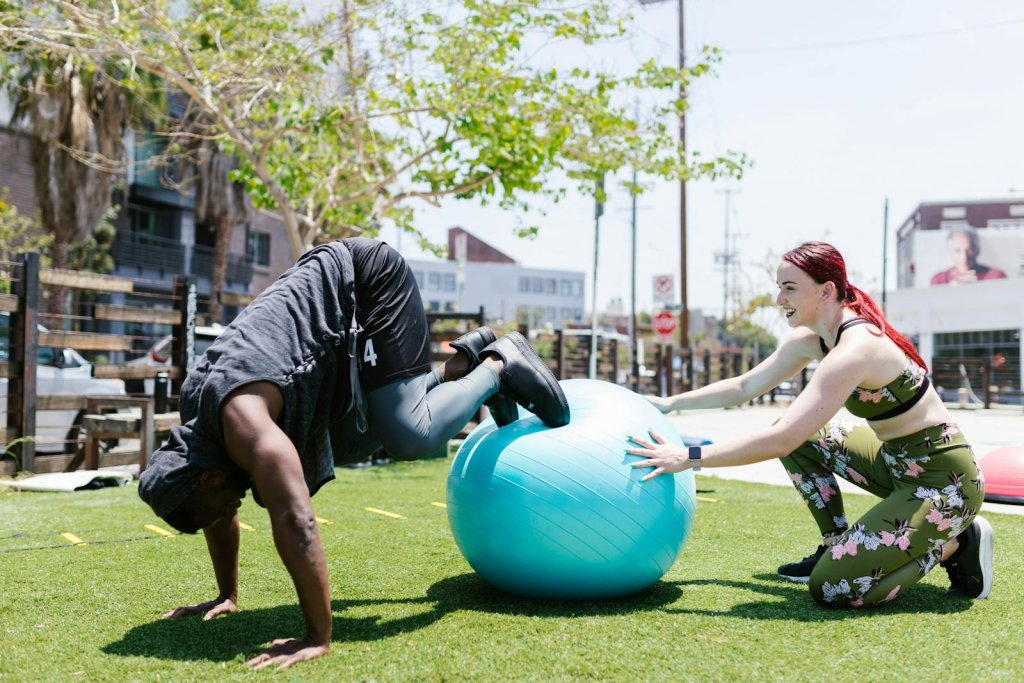
9. Assisted Nordic Hamstring Curls
How to do it:
- Anchor ankles securely or have a partner hold them
- Use bands, hands, or push-off assistance
- Lower your torso forward slowly
- Stop before losing full control
- Use assistance to return to the start
Why it works:
Assistance allows exposure to Nordic-style eccentric loading without overwhelming strength demands. Gradual progression supports adaptation while reducing excessive soreness or strain.
Muscles worked:
Hamstrings (primary), glutes, core stabilizers.
Trainer Tip:
Control matters more than depth—stop the descent before tension is lost.
10. Hamstring Walkouts
How to do it:
- Lie on your back with knees bent and feet flat
- Lift hips into a bridge position
- Slowly walk heels away from the body
- Maintain hip elevation as long as possible
- Walk heels back in to return
Why it works:
Hamstring walkouts emphasize slow eccentric loading and positional awareness. They build foundational strength and control needed before advancing to higher-intensity exercises.
Muscles worked:
Hamstrings, gluteus maximus, core stabilizers.
Trainer Tip:
Shorten the walkout distance if hips begin to drop—quality beats range.
How to Choose the Right Nordic Hamstring Curl Alternative
The best choice depends on your situation:
- Beginners or rehab-focused training: Sliding curls, band curls, walkouts
- Athletes building resilience: RDLs, single-leg RDLs, assisted Nordics
- Gym-based strength training: Seated or lying leg curls, good mornings
Clinical guidance from organizations such as the Journal of Orthopaedic & Sports Physical Therapy emphasizes combining multiple hamstring exercises rather than relying on a single movement.
What Makes a Good Nordic Hamstring Curl Alternative?
A strong alternative should meet at least one of these criteria:
- Trains the hamstrings under eccentric (lengthening) load
- Strengthens the hamstrings at longer muscle lengths
- Allows progression or regression for different ability levels
- Balances knee-dominant and hip-dominant hamstring work
No single exercise replaces Nordics perfectly—but combining the right alternatives can provide comparable benefits with better adherence.
How to Program Nordic Hamstring Curl Alternatives Safely
Programming hamstring exercises safely is about control, consistency, and gradual progression, not maximum intensity.
General programming guidelines include:
- Train hamstrings 2–3 times per week with at least one rest day between sessions
- Prioritize slow, controlled eccentric phases, especially during lengthening movements
- Combine knee-dominant exercises (such as curls) with hip-dominant exercises (such as RDLs)
- Start with manageable volume and increase reps, range of motion, or load gradually
- Keep repetitions smooth and controlled rather than fast or explosive
Publicly available guidance from sports and exercise science organizations emphasizes that steady progression and proper technique are more effective for long-term strength development than aggressive loading.
Common Mistakes to Avoid With Hamstring Exercises
Even effective exercises can become less helpful—or riskier—when performed incorrectly.
Common mistakes include:
- Rushing through the lowering (eccentric) phase
- Using excessive weight before adequate control is established
- Allowing hips to drop or pelvis to tilt during curl variations
- Over-arching or rounding the lower back during hip-hinge movements
- Training through sharp pain rather than muscle fatigue
- Ignoring recovery needs between sessions
Focusing on quality of movement over quantity helps reduce unnecessary strain and supports better training outcomes.
Who Should Be Extra Cautious or Seek Professional Guidance
Some individuals may benefit from added caution or personalized guidance when performing hamstring exercises.
This may include people who:
- Have a recent or recurring hamstring strain
- Experience persistent knee, hip, or lower-back discomfort
- Are returning to training after surgery or extended inactivity
- Have balance, coordination, or neurological considerations
- Feel uncertain about proper technique or progression
In these situations, working with a qualified fitness or healthcare professional can help ensure exercises are selected and progressed appropriately.
Frequently Asked Questions (FAQs)
Are Nordic hamstring curl alternatives as effective as Nordics?
They can be effective when combined properly. Research shows that eccentric hamstring strength—not a single exercise—is the key factor.
Can beginners skip Nordic curls entirely?
Yes. Many beginners benefit more from progressive alternatives before attempting full Nordics.
Do hip-dominant exercises really help prevent hamstring injuries?
They support overall hamstring strength and load tolerance, especially when paired with knee-dominant work.
Are machine leg curls enough on their own?
They are helpful but work best as part of a broader hamstring program that includes hip hinges.
How long before strength improvements occur?
Most studies report measurable improvements within 6–8 weeks of consistent training.
Can I do these at home without equipment?
Yes. Sliding curls, walkouts, and band curls are all effective home-based options.
Conclusion
Nordic hamstring curls are effective—but they are not the only way to build strong, resilient hamstrings. The best Nordic hamstring curl alternatives allow you to train consistently, progress safely, and match your current strength level.
By combining knee-dominant and hip-dominant exercises, you can support hamstring strength and injury prevention without forcing a one-size-fits-all approach.
References
- Including the Nordic Hamstring Exercise in Injury Prevention Programmes Halves the Rate of Hamstring Injuries (BJSM, 2019)
- Hamstring Strain Injury in Athletes: Clinical Practice Guidelines (JOSPT, 2022)
- Hamstring Injuries: Prevention and Treatment—An Update (BJSM, 2015)
- Systematic Review and Meta-Analysis of Risk Factors for Hamstring Strain Injury (BJSM, 2020)
- Greater Hamstrings Hypertrophy at Long Muscle Lengths: Seated vs Prone Leg Curl (MSSE/ACSM, 2021)
- The Sliding Leg Curl (Strength & Conditioning Journal/NSCA, 2016)
- The 11+ Injury Prevention Programme Decreases the Rate of Hamstring Injury (BJSM, 2024)
- ACSM Position Stand: Progression Models in Resistance Training for Healthy Adults (2009)