
The best barbell back squat alternatives include front squats, safety-bar squats, belt squats, hack squats, leg presses, Bulgarian split squats, goblet squats, landmine squats, step-ups, and reverse lunges. Each exercise trains the lower body differently, so the right choice depends on your goals, equipment, experience, and comfort.
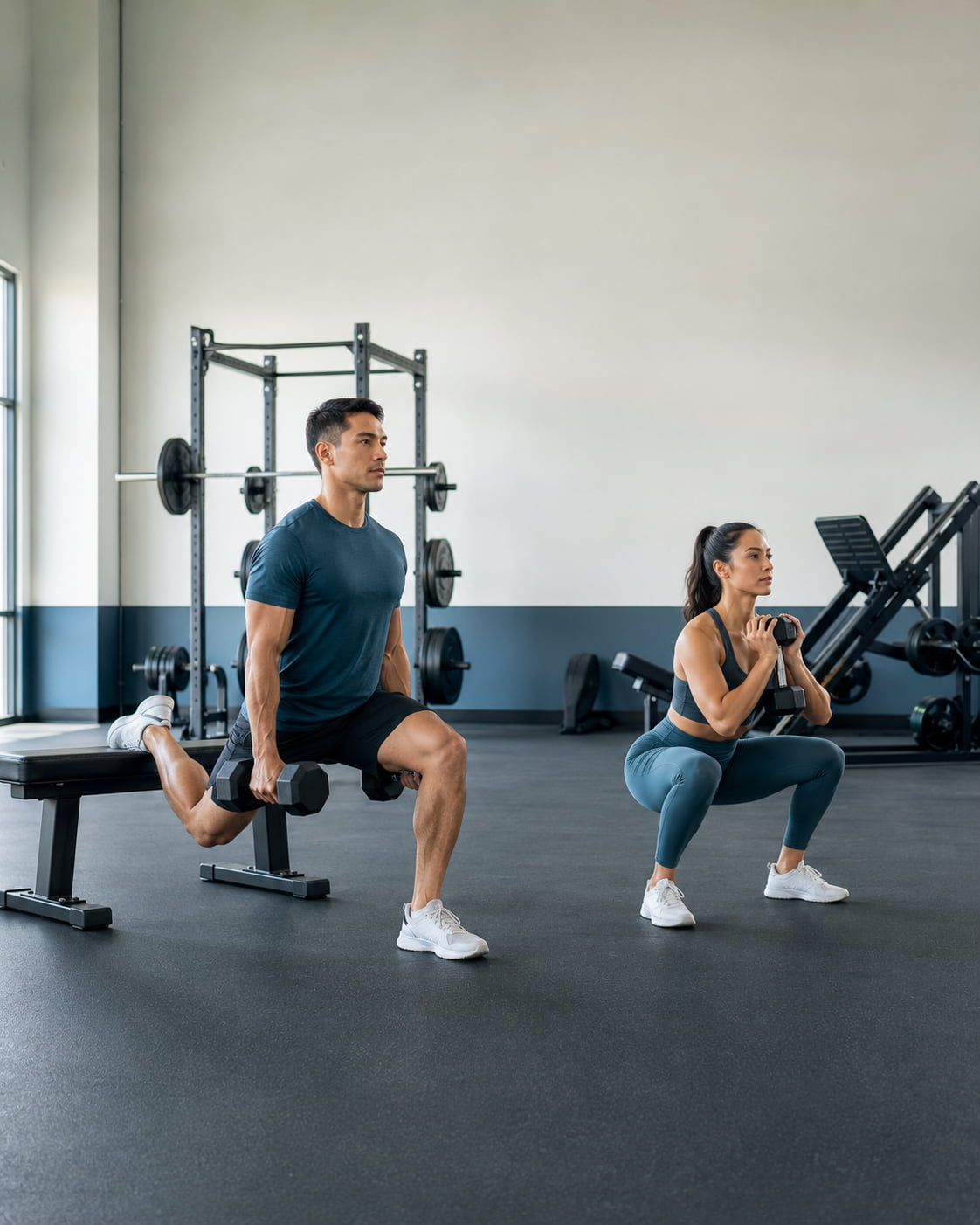
Barbell back squats are effective for developing lower-body strength, but they are not mandatory. You may need an alternative because you do not have a squat rack, the bar position feels uncomfortable, you want more unilateral training, or you simply need variety.
The American College of Sports Medicine emphasized in its March 2026 resistance-training update that consistency matters more for most healthy adults than using one particular piece of equipment. Barbells, machines, bodyweight exercises, and other resistance methods can all support strength and muscle development when training is progressive and consistent.
Can You Build Strong Legs Without Barbell Back Squats?
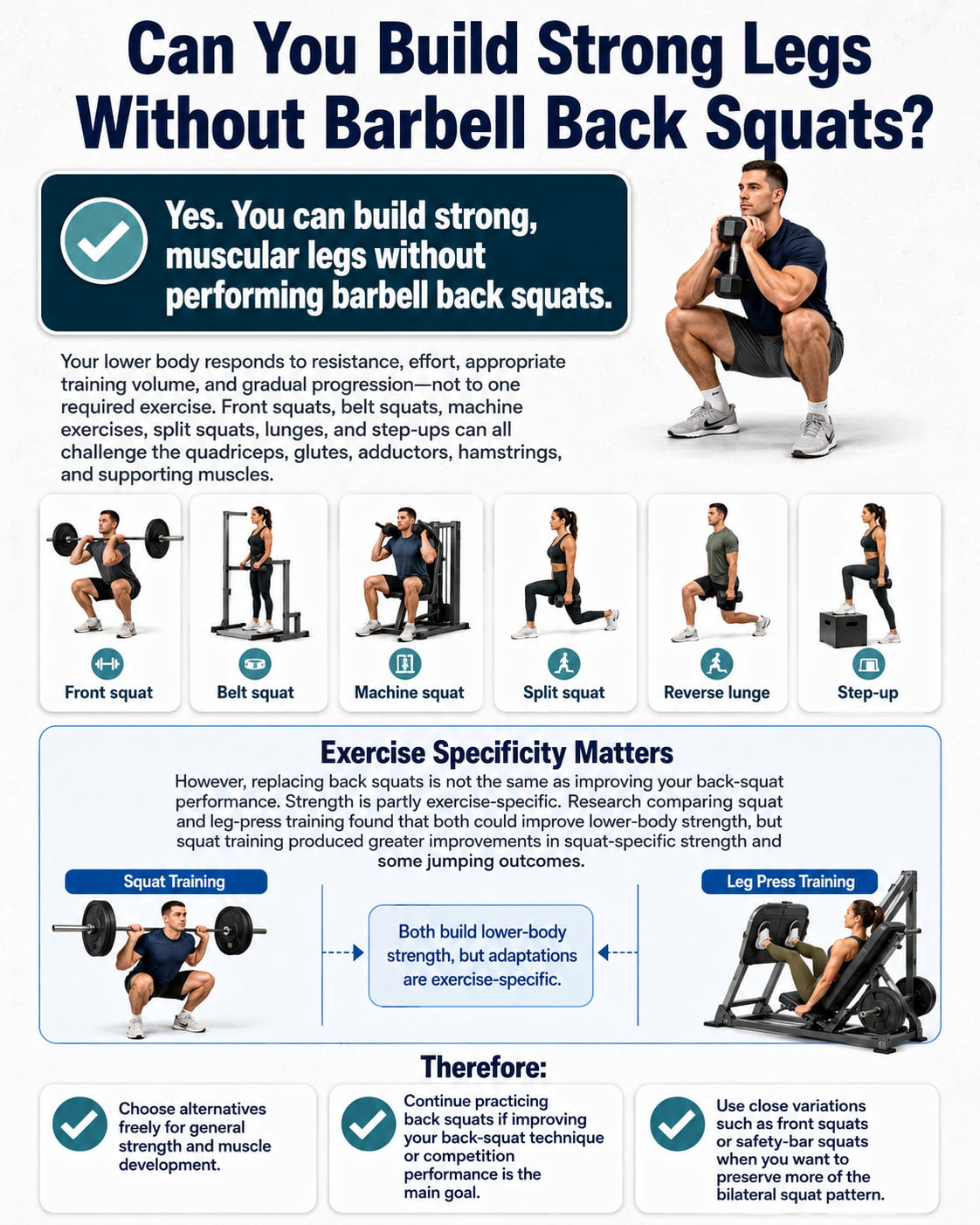
Yes. You can build strong, muscular legs without performing barbell back squats.
Your lower body responds to resistance, effort, appropriate training volume, and gradual progression—not to one required exercise. Front squats, belt squats, machine exercises, split squats, lunges, and step-ups can all challenge the quadriceps, glutes, adductors, hamstrings, and supporting muscles.
However, replacing back squats is not the same as improving your back-squat performance. Strength is partly exercise-specific. Research comparing squat and leg-press training found that both could improve lower-body strength, but squat training produced greater improvements in squat-specific strength and some jumping outcomes.
Therefore:
- Choose alternatives freely for general strength and muscle development.
- Continue practicing back squats if improving your back-squat technique or competition performance is the main goal.
- Use close variations such as front squats or safety-bar squats when you want to preserve more of the bilateral squat pattern.
Barbell Back Squat Alternatives at a Glance
| Exercise | Best for | Equipment |
|---|---|---|
| Front squat | Closest widely available free-weight alternative | Barbell and rack |
| Safety-bar squat | Squatting without a straight bar across the shoulders | Safety squat bar and rack |
| Belt squat | Heavy leg training without shoulder-supported loading | Belt-squat machine or platform |
| Hack squat | Stable, quad-focused machine training | Hack-squat machine |
| Leg press | Straightforward progressive loading | Leg-press machine |
| Bulgarian split squat | Unilateral strength and balance | Bench and optional weights |
| Goblet squat | Beginners and limited equipment | Dumbbell or kettlebell |
| Landmine squat | Guided, front-loaded squatting | Barbell and landmine attachment |
| Step-up | Single-leg strength and everyday function | Stable box or bench |
| Reverse lunge | Home, gym, or equipment-light training | Bodyweight or weights |
10 Best Barbell Back Squat Alternatives
These 10 barbell back squat alternatives can help you build stronger legs using barbells, dumbbells, machines, or bodyweight. Choose the option that best matches your goals, equipment, experience, and comfort.
1. Front Squat
Why it works: The front squat is one of the closest alternatives to a barbell back squat because it keeps the bilateral squat pattern while moving the load to the front of the body. This position typically encourages a more upright torso and places substantial demand on the quadriceps.
Muscles worked: Front squats primarily train the quadriceps and glutes. The adductors, spinal erectors, abdominal muscles, and upper back help stabilize the body and control the bar.
How to do it:
- Position the bar across the front of your shoulders using a clean grip, straps, or a secure cross-arm grip.
- Stand with your feet around shoulder-width apart and your toes slightly turned out.
- Lift your elbows, brace your torso, and keep the bar balanced over your midfoot.
- Bend your knees and hips together as you lower under control.
- Descend as far as you can while maintaining balance and a stable torso.
- Push through your full feet to return to standing.
Trainer Tip: Keep your elbows lifted throughout the repetition so the bar does not roll forward. If the front-rack position is difficult, begin with goblet squats or use lifting straps around the bar.
2. Safety-Bar Squat
Why it works: The safety-bar squat preserves a heavily loadable bilateral squat pattern without requiring the same shoulder and wrist position as a straight bar. The padded bar and forward handles can make the setup more manageable for some lifters.
Muscles worked: Safety-bar squats train the quadriceps, glutes, adductors, hamstrings, spinal erectors, and abdominal muscles.
How to do it:
- Place the padded section of the safety squat bar securely across your upper back.
- Hold the front handles lightly and step into a stable stance.
- Brace your torso before beginning the repetition.
- Lower by bending your knees and hips while keeping your feet planted.
- Keep your knees tracking in the same general direction as your toes.
- Drive your feet into the floor to extend your knees and hips.
Trainer Tip: Hold the handles for control rather than pulling them aggressively downward. Set the rack’s safety pins at an appropriate height before loading the bar.
3. Belt Squat
Why it works: The belt squat allows you to train the legs heavily without placing a bar across your shoulders. The resistance is attached near the hips, making it useful when you want a loadable squat pattern with less upper-body support demand.
Muscles worked: Belt squats primarily train the quadriceps, glutes, and adductors. The hamstrings, calves, and trunk muscles assist throughout the movement.
How to do it:
- Secure the belt around your hips according to the machine or platform instructions.
- Stand with your feet approximately shoulder-width apart.
- Brace your torso and release the machine’s support mechanism.
- Bend your knees and hips as you lower between your feet.
- Keep your feet planted and descend only as far as you can control.
- Push through the floor to return to standing.
Trainer Tip: Check that the belt and attachment are secure before every set. Start with light resistance and increase either the load or range of motion gradually, rather than progressing both at once.
4. Hack Squat
Why it works: The hack squat provides a stable machine-supported squat pattern that is easy to load progressively. Because the back and shoulders remain supported, you can focus more directly on producing force through the legs.
Muscles worked: Hack squats mainly train the quadriceps and glutes. The adductors, hamstrings, and calves assist.
How to do it:
- Position your shoulders and back firmly against the machine pads.
- Place your feet at a comfortable width on the platform.
- Extend your legs to release the safety stops.
- Lower the carriage by bending your knees and hips under control.
- Stop before your heels lift or your pelvis rolls noticeably away from the pad.
- Press through your full feet to return to the starting position.
Trainer Tip: Avoid bouncing out of the bottom or loading the machine so heavily that your range becomes very short. Add weight only after you can complete every repetition with consistent control.
5. Leg Press
Why it works: The leg press offers a stable way to train knee and hip extension without balancing a free weight. It works well for beginners, machine-based workouts, and adding extra lower-body training volume.
Muscles worked: The leg press primarily trains the quadriceps, glutes, and adductors. The hamstrings and calves assist depending on the machine and foot position.
How to do it:
- Sit with your back, hips, and shoulders supported by the machine.
- Place your feet around hip- to shoulder-width apart on the platform.
- Release the safety mechanism while keeping your feet flat.
- Lower the platform until you reach a controlled depth without your pelvis rolling away from the pad.
- Push evenly through both feet to extend your legs.
- Finish the repetition without forcefully locking your knees backward.
Trainer Tip: Use only the range you can control while keeping your hips and lower back against the pad. Avoid pressing through your toes or using your hands to help push your knees.
6. Bulgarian Split Squat
Why it works: The Bulgarian split squat develops one leg at a time, making it useful for unilateral strength, balance, and side-to-side control. It can challenge the legs effectively without requiring the same total external load as a bilateral squat.
Muscles worked: Bulgarian split squats train the quadriceps, glutes, adductors, and hamstrings. The calves and trunk muscles help maintain balance.
How to do it:
- Stand a comfortable stride in front of a stable bench.
- Place the top of your rear foot lightly on the bench.
- Keep most of your weight over the front leg.
- Lower your hips while bending the front knee and moving the rear knee toward the floor.
- Keep the front foot planted and the knee tracking with the toes.
- Push through the front foot to return to standing.
Trainer Tip: Use the rear leg mainly for balance rather than pushing yourself upward. Begin with a regular split squat or hold a rack lightly if the rear-foot-elevated version feels unstable.
7. Goblet Squat
Why it works: The goblet squat is a practical alternative for beginners, home workouts, and anyone without access to a squat rack. Holding the weight in front of the chest provides a counterbalance that can make the squat pattern easier to learn.
Muscles worked: Goblet squats primarily train the quadriceps, glutes, and adductors. The upper back, arms, and trunk help support and stabilize the weight.
How to do it:
- Hold a dumbbell or kettlebell close to the center of your chest.
- Set your feet at a comfortable squat width.
- Brace your torso and keep your feet fully planted.
- Lower between your legs by bending your knees and hips.
- Maintain control at the bottom without relaxing your posture.
- Push through your feet to stand tall.
Trainer Tip: Keep the weight close to your chest so it does not pull your torso forward. Squat to a box if you need help learning a consistent depth.
8. Landmine Squat
Why it works: The landmine squat combines front-loaded resistance with an anchored bar path. The setup can feel more guided than a free barbell while still allowing gradual increases in resistance.
Muscles worked: Landmine squats emphasize the quadriceps and glutes while also training the adductors, hamstrings, upper back, and trunk.
How to do it:
- Secure one end of the bar in a landmine attachment.
- Lift the loaded end and hold it close to your chest with both hands.
- Stand far enough from the anchor to remain balanced.
- Brace your torso and squat by bending your knees and hips.
- Follow the bar’s natural arc during the movement.
- Drive through your feet to return to standing.
Trainer Tip: Use a properly secured landmine attachment rather than placing the bar loosely in a corner. Adjust your distance from the anchor so the load does not pull you forward onto your toes.
9. Step-Up
Why it works: Step-ups develop single-leg strength through a movement similar to climbing stairs. They require little equipment and can help improve lower-body control, balance, and everyday function.
Muscles worked: Step-ups primarily train the quadriceps and glutes. The adductors, hamstrings, calves, and trunk muscles help stabilize the body.
How to do it:
- Stand in front of a stable box that is low enough for you to control.
- Place your entire working foot on top of the box.
- Lean forward slightly from the hips while keeping your spine neutral.
- Push through the elevated foot to bring your body onto the box.
- Stand tall without forcefully swinging the opposite leg.
- Step down slowly and repeat.
Trainer Tip: Choose a box height that allows you to keep the working foot planted and the knee controlled. Avoid jumping or pushing strongly from the foot that remains on the floor.
10. Reverse Lunge
Why it works: The reverse lunge develops single-leg strength while keeping the front foot planted throughout the descent. It is a practical choice for home workouts, limited-equipment training, and improving lower-body balance and control.
Muscles worked: Reverse lunges primarily train the quadriceps, glutes, hamstrings, and adductors. The calves, hip stabilizers, and core help maintain balance and body position.
How to do it:
- Stand tall with your feet around hip-width apart.
- Step one foot backward far enough to create a stable stance.
- Lower your rear knee toward the floor while keeping the front foot planted.
- Keep the front knee tracking in line with the toes.
- Push through the front foot to return to standing.
- Complete your repetitions before switching legs, or alternate sides.
Trainer Tip: Step slightly outward instead of placing the rear foot directly behind the front foot. This creates a wider, more stable base and makes it easier to keep your hips and front knee aligned.
How to Choose the Right Barbell Back Squat Alternative
There is no universal best exercise. Choose according to the result you need.
Closest Alternative to a Back Squat
Choose the front squat or safety-bar squat. Both retain a bilateral, free-weight squat pattern and can be loaded progressively.
Best Alternative Without a Squat Rack
Choose the goblet squat, reverse lunge, or step-up. Each can be performed with minimal equipment.
Best Machine Alternative
Choose the hack squat, leg press, or belt squat. Machines reduce balance demands and make incremental loading straightforward.
Best Alternative for Unilateral Strength
Choose the Bulgarian split squat, step-up, or reverse lunge. These exercises train one side at a time and can help you identify side-to-side differences.
Best Alternative for Beginners
The goblet squat is useful for learning the squat pattern, while the leg press offers a stable setup. A low step-up is another practical option.
Best Alternative Without a Bar on Your Shoulders
Choose a belt squat, hack squat, leg press, goblet squat, or landmine squat. None requires supporting a straight bar across the upper back.
How to Program Barbell Back Squat Alternatives
You do not need to perform all ten exercises. A practical lower-body workout normally uses one main squat alternative and one unilateral or machine-based accessory.
The 2026 ACSM position stand recommends training all major muscle groups at least twice per week. It also notes that strength-oriented programs may emphasize heavier loads around 80% of one-repetition maximum for two to three sets, while muscle-growth programs may benefit from approximately 10 weekly sets per muscle group. These are general targets rather than mandatory rules.
For General Strength
Select a front squat, safety-bar squat, belt squat, hack squat, or leg press.
- Perform 3–4 sets.
- Use approximately 4–8 controlled repetitions.
- Rest for 2–3 minutes.
- Finish each set while you can still maintain consistent technique.
For Muscle Growth
Combine one bilateral exercise with one unilateral option.
Example:
- Hack squat: 3 sets of 8–12 repetitions
- Bulgarian split squat: 3 sets of 8–12 repetitions per leg
Aim to increase weight or repetitions gradually rather than changing exercises every workout.
For Home Training
A simple workout could include:
- Goblet squat: 3 sets of 8–15
- Reverse lunge: 3 sets of 8–12 per leg
- Step-up: 2 sets of 10–15 per leg
Use slower repetitions, pauses, and additional repetitions when your available weights are limited.
Use Double Progression
Choose a repetition range, such as 8–12.
- Begin with a weight you can control for at least eight repetitions.
- Gradually add repetitions over several workouts.
- Once you can complete 12 controlled repetitions in every set, increase the weight slightly.
- Return to the lower end of the repetition range and repeat.
This method provides a clear way to progress without increasing the load before you are ready.
Common Mistakes When Replacing Back Squats
Assuming Every Alternative Is Identical
A leg press can develop lower-body strength, but it does not require the same balance, trunk control, or barbell technique as a back squat. Choose the exercise that matches your actual goal.
Selecting an Exercise Only Because It Looks Easier
A Bulgarian split squat or step-up may use less total weight but can be demanding because one leg performs most of the work. Start conservatively.
Adding Load Before Learning the Setup
A technically simple exercise can still become difficult when heavily loaded. Learn how to use the rack, machine stops, belt, bench, or landmine attachment before adding weight.
Forcing Uncomfortable Depth
Use the deepest range you can control while maintaining a stable foot position and manageable posture. Research has found advantages to training through a larger controlled squat range, but that does not mean every reader should force the same depth.
Changing Exercises Too Frequently
Keep your main alternative long enough to measure improvement. Six to eight weeks is a practical period for tracking load, repetitions, depth, and control before deciding whether to change it.
Ignoring Pain
Muscular effort and fatigue are expected during resistance exercise. Sharp, worsening, or persistent pain is not something to train through. Stop the exercise and seek guidance from a qualified healthcare or exercise professional when needed.
Frequently Asked Questions
What is the best replacement for barbell back squats?
The front squat is one of the closest widely available alternatives because it preserves a bilateral free-weight squat pattern. A safety-bar squat may be a better choice when the straight-bar position is the main problem. Belt squats, hack squats, and leg presses are strong options for general leg development.
Can you build strong legs without back squats?
Yes. Progressive resistance exercises such as front squats, leg presses, belt squats, split squats, step-ups, and lunges can build lower-body strength. Back squats are effective, but they are not mandatory for general fitness or muscle development.
Are Bulgarian split squats as effective as back squats?
Bulgarian split squats can be highly effective for unilateral strength and leg development, but they are not identical to back squats. Unilateral and bilateral training can produce similar overall muscle-growth outcomes, while strength improvements tend to be specific to the movement practiced.
Is the leg press a good substitute for barbell squats?
The leg press is a useful substitute when the goal is strengthening the quadriceps and glutes with greater external stability. It does not reproduce the balance, trunk demands, or specific technique of a barbell squat, so athletes who need to improve their squat should still practice a squat variation.
What squat alternative can I do without a rack?
Goblet squats, reverse lunges, step-ups, and bodyweight split squats do not require a squat rack. A securely anchored landmine squat is another option when a landmine attachment is available.
Which alternative is best for beginners?
Goblet squats are useful for learning controlled squatting with a front-held load. Leg presses provide more external stability, while low step-ups allow beginners to train one leg at a time. The best option is the one the individual can set up and perform consistently.
How many squat alternatives should I use in one workout?
Most people only need one primary squat alternative and one additional unilateral or machine exercise. For example, pair front squats with reverse lunges or combine leg presses with Bulgarian split squats. More exercises are not automatically better.
Conclusion
Barbell back squats are valuable, but they are only one way to develop strong legs. Front squats and safety-bar squats provide close free-weight alternatives, while belt squats, hack squats, and leg presses offer stable loading options. Bulgarian split squats, step-ups, and reverse lunges add unilateral strength, and goblet or landmine squats work well when equipment is limited.
Choose one primary alternative that fits your goal and equipment. Practice it consistently, record your repetitions and loads, and progress gradually while maintaining control.
This content is for informational purposes only and not medical advice.